About Me

My Photo
May 2012 - We passed one million page views - thanks and Join already :-) September 2010 I am pleased to report that my essay titled A NEW METRIC WITH APPLICATIONS TO PHYSICS AND SOLVING CERTAIN HIGHER ORDERED DIFFERENTIAL EQUATIONS' has been published by Physics Essays published by the American Institute of Physics and appeared in their June 2010 quarterly. 40 years ago I took an honors degree in applied mathematics from the University of Waterloo. My interest was Relativity and my last year there saw me complete a 900 level course under Hanno Rund on his work in relativity,as well as differential geometry(pure math) and of course analysis. I continued researching new ideas and knowledge since that time and I have prepared a book for publication titled 'Paradigms Shift'. I maintain my blog as a day book and research tool to retain data and record impressions and interpretations on material read. Do take this moment to join my blog and receive Four items of interest daily Monday through Saturday. Since my topics are usually unique or at least obscure, the ads running through adsense are often interesting and worth dipping into while also supporting this blog in a small way.

Followers

Friday, December 31, 2010

Nuclear Reaction Defies Expectations


All our work has been focused on naturally occurring fission reactions and living with the consequences.  Here we have an empirical result that questions the present theoretical regime and we need to ask what is next?

We have learned what we have learned by hurling neutrons mostly at speeds sufficient to overcome the electrostatic potential of the target.  Now we have an unusual alternative outcome that is unpredicted in our modeling.

There could be a whole range of very low probability events in play that could completely reshape our knowledge of the detail.  One should not think that what we have is anything more than a good approximation to the empirical data that is likely to run foul of the facts as has just happened.

Cold fusion, by the way, is a strong hint.

The electrostatic fields are not necessarily continuous or mathematically convenient and many good questions have never been asked let alone answered in the lab.  I thought cold fusion was an apparatus able to ask and answer some of those questions.  Other similar apparatus need to be fabricated.

Wouldn’t it be lovely to be able to move a low speed neutron along an axis to direct contact with an elemental nucleus at a specified location?  If we ever pull that off, then perhaps we know something that can be trusted about the nucleus.

Nuclear reaction defies expectations

Dec 10, 2010 


A novel kind of fission reaction observed at the CERN particle physics laboratory in Geneva has exposed serious weaknesses in our current understanding of the nucleus. The fission of mercury-180 was expected to be a "symmetric" reaction that would result in two equal fragments but instead produced two nuclei with quite different masses, an "asymmetric" reaction that poses a significant challenge to theorists.

Nuclear fission involves the splitting of a heavy nucleus into two lighter nuclei. According to the liquid-drop model, which describes the nucleus in terms of its macroscopic quantities of surface tension and electrostatic repulsion, fission should be symmetric. Some fission reactions are, however, asymmetric, including many of those of uranium and its neighbouring actinide elements. These instead can be understood by also using the shell model, in which unequal fragments can be preferentially created if one or both of these fragments contains a "magic" number of protons and/or neutrons. For example, one of the fragments produced in many of the fission reactions involving actinides is tin-132, which is a "doubly-magic" nucleus, containing 50 protons and 82 neutrons.

The latest work, carried out by a collaboration of physicists using CERN's ISOLDE radioactive beam facility, investigated the interplay between the macroscopic and microscopic components of nuclear fission. It used what is known as beta-delayed fission, a two-step process in which a parent nucleus beta decays and then the daughter nucleus undergoes fission if it is created in a highly excited state. This kind of reaction allows scientists to study fission reactions in relatively exotic nuclei and was first studied at the Flerov Laboratory in Dubna, Russia, about 20 years ago, although the Dubna measurements did not reveal the masses of the fragments produced.

Firing protons at uranium

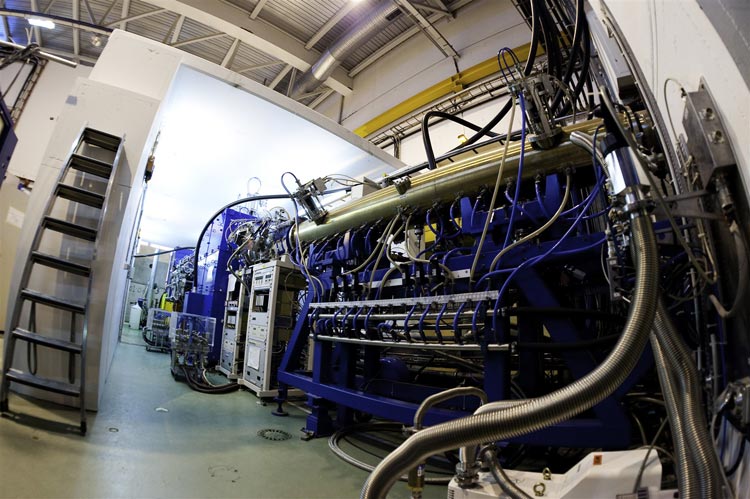
The experiment at ISOLDE involved firing a proton beam at a uranium target and then using laser beams and a magnetic field to filter out ions of thallium-180 from among the wide variety of nuclei produced in the proton collisions. These ions then became implanted in a carbon foil, where they underwent beta decay and some of the resulting atoms of mercury-180 then fissioned. Silicon detectors placed in front of and behind the foil allowed the energies of the fission products to be measured.

The researchers were expecting the fission reaction to be symmetric, with the mercury-180 splitting into two nuclei of zirconium-90, a result thought to be particularly favoured because these nuclei would contain a magic number of neutrons (50) and a "semi-magic" number of protons (40). What they found, however, was quite different. The energy of the fission products recorded in the silicon detectors did not peak at one particular value, which would be the case if only one kind of nuclei was being produced in the reactions, but instead showed two distinct peaks centred around the nuclei ruthenium-100 and krypton-80.

Collaboration spokesperson Andrei Andreyev of the University of Leuven, Belgium, (and currently at the University of West of Scotland) says that this asymmetric fission was unexpected because the observed fragments do not contain any magic or semi-magic shells. His colleague, theorist Peter Möller of the Los Alamos National Laboratory in the US had in fact devised a model of the nucleus that predicted that mercury-180 would undergo asymmetric fission. But he wasn't able to explain why that is, having plotted a three-dimensional potential energy surface for the fission of mercury-180 and then identified a minimum in that surface, but he couldn't identify which of the three variables were responsible for that minimum.

'Beautiful experimental achievement'

Phil Walker of the University of Surrey in the UK, who is not a member of the collaboration, describes the research as a "beautiful experimental achievement" that has "an impressive theoretical outcome". He says that the result will be mainly of interest to academics but believes that it might just have practical implications. "Much of our energy generation depends on nuclear fission," he points out, "and if we want to make reactors safer and cheaper we need to be able to trust the basic theory of the fission process. I would say that the theory has been found to be sadly lacking, and it needs to be fixed."

Andreyev agrees. "I hope that as a result of our paper theorists will start to think about this problem and tell us what is happening," he says. "For the moment we don't know."

The research appears in Physical Review Letters.

About the author

Edwin Cartlidge is a science writer based in Rome

0 comments:

Recent Comments

Networkedblogs