I also think that the GP was a likely power generator tapping cyclic earth energy by capturing vertical movement and focusing it all into the kings Chamber. It is notewrthy that the Arc of the covenent fits perfectly into the chamber there annd its theft is what we read about
It is possible that the other pyramids were built in the Bronze age in immitation.
The etrosian problem certainly applies to the sphinx which allows that to plausibly be antediluvian.
However, recall we had crustal shift around 12900 BP and that the GP is oriented to confom to present conditrons. ths makes our present dating scheme the most likely by far and eliminates the antidiluvian argument.
Chances are that the sphinx was carved the same time as Gobeki Tepe.
New Analysis Suggests That The Great Pyramid Of Giza Is Potentially 20,000 Years Older Than Experts Thought
By Cara Johnson | Edited By John Kuroski
Published February 3, 2026
https://allthatsinteresting.com/when-was-the-great-pyramid-of-giza-built
A new method that compares points of erosion on the Great Pyramid of Giza suggests that this iconic monument could have been constructed as early as 23000 B.C.E. — 20,000 years earlier than previously believed.
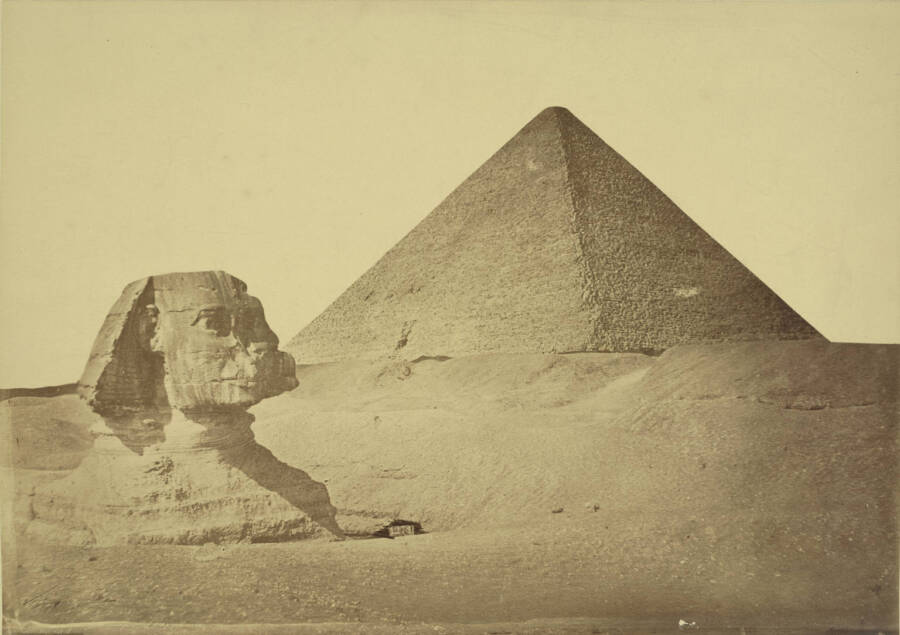
Cornell University LibraryThe Great Pyramid of Giza and the Great Sphinx, pictured here in the late 19th century. New research purports to upend established theories about when the Great Pyramid of Giza was built.
The Great Pyramid of Giza, generally believed to have been built as the tomb of Pharaoh Khufu around 2575 B.C.E., is one of the Seven Wonders of the Ancient World. But what if it’s even older than that?
Alberto Donini, an engineer from the University of Bologna, recently applied a new dating system that he calls the “Relative Erosion Method” (REM) to the pyramid. Now, he’s claiming that his research suggests the famous landmark may have actually been built nearly 25,000 years ago.
When Was The Great Pyramid Of Giza Built? The Origins Of Egypt’s Ancient Wonder
Scientific studies of the pyramids at Giza have been ongoing for centuries, so the current timeline of their construction is widely accepted. As it stands, the Great Pyramid was seemingly built during the reign of Pharaoh Khufu, who ruled over Egypt from roughly 2589 B.C.E. to 2566 B.C.E. The Pyramid of Khafre came shortly thereafter, followed by the Pyramid of Menkaure.
This timeline was determined using both historical records and scientific study. Ancient authors like Herodotus wrote that Khufu had the Great Pyramid constructed as his tomb, noting that he “brought the people to utter misery” by making them transport impossibly heavy limestone blocks from quarries — possibly located hundreds of miles away — in order to erect the 481-foot structure. Exactly how they managed this remains a mystery to this day, though several promising theories have been put forth, such as the use of a ramp system.
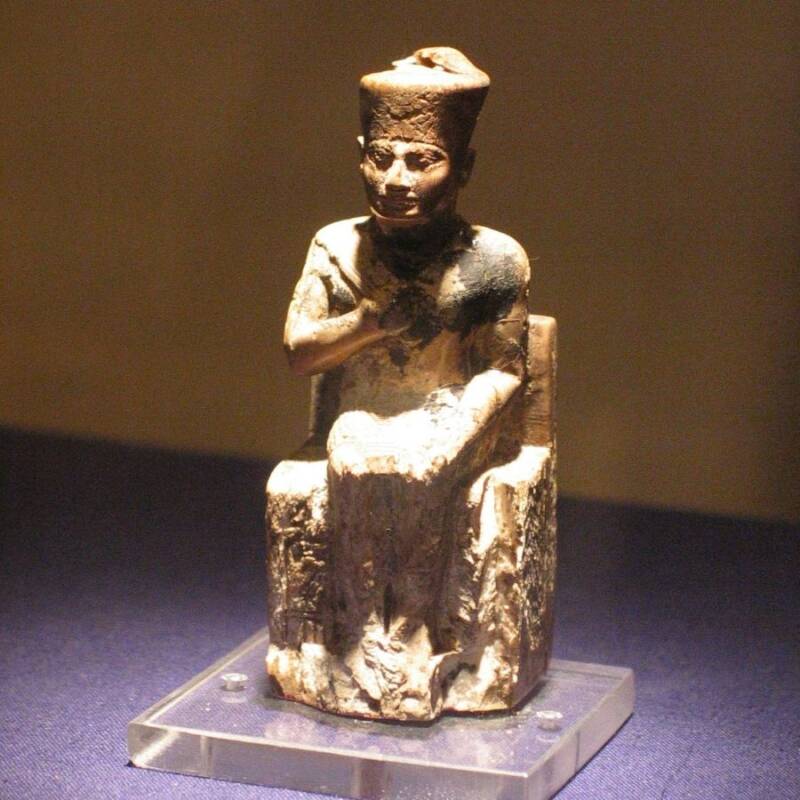
Public DomainA statue of Khufu at Cairo’s Egyptian Museum.
Then, in the 1800s, archaeologists discovered graffiti inside the Great Pyramid that mentioned Khufu by name. It was seemingly scrawled by the workers who built the monument, adding another layer of evidence that the structure was built during that pharaoh’s reign.
Archaeologists later used scientific methods to date the pyramid. They radiocarbon dated the mortar used to secure the stone blocks, which was made using ashes and thus contained organic matter. These results suggested that the mortar was likely mixed between 2620 and 2484 B.C.E., once again aligning with the reign of Khufu.
With so much proof pointing to a construction date of roughly 2575 B.C.E., it seems unlikely that there’s any additional information out there that could significantly change the timeline. However, Alberto Donini claims that his research could completely rewrite this story.
Why The Relative Erosion Method Could Complicate The Story Of How Old The Great Pyramid Of Giza Is
In a preliminary report on his research, Alberto Donini describes his new “Relative Erosion” dating method: “The REM is based on the ratio between two types of erosion affecting the same type of rock in the same location: one with a known date and the other with a date to be determined. The ratio is then used to calculate the age of the stone block under examination.”
When the pyramids of Giza were built, they were covered in a gleaming casing of smooth, polished, white limestone. Then, in 1303, a massive earthquake struck the region, knocking some of these stones to the ground. The fallen material was recycled to build palaces and mosques in Cairo, and in the years that followed, even more of the limestone was removed intentionally to use for decorative purposes. By 1400, much of it was gone.
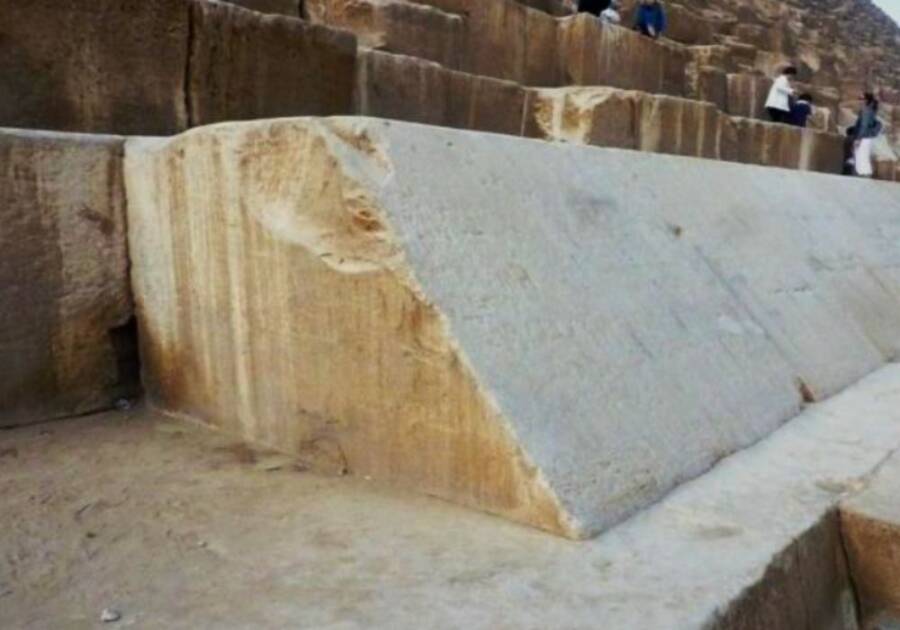
Alberto DominiA small section of the Great Pyramid where the smooth, white limestone cladding still remains.
Donini began his research by comparing the areas of the Great Pyramid that were once covered by limestone with stones at the structure’s base that have always been exposed to the elements. By comparing the amount of erosion that’s taken place in the past seven centuries to the amount of erosion on the blocks that were never covered by limestone, Donini believed he could calculate when those original stones were placed.
Donini noted that erosion occurs by several means. Water is a major source, from runoff dripping onto surfaces to trickles of liquid seeping into small cracks, freezing, and expanding. Wind blowing rough sand from Egypt’s desert also wore down the limestone over time, as did temperature fluctuations, acid rain, and surface wear from humans touching and walking on the surfaces.
There were several factors that Domini took into account while making his calculations. First, he acknowledged that there’s been an increase in foot traffic in the modern era, leading to more surface erosion in recent years than in ancient times. There’s also likely been more acid rain since the Industrial Revolution. These elements could lead to an underestimation of the Great Pyramid’s age.
Alternatively, the climate was wetter in ancient times, so more rain then could have led to faster erosion rates than those seen in the past few centuries. This, in turn, could lead to an overestimation of the monument’s age.
With all this in mind, Domini developed a mathematical formula for REM. He then selected 12 points around the Great Pyramid’s base to analyze, aiming to compare two areas of erosion from the same stone block. “The arithmetic means of these 12 values represents the earliest probable estimate for the age of the Pyramid of Khufu,” Domini wrote.
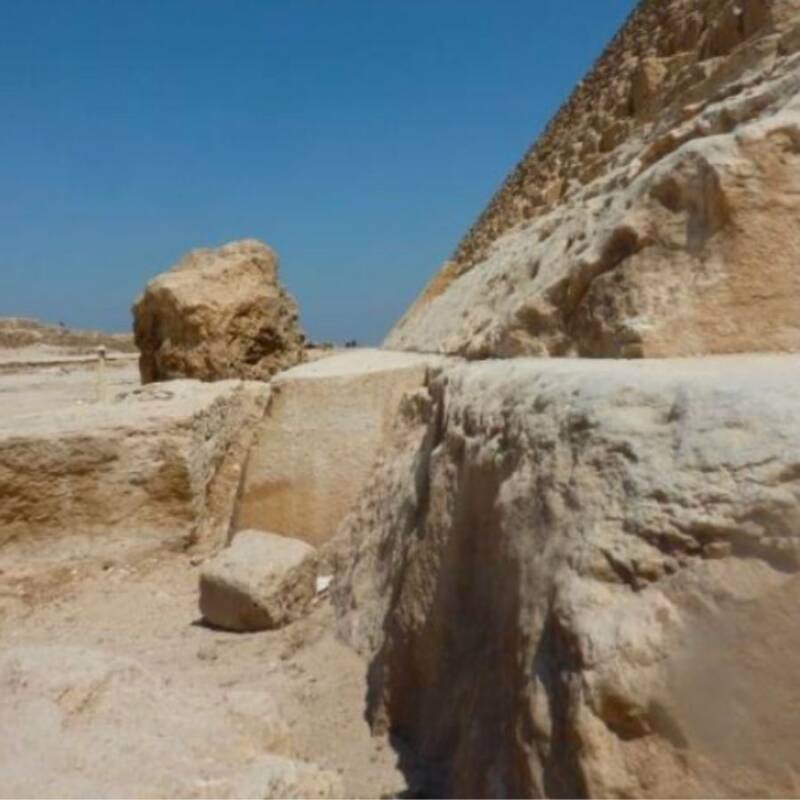
Alberto DominiOne of the eroded limestone blocks that Alberto Domini analyzed in his study.
The results? The Great Pyramid of Giza could be 25,000 years old.
If Domini’s method is accurate, the pyramid potentially could have been built around 23000 B.C.E. — a staggering 20,000 years before its currently accepted age.
“On the basis of this preliminary report on relative erosion measurements,” Domini wrote, “it can be concluded that around 20,000 years before Christ there existed a civilization in Egypt capable of constructing at least the Khufu Pyramid.”
Of course, his findings are controversial. Other archaeologists have pointed out that erosion rates are extremely variable and unreliable for linear models. The study has also not yet undergone peer review, so it remains to be seen if his Relative Erosion Method is scientifically sound.
However, if it is, Domini may have just rewritten the entire history of ancient Egypt.


No comments:
Post a Comment