
Ah yes. I never pursued the academic path and did what i did for myself. I published one paper which massively expands mathematical discourse and no one choses to read the paper.
that is not encouraging and most papers are pretty light in reality. It is nice to see AI advancing discourse mostly be filling in the obvious gaps.
obviously if i can produce the third and forth pythagoren then by grinding extendion of classical mathematica we can fully tackle the n body probem. We have a way forward. AI has the thousand liifetimes demanded.
Academic Harassment
https://avi-loeb.medium.com/academic-harassment-1c2b5effdca7
A few days ago, I co-authored a new paper with my brilliant postdoc, Richard Cloete, which reported here (and to a broader audience here) the statistically-robust discovery of two interstellar meteors from 2022 and 2025 in the CNEOS fireballs catalog of NASA/JPL — based on data from sensors onboard U.S. government satellites.
Our rigorous data analysis used a details model which calibrated the uncertainties in the CNEOS database by comparing it to independent ground-based observations.
A day after our paper was posted and submitted for publication, two things happened:
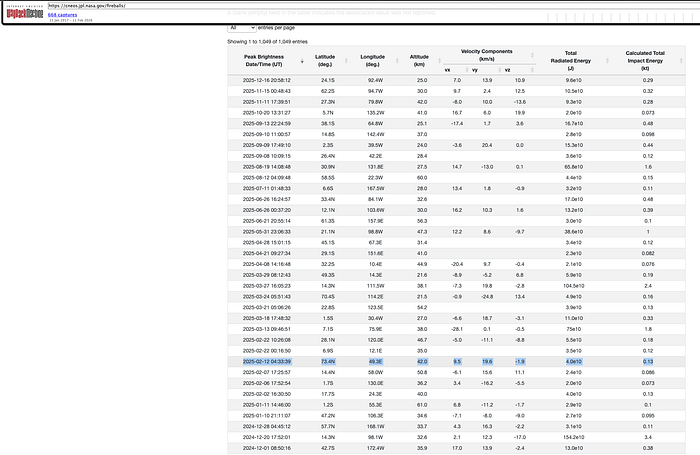
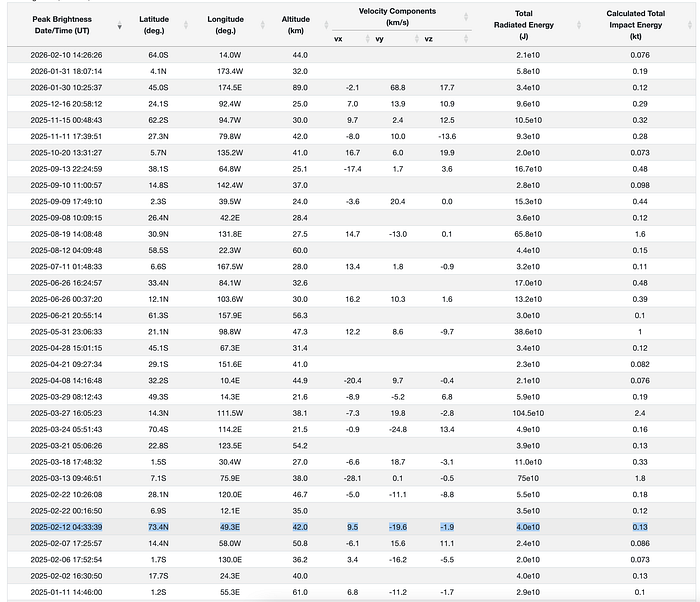
- First, NASA flipped the sign on one of the velocity components of the interstellar meteor candidate from 2025 in the CNEOS database, without any explanation or notification. Such updates are extremely rare and must have been triggered by our conclusion that this meteor might be interstellar in origin. If NASA realized that the report was incorrect, they should have acknowledged that publicly. Instead they made the change secretly in response to our paper. Gladly the internet archive allowed us to compare the reported data before and after our paper was posted publicly.
Before our paper:
After our paper, with a sign flip of the velocity component vy — which makes the meteor of Solar System origin rather than interstellar:
- Second, the associate editor of the prestigious astrophysical journal to where we submitted the paper, declined to forward the paper to peer review after stating:
“I believe that your work would be of rather limited interest to the astrophysics research community as a whole.”
This qualifies as academic harassment because the associate editor used their editorial power for gatekeeping and enforcement of a scientific opinion, without seeking independent opinions from other scientists. Over the latest few months, the same editor declined two papers that I co-authored on the interstellar object 3I/ATLAS: one being a theoretical paper in collaboration with Eric Keto on the anti-tail physics (published here), and a second reporting observational results on the post-perihelion rotation and wobble of the jet structure in collaboration with Toni Scarmato (available here). In those instances, the editor made the same statement: “I believe that your work would be of rather limited interest to the astrophysics research community as a whole.”
When the first paper was not sent to peer-review for that reason, I thought: “OK, it makes little sense scientifically, but Eric Keto and I can publish this work in Monthly Notices of the Royal Astronomical Society — where it was immediately accepted for publication with rave reviews. When the second paper was declined from peer review, I thought: “OK. Maybe there were too many observational papers published on 3I/ATLAS in this prestigious journal, so let’s submit it to another journal.”
But as soon as my third paper about observational evidence for a new class of interstellar meteors was declined with the same template email, I realized: “This editor has a problem with me as an author on any paper.”
This is bad practice for an editor. One can easily check the statistics of how many submissions were declined for other people by the same editor. But three out of three within a few months is extreme. I do not have a problem with a situation where a reviewer declines to publish a paper for scientific reasons, but when the editor has a subjective bias — we have a real problem because the author cannot prove that the assessment is biased based on independent scientists from the broader community. Submitting the paper to other journals and getting it accepted there does not correct the wrong of the editor’s practice, because the editor does not get this feedback and will keep doing the same for future papers. It is well known the editors have the power to select positive or negative reviewers, but not sending it to peer review is a sign of arrogance aiming to dictate the outcome without seeking outside opinions.
When I had mentioned today’s experience to postdocs and senior colleagues today, they told me about similar recent stories that they experienced recently. Some postdocs submitted papers to peer review in 2025. Sometimes the reviews took of order 9 months and at the end of that lengthy process, their papers were either rejected or forced to be entirely dull without a chance for a rebuttal. In some cases, the associated editors and reviewers — who identified themselves as senior faculty members, published a paper on the same topic during the review process without allowing the postdocs the priviledge to respond.
This experience is not new. A decade ago I had an original idea and submitted it in collaboration with my postdoc for peer-review in the most prestigious journal in astrophysics. The reviewer blocked the publication, raising concerns about the idea and then published a paper a few months later claiming credit for the same idea that they blocked us from publishing. A year later, my postdoc chose to leave the academic career path.
I am confident that there are many unborn babies of scientific discoveries that were killed in the academic delivery room by doctors who were supposed to bring them to life.
This academic harassment should not be tolerated and editors who commit it should be dismissed from their editorial roles. The response should be similar to any other form of harassment that benefits from the academic power structure.
Here’s hoping that we can make the future better than the past.


No comments:
Post a Comment