So let us be uncomplicated. no explanation exists for the anti tail. I also want to say that dust explantions for a draging tail run thin as well.
I do think that what we are experiencing though is the interaction of the object with the surrounding plasme field belonging to our star. I also think this holds true for all comets as wrll
This interaction can act upon the contained Dark MATTER. perhaps squeezing and twisting it to procuce an forward and backward DARK MATTER zone able to sustain duct such as carbon in particular.
Induced EM forces are also likely to produce lobes naturally. in short ,cloud cosmology gives us a potential natural explanation.
The Remarkable Anti-Tail Jet of 3I/ATLAS in New Hubble Images from January 7th, 2026
·Jan 8, 2026
Press enter or click to view image in full size
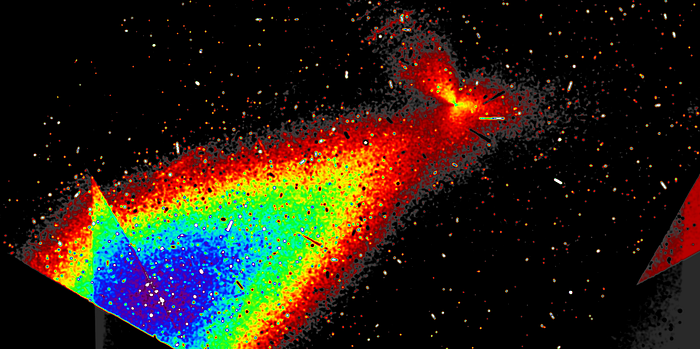
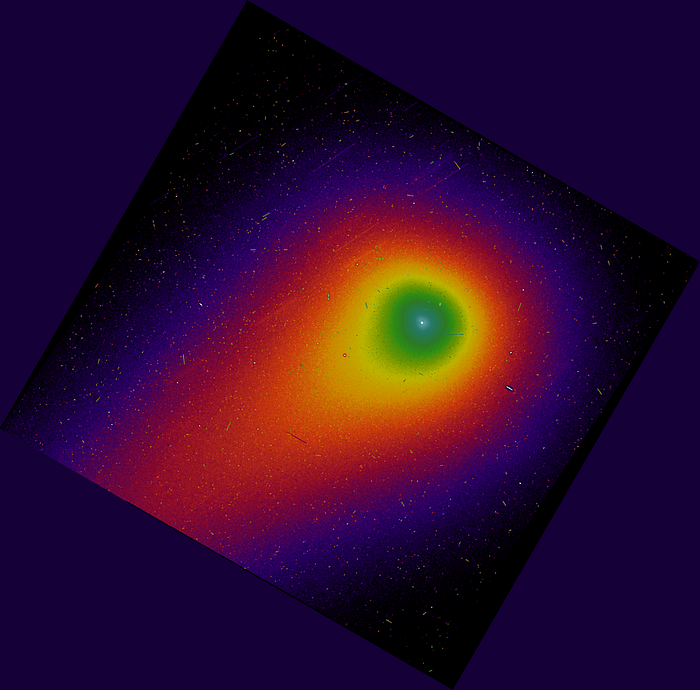
Image of 3I/ATLAS, taken on January 7th, 2026 by the Hubble Space Telescope (top panel), and processed through the Larson-Sekanina rotational gradient filter (bottom panel). The bottom panel shows a triple jet structure with a prominent anti-tail jet in the direction of the Sun, towards the lower left corner of the image. The anti-tail extends to a scale of order the Earth-Moon separation. (Image credit: Toni Scarmato, based on data released by NASA/ESA/STScI here)
When the interstellar object 3I/ATLAS was first imaged by the Hubble Space Telescope on July 21st, 2025, it became evident that the glowing halo of light around it extends by an extra factor of ~2 towards the Sun. Given that the observing line-of-sight was only 10 degrees away from the sunward direction at that time, this implied that the actual extended structure is of a jet that is 1/sin(10 degrees)=5.8 times more elongated than observed in the projected image, namely ~11.6 times longer than it is wide.
But the most surprising fact about this jet is that it is oriented in the sunward direction. Usually, the elongated feature around comets is oriented away from the Sun. The physical reason is simple: the solar-wind push on gas and the solar radiation push on dust create the appearance of a cometary tail extending away from the Sun relative to the nucleus. But 3I/ATLAS exhibits a physical anti-tail that is definitely not a visual illusion due to a projection effect created by a special viewing angle.
Intrigued by this unusual phenomenon, I wrote three papers (posted here, here and here), attempting to explain the physics behind it. When the first paper in this series, co-authored with my colleague Dr. Eric Keto, was submitted for publication in “The Astrophysical Journal Letters,” we were informed by the editor that the paper will not be sent for review because: “I believe that your results would be of rather limited interest to the astrophysics research community as a whole.” Disappointed by this response, we submitted the paper to the competing journal “Monthly Notices of the Royal Astronomical Society”, where it was accepted for publication after a very favorable referee report. This experience shows how subjective the editorial and peer-review process is in academia.
By now, it is clear that the anti-tail jet of 3I/ATLAS is one of its major anomalies, because it is clearly observed in post-perihelion images taken from different perspectives during the past couple of months. These images show (as I described most recently here, here and here) a prominent anti-tail jet that extends out to 400,000 kilometers from the nucleus of 3I/ATLAS towards the Sun.
The anti-tail is evident in the latest Hubble image, taken on January 7th, 2026. The application of a Larson-Sekanina rotational gradient filter that removes the circularly symmetric glow around the nucleus of 3I/ATLAS reveals a triple jet structure with a major tightly-collimated anti-tail jet towards the Sun. The two minor jets are equally separated in angle from each other and the anti-tail, and are not oriented away from the Sun — as expected from a familiar cometary tail.
As inferred from the first Hubble image on July 21, 2025, the anti-tail jet is tightly collimated and an order of magnitude longer than it is wide. The tight collimation and the prominence of the anti-tail relative to any tail feature, are surprising given that the anti-tail jet goes through the countering pressure of the solar wind and the solar radiation. Given that, I beg to differ with the above-mentioned editorial opinion. The physics responsible for this remarkable anti-tail jet is not “of rather limited interest to the astrophysics research community”.
From the wobble of the anti-tail jet around the rotation axis when 3I/ATLAS was approaching the Sun (as reported here), it became clear that its rotation axis is pointed at the Sun to within 7 degrees at large distances. This constitutes another unexplained anomaly on top of the alignment of the trajectory of 3I/ATLAS with the ecliptic plane, each with sub-percent probability — making their combined geometry unlikely at a level below 0.0001. NASA officials did not mention these geometric anomalies at their press conference about 3I/ATLAS on November 19, 2025, when they concluded that 3I/ATLAS behaves like a regular comet. Obviously, if one ignores the unexplained anomalies of 3I/ATLAS, one would conclude that there is nothing surprising about it. The easiest way to argue that we fully understand something is by ignoring what we do not understand about it.
However, the foundation of science is the humility to learn, not the arrogance of expertise. What is the point of pursuing science if practitioners claim that they understand nature based on past knowledge even when data shows that they might be missing something. Our ability to learn something new is limited by our willingness to admit what we are missing. Anomalous data should not be “of rather limited interest to the astrophysics research community”, but instead of great interest for the astrophysics research community.
Science is fun as long as we treat it as a learning experience. Curiosity is a genuine trait of a beginner’s mind. My hope is that the next generation of scientists will do better than my generation in revolutionizing our perception of our cosmic neighborhood. The Universe will not appear a lonely place if we find residents in our cosmic street. Finding these residents would update the priorities of humanity beyond Earth.
In a WORLD.MINDS forum led by the brilliant Rolf Dobelli yesterday, I asked the historian Sir Niall Ferguson: “Could science bring humanity to pursue a vastly better future than its past?” Niall responded that science is not separate from power politics. He argued that throughout history, humans evolved as fighters and killers. The 20th century saw extraordinary scientific breakthroughs and unprecedented mass killings. Niall suggested that these facts are not unrelated.
Niall is right about our past. But I am hopeful that an encounter with a more accomplished extraterrestrial civilization will make our future better, once we will receive our inspiration from the stars. As Oscar Wilde noted: “We are all in the gutter, but some of us are looking at the stars.” For that reason, when we observe interstellar objects in our backyard, we should not treat their anomalies as being “of rather limited interest.” Instead, let us focus on understanding the anomalies of 3I/ATLAS (as listed here), starting from its anti-tail jet. This visitor to our backyard is not a regular street cat since a tail appears to be emerging from its forehead.


No comments:
Post a Comment