If 3I/Atlas is a natural object and do understand that is not a certainty, then the munbers of such objects is truly massive and greatly exceeds the mass of material within our solar system. The good news is that our sensing tech should now sort this out.
As I have already pointed out, these objects are a natural road to the stars. Cloud cosmology tells us that we can eject the DARK MATTER out of such an object and increase its velocity to at least half of light speed . this is what a gravity ship does and we have confirmation on small UFOs for which we have over 200,000 observations.
We are already using this tech, but it is none of your business.
in interstellar space.Are There Ten Trillion Objects Like 3I/ATLAS Within the Solar System Right Now?
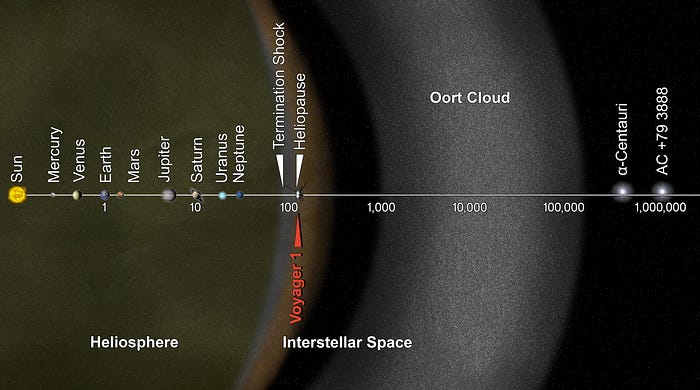
An artist’s illustration of the Solar System, calibrated by the scale of the Earth-Sun separation (1 AU). The outer edge of objects bound to the Sun in the so-called Oort Cloud is estimated to be at a distance of about 100,000 AU. Voyager 1, humanity’s most distant spacecraft, is at a distance of about 172 AU, equivalent to 26 billion kilometers or nearly a light day away. (Image credit: NASA/JPL)
The latest data from the Hubble Space Telescope (reported here) implies that the radius of the nucleus of the interstellar object 3I/ATLAS is 1.3 kilometers.
In what follows, I will assume — as most astronomers do — that 3I/ATLAS is a natural comet drawn at random from a parent population in interstellar space. For the characteristic mass density of a comet, 0.5 grams per cubic centimeter, the mass of 3I/ATLAS is about 5 billion tons.
Based on the detection of one such object by the ATLAS telescope system over the past 5 years, the latest data implies that there should be about 1–2 such objects at any given time within the orbit of Jupiter around the Sun. Since the ATLAS survey (where ATLAS stands for Asteroid Terrestrial-impact Last Alert System) discovered 3I/ATLAS within that distance, there should be a detectable object similar to 3I/ATLAS at all times. This suggests that past surveys of the sky missed a large number of these objects.
Icy rocks are gravitationally bound to the Sun all the way out to the edge of the so-called Oort Cloud, at a distance of about 100,000 (=10⁵) times the Earth-Sun separation. This distance defines the outer boundary of the Solar System, beyond which the gravitational tide from passing stars or the Milky-Way galaxy overcomes the Sun’s gravity and dislodges peripheral objects from being bound to the Sun.
Given the above-mentioned numbers, there should be ten trillion (=10^{13}) objects like 3I/ATLAS within the spherical volume of the Oort Cloud around the Sun.
Altogether, this huge 3I/ATLAS-like population of interstellar objects embedded within the Solar System, carries a total of nearly 10 Earth masses, comparable to the total mass of Oort Cloud comets that are gravitationally bound to the Sun. This is a tantalizing result for several reasons.
First, inactive interstellar objects with a nucleus size similar to that of 3I/ATLAS are much fainter and more difficult to detect because their nucleus is not supplemented by a plume of surrounding dust — which has been reflecting about 99% of the light observed from 3I/ATLAS after its discovery on July 1, 2025 within the orbit of Jupiter around the Sun.
Second, the mass of 3I/ATLAS is larger than that of 1I/`Oumuamua by more than 4 orders of magnitude. Assuming conservatively that there is a comparable amount of mass in interstellar objects per logarithmic bin of object mass, there should be a total mass of order 100 Earth masses in all of the interstellar icy rocks inside the Oort Cloud. To put it in perspective, the total amount of rocky material in Solar System planets is only a few Earth masses, about 30 times less. The total amount of interstellar dust within the Oort Cloud is several tens of Earth masses.
Since the Oort Cloud extends out to a substantial fraction of the distance to the nearest star system, alpha-Centauri, the above results suggest that each star in the Milky-Way galaxy should have ejected of the order of 100 Earth masses in rocks and ice out of its initial planetary system. Applying this locally suggests that the Solar System ejected ten times more mass in icy rocks than the rocky mass retained in the interiors of its current planets.
However, there is a caveat to the above conclusions. If 3I/ATLAS is not a natural comet drawn at random from a natural origin, because the alignment of its path with the ecliptic plane, the symmetry of its three mini-jets, the large extent of its prominent anti-tail, and its delayed shedding of organic molecules like methane, are all products of alien intelligence, then the above statistical inferences do not hold. In that case, the senders of 3I/ATLAS may have targeted the inner Solar System, as pointed out in my first paper about 3I/ATLAS (available here).
It should be straightforward to verify whether 3I/ATLAS was a unique rare visitor or a member of a population of ten trillion similar objects that are passing right now through the Solar System. The distinction is as easy as figuring out whether a car passing near our home came from a highway which carries a huge traffic of similar cars or was a unique rare car that targeted our home intentionally — in which case we will not see many more like it.
The forthcoming data to be collected over the next decade by the NSF-DOE Rubin Observatory will provide us with a clear answer to this question. From now on, we will not miss bright interstellar visitors like 3I/ATLAS because we know that they might exist out there. Our experience will be similar to meeting an intriguing visitor from a foreign country and subsequently waiting eagerly for other visitors from the same population to show up.


No comments:
Post a Comment