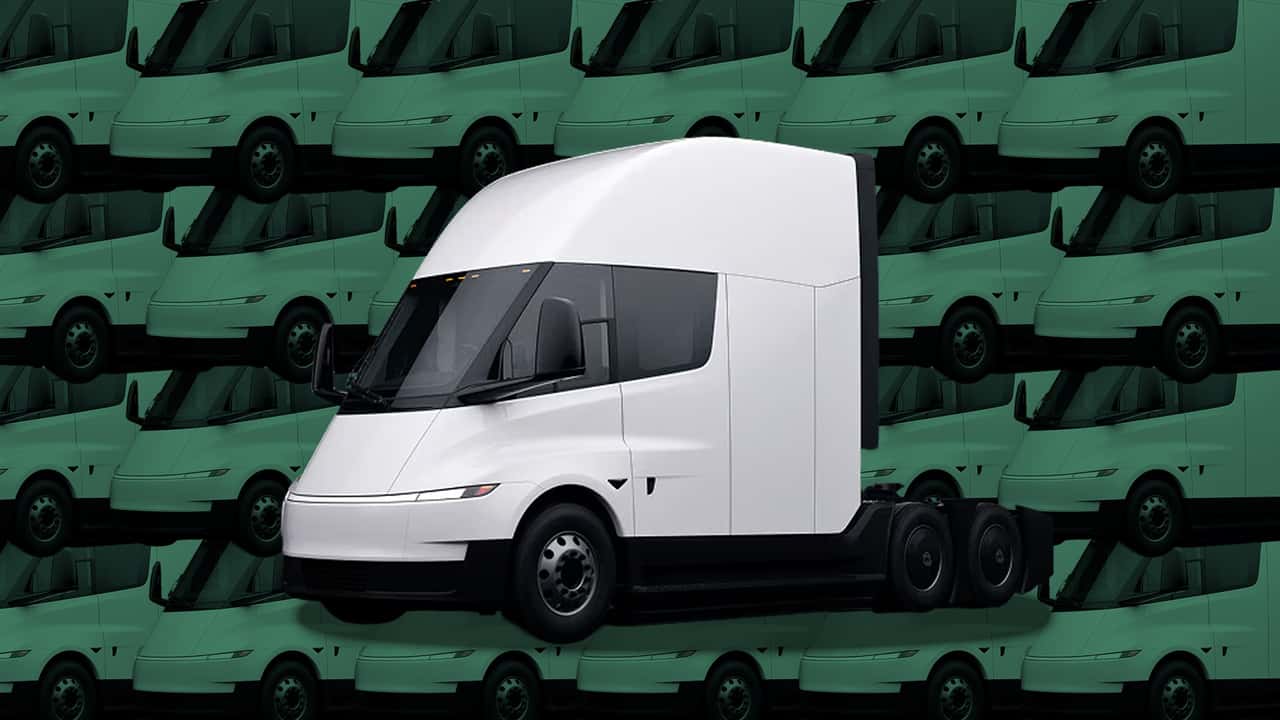
At this scale the tesla semi can be optomized to maximize utilization. Very good news. Thus will anchor a massive sales and infrastructure expansion that would otherwise be far slower.
We aill soon see them on the road.
understand that ev tech is full on displacing oil based tech everywhere which will make oil based systems totally obsolete over the next fiftennn years.
The Tesla Semi Just Got A Massive Boost
From The Biggest U.S. Electric Truck Order Ever
The record-setting order will double the number of electric Class 8 trucks in the U.S.
Photo by: InsideEVs
By: Iulian Dnistran
Sep 23, at 3:58am ET
The number of electric Class 8 trucks in the United States is about to double.
That’s thanks to the biggest truck order in the country’s history.
A coalition of the world’s largest cargo-owning shippers is buying thousands of new electric trucks, and the Tesla Semi is the main choice.
https://insideevs.com/news/809205/largest-electric-truck-order-us-tesla-semi/
America’s streets are about to get a lot more electric big rigs, thanks to the biggest single order for electric Class 8 trucks in the country’s history. Orchestrated by a shipper alliance, the order will see no fewer than 2,500 new electric heavy-duty trucks land on U.S. roads in the coming months.
The biggest winner here is Tesla, with its Class 8 Semi being selected as the primary choice for the initial 2,500 trucks. Besides Tesla, the alliance behind this huge orchestrated effort will order trucks from Kenworth, Ride, and Volvo.
“The Tesla Semi is designed for lower cost per mile operations than diesel,” said Dan Priestley, Director for the Tesla Semi Program. “ZET SCALE’s goals are exciting because they take the operational cost advantage and predictability that electricity provides and amplifies it at scale. We are proud to have been the primary selection in this RFP (request for proposal) and look forward to giving shippers and carriers a new competitive edge.”
It’s a big deal for the American electric trucking industry, as it’s set to double the number of battery-powered heavy-duty trucks in the country. It’s also a great opportunity for Tesla to make a mark with its delayed Semi, which recently went into production at a new facility in Nevada that’s capable of rolling out up to 50,000 trucks per year.
It’s just the beginning, though, as the companies that made this record-breaking order have set their sights on deploying over 10,000 electric trucks, though a timeline for the rollout has not been published.
The deal was put together by the Zero-Emission Truck Shipper-Carrier Alliance Leading Electrification (ZET SCALE), which is jointly operated by Catalyst Mobility and the Smart Freight Center. Microsoft and PepsiCo are among the companies that use ZET SCALE to ship goods across the U.S.
By pooling freight demand from multiple companies and ordering such a large number of trucks, the alliance said it was able to cut the purchase price, which improves the business case for all the shippers who wanted in on the deal.
Speaking of money, the initial order for 2,500 trucks will be paid by ZET Financial, which will then deploy the electric big rigs to the shippers through what it calls its fair market value lease program. Dubbed ZET Lease, the program eliminates residual-value risk to the fleet operator, which has traditionally been a big barrier that kept a lot of carriers and fleets from buying electric trucks.
What do you think?
The new battery-powered rigs will be deployed at high-density freight hubs with the strongest initial routes and economics, enabling operators to make full use of the trucks and the charging infrastructure. For the first round of deployments, 10 freight hubs will welcome the new trucks: Southern California/Los Angeles, Northern California/Stockton, Central California/Bakersfield, Seattle/Tacoma, Houston, Dallas, San Antonio, the Chicago area, Atlanta, and Northern New Jersey/Newark/New York City.
The Tesla Semi is currently available in two versions. The Standard Range model is advertised with an estimated 325-mile range on a full charge and an average energy consumption of 1.7 kilowatt-hours/mile. Its curb weight is under 20,000 pounds, and it has a gross combination weight of 82,000 pounds. The Long Range Model, which has more batteries, can go up to 500 miles on a full charge and weighs 23,000 lbs.


No comments:
Post a Comment