The core problem with the IC motor has been variable power demand. Direct current motors and competant battery systems allows us to finally optimize an engine to just put out steady state horse power.
we have already optimized the EV component and optimizing an IC means a huge drop in weight. think running a two opposing cylinder moter with a direct current power takeoff. i already know this can replace a traditional Briggs and Stratten system for a fraction of the mass. and obviously a fraction of the fuel.
it also supplies available heat.
We have got the rest.
Extended-range EVs (EREVs) from Scout, Ford, Hyundai and more promise all the benefits of electric cars without the range anxiety.
Photo by: Scout Motors

Updated: Aug 31, at 1:58pm ET
https://insideevs.com/features/786506/every-erev-extended-range-ev-america-2026/
As Americans come to grips with the new reality of the car market, where the $7,500 federal tax credit is a distant dream, a new type of hybrid vehicle is preparing to take the country by storm. Companies like Ford, Hyundai, Ram, and Jeep are all jumping into the fray to launch "extended-range electric vehicles" in the U.S. over the next few years.
Below we've compiled all the EREVs confirmed for the U.S. market—and what we know about them so far.
What is an extended-range EV (EREV)?
Just like other hybrids, EREVs combine a combustion engine, an electric motor (or motors), and a battery. But while traditional hybrids are essentially gas vehicles with a little electric assistance, EREVs are electric vehicles first and foremost. They're propelled by an electric powertrain that's virtually identical to what you'd find in an electric car, but they feature a combustion engine that solely acts as a generator to boost range.
As a result, EREVs promise many of the benefits of regular EVs—smooth acceleration, quiet operation, and zero-emission travel—but without the range anxiety or charging concerns. The concept is similar to a plug-in hybrid, but typically with more electric driving range.
EREVs can be plugged in at home or at a public fast charger for daily trips. But the gas component can come in handy too for longer journeys or other situations where electricity alone can't cut it. Long lines at the fast-charging station? No problem. No charger in the hotel parking lot? No sweat. Just fill up your EREV's tank at the local gas station and let the generator feed the battery. That gas engine can't drive the wheels directly in an EREV, but it can create electricity for the car's electric motors.
In particular, automakers are embracing the idea for large pickup trucks and SUVs. By pairing an electric powertrain with a gas tank, the thinking goes, companies can offer more range for towing. Plus, bulky vehicles are harder to electrify in a cost-effective way than smaller ones, due to the enormous batteries required to deliver enough range. (One example: Ford couldn't crack the economics on the F-150 Lightning EV, so it is planning an EREV version.)
EREVs are popular in China and have existed in the U.S. before; think the first-generation BMW i3, Fisker Karma, or subsequent Karma Revero. But the concept is getting a modern reboot in America as automakers content with a public and a regulatory environment that's less open to pure EVs than they previously expected.
Now, let’s take a look at all the EREVs that will go on sale in America in 2026, 2027 and beyond.
Ram 1500 REV (2026)
Despite several delays and a name change, the Ram 1500 REV is slated to become one of first next-generation EREVs to hit America’s streets. The extended-range full-size pickup is expected to go into production in the second half of 2026 as a 2027 model. That’s three years after its initial debut, when it was wearing the Ramcharger name.
Everything changed after Ram’s parent company, Stellantis, decided to pull the plug on the all-electric Ram 1500, placing its bets on this extended-range version instead. That was probably the best decision at the time, seeing as sales of electric pickups in the U.S. have been light-years away from their gas-powered counterparts.
The 2027 Ram 1500 REV will have a hefty 92-kilowatt-hour main battery pack nestled between the chassis rails. It sends power to a pair of electric drive modules—a 250-kilowatt unit at the front and a 248 kW unit at the rear—for a combined power output of 647 horsepower and 610-pound-feet of torque.
With a full battery, the full-size truck has an estimated 145 miles of range, but a full tank of gas will increase that figure to 690 miles. Said gasoline will be burned by a 3.6-liter Pentastar V-6 engine that has spins a 130 kW generator.
All this being said, there’s still a CCS-1 fast charging port on the front-left of the truck, which can accept up to 145 kW from a DC charger, adding up to 50 miles of electric range in 10 minutes. There’s no word on pricing yet, but I expect the Ram 1500 REV to sit above the regular gasoline models, which top out at $90,000.
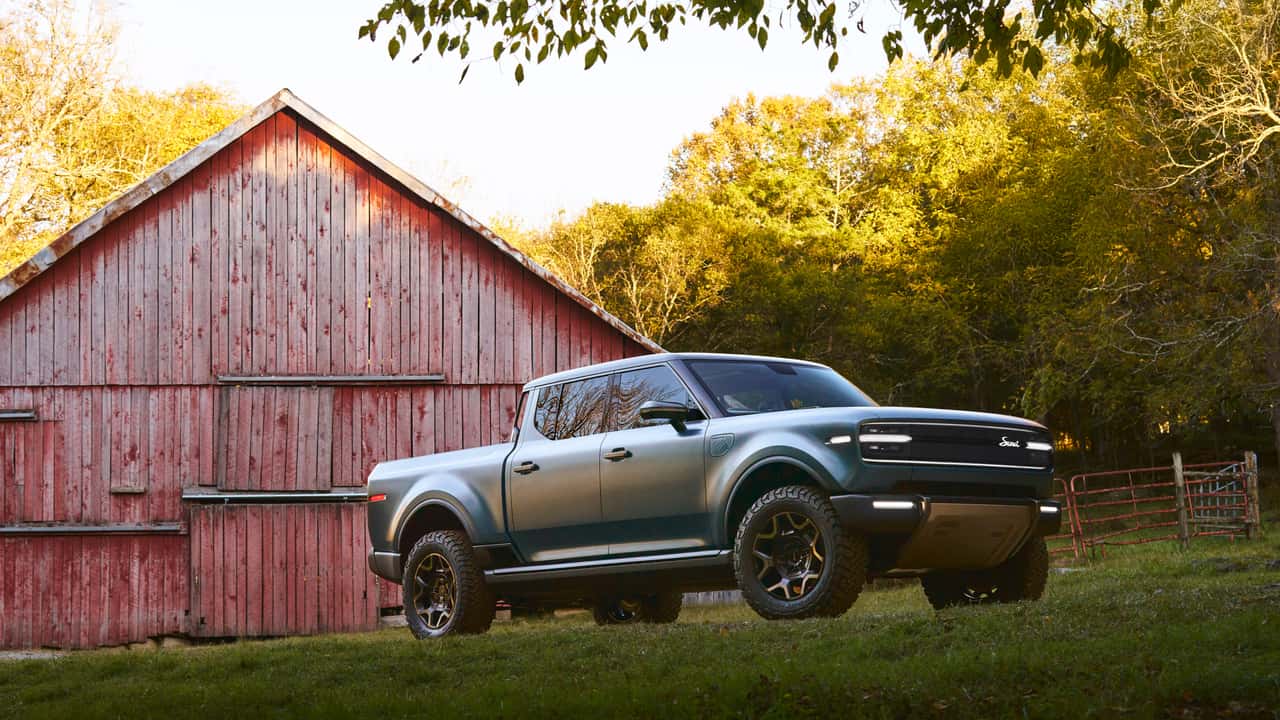
Scout Motors Terra pickup and Traveler SUV (2027)
Scout’s “Harvester” EREV pickup and SUV are expected to go into production at a brand new factory in South Carolina by the end of next year. The Terra truck and Traveler SUV hark back to International Harvester’s iconic Scout models of the 1960s and 1970s, only with a modern twist.
Just like their predecessors, the new models are developed and built in America for a new generation of buyers who want more than just a simple work truck.
The EREV versions of the Terra and Traveler will have a main lithium-iron phosphate (LFP) battery with a capacity of roughly 63 kWh, Scout CEO Scott Keogh told us. That pack gives them an all-electric range of around 150 miles. A naturally aspirated four-cylinder gas engine mounted at the rear, close to the rear axle, will provide extra range. In total, the two EREVs will offer around 500 miles on a full tank of gas and a full battery.
Scout will also offer all-electric versions of its two models, which will be able to drive around 350 miles, courtesy of a roughly 120-130 kWh battery. Approximately 85% of all Scout reservation holders opted for the EREV versions, Keogh told us, which signals strong interest in this new breed of hybrid.
Scout says pricing for its vehicles will start at under $60,000, but it’s unclear if this figure applies to the EV or EREV.
Jeep Grand Wagoneer (2026)
The same layout found in the Ram 1500 REV will power another Stellantis vehicle: the recently refreshed Jeep Grand Wagoneer. Stellantis claims this will be "America's first range-extended electric vehicle," indicating it may arrive before the Ram.
We’re talking about a 92 kWh battery that sends electricity to two electric motors, one at the front and one at the rear. The maximum output is 647 hp and 620 lb-ft, so the four-wheeled behemoth should be plenty swift for what it is, accelerating from a standstill to 60 mph in just five seconds. That makes it the fastest Grand Wagoneer in the lineup.
The all-electric range is not yet available, but Jeep said that the combined electric and combustion range is “upwards of 500 miles.” That’s less than the Ram 1500 REV, and it probably has something to do with the size of the gas tank. As for the gas engine, it’s the same 3.6-liter Pentastar V-6 found in the Ram.
Hyundai Santa Fe (2027)
The Hyundai Santa Fe EREV will arrive in 2027 and will be manufactured at the automaker's plant in Alabama, the company announced at an investor day in August. We've known for a while that Hyundai wanted in on the EREV action, but now the company has announced a specific model, a release timeline, and some powertrain details.
Hyundai says its EREVs will use its own high-nickel battery cells and that the battery packs will be less than half the size of a comparable EV's battery. The Santa Fe will offer more than 600 miles of range and have EV driving characteristics, Hyundai said.
The company has previously said that an EREV would be cheaper than a similar EV model.
Genesis SUV (TBD)
Genesis will launch an EREV SUV before the end of the decade with more than 640 miles of range, Hyundai, its parent company, said in August. The company hasn't announced which specific model will get the extended-range treatment.
Together, the Hyundai and Genesis EREV SUVs have a production target of 80,000 units per year in the United States alone. Further capacity will be added in China.
Kia Telluride & Pickup Truck (2029/2030)
At its Investor Day on April 9, Kia announced plans for two extended-range EVs coming by the end of the decade. The fan-favorite Telluride three-row will get an EREV option in 2029, the company said. The company will also enter the U.S. pickup truck market for the first time. That vehicle will be available with both an EREV and conventional hybrid powertrain.
The announcement lends some specifics to plans Kia has only mentioned in vague terms. Last year, the company’s president and CEO, Ho Sung Song, said that the automaker was developing an EREV system based on a 2.5-liter gas engine, which will also be used in its next-generation hybrid powertrains.
Ford F-150 Lightning EREV (TBD)
The all-electric Ford F-150 Lightning is dead, despite being the best-selling electric pickup in America for most of its three-year life. Despite making headlines, it couldn’t achieve anywhere near the sales figures of its gas-powered counterpart. A little over 30,000 units found new owners in 2024, the truck's most successful year of sales. The hybrid F-150 sold about twice as well.
But the F-150 Lightning will return as an extended-range EV someday. With an expected range of over 700 miles, Ford’s new EREV will address one of the biggest issues faced by current Lightning owners: towing. The automaker said the gas-assisted truck will offer longer-distance towing than its predecessor, but didn’t provide additional details.
There’s still a lot we don’t know about the new F-150 Lightning with a gas engine, but we do know that it will take the place of the EV’s presumed successor, which was known as Project T3. That vehicle was delayed several times, with the latest timeline suggesting a 2028 launch, but it was ultimately canceled altogether in favor of the F-150 EREV.
Honorable mentions
Nissan Rogue e-Power (2026)
The next-generation Nissan Rogue is on track to receive the Japanese automaker’s latest iteration of the e-Power system. This system works sort of like an EREV, but it cannot be externally charged. In other words, this is a series hybrid. But, much like an EREV, the system is designed to lend the smoothness and efficiency of an EV to a vehicle that you can fill up with gas.
In it, the same 1.5-liter, three-cylinder turbocharged engine from the gasoline Rogue feeds a 2 kWh battery that powers the drive motors. Nissan tells InsideEVs the e-Power Rogue will return north of 40 miles per gallon and have dual-motor all wheel drive.
InsideEVs tested this system in in different model and found it smoother than most hybrids—though not quite as seamless as a pure EV.
Volvo’s next-generation plug-in hybrids (Timing Unknown)
Volvo is already working on its next-generation plug-in hybrids, which are expected to offer around 100 miles of electric range, double that of its current offerings. However, it’s worth noting that while Volvo describes its upcoming PHEVs as functioning a lot like EREVs, they’re not the same.
The basics will be similar, with a decently sized high-voltage battery, external charging and a gas engine that acts as a generator. That said, the gas engine will also be capable of delivering power directly to the wheels, similar to the discontinued Chevrolet Volt and a lot of Chinese cars that are rolling off the production lines as you’re reading this.
This approach should truly offer the best of both worlds. At highway speeds, electric motors are not particularly efficient, but gas engines can be. So Volvo’s upcoming PHEVs will likely run in EV mode for most of the time, but when they hit higher speeds, the gas engine will be able to drive the wheels more efficiently.
BMW X5 & 7-Series EREV (Unconfirmed)
The original BMW i3 in REx guise was a pioneer, and the German automaker is reportedly working on bringing back the technology for a large SUV. Bloomberg reports that BMW is considering adding EREV powertrains to some of its larger, higher-end vehicles, such as the X5 SUV or 7-Series sedan.
Audi SUV (Unconfirmed)
Germany's Automobilwoche reported last year that Audi is working on a U.S.-bound SUV with an EREV powertrain. The unconfirmed model will reportedly use the same platform as Scout's Traveler and Terra. Both automakers fall under the Volkswagen Group umbrella, and Scout's CEO has signaled that its factory could produce other VW Group vehicles.
Lotus Eletre PHEV (Unconfirmed)
Lotus is already selling an all-electric version of the Eletre SUV in the United States, as the company was looking to ditch all of its gas-powered models in the pursuit of becoming a zero-emissions sports car manufacturer.
Well, that plan didn’t last very long. In China, the Eletre SUV has been retrofitted with a plug-in hybrid powertrain that can also act as an EREV, much like Volvo’s upcoming PHEVs. That’s not exactly a coincidence, seeing how both Lotus and Volvo are under Geely’s umbrella. Geely has several plug-in hybrids on sale in China, so the technology is already available. In fact, the Eletre PHEV’s system is very similar to that of fellow Geely brand Zeekr's 9X luxury SUV.
In China, the Lotus Eletre For Me—that’s its official name—is scheduled to go on sale in the second half of 2026, powered by a 70 kWh battery pack and two electric motors. Additionally, a 2.0-liter gas engine can act as a generator, or it can power the front wheels directly. In total, the Eletre PHEV puts down 982 hp, making it the most powerful version of the SUV to date.
There’s no word on when the gas-assisted luxury SUV will make it to the United States.


No comments:
Post a Comment