Why this is important is because it can then match corn prodction volummes. This matters. No one really tries to make bread from either corn or rice except with wheat flour on board.
The story is long from been over for wheat.
In an age in which many grains are emerging, having a higher volume yield in wheat is important.
now it would also be good if wheat straw became useful as well. I could become hay?
Mutant wheat breakthrough could triple grain yields
By Ben Coxworth
October 19, 2025
https://newatlas.com/science/mutant-wheat-triple-yields/?
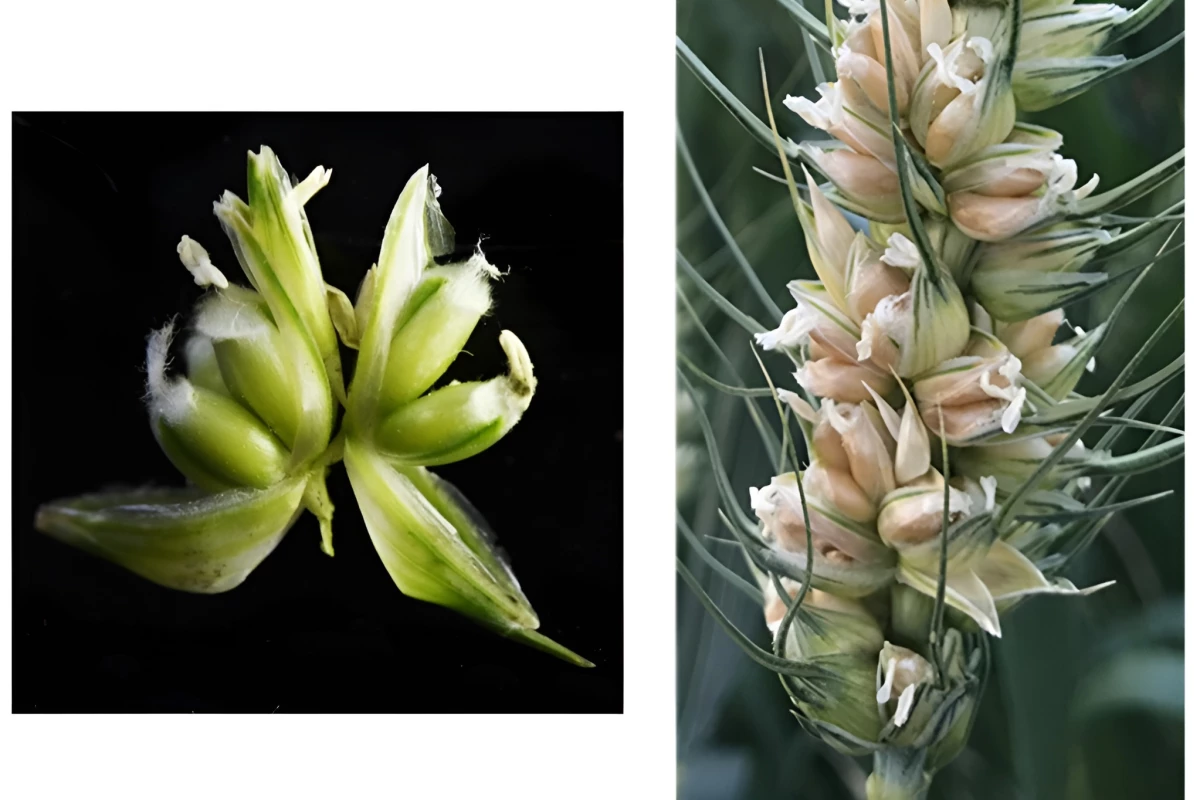
A mutant MOV wheat spikelet (left) and spike (right), the florets of which produce three grains each instead of the usual one grain
Vijay Tiwari, University of Maryland
Imagine if three times as much grain could be obtained from the same amount of wheat plants as is currently possible, using the same amount of land, water and fertilizer. Well, that could soon be possible, thanks to a new genetic discovery.
Usually, each "floret" in an ordinary wheat plant's seed head produces a single ovary, which in turn produces a single grain. Every once in a while, though, a mutant MOV (multi-ovary) plant occurs, which may have up to three ovaries per floret. So yes, that means each floret can produce as many as three grains, not just one.
Up until recently, however, it wasn't clear what genetic mechanism caused this phenomenon to take place. Now, scientists from the University of Maryland believe they know the answer, and are hoping they can use it to breed higher-yielding wheat crops.
The researchers thoroughly mapped the DNA of MOV wheat and compared it to that of regular bread wheat, searching for any differences. They discovered that a normally dormant gene known as WUSCHEL-D1 (WUS-D1) is "switched on" and active in the MOV wheat.
That gene boosts the development of tissues used in the production of extra female flower parts such as pistils and ovaries. Therefore, if WUS-D1 can be activated in cultivated wheat plants, those plants should start producing more grain.
"Pinpointing the genetic basis of this trait offers a path for breeders to incorporate it into new wheat varieties, potentially increasing the number of grains per spike and overall yield," says Assoc. Prof. Vijay Tiwari, co-author of the study. "By employing a gene editing toolkit, we can now focus on further improving this trait for enhancing wheat yield."
By Ben Coxworth
October 19, 2025
https://newatlas.com/science/mutant-wheat-triple-yields/?
A mutant MOV wheat spikelet (left) and spike (right), the florets of which produce three grains each instead of the usual one grain
Vijay Tiwari, University of Maryland
Imagine if three times as much grain could be obtained from the same amount of wheat plants as is currently possible, using the same amount of land, water and fertilizer. Well, that could soon be possible, thanks to a new genetic discovery.
Usually, each "floret" in an ordinary wheat plant's seed head produces a single ovary, which in turn produces a single grain. Every once in a while, though, a mutant MOV (multi-ovary) plant occurs, which may have up to three ovaries per floret. So yes, that means each floret can produce as many as three grains, not just one.
Up until recently, however, it wasn't clear what genetic mechanism caused this phenomenon to take place. Now, scientists from the University of Maryland believe they know the answer, and are hoping they can use it to breed higher-yielding wheat crops.
The researchers thoroughly mapped the DNA of MOV wheat and compared it to that of regular bread wheat, searching for any differences. They discovered that a normally dormant gene known as WUSCHEL-D1 (WUS-D1) is "switched on" and active in the MOV wheat.
That gene boosts the development of tissues used in the production of extra female flower parts such as pistils and ovaries. Therefore, if WUS-D1 can be activated in cultivated wheat plants, those plants should start producing more grain.
"Pinpointing the genetic basis of this trait offers a path for breeders to incorporate it into new wheat varieties, potentially increasing the number of grains per spike and overall yield," says Assoc. Prof. Vijay Tiwari, co-author of the study. "By employing a gene editing toolkit, we can now focus on further improving this trait for enhancing wheat yield."


No comments:
Post a Comment