This is interesting because of capability. The land mass is huge and measuring adjustments is a worthy proposition. Ultimately we need global survey points triangulated this way. Ultimately it can pick up earthquake threats that identify counter movement and locked joints. I do not know what level of density is needed but it is all possible.
AI can watch the data flow. Comparables can produce signals. side stepping just one serious earthquake is a win able to pay for it all.
Greenland is a great test bed with scant activity expected and provides a base case.
Greenland is Shrinking, Satellite Data Reveals
OCT 15, 2025 AT 11:58 AM EDT
By Rachael O'Connor
https://www.newsweek.com/greenland-is-shrinking-satellite-data-reveals-10883062
Greenland is shrinking and drifting further northwest, geoscientists have discovered after analyzing satellite data.
The world's largest island—at 2,175,600 square kilometers—Greenland is an autonomous territory of the Kingdom of Denmark and is home to just over 50,000 people.
It lies between the Arctic and Atlantic oceans, with some 1.8 million square kilometers of the country covered by the Greenlandic ice sheet—and it is this sheet, or rather its loss, that is sending Greenland on the move.
The ice sheet's melting is reducing pressure on the subsurface, causing movements in the bedrock and tectonic plates belowand causing Greenland to drift northwest.
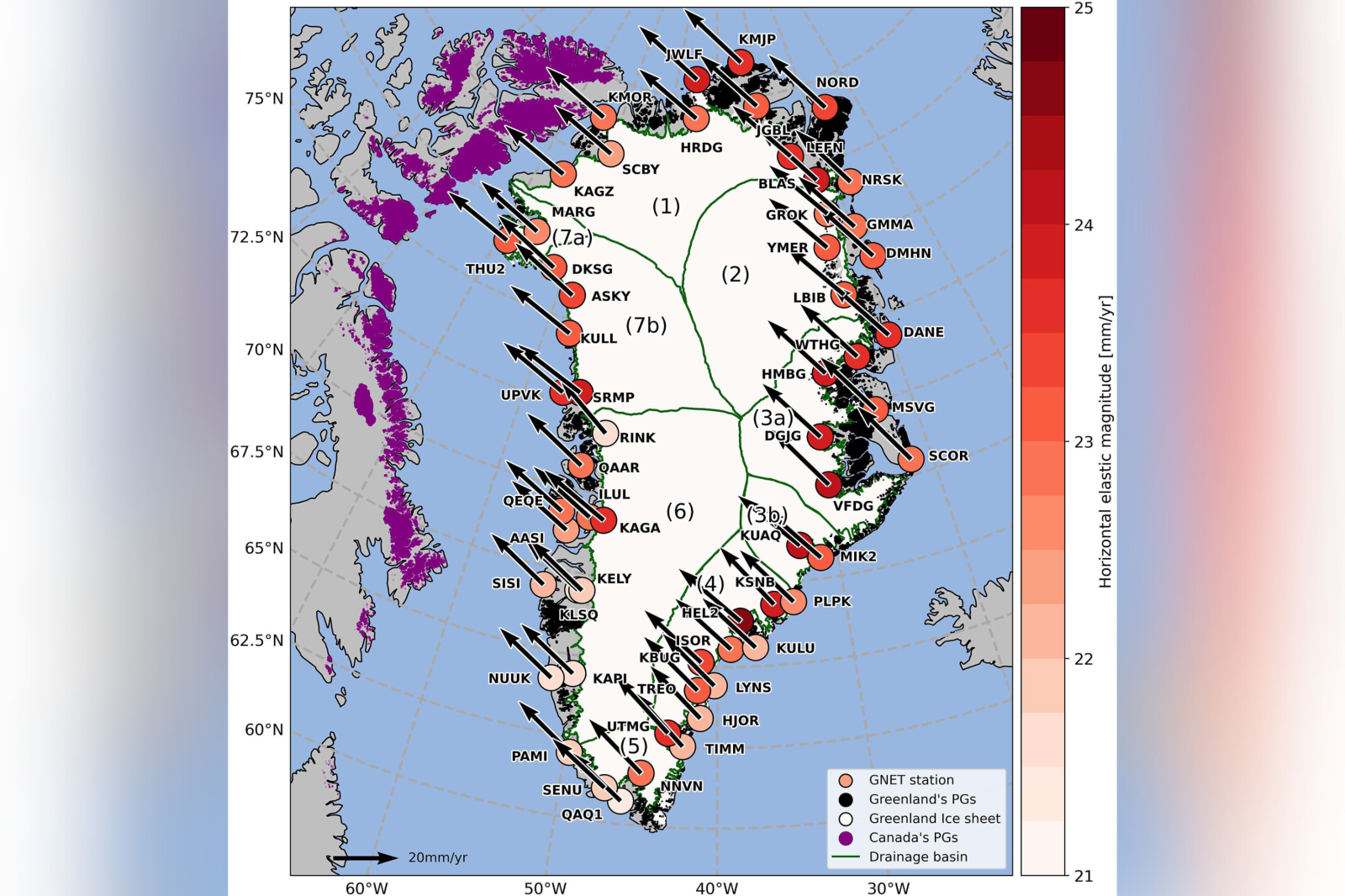
Horizontal land motion of Greenland observed by the satellite stations (Picture: Journal of Geophysical Research: Solid Earth)
In the past 20 years, the island has drifted by about two centimeters each year, and the island itself is both expanding and contracting: stretching out in some regions, and becoming compressed in others.
Paper author and geodesist Danjal Longfors Berg of the Technical University of Denmark said in a statement that the assumption until now is that Greenland was primarily being stretched, "due to the dynamics triggered by the ice melting in recent years.
"But to our surprise, we also found large areas where Greenland is being 'pulled together,' or 'shrinking,' due to the movements."
Longfors Berg told Newsweek: "The Laurentide Ice Sheet, which in the past covered large parts of North America, is still causing Greenland to shrink.
"Present-day mass loss from Greenland has the opposite effect, pushing Greenland outward. Depending on the region, the land either contracts or expands, but for now we observe that most of Greenland is still slowly shrinking."
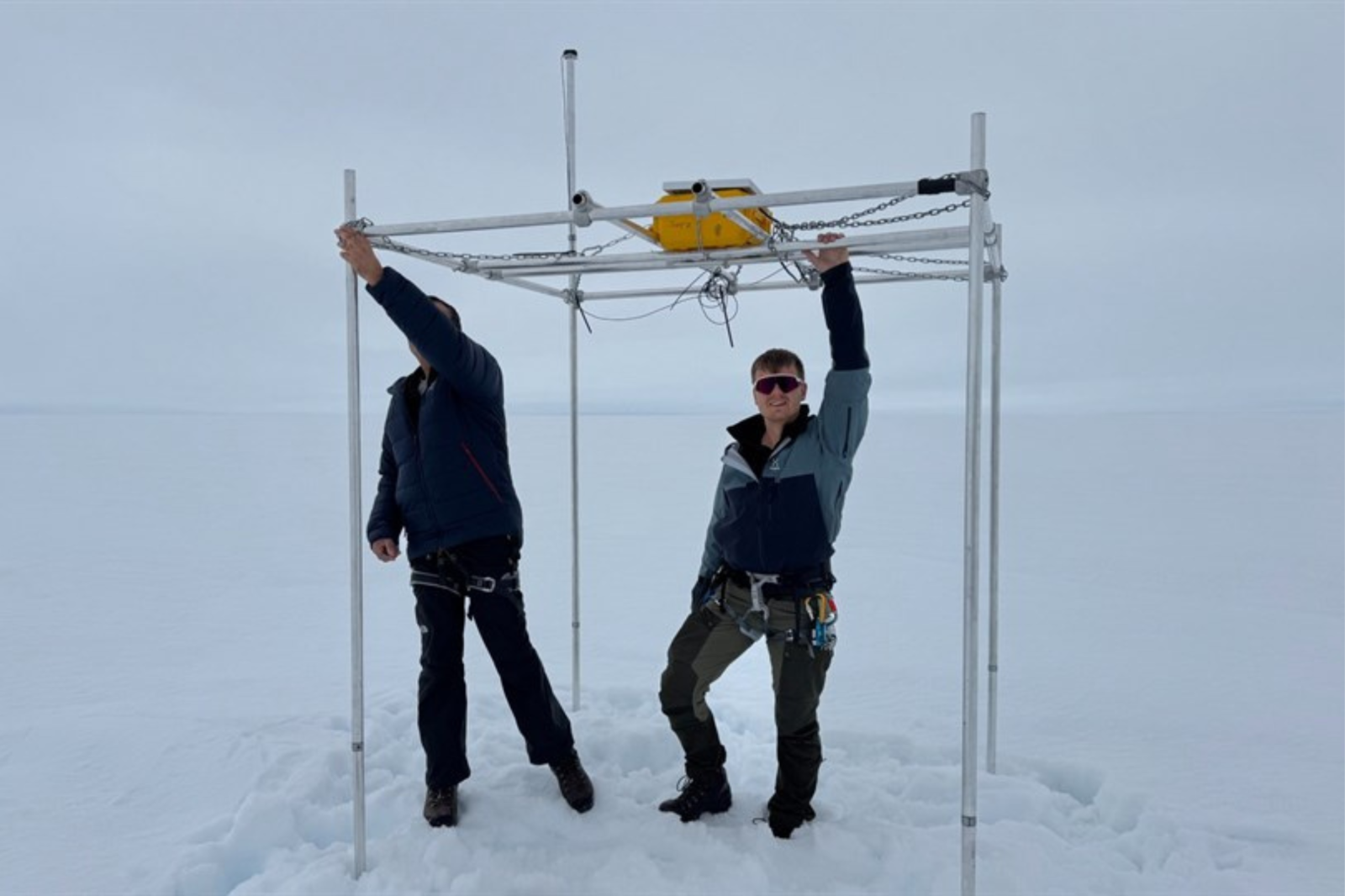
Researchers of the study in Greenland (Picture: DTU Space)
In their study, the researchers analyzed measurements from 58 GPS stations around Greenland to show elevation changes and changes in the island's overall position. It is the first time that these movements have been described in such detail.
Researchers succeeded in creating a model that shows Greenland's movements from about 26,000 years ago to the present, along with precise measurements from the past 20 years, as accelerating climate change affects the Arctic.
Berg added in a statement: "It’s important to understand the movements of landmasses. They are, of course, interesting for geoscience. But they are also crucial for surveying and navigation, since even the fixed reference points in Greenland are slowly shifting."
He told Newsweek that the GNSS stations installed on bedrock around Greenland "provide a powerful tool to monitor how the ice sheet evolves in a changing climate."
Next, he added, "I plan to explore how the ice sheet and the solid Earth evolve together as the climate continues to warm—both on local and Greenland-wide scales."


No comments:
Post a Comment