I remember first reading about graphene and saying oh yes. It is now almost twenty years on but it appears fabrication has been mastered.
It should largely supercede silicon over the long bterm.
Panels that absorb all light are intriguing.
Graphene Dream Becomes a Reality as Miracle Material Enters Production for Better Chips, Batteries
By Andy Corbley
-Oct 23, 2025
https://www.goodnewsnetwork.org/graphene-dream-becomes-a-reality-as-miracle-material-enters-production-for-better-chips-batteries/
Graphene, a sort-of ‘miracle’ material derived from graphite, was adapted over a decade ago as a potentially revolutionary alternative to silicon and other minerals for the manufacturing of dozens of vital technologies.
Now, after years of R&D, some of the material’s original promised potential now seems tantalizingly close at hand.
To offer an idea of the graphene-dream, graphene microprocessors deliver more data at the same speeds than silicon, and at far lower costs. They can run smoothly across a wide degree of operating temperatures, and consume around 80% less energy while doing all this.
Sounds like miracle stuff, and Ben Jensen, the chief executive of 2D Photonics, a startup spun out from the University of Cambridge that’s currently working to commercialize these chips, explained to the Guardian what went wrong with the black stuff’s promise.
“The material when it came out of academia was hyped to death … but the challenge is going from ‘lab to fab,'” he said. “The value proposition must be extremely good, but there also must be a way to manufacture the material and manufacture it at scale for the application … then you have to meet price expectations.”
Those challenges were too much for some, for example Bayer. The German pharma giant shut down a manufacturing plant that would have produced various products made of rolled-up graphene sheets known in the industry as carbon nanotubes. These were used by Jensen himself to invent the “world’s blackest black,” called Vantablack. The novel coating has been used in art pieces, and also by BMW on its cars. It captures another of graphene’s properties: it’s ability to absorb light.
Vantablack absorbs 99.96% of all the photons shined upon it, making it appear from any angle as black as when your eyes are shut in a closet with the door closed in the middle of the night. Jensen founded Surrey NanoSystems to sell the material through the brand name Vantablack.
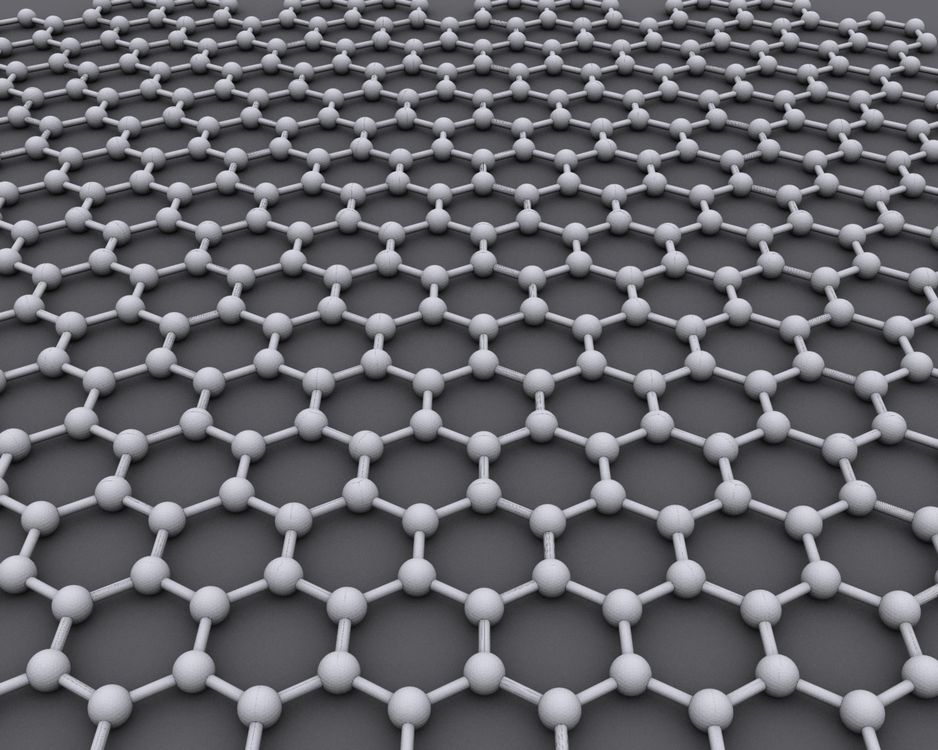
The essential structure of Graphene – credit, AlexanderAlUS – Own work, CC BY-SA 3.0
2D Photonics, at which Jensen also works, was formed out of Cambridge University in partnership with Italy’s CNIT research institute. It’s received huge backing, from private sector titans like Bosch and Sony, to government funding, and even R&D dollars from NATO, the military alliance of Europe and North America.
Their graphene chips measure 1 atom in depth (hence the same ‘2D’ Photonics), and the pilot production plant the firm is planning to build in Milan will produce them at the 200mm-scale for use in every hi-tech system you can imagine, from aircraft and radar systems for the military (presumably) to 6G computing platforms and data centers.
For more civilian uses, there’s Paragraf, another Cambridge cut-out that manufactures graphene-based sensors for biomedical and agriscience use, as well as for new automobiles. The United Arab Emirates sovereign wealth fund recently bought a 12.8% stake in Paragraf.
Nanotech Energy in the US is already manufacturing graphene-based lithium-ion batteries that fully research in seconds, are literally bulletproof, and which the company is now adapting to EVs, household uses, and grid-scale renewable energy storage.
This year its fabrication plant has been creating 21,700 battery cells per day, and the company is expanding its operations into creating graphene-reinforced concrete.
“When we add graphene or graphene oxide, it works like a super-fine sieve within the concrete, making the tiny spaces inside the cement even tinier,” said Dr. Maher El-Kady, Nanotech Energy’s chief technology officer. “That’s good news because it means water can’t sneak in as easily, and less water means less chance of corrosion.”
California’s center of innovation was famously dubbed “Silicon Valley.” It remains to be seen how the word graphene will come into the zeitgeist with the same vigor, but considering the material’s diffusion and wide-ranging application, it’s probably a safe bet it will be something like the “Graphenocene.”


No comments:
Post a Comment