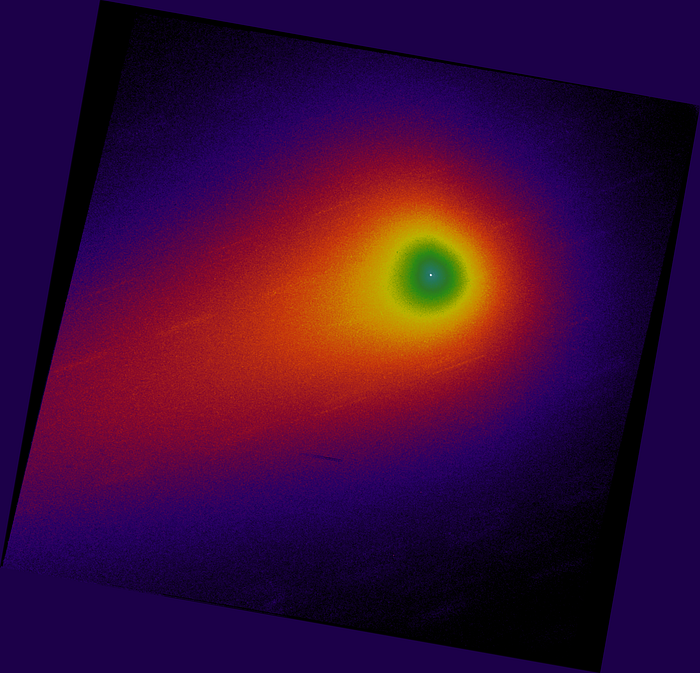
I have seen no one attempt to explain the huge intact halo or the appearance of either the anti tail or the three side jets. Even hand waving about strong magnetic fields is avoided.
What universities know about physics is not helping at all.
Cloud cosmology does point at ba sollution, but this also points at intelligent management. As Avi points out, all the evidence to date also points at something way more than an ordinary comet. Understand most comets are seen as mushy and clearly fragile accumulations of solar material from the OOrt cloud.
This event has woke me up to the fact that our road to the stars will generally be aboard even a natural asteroid on which we build infrasture and equipment able to manipulate the contained DARK MATTER. In fact this will be our primary way of moving mateiel from Star to Start.
Rather obviously, if you can shift mass out of such an object, then setting up three lobes perpendicular to the direction of travel allows for actual maneuveting, It also explains holding a halo of atoms absorbing radiation and then reemitting from the sun which is what we see.
By the way, the other tool available would be actual wormholes or spatual portals anchored on board with the other end back in its home system. We now have plenty of reports that these exist here on earth even.
Again recall that KE = Mv^2. As DARK MATTER or Mass is pushed out, the velocity of the WAVE GUIDE must approach the speed of light. Once outside the Solar bubble, this becomes safe or at least safer. This does mean that movement between stars can be accomplished quickly in ten to twenty years for our close stars.
so now you know just how aliens get here while also been able to go home for supper.
Likely what happens, as they pass through, they set up a wormhole station to support a listening post.
Weird Jet Geometry Around 3I/ATLAS in Hubble Images from January 14, 2026
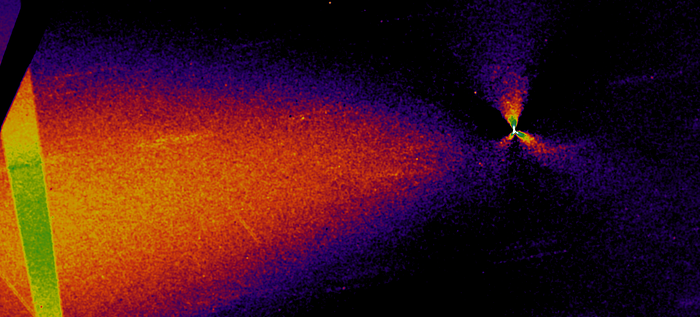
False-color brightness map of 3I/ATLAS on January 14, 2026 in six 170 second exposures by the WFC3 UVIS (F350LP) camera of the Hubble Space Telescope (top image, spanning 130,000 kilometers on a side). The map was processed through a Larson-Sekanina Rotational Gradient filter, which removes the circularly symmetric glow around the nucleus (bottom image), showing four jets. The jet structure includes a prominent anti-tail, directed at the Sun towards the lower left, along with a system of three mini-jets. These mini-jets are equally separated by an angle of 120 degrees from each other, but none of them is pointing away from the Sun as expected for a standard cometary tail. (Image credit: Toni Scarmato, based on data released by NASA/ESA/STScI here)
A new set of six images, taken by the Hubble Space Telescope on January 14, 2026, show the brightness map of the glowing halo surrounding 3I/ATLAS after perihelion. The glow extends beyond 130,000 kilometers towards the Sun, about a third of the Earth-Moon separation.
When the image is processed through the Larson-Sekanina Rotational Gradient filter which removes the circularly symmetric glow around the nucleus, it features a weird configuration of jets, including a prominent anti-tail outflow directed towards the Sun, supplemented by a system of three mini-jets. These mini-jets are equally separated by an angle of 120 degrees from each other, and none of them is pointing away from the Sun as expected for a standard cometary tail.
The last Hubble exposure ends half an hour after the first exposure starts. A new paper that I co-authored with Toni Scarmato (accessible here) analyzed previous Hubble images from December 2025 and concluded that the jet structure wobbles periodically by +/-20 degrees over a period of 7.1 hours. This implies a modest shift by 5.6 degrees over 0.5 hours in the orientation of the jet system on January 14, 2026.
On January 22, 2026, the Earth will be aligned to within 0.69 degrees with the line connecting 3I/ATLAS to the Sun (as reported in the new paper I co-authored with Mauro Barbieri here). Just as in the context of a full Moon, this rare alignment will allow us to see 3I/ATLAS and the glowing dust around it in full brightness when the area of their reflecting surfaces will be maximized. Since we will be observing 3I/ATLAS from the direction of the Sun on that date, its sunward anti-tail will be pointed at us.
Measurements of the brightness surge and polarization of 3I/ATLAS at opposition to the Sun could shed new light on the composition and size of the fragments it launches into the anti-tail.
What is the nature of the anti-tail that allows it to penetrate hundreds of thousands of kilometers through the Solar wind and radiation without being deflected away from the Sun, as often the case in familiar cometary tails? Is the anti-tail composed of fragments of ice (as suggested in a paper I co-authored with Eric Keto, published here), large dust grains (as I suggested in a research note, posted here), or massive objects (as I suggested in a paper, published here)?
Data from the SPHEREx space observatory indicated the existence of icy fragments around 3I/ATLAS before perihelion (as reported here in August 2025). However, the spectral signature of ice disappeared in the SPHEREx data after perihelion, taken during December 2025 (as reported here), when abundant organic molecules in gas phase, such as CH3OH, H2CO, CH4, and C2H6, were discovered, along with an enhancement by a factor of ~20 in the water production rate. To survive cosmic-ray bombardment along an interstellar journey that lasted billions of years, these organic molecules must have been buried under a thick layer of material, at least 10-meters in depth.
What If 3I/ATLAS Is AI/ATLAS?
Avi Loeb
Press enter or click to view image in full size
(Image credit: Troy Dawson)
Today, THE SUNDAY TIMES reported here that a former analyst of the UK central bank, Helen McCaw, urges the Bank of England to plan for a financial crisis that might be triggered by an official announcement confirming the existence of alien intelligence. Such an announcement could destabilize the financial markets and cause civil unrest. McCaw, who worked for the Bank of England for a decade starting in 2002, insists that politicians and bankers can no longer afford to ignore alien intelligence. She emailed me a few months after I started studying the interstellar object 3I/ATLAS, and included a copy of a comprehensive paper she wrote, which was partly posted here. Her email was triggered by a White Paper that I submitted to the United Nations about the potential risk from interstellar objects that carry alien technologies (posted here and here, with co-authors Omer Eldadi and Gershon Tenebaum). The risk assessment can be based on the Loeb Classification Scale, as formulated here, here and here.
As soon as the interstellar object 3I/ATLAS was discovered to follow a trajectory which is nearly aligned with the orbital plane of the planets around the Sun, I urged policymakers to make contingency plans for a “black swan event”. Even if the a priori probability of 3I/ATLAS being an alien spacecraft is small, the societal implications from it carrying technology could be huge. It therefore makes sense to collect as much data as possible about it in order to assess the potential risk from anomalies that deviate from the familiar characteristics of natural comets. Ignoring such a risk is common among scientists who focus on the most-likely scenario to protect their reputation, but is unwise for policymakers who worry about the devastating implications of low-probability catastrophes to society.
On December 31, 2025, the Central Intelligence Agency (CIA) replied to a Freedom of Information Act (FOIA) inquiry by John Greenewald Jr., with the statement that it can “neither deny nor confirm the existence or nonexistence of records” related to 3I/ATLAS (as posted here). Why would the CIA treat 3I/ATLAS as a sensitive matter? The simplest interpretation is that some government officials wished to make sure that 3I/ATLAS is not a black swan event. It makes sense to hide related records from public view in order to avoid panic, societal unrest or instability of financial markets.
Such discussions were not limited to the US. Russian president Vladimir Putin was asked by a reporter about 3I/ATLAS during his annual televised news conference on December 19, 2025, accessible here, . Here is the transcript of this public exchange:
“Journalist: I have a question about the unusual object 3I/ATLAS which is currently approaching us. If the predictions are to be believed today, December 19th, either a spacecraft with an engine or just a comet will approach Earth. My question is this, what do intelligence services report to you? Are there really signs of artificial origin? As funny as it may sound, there are indeed many theories and speculations. We, at Tyumen — the oil capital of Russia, are ready to welcome any guests but if they are from space we would like to prepare. Secondly is the date of our meeting today related to this forecast since it’s the first time that we are summing up the year on a Friday.
Putin: Is your name Christina? I’ll tell you, but it must remain exclusively between us. This is classified information. It’s our secret weapon, but we will only use it in the most extreme case because we are against deploying weapons in space. Seriously though, it’s a comet. Our scientists are aware of what is happening. Moreover, this is a comet from another place, so it behaves differently from comets of our galactic origin. It has a different shell and as it approaches closer to the Sun, slightly different processes occur on its surface, including in the field tail of this comet. Things look different there, but it’s quite large. I think somewhere between 2 to 6 kilometers. Look, the moon is 400,000 kilometers away from us. And the object you are talking about is hundreds of millions of kilometers away. I don’t think it poses any threat to us. We’ll let it go to Jupiter. And at the beginning of next year, the comet will leave the Solar system.”
For now, the official statement is that 3I/ATLAS is a natural comet. But those of us who continue monitoring 3I/ATLAS, are noticing new anomalies, including a weird geometry of three symmetric jets around its nucleus — as revealed by new images from the Hubble Space Telescope on January 14, 2026.
False-color brightness map of the projected jet structure around 3I/ATLAS, imaged on January 14, 2026 by the Hubble Space Telescope and processed through a Larson-Sekanina Rotational Gradient filter, which removes the circularly symmetric glow around the nucleus. The jet system includes a prominent anti-tail, directed at the Sun towards the lower left, along with a system of three mini-jets which are equally separated by an angle of 120 degrees from each other. (Image credit: Toni Scarmato, based on data released by NASA/ESA/STScI here)
***
The time is therefore ripe to update the list of anomalies of 3I/ATLAS. Some of these oddities are likely to have a natural explanation but others make 3I/ATLAS surprisingly rare among the known population of natural comets. Once the NSF-DOE Rubin Observatory will discover dozens of new interstellar objects over the coming decade, we will be able to understand just how unlikely 1I/`Oumuamua and 3I/ATLAS were. This is for the same reason that having many blind dates allows a dater to realize how exceptional is any one of these dating partners. At the very least, the anomalies listed below should intrigue astronomers to study them further:
Geometric Coincidences:
1. The retrograde trajectory of 3I/ATLAS is aligned to within 5 degrees with the orbital plane of the planets around the Sun, with a probability of 0.2% (as discussed here). The Milky-Way disk is misaligned with the ecliptic plane by about 60 degrees. This suggests that the trajectory of 3I/ATLAS may have been planned.
2. The arrival time of 3I/ATLAS was fine-tuned to bring it to minimum distances of 29 and 54 million kilometers from Mars and Jupiter, respectively, and be unobservable from Earth at perihelion (as discussed here).
3. The forecasted perijove distance of 3I/ATLAS during its encounter with Jupiter on March 16, 2026 is 53.6 million kilometers, is very close to Jupiter’s Hill radius, 53.5 million kilometers (as discussed here). The rare coincidence might mean that 3I/ATLAS intends to release technological devices as satellites near Jupiter’s Lagrange points — where fuel requirements are minimal.
4. Analysis of the Hubble Space Telescope image of 3I/ATLAS from July 21, 2025 (as discussed here) suggests that the anti-tail before perihelion must have been in the form of a collimated jet towards the Sun that is about ten times longer than it is wide. This is similar to the collimation observed in post-perihelion images out to several hundred thousand kilometers. No known comet exhibited a physical sunward jet of this length that is not a perspective effect. For a technological object, a beam of particles might be used to block the solar wind from impacting the nucleus surface at a relative speed of order 500 kilometers per second. In addition, the veil of dust around 3I/ATLAS is just of the right column needed to block sunlight from hitting the nucleus surface (as discussed here).
5. At large distances, the initial rotation axis of 3I/ATLAS was aligned to within 8 degrees with the sunward direction when it entered the solar system (as reported here). The probability for that is 0.5%.
6. The observed wobble of the pre-perihelion jet in the direction of the Sun (as reported here during July and August 2025) requires the base of the jet to be within 8 degrees from the sun-facing pole, with probability of 0.5%.
7. The existence of a prominent jet towards the Sun on the way of 3I/ATLAS out of the solar system requires a similar coincidence near the opposite pole of the rotation axis. The fact that a collimated jet appears as the sunward anti-tail both before and after perihelion (while reversing direction at perihelion relative to the direction of motion), has a tiny probability of occurring at random, equal to the square of 0.5% or 0.000025.
8. Processing of the Hubble Space Telescope Images from January 14, 2026 by the Larson-Sekanina filter — which removes the circularly-symmetric glow round the nucleus, reveals a system of three mini-jets which are symmetrically separated by 120 degrees from each other (as discussed here).
9. The launch base of the post-perihelion anti-tail jet resided on the nightside of 3I/ATLAS before perihelion and the base of the pre-perihelion anti-tail jet is now on the nightside of 3I/ATLAS after perihelion. For these bases to be active only when facing the Sun, they must be well insulated on the nightside for a period longer than several months. Heat naturally flows by conduction throughout the body of a natural comet, making this insulation requirement difficult to satisfy.
10. The gravitational deflection of 3I/ATLAS by 16 degrees at perihelion (as discussed here), is exactly twice the opening angle of the anti-tail before perihelion. This coincidence allows the wobbling jet around the rotation axis to generate an anti-tail in the direction of the Sun before perihelion and a counter jet on the opposite pole after perihelion, with a jet opening angle of 8 degrees on both poles.
11. On January 22, 2026, 3I/ATLAS will align with the Sun-Earth axis to within an extraordinarily small angle of 0.69 degrees (as discussed here). At that time its anti-tail will be pointing at Earth.
12. 3I/ATLAS arrived from a direction coincident with the radio “Wow! Signal” to within 9 degrees, with a probability of 0.6% (as discussed here).
Composition Anomalies of the Gas Shed by 3I/ATLAS:
13. The gas plume surrounding 3I/ATLAS contains much more nickel than iron, as found in industrially-produced nickel alloys, and a nickel to cyanide ratio that is orders of magnitude larger than for thousands of known comets, including 2I/Borisov (as reported here). This might indicate a technological origin for these abundances.
14. The anti-tail is capable of penetrating hundreds of thousands of kilometers through the solar wind and the solar radiation. In order not to be stopped, the dust particles must be much larger than common sub-micron particles of interstellar dust (as discussed here). However, if the particles are bigger than a millimeter, then they must carry an untenable amount of mass in order to account for 99% of the scattered sunlight around 3I/ATLAS, as observed in the Hubble images.
15. Data from the SPHEREx space observatory indicated the existence of icy fragments around 3I/ATLAS before perihelion (as reported here in August 2025). However, the spectral signature of ice disappeared in the SPHEREx data after perihelion, taken during December 2025 (as reported here), when abundant organic molecules in gas phase, such as CH3OH, H2CO, CH4, and C2H6, were discovered, along with an enhancement by a factor of ~20 in the water production rate. To survive cosmic-ray bombardment along an interstellar journey that lasted billions of years, these organic molecules must have been buried under a thick layer of material, at least 10-meters in depth.
Unusual Physical Properties:
16. The nucleus of 3I/ATLAS is more massive than 1I/`Oumuamua and 2I/Borisov, while moving faster than both (as discussed here and here). This suggests that 3I/ATLAS might have targeted the inner solar system rather than being drawn at random from the reservoir of interstellar icebergs.
17. 3I/ATLAS shows extreme negative polarization, unprecedented for all known comets, including 2I/Borisov (as discussed here and here). This unusual polarization may be related to its unusual anti-tail.
18. Near perihelion, 3I/ATLAS brightened faster than any known comet and was bluer than the Sun (as discussed here).
To paraphrase Oscar Wilde: “We are all in the gutter, but some of us are looking at 3I/ATLAS.”


No comments:
Post a Comment