We are now approaching the connection scale of the human brain which is a huge achievement. Wha this means remains to be seen.
we have identified two issues. our symbolic logic architecture lacks the natural sixth operator which naturally provides a global choice mechanism down through TIME. This is the architecture of GOD and might be important. worse it wonderfully recalls the past but completely fails to recall the future which biology can do. We live on pages of TIME both forward and backward and can sense subconsiously both ways.
How can this be replicated with hardware?
An Experimental Test for the Existence of the Human Soul
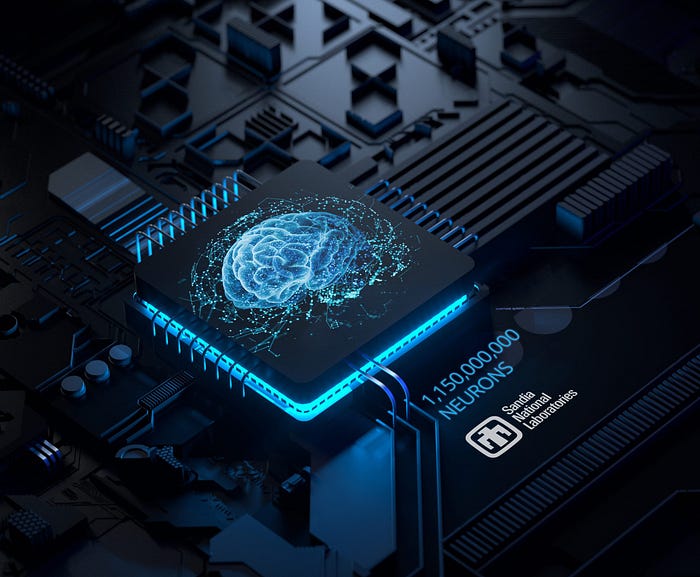
In 2024, Sandia National Laboratories received a brain-based computing system called Hala Point from Intel Corporation, that has 1.15 billion artificial neurons aiming to advance large-scale brain-inspired computing. The image shows a three-dimensional rendering of the motherboard with an illuminated AI chipset used by this neuromorphic computer. (Image credit: Sandia National Laboratory)
At the end of a late-night interview yesterday with the brilliant Nate Cain at The Raising Cain Show podcast (accessible here), I was asked whether humans have a soul, given their sense of free will, consciousness and “out of body” experiences? By a soul, Nate referred to an ingredient that extends beyond our physical bodies.
In reply, I admitted that I am a practical person and rather than have an opinion on this matter — I prefer an experimental approach for finding out the answer to this fundamental question.
Another way to frame the question is whether human experiences are all explained by the physical properties of the human brain. The reason I propose an experimental test is that we will soon have the ability to simulate the human brain with artificial intelligence (AI).
The human brain contains a network of about 100 billion neurons with a quadrillion synaptic connections. Biological evolution is slow. Historic data on the increase in the size of the human skull implies that over the past 10 million years, the number of connections in the human brain increased merely by one order of magnitude. In contrast, the number of parameters in artificial neural networks could increase exponentially on a timescale of years and exceed the number of synaptic connections of a biological brain within the coming decade.
It is not entirely unclear how AI parameters relate to biological synapses as predictors of cognitive ability in large neural networks. But it is meaningful to compare the physical properties of the human brain to neuromorphic computers, which more explicitly model the architecture of a biological brain.
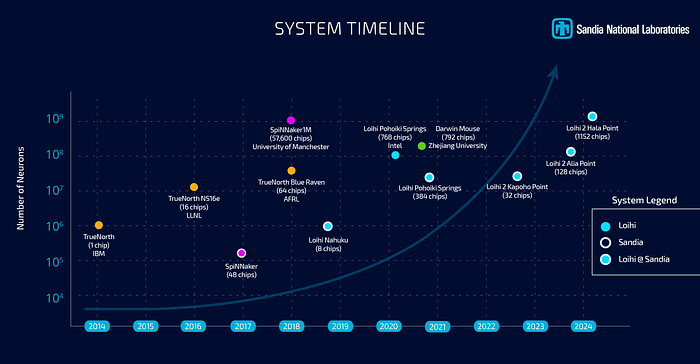
At present time, the largest neuromorphic computer, Intel’s Hala Point, contains 1.15 billion artificial neurons and 128 billion artificial synapses, or equivalently ~1% of the number of biological neurons and ~0.01% of the number of connections in the human brain. This computer, located at Sandia National Laboratories, can process 380 trillion 8-bit synaptic operations per second. As impressive as that sounds, Hala Point still falls short by several orders of magnitude in performance relative to the human brain. Yet, Hala Point consumes 2,600 Watts, about a hundred times more than the power used by the human brain.
Hala Point packs 1,152 Loihi 2 processors into the size of a microwave oven. While newer processors like Loihi 3 have been announced for release in 2026, featuring higher density (up to 64 billion synapses per single chip), Hala Point is currently the largest integrated neuromorphic system available.
Press enter or click to view image in full size
(Image credit: Sandia National Laboratory)
A larger-scale project, the DeepSouth neuromorphic supercomputer being developed by Western Sydney University in Australia, is designed to simulate a network of 100 billion artificial neurons — comparable in size to the human brain, with 228 trillion synaptic operations per second. When a project of that scale will come to fruition, we will be able to put Nate’s question to an experimental test by asking:
Will a neuromorphic supercomputer with 100 billion neurons with a quadrillion synaptic connections, show the phenomena of free will, consciousness and “out of body” experiences?
Nate forecasts that it will not.
He may be right, but I prefer to stay agnostic until the experiment is done. One way to view this experiment is as an advanced version of the Turing Test — which was formulated by Alan Turing in a 1950 paper titled “Computing Machinery and Intelligence”, available here.
Nevertheless, the `AI-soul experiment’ has greater ethical consequences than the Turing Test. In particular, if the neuromorphic supercomputer will behave in ways that are indistinguishable from human experiences, turning this machine off would be equivalent to murder.


No comments:
Post a Comment