nice investigation of the system, but we are still loking at years of dedicated work before commercialization. as said, it is nice vto have options.
it is a high power solution and may have a future for that. hopefully without using sodium which surely doubles the complexity.
Yet we really need something easier than lithium if we can get it.
New battery idea gets lots of power out of unusual sulfur chemistry
Rather than being used as a storage material, the sulfur gives up electrons.
John Timmer – Jan 7, 2026 8:02 AM | 85
New battery idea gets lots of power out of unusual sulfur chemistry
Rather than being used as a storage material, the sulfur gives up electrons.
John Timmer – Jan 7, 2026 8:02 AM | 85
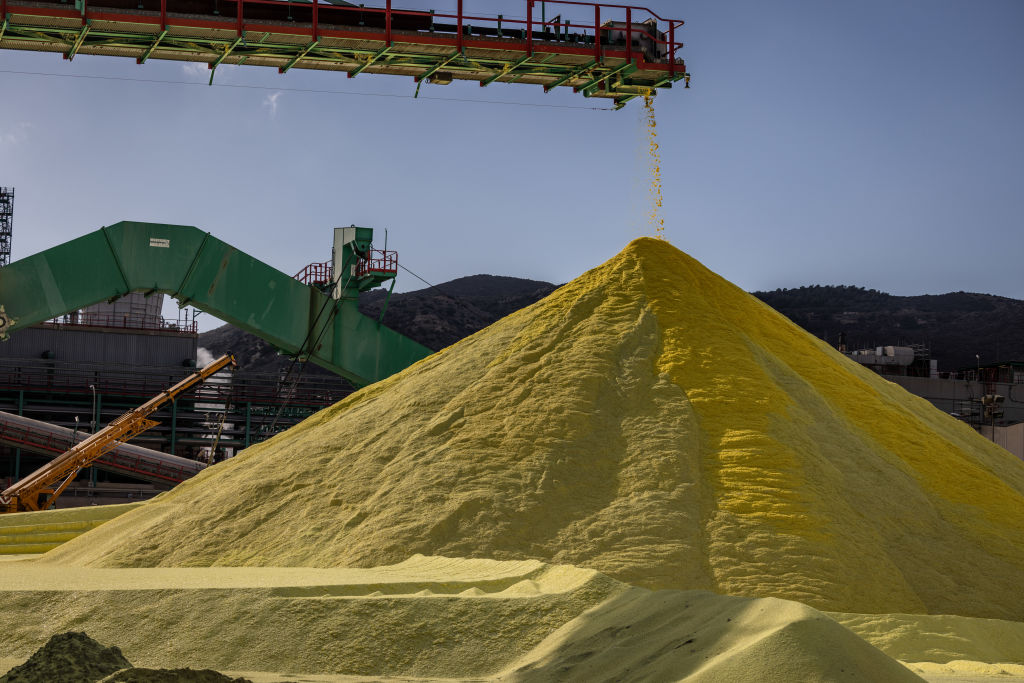
Sulfur is both abundant and cheap. Credit: Bloomberg
Anyone paying attention to battery research sees sulfur come up frequently. That’s mostly because sulfur is a great storage material for lithium, and it could lead to lithium batteries with impressive power densities. But sulfur can participate in a wide range of chemical reactions, which has made it difficult to prevent lithium-sulfur batteries from decaying rapidly as the sulfur forms all sorts of unwanted materials. As a result, despite decades of research, very few lithium-sulfur batteries have made it to market.
But a team of Chinese researchers has managed to turn sulfur’s complex chemistry into a strength, making it the primary electron donor in a sodium-sulfur battery that also relies on chlorine for its chemistry. The result, at least in the lab, is an impressive energy per weight with extremely inexpensive materials.
Sulfur chemistry
Sulfur sits immediately below oxygen on the periodic table, so you might think its chemistry would look similar. But that’s not the case. Like oxygen, it can participate in covalent bonding in biological chemistry, including in two essential amino acids. Also, like oxygen, it can accept electrons from metals, as seen in some atomically thin materials that have been studied. But it’s also willing to give electrons up, forming chemical compounds with things like chlorine and oxygen.
It’s that last feature the researchers behind the new paper are most interested in. Pure sulfur forms an eight-atom complex that can give up 32 total electrons under the right conditions. The trick was finding the right conditions.
The system had a cathode of pure sulfur and an anode that was simply a strip of aluminum that acted as a current collector. The electrolytes the researchers tested contained a lot of aluminum, sodium, and chlorine (typically something like eight Molar aluminum chloride and a 4.5 Molar solution of some sodium salt). The aluminum helps stabilize the foil at the anode, while the other two chemicals participate in the reactions that power the battery.
When the battery starts discharging, the sulfur at the cathode starts losing electrons and forming sulfur tetrachloride (SCl4), using chloride it stole from the electrolyte. As the electrons flow into the anode, they combine with the sodium, which plates onto the aluminum, forming a layer of sodium metal. Obviously, this wouldn’t work with an aqueous electrolyte, given how powerfully sodium reacts with water
High capacity
To form a working battery, the researchers separated the two electrodes using a glass fiber material. They also added a porous carbon material to the cathode to keep the sulfur tetrachloride from diffusing into the electrolyte. They used various techniques to confirm that sodium was being deposited on the aluminum and that the reaction at the cathode was occurring via sulfur dichloride intermediates. They also determined that sodium chloride was a poor source of sodium ions, as it tended to precipitate out onto some of the solid materials in the battery.
The battery was also fairly stable, surviving 1,400 cycles before suffering significant capacity decay. Higher charging rates caused capacity to decay more quickly, but the battery did a great job of holding a charge, maintaining over 95 percent, even when idled for 400 days.
While the researchers provide some capacity-per-weight measurements, they don’t do so for a complete battery, focusing instead on portions of the battery, such as the sulfur or the total electrode mass.
But with both electrodes considered, the energy density can reach over 2,000 Watt-hours per kilogram. While that will undoubtedly drop with the total mass of the battery, it’s difficult to imagine that it wouldn’t outperform existing sodium-sulfur or sodium-ion batteries.
Beyond the capacity, the big benefit of the proposed system appears to be its price. Given the raw materials, the researchers estimate that their cost is roughly $5 per kilowatt-hour of capacity, which is less than a tenth of the cost of current sodium batteries.
Again, there’s no guarantee that this work can be scaled up for manufacturing in a way that keeps it competitive with current technologies. Still, if the materials used in existing battery technologies become expensive, it’s reassuring to have other options.


No comments:
Post a Comment