This could be interesting if properly supported. Thanks to the first nations land freservebsystem ,land itself cannot be used as capital Yet we also live in a world in which a slab of concrete is a souce of capital.
Can we construct rigid slabs eight feet by forty eight that can be easily popped on a flat bed and also set up on ground posts and easily leveled? blow in dirt to fill any voids as well. there is your building slab easily extended.
Banks need to understand building slabs as capital. A slabcan be set up down town or hte middle of the wilderness.
First Nation Innovates Prefabricated Housing System from Locally-Sourced Wood
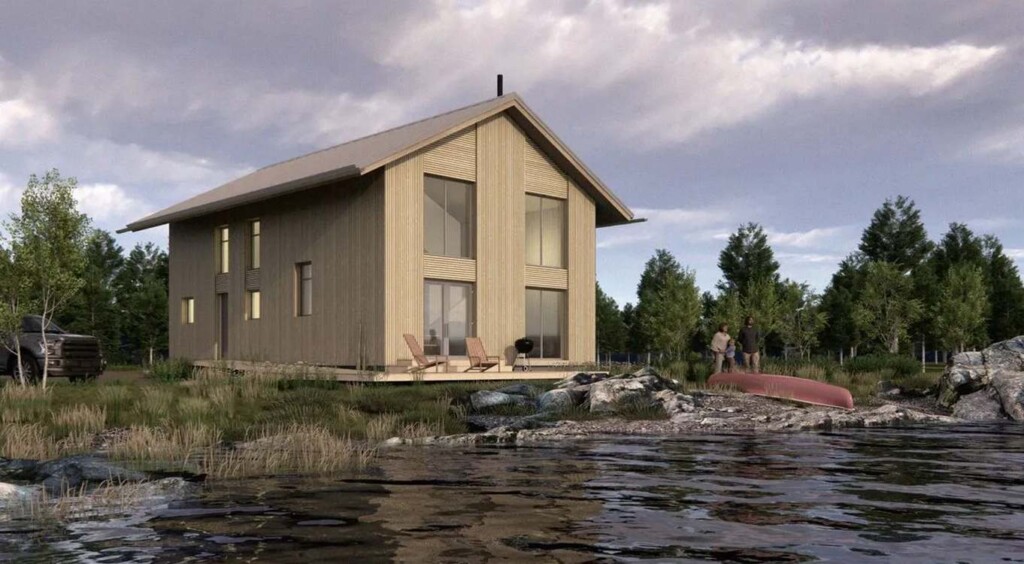
A rendering of Timber House from the Nak’adzli Development Corporation – credit, released
https://www.goodnewsnetwork.org/first-nation-innovates-prefabricated-housing-system-from-locally-sourced-wood/
Prefabricated housing holds the potential to erect both economic opportunities and affordable housing in Canada’s far northwest, tribal leaders believe.
Using low-quality timber sourced locally, the Nak’adzli Whuton, a first nation located near Fort St. James in British Columbia, are creating mass timber panels that can be quickly assembled into a standard building.
The Nak’adzli Whuton Development Corporation teamed up with the University of Northern British Columbia’s Wood Innovation Research Lab, and Deadwood Innovations, a lumber industry player looking to turn low-quality, low-impact wood into high-quality beams and panels. This includes inputs like aspen trees, which grow in colonies and don’t need to be replanted, but which wouldn’t typically be used in logging.
Mass timber is a wood engineering technique that involves gluing, heating, and compressing multiple small boards of wood together to create stronger, larger forms. They’ve proven to be a transformative innovation in timber construction, and it creates the chance for a secondary industry to be spawned from tribal forestry.
“This house means security not only in housing, but in economics and community longevity,” said Nak’azdli Whuten member Elky Taylor.
“We have limited economics in Fort St. James and to create a secondary industry with our timber is something that’s been a long time coming and we’re hoping to see success in this pilot project.”
The house is an upright timber construction featuring an open concept living room/kitchen on the ground floor, and three bedrooms in a loft arrangement on the second floor. Project team leaders spoke with CBC News and said that a 3 bedroom 2 bathroom home could be fully assembled in just 10 days.
Additionally, because all the housing panels are assembled in a factory setting, each can be subject to more rigorous quality control, eliminating the chance for defects to arise in the construction on site, and having to either compensate, or improvise.
“You can build the panels through the winter months, and then in the summer you can erect the houses a lot quicker,” said John-Paul Wenger, CEO of Nak’azdli Whuten Development Corp.
“The idea would be instead of producing two or three houses, we could maybe do 10 houses in this area with our construction crew and local contractors.”
The floor plan for the homes can of course be quickly and easily changed to fit the needs of the community or resident since the building is done so fast.
Fort St. James is one of several northern BC towns that have shared the downturn in the provincial timber industry. As much as the town, like pretty much everywhere else in the Western world, needs more housing at a lower price, the partnership between the Nak’azdli Whuten, Deadwood, and UNBC is as much about creating skillsets that


No comments:
Post a Comment