Saturday, January 31, 2026

Tesla Completing Not Just a Car Company Transformation


What is poorly understood is that Teslas persistent rise is driven by the rapid adoption of computer driven manufacturing capability.  Their competators simply dragged their feet and that killed them.

Who thought that they were making a future iphone.

This is a case study in the failure of imagination.

what is most amazing is actual consumer acceptance


Tesla Completing Not Just a Car Company Transformation

January 28, 2026 by Brian Wang

https://www.nextbigfuture.com/2026/01/tesla-completing-not-just-a-car-company-transformation.html#more-208250


– Most important earnings call in Tesla history – not just for Tesla, but any company
– Stock hit $450 briefly, pulled back to $440 post-call
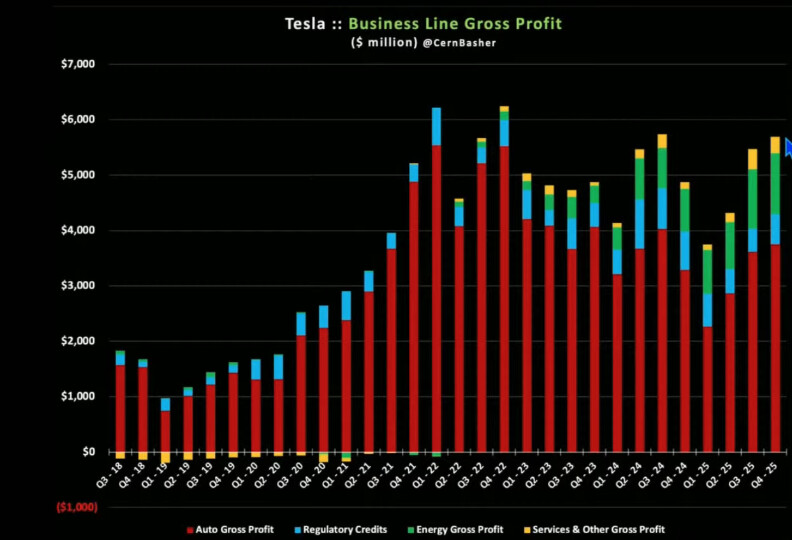
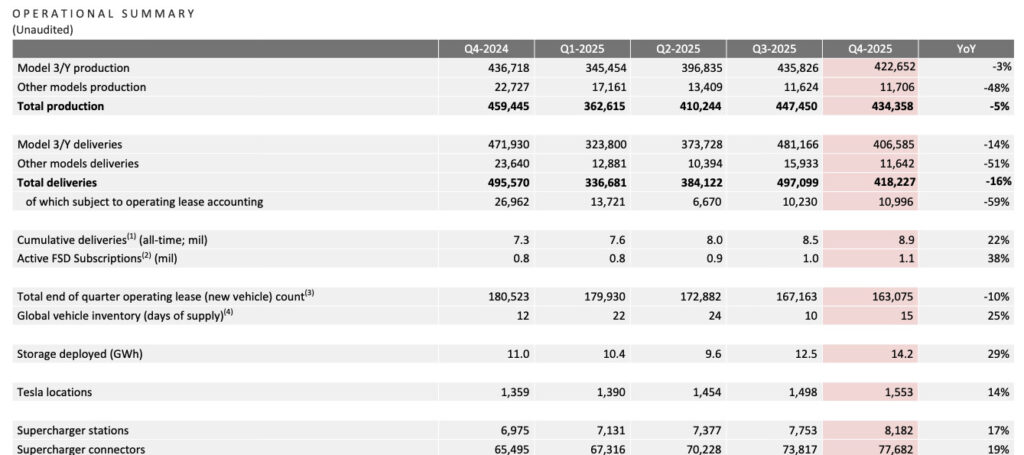
– Strong profitability despite 16% fewer deliveries Q3→Q4
– Higher profit margin: 18% → 21% gross margin
– Beat expectations: 50¢ vs 44¢ expected EPS


Quarterly Deck Transformation – AI Company Recognition

– First time quarterly deck reflects Tesla as AI company, not car company
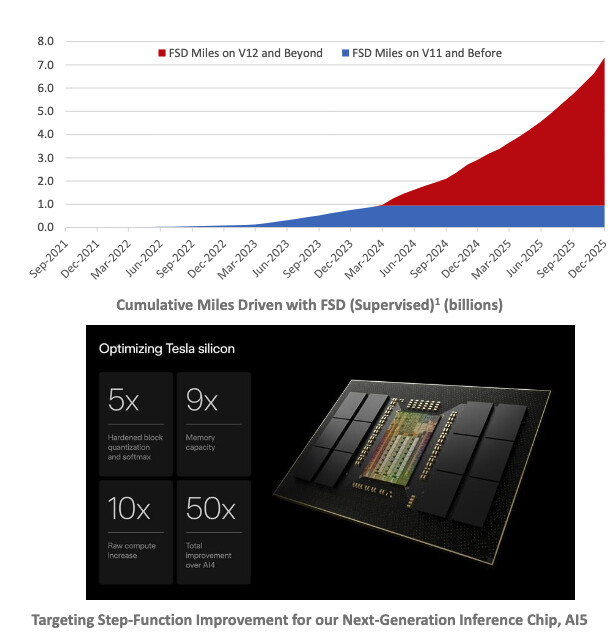
– Page 4: Active FSD subscriptions now tracked (800K → 1.1M)
– Forces analysts to acknowledge AI metrics
– 80-90% US market, expansion to China/Europe coming
– 75-80% of company presentation now non-automotive
– AI training/compute, robotics, energy dominate narrative
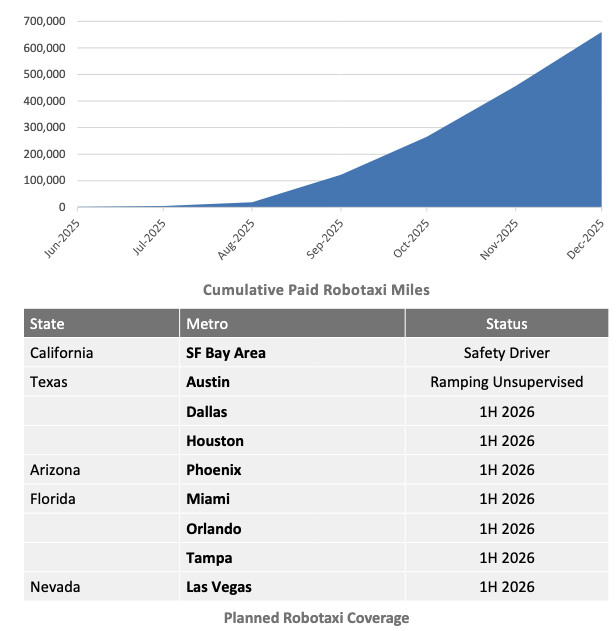
– Cumulative paid robotaxi miles now tracked metric

FSD Revenue Surge

– 70% of Q4 vehicle sales included upfront FSD purchases
– ~100K FSD sales at $8K each = equivalent profit to 100K additional cars
– 518K total “unit profits” (418K cars + 100K FSD)
– Final opportunity for $8K purchase before subscription-only model
– Potential Q1 windfall: 4-5% of 8.3M non-FSD vehicles could purchase
– Could reach 400-500K sales = doubling car profitsScreenshotScreenshotScreenshotScreenshotScreenshotScreenshot

Robotaxi Deployment Reality Check

– Current fleet over 500 vehicles (tracking sites missed 50%+ of cars)
– Doubling every month target
– 2 months: Pass Waymo
– 10 months: 500K vehicles if sustained
– Infrastructure challenges caused delays
– Airbnb model still targeted for 2026, possibly sooner

Manufacturing & CapEx Explosion

– Doubling CapEx spend: $10B → $20B annually
– Excludes chip/solar fab investments
– Six factories building simultaneously
– Model S/X production ending in Fremont
– Space for 1M+ Optimus bots annually
– Potentially 10M bot capacity with full conversion

Chip & Memory Strategy

– Memory shortage bigger constraint than chip shortage
– Vertical integration: dirt → solar cells → panels
– Tesla 10x more memory efficient than competitors
– AI5 chip production for internal use first
– Learning curve for lunar manufacturing capabilities

Financial Projections & Debt Strategy

– 100K robotaxis = $4B annual profit potential
– 2M vehicles by 2027 at $100K profit each = $200B revenue
– Debt financing viable with robotaxi cash flows
– Amazon-style growth model: temporary losses for massive scaling


Insurance & Subscription Bundling

– Lemonade projecting 50% risk reduction already
– 10x safer by FSD v15-17 (2-3 years)
– Insurance could drop to $30-50/month vs current $250
– Bundled FSD + insurance packages coming
– Transportation-as-a-service becoming dominant model within 3 years


Video: Is America against Europe? Donald Trump: “We Are No Longer Friends”


We live in bizarre times.  THe Trump wreaking ball has upended multiple systems. all with the suppoesed intent of improving american leverage.  Except the opposite is occuring.  It will not work at all and Canada has stepped up to organnise a global counterweight consensus in which the USA is diminished and valso deeply contained.

This has deeply weakened USA operational flexibility.  It will take years to repair this unless we actually face an existential threat which we do in terms of population shrinkage.  Resolving that will actually be devisive.

China is following Japans path and will soon be no threat to anyone and even sooner if the CCP blows away.

Modernity will soon be anchored in India and Africa as their populations transition.  This will be werlcome and the population resolution will ultimately transform the whole earth.


Video: Is America against Europe? Donald Trump: “We Are No Longer Friends”

By Prof Michel Chossudovsky and Drago Bosnic

Michel Chossudovsky

Jan 29


Donald Trump’s administration made plans to pull four friendly countries out of the EU, in an effort to “Make Europe Great Again.”


A 29-page US National Security Strategy (NSS) condemns trump’s European allies as “weak.”


“The White House pushed back on claims that Washington was seeking to take nations including Italy and Hungary out of the EU.” (Independent)


According to Defense One, a longer and unpublished version of the document suggested taking Austria, Hungary, Italy and Poland out of the EU and into greater alignment with the US, while backing movements supportive of “traditional European ways of life.”


What this 29-paged NSS report confirms is America’s intent to destabilize and fragment the European Union.


Reach out to people in all major regions of the world:


Western Europe, The Americas, the Middle East, Africa, Russia, China, India, East and South East Asia, The Pacific.


Our longstanding commitment is to world peace and “true democracy.”


Our thanks to Lux Media for their support in the production of the video with subtitles in 15 languages.


To contribute to the GRTV-Lux Media video project, please consider subscribing to my Substack. Click here to see subscription options.


Click here to watch the video with subtitles in 15 languages.


A revolutionary breakthrough in dental science is changing how we fight tooth decay.


A lot of effort is going into augmenting tooth remineralization. This is a high bar but a great objective. It sould result in dental protocols to produce strong teeth at the least. I came out of the last generation for which dental care was rudimentary at best. So I benefited with the advent of sound dental care but not until my mouth was partically damaged.

Natural tooth restoration is the object of dental care.


We may well be getting there.


A revolutionary breakthrough in dental science is changing how we fight tooth decay.


Scientists have developed a gel that can naturally regrow tooth enamel and repair damage caused by cavities. Unlike traditional treatments that rely on fillings or invasive procedures, this gel works at the microscopic level to restore teeth from within.

The gel contains special compounds that stimulate the natural remineralisation process, helping enamel regenerate and strengthen over time. By repairing the damaged layers of the tooth, it not only restores structure but also protects against further decay. Early research and laboratory tests have shown promising results, with treated teeth exhibiting noticeable enamel growth and improved resilience. This innovation could transform dental care by reducing the need for drilling, fillings, and other invasive procedures, making oral health maintenance easier, less painful, and more natural. Regular use of such enamel-regenerating gels may also prevent future cavities, offering long-term protection and stronger teeth.

brain to repair itself using focused sound waves, eliminating the need for invasive surgery.


This is very promising and one wonders if the tool can be appiled to damaged tissue elsewhere. after all this is allowing natural healing to overcome damage displacement producing scar tissue.

Just saying but do understand that three focused ultrasound tools working together with a computer can powerfully intrude on a narrow damaged locale.  Better yet, undamaged tissue will resist deisturbance well.

All this can stimulate true natural healing modualities.  We need better tools now.

brain to repair itself using focused sound waves, eliminating the need for invasive surgery.


https://www.linkedin.com/posts/vincentius-liong_unboxfactory-neuroscience-medicalinnovation-share-7422157205682184192-oB3x/


Scientists at University of Oxford have demonstrated a breakthrough technique that allows the brain to repair itself using focused sound waves, eliminating the need for invasive surgery. The method uses focused ultrasound, which can precisely target damaged brain tissue and temporarily open the blood-brain barrier. This allows therapeutic molecules to reach areas previously inaccessible to treatment. In early trials, the technique stimulated neural repair, reduced inflammation, and improved neurological function in patients with brain injuries and neurodegenerative conditions. The procedure is non-invasive and does not require incisions. Traditional brain surgery carries high risks, including infection and permanent damage. Sound-based therapy offers a safer alternative with faster recovery times and broader accessibility. Neuroscientists say this technology could transform treatment for conditions like Alzheimer’s, Parkinson’s, stroke damage, and traumatic brain injury—marking a new era of precision neurology.

Friday, January 30, 2026

Consumer Confidence Dives to the Lowest Point since 2014, Below Covid Low


You cannot do obvious stupid without making folks mad at you.  and inflating prices without pulling back when it is failing will do wonders for confidence.

this is very bad, but i also expect that hte current regime cannotbstand much longer.

it will surely be followed by a massive reversal of stupid.  whipsaw time.

Consumer confidence Dives to the Lowest Point since 2014, Below Covid Low

January 27, 2026

10:08 am


“Confidence collapsed in January.” But Why?


Confidence collapsed to lowest point since 2014, surpassing pandemic depths

The Conference Board Consumer Confidence Index® fell by 9.7 points in January to 84.5 (1985=100), from an upwardly revised 94.2 in December. A 5.1-point upward revision to December’s reading of the Index resulted in a slight increase last month, reversing the initially reported decline. However, January’s preliminary results showed confidence resumed declining after a one-month uptick.

The Present Situation Index—based on consumers’ assessment of current business and labor market conditions—dropped by 9.9 points to 113.7 in January. The Expectations Index—based on consumers’ short-term outlook for income, business, and labor market conditions—fell by 9.5 points to 65.1, well below the threshold of 80 that usually signals a recession ahead. The cutoff for preliminary results was January 16, 2026.


Consumer Confidence Present Situation and Expectations


“Confidence collapsed in January, as consumer concerns about both the present situation and expectations for the future deepened,” said Dana M Peterson, Chief Economist, The Conference Board. “All five components of the Index deteriorated, driving the overall Index to its lowest level since May 2014 (82.2)—surpassing its COVID-19 pandemic depths.”

The Present Situation Index fell, as net views on current business conditions dwindled to just barely positive, at +0.1%. Perceptions of employment conditions also edged lower, with the labor market differential—the share of consumers saying jobs are “plentiful” minus the share saying jobs are “hard to get”—continuing to flag. All three Expectations Index components also weakened in January. Expectations for business and labor market conditions six months from now fell further into negative territory. The outlook for household incomes became less positive.

Among demographic groups, confidence on a six-month moving average basis dipped for all age groups in January, although consumers under 35 continued to be more confident than consumers age 35 and older. Confidence among all generations trended downward in the month, but Gen Z remained the most optimistic of all generations surveyed. By income, confidence on a six-month moving average basis ticked downward for all brackets, and consumers earning less than $15K remained the least optimistic among all income groups. Consumer confidence continued to fade in January among all political affiliations, with the sharpest decline among Independents.

Peterson added: “Consumers’ write-in responses on factors affecting the economy continued to skew towards pessimism. References to prices and inflation, oil and gas prices, and food and grocery prices remained elevated. Mentions of tariffs and trade, politics, and the labor market also rose in January, and references to health/insurance and war edged higher.”

Homebuying expectations continued to retreat. Plans to purchase refrigerators, dishwashers, furniture, and TVs decreased. Plans to buy electronics dipped in all categories besides smartphones, which continued to trend upward on a six-month moving average basis. Used cars, furniture, TVs, and smartphones remained the most popular within their categories for future purchases.

The only surprise in the report is Gen Z. They are the generation most impacted by inflation and jobs.

Labor Market Notes23.9% of consumers said jobs were “plentiful,” down from 27.5% in December.
20.8% of consumers said jobs were “hard to get,” up from 19.1%.
Only 13.9% of consumers expected more jobs to be available six months from now, down from 17.4% in December.

Much more in the report.

Is the Plunge That Shocking?


I Think We “Should” All Agree


Vance and Miller Justify Murder


Steve Miller, J.D. Vance and Homeland Secretary Kristi Noem are the scummiest of the scum.

Is it any wonder confidence is sinking?


Given the Nazi slogans of Noem, and the Gestapo tactics of ICE, does anyone doubt that?

Is it any wonder confidence is sinking?

America Screamed Loudly


Trump demoted Border Patrol Commander Greg Bovino. One down. Many coming.

Today we heard echoes of those screams. The echoes are in the form of two Conference Board charts.


This post originated on MishTalk.Com

Thanks for Tuning In!

The Ruthlessness and Brutality of the U.S. Government


What is most troublesome is that way too many agencies are visibly packing.  Wrong signal.  Certainly no promise of proper training.  Do you really want a scared clerk pulling a gun on you?

The rule should be to expect cooperation and when that is an issue, to then call for actual trained enforcement.  ANd jst why are traffic stops using highly trained personel?

Calming your instituions goes a long way toward calming the put upon.  Nice also works.

The Ruthlessness and Brutality of the U.S. Government


January 26, 2026

https://www.fff.org/2026/01/26/the-ruthlessness-and-brutality-of-the-u-s-government/

I have long maintained that one of the big obstacles libertarians face in the achievement of a genuinely free society is the fact that most Americans honestly believe they are free. When people are convinced they are free, they have no reason to want to join up with us libertarians in our effort to establish a genuinely free society. Instead, they simply view libertarianism as a “weird” philosophy that purports to achieve what we already have — a free society.

One can only hope that the recent killings of 37-year-old Renée Good and 37-year-old Alex Pretti in Minneapolis, both of whom were regular American citizens, will enable at least some Americans to break through the inches-thick indoctrination that has encased their minds and that has convinced them that they live in a free society. After all, how can a society genuinely be considered free when the government wields the omnipotent power to kill anyone it wants?

And make no mistake about it: As we have seen, U.S. officials have the omnipotent power to kill any American they want. That’s a harsh reality that so many Americans still do not want to accept. They’d rather remain convinced that they live under the same governmental structure on which our nation was founded, one in which the federal government’s powers were limited and restricted by the Constitution and the Bill of Rights.

So many Americans do not want to face reality — that this is a very different type of government — one that is every bit as brutal and ruthless as totalitarian-like regimes throughout history and one that wields such omnipotent powers as killing, torture, and indefinite detention without due process and trial by jury.

Consider the drug war, one of the most tyrannical powers that any totalitarian-like government, even one whose officials are democratically elected, can wield against its own citizens. Look at how many people they have killed over the years with this aberrant governmental program.

Indeed, just look at those 100-plus people they’ve just killed in cold blood on the high seas using the drug war as their justification. That’s what’s called the exercise of brutal and ruthless omnipotent power. No one is ever going to be prosecuted or convicted for killing those people.

But Americans have let them get away with drug-war ruthlessness and brutality, year after year, decade after decade. Never mind that U.S. officials never get even close to “winning” their drug war. What matters is that U.S. officials be permitted to continue waging it, even if that has meant the destruction of our very own freedom at the hands of our very own government.

A dark irony in the destruction of our freedom is the fact that the federal government oftentimes creates the problem that it then uses as the excuse to further destroy our freedom. For example, take drug cartels. They don’t exist in a genuinely free society because drugs are legal in a genuinely free society. Thus, in a free society, drugs are sold by pharmacies and other reputable businesses, and drug cartels and drug gangs simply do not exist.

Seizing on drug addiction as a societal problem that the government supposedly needs to resolve (but never can do so), the government declares the sale of drugs to be illegal. Immediately, the drug cartels come into existence as part of the black-market effort to meet the demand of drug consumers. Rather than repeal the drug laws that bring this black market into existence, the government instead uses the existence of the drug cartels to expand its powers, including, as we have seen, the omnipotent power to kill people who the government suspects are violating its drug laws.

If anyone thinks that the government’s omnipotent power to kill drug-war suspects on the high seas is limited to foreigners, he is living in a world of hyper-naiveté and delusion. With those killings in cold blood on the high seas, the U.S. government, especially the Pentagon, the CIA, and the NSA, are sending a powerful message to the American people: “We are in charge. What we are doing here on the high seas, we can do anywhere and to anyone, including Americans, and there isn’t anything anyone can do to stop us. Get used to it.”

In 1967, Martin Luther King, Jr., pointed out that the U.S. government had become the greatest purveyor of violence in the world. What so many Americans do not wish to confront is that nothing has changed and, in fact, the problem has only gotten worse and worse. Over the years, it has been foreign citizens who have borne the brunt of the ruthlessness and brutality of the U.S. regime, but what so many Americans have simply blocked out of their minds is the fact that the power to exercise that ruthlessness and brutality against Americans has always been there, like a sword ever ready to be unsheathed when necessary.

We are now witnessing this phenomenon in the war on illegal immigration. ICE agents and the Border Patrol have the power to kill any American protestor they want. No one can stop them. No one can prosecute them. No one can convict them. The killers are fully protected, even if that means lies, cover-ups, pardons, defense, and support. Just get used to it. Even if the ICE and Border Patrol killings (of 

The federal siege at Waco.

From time to time, the American people need to be reminded (e.g., Waco and Ruby Ridge) who is the boss. The boss is the U.S. government. The citizenry are the serfs, the servants, the subordinates. The job of the citizenry is to work and produce wealth so that there are alway sufficient tax revenues to support the masters. The job of the federal government is to rule and govern. That sometimes entails ruthlessness and brutality, but that’s just the way it is. Get used to it.

The easiest thing for people who are breaking free of the “we are free” indoctrination that has encased their minds is to assume that the problem is Donald Trump, ICE, the Border Patrol, the DEA, or military or CIA “overreach.” They are mistaken. The problem is not the people running the illegitimate systems. The problem is the systems themselves, including drug prohibition and America’s socialist system of border controls, that have attached themselves to the federal government, much as a malignant cancer attaches itself to a person’s body.

To achieve a genuinely free society, it is necessary for a critical mass of Americans to come to the realization that the solution lies not in reforming these malignant systems or in getting “better” people to run them. The solution lies instead in fully and completely excising all of the wrongful, destructive, and malignant systems that have attached themselves to the federal government.


It’s CHINA folks:


What we are saying is that China is usng cutouts to funnel money to paid activists working to distabalize the USA.

Stopping bthis requires the ruthlees appliication of intel gathering and actual spy killing in orderr to make it way too costly to continue.  after all ,that is what the CCp did to our outed spys in China.

just saying.  They will meddle and we must kill the weasels.  There exists no alternative in this type of warfare.

It’s CHINA folks: Bill O’Reilly just EXPOSED what he says is the most important detail of the Minnesota saga…and proves that the media is refusing to report it.


Listen closely. It starts with a billionaire living in Shanghai. O’REILLY: “Now, here’s the most important part of this whole thing, UNREPORTED.” “There is a man in Shanghai, China, an American citizen, his name is Neville Roy Singham. He works with the Beijing government.” “He is funneling MILLIONS of dollars into the United States of America through 501s, like Party for Socialism and Liberation, Democratic Socialists of America, Minnesota Immigration Rights Action Committee.” “He is funneling money here to these radical organizations who are then agitating professional people, communists mostly — because Singham’s a communist — to go in and foster rebellion.” “You heard that story reported? That is ABSOLUTELY true. The man has been investigated by the FBI in the past. This Singham character. Okay.” “This isn’t some organic thing. This is a foreign power, Beijing using this American citizen who lives openly in Shanghai in luxury, knowing that this man is funneling 10’s of millions, probably more into this country to try to destroy the government.” “What the DEUCE is that?!” “WHERE ARE YOU New York Times?!” “That’s the second part of the story. There’s a local federal story and there’s the international story.” “And I’ve had it! You don’t like what I’m saying…BLANK you! Because I’m telling you the truth!”

Sound Money Requires Voluntary Governance


all this historic disfunction ends with applicsation of the Rule of Twelve Protocol. Money can become sound.

Of course, you cannot understasnd ,but do know it is possible;  This item describes the history of failure.

understand that the rule of twerlve replaces the king.

Sound Money Requires Voluntary Governance
 

January 27, 2026


If things are to change, one must realize the extent to which the foundation of tyranny lies in the vast networks of corrupted people with an interest in maintaining tyranny. — Etienne de La Boetie

“Your money or your life” has been government’s calling card for as long as government of the involuntary kind has existed. Of the choice between the two — money or government — there apparently is none. If we had no money we would be without a medium of exchange, the division of labor would collapse and civilization along with it.

As for government as it exists, its alleged necessity is drilled into our heads soon after we meet a public school teacher for the first time. In my case, as a kid in the late Forties, our government was the soldiers who fought bad people in other countries. It was called war, and government taxed our parents to pay for it. In classrooms, teachers made us sing praises to the soldiers who defended us and to the government they represented. The message was clear: It was only government that stood between us and evil people. Clearly, government was necessary.

I and most other people from my generation didn’t read War is a Racket or Perpetual War for Perpetual Peace until much later in life, after the World Wide Web made them accessible. Nor was Murray Rothbard’s Anatomy of the State around to clarify the meaning of government as we know it. If war and theft are characteristic of the political class, why do we put up with it?

Thomas Jefferson’s words in the Declaration of Independence should serve to guide us:

Prudence, indeed, will dictate that Governments long established should not be changed for light and transient causes; and accordingly all experience hath shewn, that mankind are more disposed to suffer, while evils are sufferable, than to right themselves by abolishing the forms to which they are accustomed.

Accordingly, people suffer taxation and other abuses as long as they don’t get out of hand. When they do, heads tend to roll.

Over the ages government leaders caught on and have developed more sophisticated means to steal our property. One way was withholding, a wartime emergency measure in WW II that haunts us to this day. The idea is if you’re never allowed to hold in your hands the money you’ve earned, you might not miss it. Among others, free-market champion Milton Friedman had a hand in designing federal withholding that took effect in June, 1943.

The other form of theft is more subtle: Corruption of the money we use. It is so opaque John Maynard Keynes famously said “not one man in a million” could figure it out. Even fewer bother to try, especially in times of war.

When Keynes made this observation the internet was still far in the future. Thanks to Moore’s Law — “the unsung hero behind why our gadgets keep getting faster and better without breaking our banks” — economies around the world are much further ahead than they would otherwise be. It’s a case of a central bank’s worst nightmare — deflation — counteracting inflationary banks. In 2015, IHS, a business information provider that merged in 2022 with S&P Global, issued a 50th anniversary report on Moore’s Law:

Technological innovation enabled directly and indirectly by Moore’s Law continues to drive gains in productivity. As productivity improves, costs decrease and new opportunities emerge that spur economic growth. The report estimates that the impact of Moore’s Law could be as high as $11 trillion in incremental GDP over the past 20 years. [Emphasis mine]

In economics, thanks to Gordon Moore’s “offhand observation” about semiconductors getting cheaper and more powerful with each generation, we are not limited to textbook king Paul Samuelson or retired Keynesian columnist Paul Krugman. As an antidote, we have the bountiful offerings of Mises Institute, one of countless institutions benefiting from Moore’s Law.

It’s important to remember that Moore’s Law is the fifth paradigm to bring exponential growth in the price-performance of computing. Talk of the Law ending is misleading. It will end and likely be transcended by something better, as happened with the previous four paradigms.

The Fed, the bankers’ solution

A central bank like the Fed was once believed to be necessary for an economically advanced nation, because only such an institution could ensure the economy would never run out of money.

Taking lessons from John Law and other inflationists about the downsides of fractional reserve banking, which led to bank runs and interbank settlement problems, the Fed cartel’s mission was to furnish an elastic currency, one that could be increased at will while protecting member banks from penalties imposed by the market. A centralized, banker-controlled counterfeiting cartel, in other words, was promoted as the benefactor of the economy.

Working with government the Fed created a forgotten depression in 1921 (a result of funding World War I) then later increased the money supply during the 1920s to provoke another crisis in 1929, which led to the Great Depression. Staying on the gold standard was incompatible with monetary elasticity (inflation), so FDR issued a decree in 1933 outlawing the hoarding of gold. Money substitutes (paper) became money itself for Americans.

Monetary policy thus became inflation policy, a regressive policy because of the Cantillon Effect where first users of the new money benefit just as any counterfeiter would, while users at the end of the line suffer higher prices because of the increased supply. FDR’s forgotten man was getting shafted.


Money and the State

At the Electronic Cash Conference in Prague on August 27, 2022, economist Thorsten Polleit delivered a speech titled “Everything You Wanted to Know about Money but Were Afraid to Ask.” Here available as an article, it’s a bold undertaking that goes a long way toward success.

After defining money as the “universally accepted means of exchange” and discussing other related matters, he brings up the subject of intermediation:

We have pretty good reason to believe that not all money users will want to or can rely on peer-to-peer transactions.

In a modern, highly developed economy, people demand settlement, storage, and safeguarding services for their money, provided by intermediaries, such as deposit banks or payment processors.

This also applies to the crypto space—just think of the large number of people holding their cryptos with trading platforms rather than in their personal wallets.

Developed credit markets cannot function without specialized intermediaries who channel money from savers to investors.

If a money did not allow for intermediation it would “likely be overtaken by alternative money that allows for intermediation services.” Would this money be “anonymous and trustless,” as bitcoin promotes? It’s hard to see how it could be. And yet, Polleit says, “without complete anonymity, the government will be breathing down people’s necks in all money matters—be it bitcoin money, gold and silver money, or any other form of money.”

The problem, then, is either sound money or government as it exists; it’s either-or, not both.

Central bank counterfeiting, because it benefits the violent state, will not have a happy ending for anyone.

Conclusion

The solution, in my view, is to apply free market principles to governance. We rely on the free market for everyday transactions such as shopping for groceries, building a skyscraper, or even protecting our property. Is there anything in the nature of governance that precludes a free market approach? If not, then why do we have the traditional monopoly of violence overseeing everything we do voluntarily?

Thursday, January 29, 2026

The shape of time


I totally reject the idea that TIME is a line at all.  It is waqy better to think of it as flipping through pages while connecting contents with consciousness.  this naturally accepts that empiracle infinity is in fact finite and that the inverse is not zero.

understanding this completely alters our understanding of physics.  This produces Cloud Cosmology while allowing particle physics to be come mathematically rigorous.

just saying.

The shape of time

In the 19th century, the linear idea of time became dominant, forever changing how those in the West experience the world


Detail from Adams Synchronological Chart of Universal History created by Sebastian C Adams in 1881. This timeline is a visual representation of world history, spanning from 4004 BCE to 1881 CE. Courtesy the David Rumsey Map Collection

Emily Thomas  is professor of philosophy at Durham University, UK. Her scholarly books include Absolute Time: Rifts in Early Modern British Metaphysics (2018), Victoria Welby (2023) and Real Time: A Reinvention in British Metaphysics 1883-1928 (forthcoming). She has also written a trade book, The Meaning of Travel: Philosophers Abroad (2020).


‘It’s natural,’ says the Stanford Encyclopedia of Philosophy, ‘to think that time can be represented by a line.’ We imagine the past stretching in a line behind us, the future stretching in an unseen line ahead. We ride an ever-moving arrow – the present. However, this picture of time is not natural. Its roots stretch only to the 18th century, yet this notion has now entrenched itself so deeply in Western thought that it’s difficult to imagine time as anything else. And this new representation of time has affected all kinds of things, from our understanding of history to time travel.

Let’s journey back to ancient Greece. Amid rolls of papyrus and purplish figs, philosophers like Plato looked up into the night. His creation myth, Timaeus, connected time with the movements of celestial bodies. The god ‘brought into being’ the sun, moon and other stars, for the ‘begetting of time’. They trace circles in the sky, creating days, months, years. The ‘wanderings’ of other, ‘bewilderingly numerous’ celestial bodies also make time. When all their wanderings are ‘completed together’, they achieve ‘consummation’ in a ‘perfect year’. At the end of this ‘Great Year’, all the heavenly bodies will have completed their cycles, returning to where they started. Taking millennia, this will complete one cycle of the universe. As ancient Greek philosophy spread through Europe, these ideas of time spread too. For instance, Greek and Roman Stoics connected time with their doctrine of ‘Eternal Recurrence’: the universe undergoes infinite cycles, ending and restarting in fire.

Such views of time are cyclical: time comprises a repeating cycle, as events occur, pass, and occur again. They echo processes in nature. Day and night. Summer to winter. As the historian Stephen Jay Gould explains in Time’s Arrow, Time’s Cycle (1987), within the West, cyclical conceptions dominated ancient thought. It’s even hinted at in the Bible. For example, Ecclesiastes proclaims: ‘What has been will be again … there is nothing new under the sun.’ Yet, Gould writes, the Bible also contains a linear conception of time: time comprises a one-way sequence of unrepeatable events. Take Biblical history: ‘God creates the earth once, instructs Noah to ride out a unique flood in a singular ark.’ Gould describes this linear understanding of history as an ‘important and distinctive’ contribution of Jewish thought. Biblical history helped power linear ideas of time.

Cyclical and linear conceptions of time thrived side by side for centuries, sometimes blurring into one another. After all, we live through natural, cyclical seasons and unrepeatable events – birth, first marriage, death. Importantly, medievals and early moderns didn’t literally see cyclical time as a circle, or linear time as a line. Yet in the 19th-century world of frock coats, petticoats and suet puddings, change was afoot. Gradually, the linear model of time gained ground, and thinkers literally began drawing time as a line. To explain how, I point to four key developments.


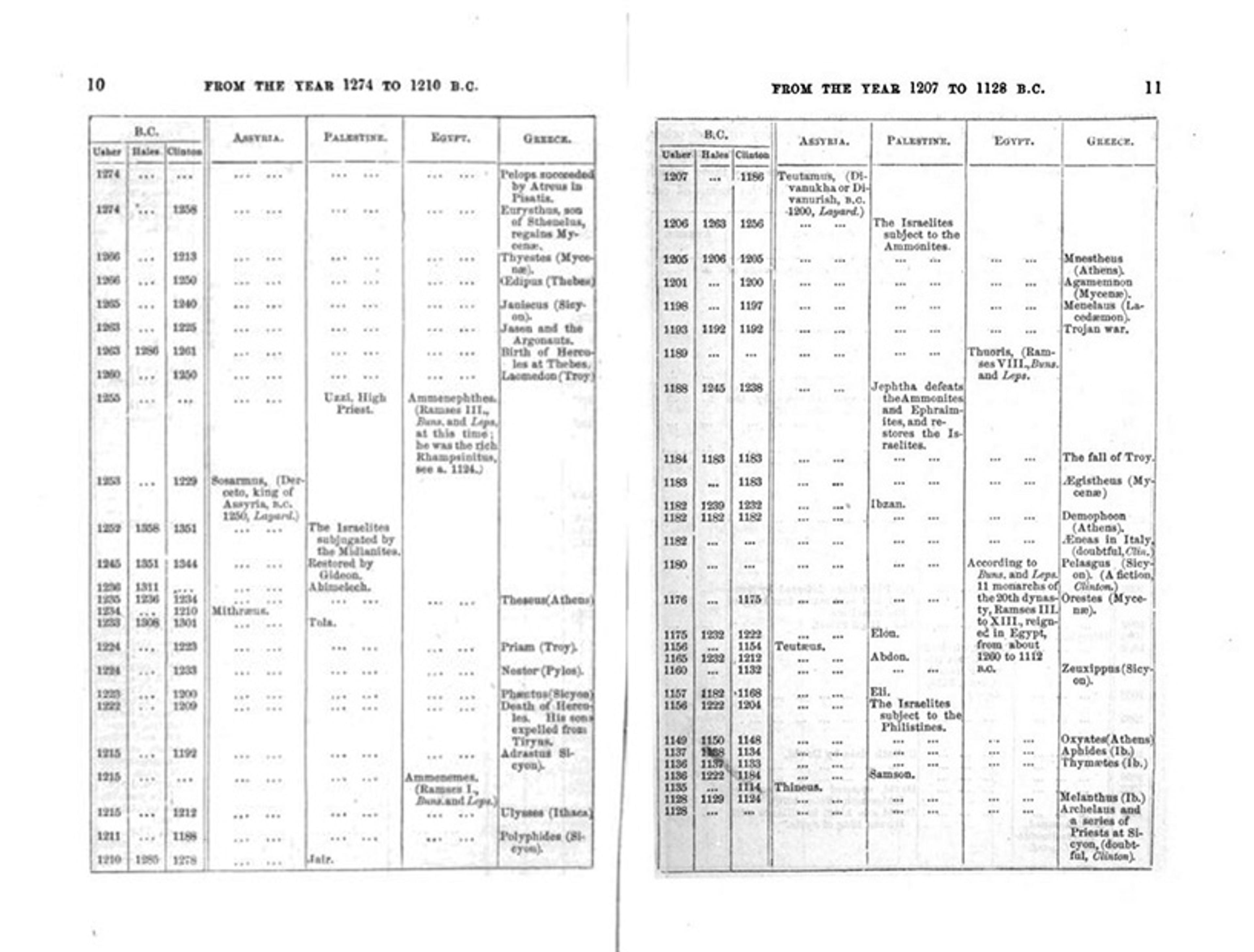
First: chronography, the art of representing historical events. Historians have always struggled with how to best display events on a page, and since ancient times a popular solution lay in ‘time tables’: grids displaying dates


From the 1856 edition of Blair’s Chronology. Public domain. Courtesy the Internet Archive

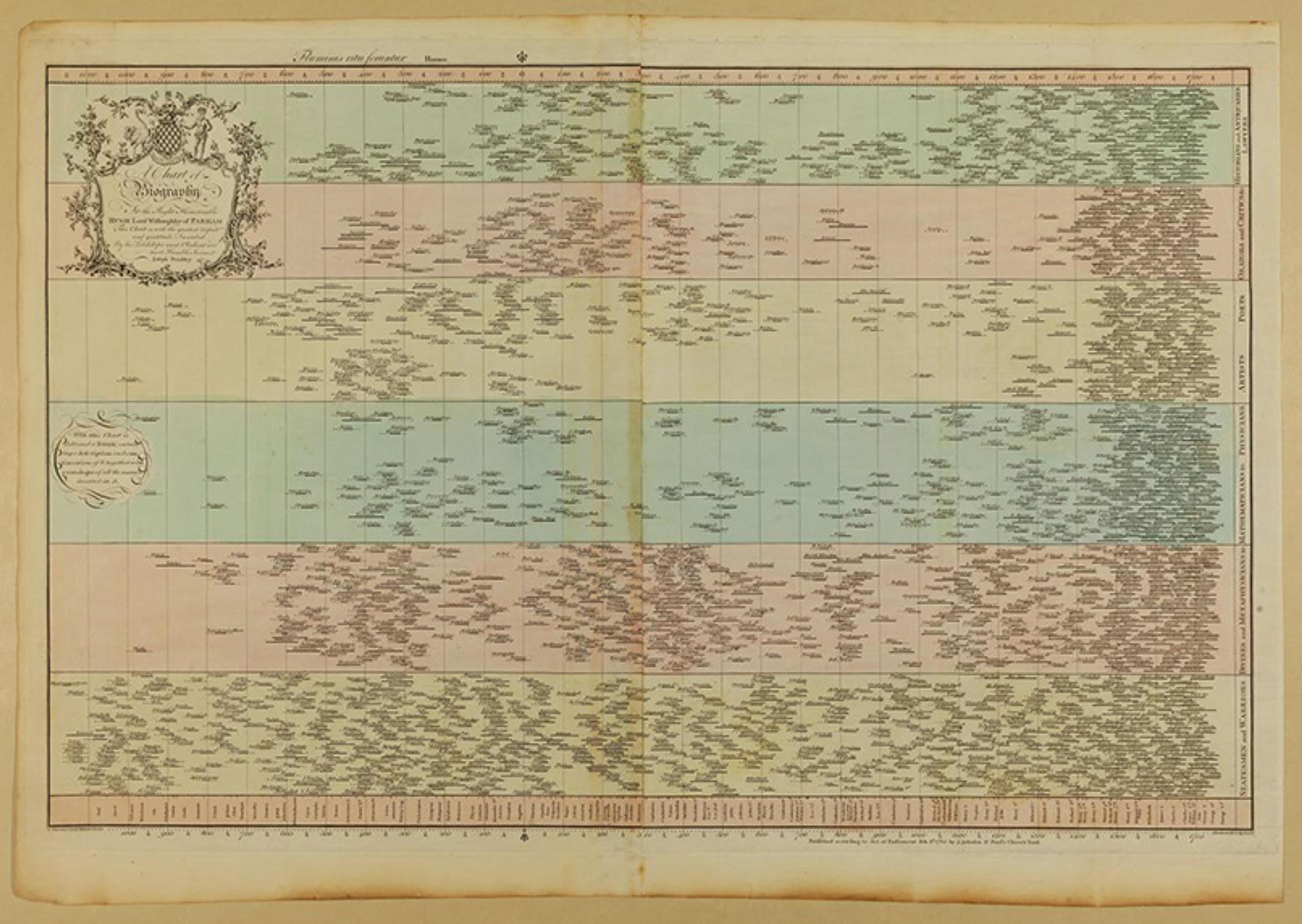
A crucial innovation lay in the invention of ‘timelines’. As Daniel Rosenberg and Anthony Grafton detail in their coffee-table gorgeous Cartographies of Time (2010), the ‘modern form’ of the timeline, ‘with a single axis and a regular, measured distribution of dates’, came into existence around the mid-18th century. In 1765, the scientist-philosopher Joseph Priestley, best known for co-discovering oxygen, invented what was arguably the world’s first modern timeline.


From A Chart of Biography (1765) by Joseph Priestley. Courtesy the National Endowmment for the Humanities

On his A Chart of Biography (1765), time flows from left to right, from 1200 BCE to (what was then) the present. More than 2,000 miniature lines painstakingly plot the durations of people’s lives, including the likes of Cicero, Queen Elizabeth I, and Isaac Newton. Because his method of representing time using lines was so novel, Priestley felt moved to justify it:

THAT there must be a peculiar advantage in a chart constructed in this manner I shall endeavour to show …

TIME … admits of a natural and easy representation in our minds by the idea of a measurable space, and particularly that of a line; which, like time, may be extended in length, without giving any idea of breadth or thickness. And thus a longer or a shorter space of time may be most commodiously and advantageously represented by a longer or a shorter line.

Rosenberg and Grafton describe A Chart of Biography as ‘path-breaking’, a ‘watershed’. ‘Within very few years, variations on Priestley’s charts began to appear just about everywhere … and, over the course of the 19th century, envisioning history in the form of a timeline became second nature.’ Priestley’s influence was widespread. For example, William Playfair, the inventor of line graphs and bar charts, singled out Priestley’s timeline as a predecessor of his own work. Rosenberg and Grafton explain that, over the next 50 years, Playfair’s line graph, which used one axis for time, and another for economic measures such as exports, ‘became one of the most recognisable chronographic forms’. By the time of Charles Dickens, timelines were common across books, posters, newspapers.

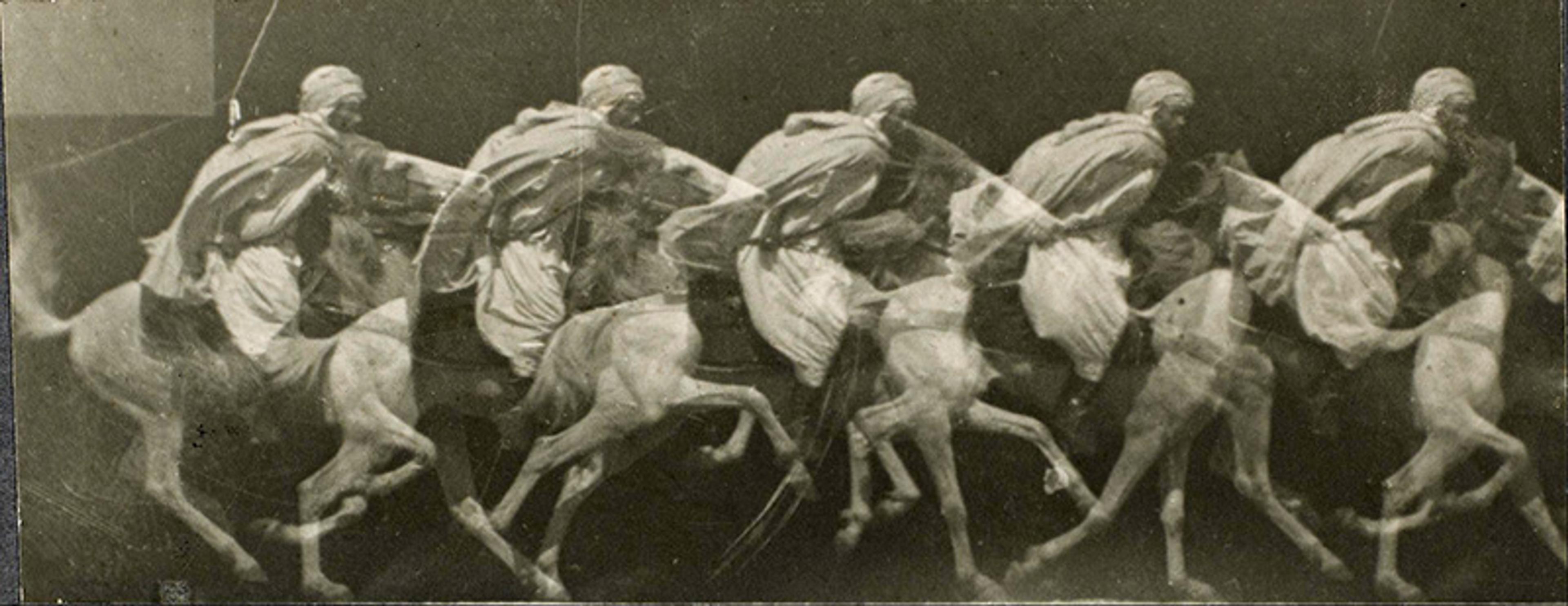
Chronophotography portrays a temporal process, such as a horse’s gallop, spread out across the page

The second key development concerns evolution. During the early 19th century, scientists created linear and cyclical models of evolutionary processes. For example, the geologist Charles Lyell hypothesised that the evolution of species might track repeatable patterns upon Earth. This led to his memorable claim that, following a ‘cycle of climate’, the ‘pterodactyle might flit again through the air.’ However, with the work of Charles Darwin, cyclical models faded. His On the Origin of Species (1859) conceives of evolution in linear terms. It literally includes diagrams depicting species’ evolution over time using splaying, branching lines. These diagrams assume a linear model of time: time runs in a linear, vertical fashion from the past at the bottom of the page to the present at the top. Gould describes Darwinian evolution as a linear ‘arrow’ in the ‘fullest sense’: ‘a quirky sequence of intricate, unique, unrepeatable events’.
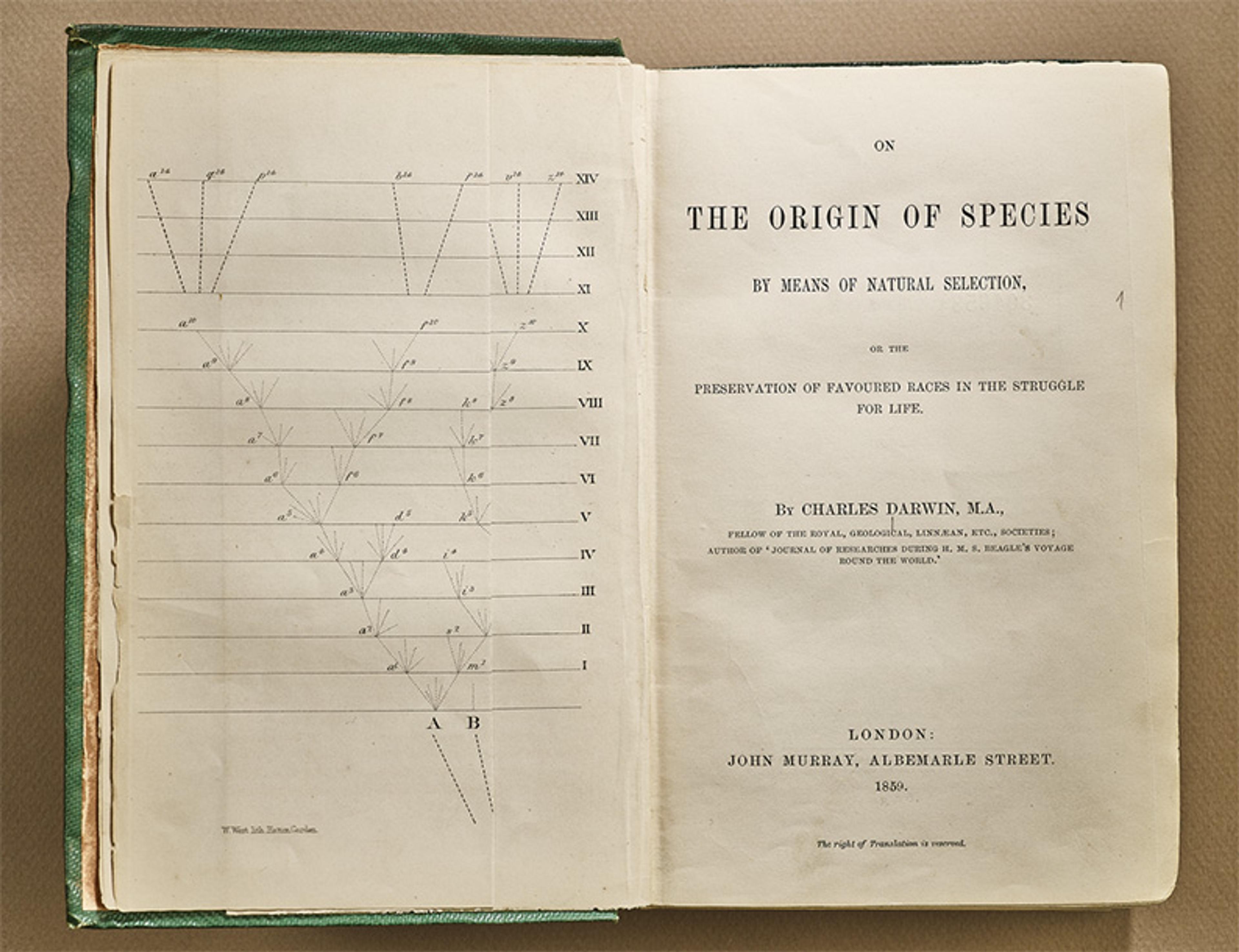

The evolution of species through linear time, from On the Origin of Species (1859) by Charles Darwin. Courtesy NYPL

The third key development emerged in the 1870s: chronophotography. This new art form captured motion through successive images. Chronophotography seems to spatialise time by portraying a temporal process, such as a horse’s gallop, spread out across the page. In his landmark book Le Mouvement (1894), the photographer Étienne-Jules Marey opens with a statement that could be drawn directly from Priestley: ‘Time … can be represented in a graphic form by straight lines of various lengths.’


Arab Horse at a Gallop (1887) by Étienne-Jules Marey. Public domain, courtesy of Wikipedia Commons

The last development stemmed from mathematics: theories of the fourth dimension. Humans perceive three spatial dimensions: length, width, and depth. But mathematicians have long theorised there were more. In the 1880s, the mathematician Charles Hinton popularised these ideas, and went further. He didn’t just argue that space has a fourth dimension, he identified time with that dimension. Hinton argued that, because of the limitations of human consciousness, we perceive four-dimensional objects as changing three-dimensional objects. Yet reality is really an unchanging, four-dimensional space. What we perceive as time is misperceived space. The world is a ‘stupendous whole, wherein all that has ever come into being or will come co-exists’. Hinton doesn’t describe time as a line but, implicitly, describing time as a dimension of space means that, if time were taken by itself, it would be a line. Hinton’s work was speedily absorbed into the 19th-century air, and soon other 1880s thinkers were identifying the fourth dimension of space with time.
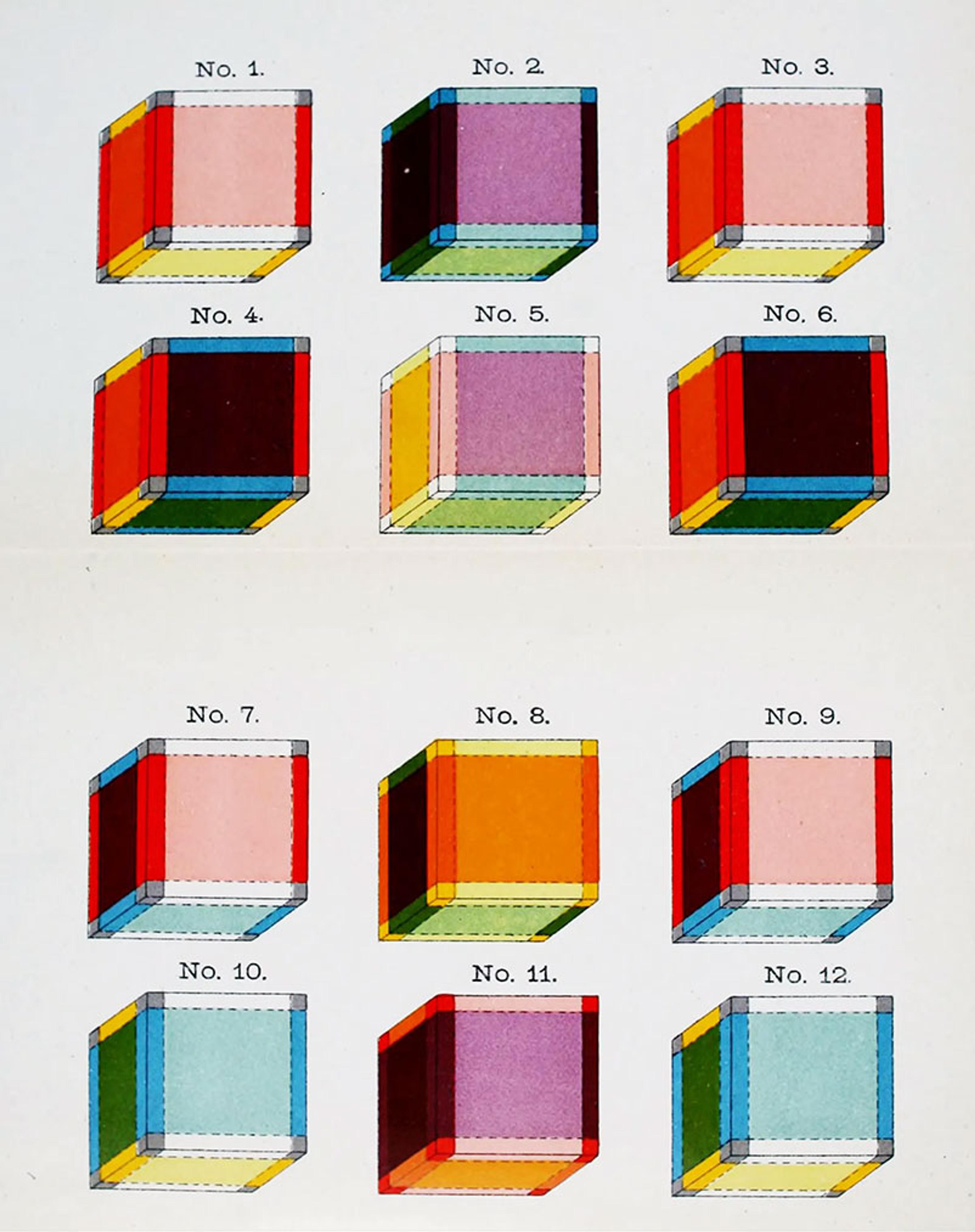
Four-dimensional cubes by Charles Hinton, 1880s. Courtesy the Public Domain Review

By the late 19th century, representing time as a line was not just widespread – it was natural. Like today, it would have been hard to imagine how else we could represent time. And this affected how people understood the world.

Within history, conceiving of time as a line helped to fuel the notion that humanity is making progress. Joseph Priestley, our timeline inventor, is partly responsible for this. The man once listed inventions that have made people happier, including flour mills, linen, clocks, and window glass. His Chart of Biography evidenced this positive take on human progress. It places figures into groups, such as ‘Artists & Poets’, ‘Mathematicians & Physicians’, ‘Divines and Metaphysicians’. If you look back to his Chart, you’ll see that, as time goes on, increasing numbers of these figures appear. This confirmed Priestley’s belief that humanity is improving.

For Victorians, belief in progress only grew, impelled by rapid scientific and technological development. Victorians saw the invention of railway systems, light bulbs, telegraphs, typewriters, fridges, telephones. The historian Thomas Macaulay claimed: ‘The history of England is emphatically the history of progress.’ Such narratives received further support via the ideas of Darwinian evolution.

Darwinian evolution was portrayed not as a many-branched tree, but as an arrow

Darwin’s evolutionary diagrams resemble trees with forking branches. As the historian of science Peter Bowler explains, this rightly implies that ‘evolution has no main line and hence no particular goal’: ‘The human race is not the inevitable end-product of animal evolution, but an unusual species formed by a unique combination of circumstances forced upon its ancestors.’ Nonetheless, Darwin made sure that On the Origin of Species could be interpreted as progressivist. For example, the book bluntly states that life forms ‘tend to progress towards perfection’. Victorians took this on board, cheerfully incorporating evolution into their broader story of progress. Darwinian evolution was portrayed not as a many-branched tree, but as an arrow: over time, species evolved in a line from less perfect to more perfect.

Within philosophy, conceiving of time as a line led to thinkers debating the reality of the past and future. Picture a line: all its parts, the fractions of ink that make it up, exist. When we picture time as a line, this leads us to think that all its parts exist too. In the 1870s, the German philosopher Hermann Lotze became anxious about this. ‘We speak of Time as a line, but,’ he writes, ‘the conception of a line involves that of a reality belonging equally to all its elements. Time however does not correspond to this.’ For Lotze, if time were a line, it would only ‘possess one real point’: ‘the present’.

Early 20th-century philosophy saw major debates emerge over the reality of the past and future. In my view, these debates were triggered by the new idea that time is a line. On one side of these stood the likes of Lotze, who argued that only the present exists. Henri Bergson also argued for the unreality of the future, attacking the linear conception of time. His very first book, Time and Free Will (1889), argues vehemently that ‘time is not a line’ (my emphasis). Amusingly, in the English translation of this book, the index entry for ‘Line’ provides page references to ‘time not a’. Later, Bergson’s Creative Evolution (1907) attacks the new arts of chronophotography and cinematography, for failing to capture the true nature of time. The Frenchman writes: ‘Of the gallop of a horse our eye perceives chiefly a characteristic, essential … form.’ In contrast, ‘instantaneous photography’ spatially ‘spreads out’ the horse’s gallop, portraying mere ‘quantitative variations’. The naked eye captures the form of a horse’s gallop in a way that photography cannot.

On the other side of this debate stood the likes of the British philosopher Victoria Welby, who drew on chronophotography and the fourth dimension to argue that time is literally space. The past is as real as a piece of land we’ve just journeyed through, the future as real as the country waiting ‘below a given horizon’. Similarly, Bertrand Russell argued: ‘Past and future must be acknowledged to be as real as the present.’ Evoking new art forms, Russell proudly describes his view as ‘cinematographic’. His peer Samuel Alexander also argued for the reality of past, present and future, and offers a similarly cinematographic theory. If we could properly see the world, Alexander argues, we would see that past events do not ‘vanish’. They have merely ‘moved back upon the film’. Our present is merely further forwards on the reel of film that is reality.

Of course, the best development produced by conceiving of time as a line was time travel. People had imagined visiting the past or future in one way or another for centuries – by dreams, or visions – but H G Wells gave it a whole new, scientific spin. His novel The Time Machine (1895) drew directly on Hinton’s ‘fourth dimension’ to explain how we can travel in time. As his fictional time-traveller puts it:
There are really four dimensions, three which we call the three planes of Space, and a fourth, Time. There is, however, a tendency to draw an unreal distinction between the former three dimensions and the latter, because it happens that our consciousness moves intermittently in one direction along the latter from the beginning to the end of our lives …
Really this is what is meant by the Fourth Dimension … It is only another way of looking at Time.

Conceiving of time as the fourth dimension of space enables time travel

Decades later, Wells described the core of his novel as ‘the idea that Time is a fourth dimension and that the normal present is a three-dimensional section of a four-dimensional universe.’ This is pure Hinton, writ large.

The Time Machine also happily conceives of time as a line:
Scientific people … know very well that Time is only a kind of Space. Here is a popular scientific diagram, a weather record. This line I trace with my finger shows the movement of the barometer. Yesterday it was so high, yesterday night it fell … Surely the mercury did not trace this line in any of the dimensions of space generally recognised? But certainly it traced such a line, and that line, therefore, we must conclude, was along the Time-Dimension.

The barometer’s line was traced through time, rendering it another dimension of space. And, of course, for Wells’s story, conceiving of time as the fourth dimension of space enables time travel. One of his characters argues: ‘admit that time is a spatial dimension … it becomes possible to travel about in time’. After Wells, time-travel stories exploded. One critic dubbed Wells the ‘literary pioneer of time travel’.

Today, conceiving of time as a line remains widespread. Timelines are everywhere: in the history of evolution, the history of video games, and the history of chocolate. There’s even a timeline of timelines. And the effects of this line of thought (pun intended) are still with us. Philosophers continue to debate the reality of past and future: just check out this bumper encyclopaedia article on ‘Presentism’, ‘the view that only present things exist’. Time-travel stories run rife. Back to the Future. Groundhog Day. The Time Traveler’s Wife. Historians have largely dropped Victorian faith in the progress of humanity, yet progress stories about particular areas remain. For example, take this timeline: it straightforwardly depicts technological progress over time. All these ideas are powered by the notion that time is a line. Were we to reshape our idea of time, perhaps these other ideas would also find themselves bent into new forms.