Monday, December 29, 2008

Crop Circle Fabrication and Update

This recent article is way too long to post directly, so I invite you to tackle it at your leisure. The www.cropcircleconnector.com has been the chronicler of the crop circle phenomena from early days. The most important development that has evolved over the past twenty years is the evolving complexity, size and apparent intellectual content of the images.

I was frustrated for years by this phenomenon. It went from images that might have a natural origin to images that clearly could not. Yet through all this little in the way of empirical methodology seemed to be applied to their study. By this I mean getting down on your knees and inspecting the ground grid square by grid square. No human made event could withstand such scrutiny.

Then about three years ago, a researcher did the obvious and reported that the clearly authentic images are formed with six inch pixels. That made it completely clear, at least to me. We already knew that microwave energy was involved to collapse the plant stems. Now we are describing action caused by a beam of microwave energy hitting the ground.

This means that a microwave laser is producing this effect at a distance while been controlled by a computer driven aiming device. That is the obvious mechanism. The crop circle history also conforms to the steady improvement in human computer graphic capabilities. I immediately dismissed the whole story as a typical top secret military research program aimed at mastering the art of microwave laser weaponry. Recall that microwave technology has been militarized from the beginning and that the only technology releases have been ovens and communications.

In short, I had a perfectly good human agency quite up to the task of annoying us with these damn pictures, while producing a wonderful smokescreen.

The alternative explanation of ET simply was not necessary. Except that recently the complexity, from a mathematical viewpoint, is becoming compelling. Although, I am still unconvinced. However, I am also very aware that all previous thresholds of credibility have been crossed.

This article is a good beginning in the understanding of the mathematics. Much is made of new geometric theorems, but that is not very convincing. Euclidean based geometric problems are potentially vast in number and for that reason not overly pursued and published. Maybe this will help restore the hobby to its importance in mathematics.

But you can see the effort this is beginning to entice. I do not see yet where we are going with it, and it would be very annoying to discover another mathematical hobbyist at work over at the defence department. Maybe one of you can do better.

In the meantime, this ninety page article covers the history and various interpretations the images have generated to this year. That every image seems to be linkable to past symbology that is in the record (or maybe not) is a clue as to the interests of the generating artists (or the interpreting artists) and is itself a clue that we are kidding ourselves. More importantly, the technology has made great strides.

http://www.cropcircleconnector.com/anasazi/WHAT%20DO%20MODERN%20CROP%20PICTURES%20MEAN.html

WHAT DO MODERN CROP PICTURES MEAN?
Table of Contents
I. A scientific overview for the end of 2008
II. Mayan calendars and Mayan binary codes
III. More clues of various kinds
IV. Jaime Maussan and the Quetzalcoatl hypothesis
V. Some crop pictures have predicted the future
VI. Quetzalcoatl, Jesus and the year 2012

Solomon's Bronze

This is a bit long, but it is an excellent reconstruction of bronze casting technology at the very end of the Bronze Age well before any of the methodology was likely to be abandoned and perhaps even forgotten.

I am reminded that the science of archeology has never been happy with speculative reconstruction of past technologies. Partly this is because of the limitations of the evidence where simple lack of evidence is assuredly not evidence of a lack of appropriate technology.

The mere existence of a single chard of pottery is often a pretty good clue as to a major charcoaling operation. The mere fact that it was economically viable to mine ores in Ireland at the height of the Bronze Age grading a mere eight pounds to the ton, immediately infers an extensive copper trade whose value was huge.

That helps put this knowledge in its proper perspective. All this bronze was real wealth in the time of Solomon.

We have to thank the enthusiasms of members of the Masons for this very complete analysis.


SOLOMON'S TEMPLE - The Bronze Castings of Jachin and Boaz Pillars.

by W.Bro. Harvey Lovewell

Secretary WHJ Mayers Lodge of Research
Lodge Millaa Millaa #351
United Grand Lodge of Queensland, AU.

Introduction

I received a letter from a brother who is getting on in years and looks forward to receiving the newsletter of the W.H.J. Mayers Lodge of research, The Lectern. In his letter he asked for information on how the two pillars of Solomon's Temple, Boaz and Jachin, could have been constructed.

His request prompted the reply to him that I did not know, and looking through our books, I was unable to find or give him an answer. This, then, started my research into this subject, and the research has taken me all over and has touched onto subjects that were to appear to have no bearing on the subject of the research. Many new questions have arisen from the initial question, the answers to which are a matter of conjecture; some I have been able to answer and others for the purpose of this paper will remain unanswered.

There are many translations and interpretations of the books of the bible many of which do not agree with each other. For the purpose of this paper I have chosen to use The Jerusalem Bible. As my copy, has a complete set of annotations for explanation where needed, so all references to the Bible are from that translation. Where I have found conflict I have described the alternatives and leave you to make up your own mind on the matter.

I therefore, present to you my ideas on how our forefathers may have built large bronze objects like the Pillars and the sea.

The Pillars.

The pillars Jachin and Boaz, which were placed at the entrance to King Solomon's Temple, are mentioned in many writings. In the Bible, 1 Kings, 7.21; and in 2 Chronicles, 3.17; and many references in Masonic Writings. The Pillars Jachin and Boaz are also mentioned in An Apocalyptic Cyclopaedia of Advanced Magical Arts and Alternate Meanings 2nd Edition 1996, where they are given the meanings, strength and beauty among others. In the annotations to the Jerusalem Bible, referring to the pillars, it states the two names are obscure: possibly, “it is firm " and "it is strong ".

http://www.freemasons-freemasonry.com/pillarST05.jpg


Albright in his book; Archaeology and the Religion of Israel
[i] page 139, in discussing the work of R.B.Y. Scott, states “that the names of the two columns Jachin and Boaz. Which stood before the Temple of Solomon, represent the first words of dynastic oracles, which were inscribed upon them. The Jachin formula may have been "Yahweh will establish (Yakin) thy throne forever” (or the like) and the Boaz formula may have run "in the strength of Yahweh shall the king rejoice or something similar

Further on page 144 he says when discussing pillars, “some of these pairs of columns were used to support the roof of the portico, in megaron fashion, others were free standing. Without constructional relation to the building. There can he no reasonable doubt that the pillars Jachin and Boaz were of the latter type.”-

Colin Breckon in his paper, The Building of Solomon’s Temple [ii] says, on page 8, when referring to Alex Horne; Boaz could be a corruption of a now obsolete word Bose or Boss which at one time meant hollow.

Other writers have referred to them as "cosmic Pillars" "like the pillars of Hercules" and as representing the twin mountains between which the sun was believed to emerge each morning. They have also been described as cult objects for burning incense.


History

Much of what we know of our ancestors from the time before Christ can be attributed to the study of ancient man as he lived in what could be called the cradle of civilization. That is the middle east, that area described by Dr Werner Keller in his book ”The Bible as History”
[iii] as the Fertile Crescent, reaching from the Persian Gulf to the Red Sea encompassing the area of the Tigris and Euphrates rivers through to the Mediterranean Sea.

Probably the most researched documents of this area, is the collection of books that we know as the Bible, especially the Old Testament which tells stories of people who lived then, and the places they lived in as well as aspects of their culture. The Historical Books remain the primary witness to the culture of Israel and Judah. Recent scholars however refer to these as theological mythology. The text, almost a polemic (dispute one side wanting to force its view on the other) of the southern tribes against the religiosity of the northern tribes and other neighbouring peoples, was composed about 800 to 600 BCE and is written in part to chronicle the Deity’s actions in history. This view of the stories of events as perceived and researched by the writers, this can be seen in the differing versions of the one event. There is controversy in using these texts for historical reconstruction, nevertheless using these writings and the findings of archaeology; one can obtain some idea of the culture and technology of the times.


The part of the Bible that set in motion the research for this paper is 1 Kings 7,13:26 together with 2 Chronicles, 3-4. This tells the story of a bronze worker, Huram-Abi, (Hiram Abif) who came from Tyre, an island on the coast of what is now Lebanon, but in those days was Phoenicia. He was employed on the construction of King Solomon's Temple. Huram-Abi is described, in 2 Chronicles 2,14, as the son of a Danite woman by a Tyrian father. He is skilled in the use of gold, silver, bronze, iron, stone, wood, scarlet, violet, fine linen, crimson, in engraving of all kinds, and in the execution of any designs suggested to him, In Kings he is described as “a widow’s son from the tribe of Naph-ta-li” Where he is from will not affect this work. He really sounds like a versatile and clever worker. The purpose here, however is to concentrate on his bronze work.

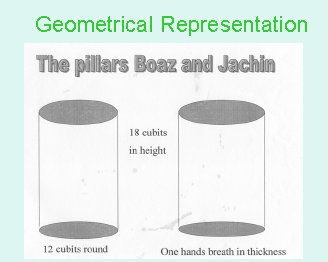
To quote from, I Kings 7, 15 He cast two bronze pillars, the height of one pillar was eighteen cubits and a cord of twelve long gave the measurement of girth. As was also second pillar.

In Chronicles the pillars are described as being “30 and 5 cubits high!”

http://www.freemasons-freemasonry.com/pillarST07.jpg


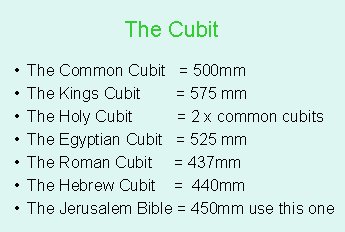
To get an idea of what the exact length a cubit was, in itself, not an easy task, as there are cubits and cubits. World Book Encyclopaedia,
[iv] says in reference to a cubit It was based on the length of a man 's arm from the tip of the middle finger to the elbow. No one knows when this measurement was established. The Egyptian cubit was 21 inches, the Roman cubit was 17.5 inches, and the Hebrew cubit was 17.58 inches. In the English system the cubit is 18 inches. My measurement is 19.75 inches or 50cm. says in reference to a cubit It was based on the length of a man 's arm from the tip of the middle finger to the elbow. No one knows when this measurement was established. The Egyptian cubit was 21 inches, the Roman cubit was 17.5 inches, and the Hebrew cubit was 17.58 inches. In the English system the cubit is 18 inches. My measurement is 19.75 inches or 50cm.

The People's New Testament 1891
[v] says A cubit, somewhat more than one foot nine inches English. That is 21 inches or 53 cms . From Biblical weights and measures as described by The First Church of the Nazarene [vi] a cubit is 50 centimetres.

In the Jerusalem Bible the cubit is given as 18 inches or 45 centimetres. As already stated I will use the Jerusalem Bible, as my reference, as to what the truth is, academic argument will not change the concept I am trying to develop.

http://www.freemasons-freemasonry.com/pillarST08.jpg
http://www.freemasons-freemasonry.com/pillarST09.jpg

I will therefore use this measurement, which is a cubit of 45 cms. The metric measurements of the pillars, from 1 Kings 7, 15 are, eight point one meters in height and a circumference of five point four meters. Traditionally we are told that the pillars were hollow, I have been unable to find out if this is true or not. For the pillars to be solid the mass would be enormous. In my research it has also been suggested by some scholars that the pillars could have been built of timber and then gilded.

Colin Breckon in his paper, The Building of Solomon’s Temple
[vii] says, on page 8, when referring to Alex Horne; Boaz could be a corruption of a now obsolete word Bose or Boss which at one time meant hollow.

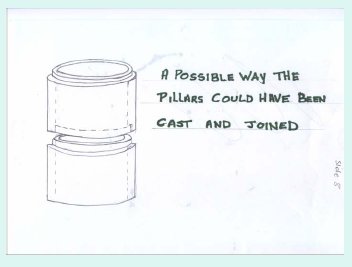
This hypothesis would make a lot of sense and solve many problems. In spite of all this I will assume that the pillars were cast bronze and hollow. Also in my research some scholars have suggested that the pillars could have been cast in sections each fitting into the other, similar to the construction of a stone pillar. This theory has a lot going for it, as the problems of handling large quantities of molten metal would be reduced to more manageable proportions, as would the transport of the castings.

Bronze cauldrons dated to 100 B.C.E. with a capacity of 600 litres have been found. These were made in segments and joined together with rivets.

In addition he made a capital to top the pillar. This was five cubits, or 2.25 meters high, and this was decorated around the outside with filigree and pomegranates. I will not consider these capitals as part of this paper although the treatment of them would be similar to the other castings.

http://www.freemasons-freemasonry.com/pillarST10.jpg


He also made other large castings. I Kings 7, 23 He made the Sea of cast metal, ten cubits, from rim to rim, circular in shape and five cubits high; a cord of thirty cubits long gave the measurement of its girth. That is a bowl 4.5 meters in diameter and 2.25 meters deep.

Twelve cast bronze oxen, three for each side of a square, supported this bowl. My research has revealed that there is no agreement on the shape of The Sea. A Zuidhof
[viii] In his computer program The Molten Sea, states that the Sea is Cup shaped. The program tries to answer the claim that the Bible says that pi is equal to 3.

In Asimov's Guide to the Bible, Isaac Asimov remarked:

“The exact function of the ‘molten sea’ is not stated, though it seems most likely that it was a container for water used in the various rituals.

“The interesting point is that its upper rim seems to be circular in shape with a diameter of ten cubits and a circumference of thirty cubits. This is impossible, for the ratio of the circumference to the diameter (a ratio called ‘pi’ by mathematicians) is given here as 30/10 or 3, whereas the real value of pi is an unending decimal which begins 3.14159 . . . If the molten sea were really ten cubits in diameter it would have to be just under thirty-one and a half cubits in circumference.

“The explanation is, of course, that the Biblical writers were not mathematicians or even interested in mathematics and were merely giving approximate figures. Still, to those who are obsessed with the notion that every word in the Bible is infallible (and who know a little mathematics) it is bound to come as a shock to be told that the Bible says that the value of pi is 3.”

Consider the following possibilities, which I offer for your consideration.

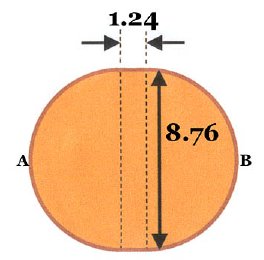
The shape of the following illustrations equates to the description in the scripture.
The first is oval shaped.

The layout consists of two semicircles with diameters of 8.76 cubits, separated by a rectangle 1.24 cubits wide.

At its widest point, A to B, this Sea measures 8.76 + 1.24 = 10.00 cubits from brim to brim. Its circumference is (8.76 x pi) + 1.24 + 1.24 = 30.00 cubits.

http://www.freemasons-freemasonry.com/pillarST12.jpg


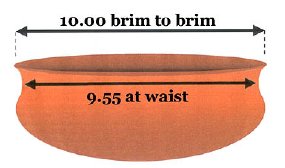
Is this oval the best solution to the problem? Probably not. Maybe we can consider a circular Sea but to look at it in three dimensions. We know that it had a rim, so it was somewhat narrower just under the rim.
Therefore, it could easily have measured 10.00 cubits from brim to brim, yet have been only 9.55 cubits wide at the waist, where “it took a line thirty cubits long to go round it” because 9.55 x pi = 30.00.
http://www.freemasons-freemasonry.com/pillarST13.jpg


Josephus
[ix] Was originally known as Joseph Ben-Matthias, the commander of the Jewish insurgents at Joppa in the time of Emperor Nero. He changed sides and went over to the Romans changing his name to Josephus. Writing in his work, The Antiquities of the Jews says “Solomon also cast a brazen sea, the figure of which was a hemisphere”. I have assumed therefore that the sea, was a hemisphere or one half of a sphere and my calculations reflect this. The argument as to the exact shape of the sea will not change the hypothesis I am trying to develop. Singer et al [x] page 633 when commenting on the casting of the bronze articles mentioned in Kings and Chronicles says; it has been estimated that the Brazen Sea alone weighed 200 tons. I will dispute this statement later on. One can see however, that we are dealing with large castings and heavy quantities of metal.

These must be handled and melted and handled again. In 2 Chronicles 4, 17:18. The king made them by the process of sand casting in the Jordan area between Succoth and Zeredan Solomon made all these articles in great quantities, no reckoning being made of the weight of the bronze.

The Castings. Their Size.

Let us now look at these castings and see what we can make of them.

How much bronze is in the pillar?
How much did it weigh?

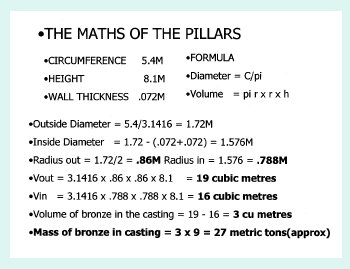
We are told that the height is 8.1M and the circumference is 5.4M. The thickness of the pillar we are told is a hands breadth. My hands breadth is 97mm. However the Jerusalem Bible says that a hands breadth or palm is 72mm so I will use this value in my calculations. All calculations rounded to the nearest whole number.

The pillar’s circumference is, c=5.4M
Therefore the outside diameter will be o/s d = c / pi
= 5.4/3.1416
We will call the outside diameter, D1 = 1.72M
And the inside diameter D2
Therefore the outside radius R1 = 1.72/2 =.86M

The inside diameter will be equal to the outside diameter minus the wall thickness of 72mm multiplied by two. (.144m) The outside radius Rl and inside radius R2 will be one half of the appropriate diameters. I will use the measurement of the radius to calculate the volume.

D2 = D1- .72x2 = 1.72-(.072x2) = 1.576m
Inside radius r2= 1.576/2 = .788m

Volume of pillar VP = v I of outside dimensions less v2 of core

vI = pi r2 h, therefore v1 = 3.1416 x .86 x .86 x 8.1 = 19M 3 volume of outer cylinder
v2 = pi r2 h, therefore v2 = 3.1416x.788x.788x8.1 = 16M3 volume of inner cylinder

VP = v1-v2 = 19 – 16 = 3M3 this is the volume of bronze in the pillar.

The weight of Bronze can vary dependent on the percentage of copper and other metals used in the alloying process. The variant will be a percentage plus or minus around 9 tons per cubic meter. We will therefore assume a weight of 9 tons per m3. It follows then that the weight of one pillar without the capital will be.

3 x 9 = 27 tons. (approx.)

http://www.freemasons-freemasonry.com/pillarST16.jpg


If the pillar had been cast in sections, say 10 sections, each 81 cm long, then each would have weighed 2.7 tonnes, this is far more believable than one casting. The technology for melting and handling large amounts of molten metal and successfully casting same was just not available at this time in history. Even at 2.7 tonnes credibility is stretched.

My investigations and discussions with a Professor of Archeometallurgy brought the response of total disbelief that "the people of the Bronze age were able to cast bronze weighing tons".

Tylecote
[xi] in his work The Coming of the Age of Iron discussing the size of castings, says in reference to the Chou dynasty (770 BCE) A bronze caldron found at Anyang in 1946: it weighted 1400kg and was about/ 1M across. Of course these may have been t/he product of good organization rather than large capacity smelting and melting.

Earlier I made mention of the Sea sometimes referred to as the Molten Sea or Brazen Sea. The size of which was 4.5m in diameter and 2.25m deep and a hands breadth in thickness. These measurements suggest that it is one half of a sphere.

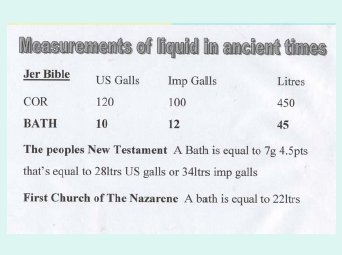
We can therefore calculate both the volume of bronze and the capacity of the bowl. 1 Kings 7, 26. Tells us that it held two thousand baths. Chronicles tells us however, that the sea held 3000 baths. These inconsistencies I leave for each of you to consider. The measurements for liquids used in the Bible are the words seah, cor and bath. A cor is equal to 450 litres and a bath is one tenth of a Cor or 45 litres. However we have variations from this measurement as well.

http://www.freemasons-freemasonry.com/pillarST17.jpg


The Peoples New Testament States The Bath, the tenth of the chomer, ( cor) or seven gallons and four pints and a half Using US gallons that's.28 litres, using imperial gallons that's 34 litres. One can assume that US gallons were used in this version.

According to the First Church of The Nazarene one Bath is equal to 22 litres.

All these translators seem to believe that their version is the correct one!!

The capacity of the Sea would then be equal to 2000x45 or 90000 litres, on the assumption that a bath, was in fact 45 litres.

On looking at this, it does not seem quite right as my swimming pool holds 67000 litres and is much bigger, we will see what the calculations tell us later .

On the other hand, if a bath is equal to 22litres then the capacity would be 2000x22 or 44000 litres, this is quite a deal different.

http://www.freemasons-freemasonry.com/pillarST18.jpg


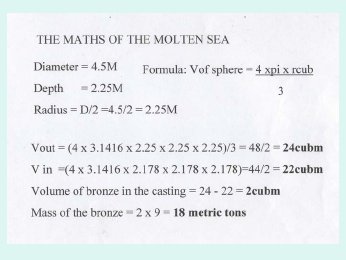
By calculation, the volume of a sphere is:
v = 4 x π x r3 ( π or pi =3.1416 & r = half d)
3

To calculate the volume of bronze that makes up the Sea therefore, we must find the volume of two spheres then subtract the inner from the outer, then divide by two as we want the volume of the bowl which we will assume is one half of a sphere, that is, the Sea. Whilst this may appear simplistic, as there could be variations in size due to ornamentation etc. for the purpose of this exercise the variations would be small and would not affect the ideas presented.

The volume of the outside sphere is vI, and the inside sphere is v2. However we need to find the volume of our basin, which is one half a sphere. To do this we divide the volume of the sphere by 2 :

vI= 4 x 3.1416 x 2.25 x 2.25 x 2.25 = 48 m3 = 24m3
3 2

Again we are told that the Sea is a hands breadth in thickness so we must reduce the diameter .by two times 72mm that is 144mm. But our calculation uses the radius so we will reduce it by 72mm.

v2 = 4 x 3.1416 x 2.178 x 2.178 x 2.178 = 44m3 = 22m3 this is the capacity of the bowl
3 2

The volume of the metal in the Sea therefore is:

vI -v2 or 24 -22 = 2m3

As we have seen, the weight of bronze is 9 tons per m3, therefore its weight would be:-

2 x 9 = 18 tons

With reference, to the statement of Singer earlier. I cannot make the sea 200 tons given the availability of current data. His statement, I believe, is just a bad guess unless he took into account the mass of the water in it as well. Even so the capacity of the sea would also affect the total mass, given that one litre of water weighs 1kg.

The capacity of the Sea is calculated as follows. One cubic meter is equal to 1000 litres of water. The Sea's capacity would be, therefore 22m3 times 1000 or 22000 litres. Compare this with 90000 litres or indeed 44000 litres. One of the big problems associated with references in the Bible translations is the fact that the numbers do not add up. We must also remember that the writers were writing on their own perceptions and their limited knowledge.

We have read in Kings that the Sea held 2000 baths. If the calculations are correct, then a bath would be equal to 11litres. One can see the difficulties in determining the truth, when using ancient writings. As I do not know the truth and my research has shown that scholars in this area do not agree or are guessing. I leave these discrepancies for you to ponder

This big basin, used by the priests for ritual washing before sacrifices, symbolized the
Source of life, stood on the backs of twelve bronze oxen. The rim must have been four metres off the ground!

Bronze Making

Now we must try to answer the following questions. Where did these people get the ore? How did they smelt it? How did these people melt all this metal? Where did they do it? How did they make the moulds? How did they get the molten metal to the moulds? How did they get the finished product to the site? How did they erect the pillars and the sea?

To find answers to these questions we must look at what Archaeology tells us about early metal workings. Humans have used metals for only the last 12000 years, a much shorter time than the period which stone was used for tools, weapons and ornaments. The McGraw Hill " Encyclopaedia of Science and Technology
[xii] tells us, The earliest datable finds of human-altered metal are small copper objects from sites in the Near East, including a pendant from Shanidar in Iraq dated around 9500 BC. Copper was used at this time in the Middle East and prehistoric Europe for jewellery and in ritual religious ceremony.

The first coins were made and used in Asia Minor in the early part of 7000 BCE. Smelting was discovered in the middle of 5000 BCE. At this time, trade in metals was taking place so metals not found naturally in one place were traded with those peoples who had them. Copper was available from the mines in the Arabah. Tin was traded with the British who mined it at Cornwall. Other metals as well as tin were alloyed, arsenic, antimony and lead each used for particular purposes. Knowledge of smelting led to the mixing of metals and the discovery that this alloying made a better metal than either of those mixed. Primitive bronze has been excavated and dated as far back as 3000 BCE.

http://www.freemasons-freemasonry.com/pillarST20.jpg


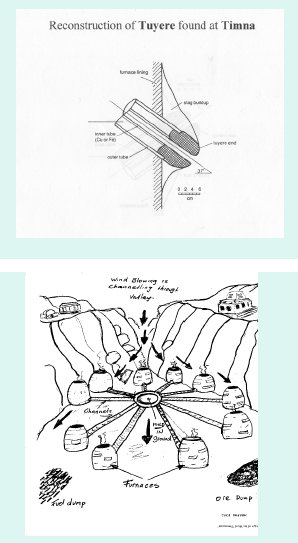
As copper melts at a temperature of 1083°C, high heat was needed and a means of forcing air, to make the fire hotter, had to be invented. The furnace was developed. A good example of these early furnaces was discovered at Timna, these were dated at between 1200 and 1400BC. Ingots of copper have been found. Of the ingots that have been found, some have solidified in the furnace and others have been made by being poured into ox hide molds. These ingots weighed between 30 and 40 kg with a thickness of 4cm,

The production of bronze by mixing copper and tin was an established practice throughout the Eurasian landmass by 1500 BCE. In those times bronze was used mainly for weapons and cutting tools, swords, axes, spears, arrow heads, adzes and shields, although bowls and cauldrons were also made from bronze .

To make bronze castings the following things are essential, ores, fuel, blast air and tools, furnaces and crucibles and have of course, a mold. Forbes in Metallurgy in Antiquity
[xiii] says. The ores were mostly plentiful and of good quality in the ancien1 Near East and further but the fuel was often rather a problem. For the quantity and above all the quality of the fuel determine to a large extent the temperature attained in the furnace and this again is largely responsible for the possibility of working certain ores and of using certain processes. In other words the fuel determines to a certain degree the melting and smelting activities of the early smith.

The Problem of Fuel.

What then of this fuel problem? To overcome this problem smelting was done close to a supply of appropriate fuel. We are all aware of the desert nature of the areas we are discussing. Was this always so? R.J. Forbes,
[xiv] says. It has been proven that the Romans used 21.8 kg wood to roast one kg of ore, and an additional 68.5 kg wood for smelting and refining (one third of the fuel was wood and the remainder charcoal). One kg charcoal has a calorific value equal to that of 90.2 kg wood. That’s burning an awful lot of wood.

One can assume that Hiram needed similar quantities. Studies done in similar climates have shown that one acre of land grew 125 trees and 900 kg of fuel were produced from each 40-year-old tree. A tree bearing area of .8 acre was required for each one ton of copper. In modern times we know that this area is rich in oil. Could these people have found on the surface quantities of pitch?

Writing in the Palestine Quarterly Menashe Har-Er
[xv] states, Smelting and casting of the metal was usually done near the mines, and mainly in the vicinity of the sources of forest wood and apparently utilized the stands of Haloxylon persicum which were common in the region and reached heights of 3-5 meters these plants have almost completely disappeared today.

Stands of Quercus calliprinos a slow growing oak and Juniperus Photicia, a softwood
Juniper tree from altitudes of 1000 to 1600 meters reached heights of 10 meters and more, they grew in the western Edom Mountains and were cut and converted to charcoal and transported to the smelting sites by camel and donkey caravans.

Early smelting was carried out with a variety of primitive furnaces. This usually burnt charcoal, but other fuels were also burnt; including dung, date seeds brush etc.

http://www.freemasons-freemasonry.com/pillarST21.jpg
http://www.freemasons-freemasonry.com/pillarST22.jpg


The Furnace.

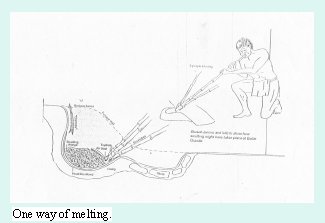
For the melting of scraps of metal in crucibles, usually a fired clay bowl, a ring of stones a pile of hot charcoal and a clay tuyere {pronounced “twee-yer” a ceramic tube) connected to a bellows are all that would be required.

Have you ever blown air on to a fire to get it going? This phenomenon no doubt gave man the idea to build bellows, to give more air at a greater pressure, the size of the bellows increasing to meet the need for greater pressure and heat to work larger quantities of metal. These are still in use in some parts of the world.


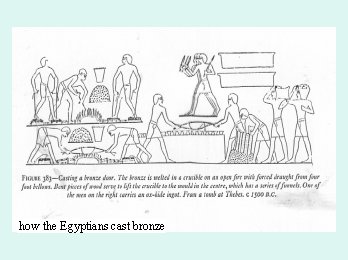
The melting of large quantities of metal is however another matter. This was probably done by using multiple furnaces, adjacent to the mold in the ground, with channels leading from each furnace into the mold between the furnaces. This would enable the quantity of molten metal needed for the pour to be cast before the metal solidified.

Werner Keller [xvi] describes an excavation that was made by Nelson Glueck in the 1940s at an area known as Wadi-el-Arabah. The excavation site at Ezion-geber, also known as Elath and today called Elat: In the middle of a square walled enclosure an extensive building came into view. The green discoloration on the walls left no doubt as to the purpose of the building, it was a blast furnace. The mud brick walls had two rows of openings. They were flues: a skilful system of air passages was included in the construction. The whole thing was a proper, up to date blast furnace, built in accordance with a principle that celebrated it resurrection in modern industry a century ago, as the Bessemer System. Flues and chimneys both lay along a north to south axis, for the incessant winds and storms from the Wadi-el- Arabah had to take the role of bellows.

A further description of this area comes from Nelson Glueck
[xvii] he is writing about the excavation at Ezion-geber which was found buried at Tell el-Kheleifeh. What puzzled us greatly when we first commenced operation at Tell el-Kheleifeh was what seemed to us to be the particularly unfortunate location of the site. Situated in the center of the Arabah rift, which is banked on either side by high hills leading, respectively, into Arabia and the Sinai, it is open to the full fury of the almost constant winds that blow fiercely down the Wadi Arabah, as if forced through a wind tunnel and further on The very first building brought to light at the northwest corner of the mound turned out to be the largest and most elaborate smelter ever discovered in antiquity. Each of the walls of its rooms was pierced by two rows of carefully constructed apertures, which could only be flues. The upper rows opened into a system of transverse air channels utilising the winds blowing constantly from the north and northeast to fan the flames in the furnace rooms. The lower rows were intended to permit the gases formed in one chamber to penetrate into the second and so on and preheat its contents. It was easy to reconstruct the smelting process. The ores were given a preliminary "roasting" at the individual mining sites in the Wadi Arabah, and then brought for further smelting and refining at Ezion-geber. Layers of ore »ere placed between layers of lime in large, thick walled, pottery crucibles. Piles of charcoal from the wooded hills of Edom were packed all around them in the open furnace rooms of the smelter, with the fires being ignited in successive order at proper intervals of time.

The Arabah is an extension of the great rift valley that goes from Africa through the Red Sea the Gulf of Aqabar and on to the Dead Sea and Glueck
[xviii] page 158 says in reference to the site of Ezion-geber and shelter under the lee of the hills from the fierce winds which blow down the center of the funnel like rift of the Wadi Arabah, The bronze workers used this wind to operate a natural blast for their furnaces, That was 3000 years ago, Today we use compressed air, In the same area were discovered smelting pots with a capacity of 14 cubic feet or 1.3m3, I believe the forgoing tells us how the bronze could have been produced and the metal melted prior to being placed into a mold.

Whilst this description gives some idea of where and how a furnace could operate this area is many kilometres from Jerusalem and may or may not have been the site for Solomon’s bronze work, scholars are still debating this. The site is also far away from where Succoth is believed to have been.

The Mold.

To make up the castings a mould is required to get the shape needed, be it the pillars, the sea, or any of the other articles previously mentioned, Man has used various molds in the past, an open mould made in stone and clay was common for such things as axe and arrowheads.

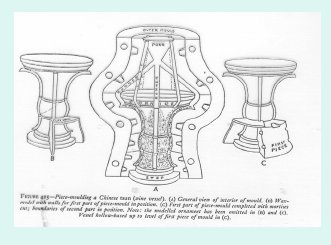
A two piece mould was used for more complex molds like sword handles. To make more elaborate shapes a method called the lost wax technique was used. This involved the forming of the desired shape in wax, then enclosing the wax model in fine clay, but leaving a small channel to the exterior, When the clay is heated the melted wax can be poured out; thus the clay becomes a hollow mould and molten metal can be poured into it, After it is cooled the, clay can be broken away and one is left with a metal copy of the original.

We however, must look at a mould of very much larger proportions. As previously mentioned, the Bible says that the castings were made by the process of sand casting.

Singer
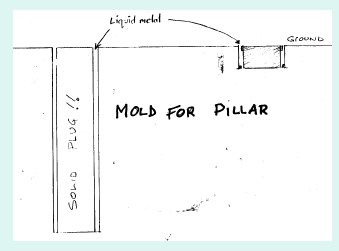
[xix] page 628, says that, moulding in clay was the principal process for casting in antiquity, I have given a description of a furnace found in the Arabah and how use was made of the prevailing winds to assist in the smelting. Singer [xx] continues on page 633 where he goes on to give us a description of the area and method of building these castings. The soil is a marl, with patches of clay. It is clear that the molds were actually excavated in one of these patches; there is no mention in the Hebrew text that any special clay was used. Such vast mo1ds could hardly have been constructed in any other way. This is only one small step beyond the method already used in Egypt and common elsewhere, of supporting clay molds by burying them in the ground before the furnace.
This would allow the molten metal to be poured direct from the smelter to the mould, with channels from several furnaces to different parts of the mold, to ensure an even distribution of the melt, Singer goes on with a description of the construction of the mold for the Sea or great bowl


In front of the furnace pit was dug. To an arm pivoted at its centre a template was attached, the outer edge being curved to the profile of the basin, so that when the arm swung around the pivot the template described the desired shape, Ropes probably of straw, were laid on the floor and up the sides of the pit, and then covered with well beaten clay and broken pots. The ropes provided vents for the escape of gases evolved when the molten metal was poured into the mold. The space between the walls and, the floor of the pit and the edge of the template was gradually filled up with more clay and broken bricks or pots, the template being moved round as required. The outermost quarter inch or so of the filling was of more finely textured clay suitable for modelling the decorative borders of the bowl, "like the brim of a cup the flower of a Lily ". The clay surface was allowed to dry slowly, cracks being stopped with clay. The construction of the core for the inner surface of the basin was now col1sidered; this core would be suspended within the mould, and only a handbreadth above it. A framework of metal supports would be placed to keep it in position, After drying, the mould and channels leading to it from the furnaces would be well baked, and heated with charcoal so that the metal would not become chilled. When the glowing coals had been swept out, the sections of the inner mould were firmly fixed in register, lest it should float upon the molten metal. The mold was now ready for the metal.

http://www.freemasons-freemasonry.com/pillarST24.jpg


The method of casting the pillars would have been similar, These could have been made vertical with the outside part done first with whatever decoration desired, The core could then

have been built up in the middle with the appropriate handbreadth left for the molten bronze, However, if the mold were the full 8.1 metres the pressure of the molten metal at the base together with its depth would make a successful cast unlikely, In addition it would be difficult to get the melt in fast enough for even solidifying. When solidified they could have been dug up, Even so it would still have been a major task to lift, Possibly it was done with a timber framework and levers, no doubt there was plenty of manpower. It appears to me that, if the hypothesis that the pillars were cast in sections is accepted, then the construction of the mould or moulds would have to be easier there would be less metal in the melt and handling would not be so hard.

Stone pillars were built this way for the same handling reasons.


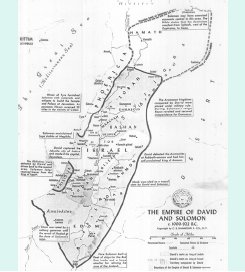
We now must look at how these huge castings were taken to the Temple, From the map of Israel it can be seen that the distance from the smelters located at Succoth, which we have been told is situated at Tell Deir AlIa is a considerable distance.

In addition to this Werner Keller,
[xxi] on page 202 tells us that:- At Tell Deir AlIa in, Transjorden where the River Jabbok leaves the hills six miles before it joins the Jordan the expedition discovered traces of Succoth, the Israelite city dating to the days of Joshua this is adjacent to the Wadi-el-Arabah.

Goods in those days were transported on the backs of asses or camels. Horses and chariots were well known, but the horses were not the heavy draught horses of today. They were fairly light horses, and with the primitive harness in use at that time, pulling a fairly light chariot with one or two men in it was probably as much as they could do. Thus, we can forget about drays, heavy carts and the like. We must therefore, question just how big a load could have been moved!

Asses and camels had been used by the Israelites and others for transporting goods for hundreds of years. I believe it safe to assume that asses were used to transport the castings from the foundry to Jerusalem. I don't know the carrying capacity of an ass, but it probably does not exceed l00 kilograms. Further, this load would have to be in two equal parts -one each side of the ass. So we get back to castings of no more than 50 kilograms -about the maximum load of a single furnace.

Then there is the biblical statement act that the casting was done in the plain of the Jordan River, between Succoth and Zarethan. (see earlier map)These are in the Rift Valley, about 35 kilometres from Jerusalem, and about 25 kilometres from where the Jordan enters the Dead Sea. The Dead Sea is about 1290 feet (393 metres) below sea level. The foundry was probably some 1100 to 1150 feet (335 to 350 metres) below sea level. Jerusalem is about 2700 feet (822 metres) above sea level. So transporting the castings involved a climb of some 3800 feet (1158 metres) through rugged country, where the road consisted of a dirt track probably not much wider in many places than the space taken by a man leading a loaded ass. This, I believe, would absolutely preclude the use of any form of wheeled transport for goods being taken to or from the foundry. So again we get back to asses each carrying two castings of not more than about 50 kilograms each. Bronze, when cast, takes the form of the mould very accurately.


It would have relatively easy for the artisans of King Solomon' s time to make moulds sufficiently accurate for the resultant castings to fit together closely. The pillar or other object thus formed would appear to the casual observer to be one piece


We know that King Solomon had many horses and chariots, I Kings 10.26:29 Solomon built up a force of chariots and horses; he had one thousand four hundred chariots and twelve thousand horses; one could ask given the above could chariots have been use to transport the castings given the hypothesis that the castings were small then joined together. Were these objects constructed and raised gradually in place? Were they assembled then lifted?

There are many theories, as to how heavy objects were raised. The pillars had to be lifted onto their base and stood up, then fixed down. Levers could be used to raise them a small amount, then wedges and blocks inserted and the process repeated until the required height was achieved. The construction of heavy timber scaffolding at the side of the object to be raised allowing lifting by cables affixed to levers. Whatever the method used it would have been laborious. We can only wonder at the ingenuity of our forefathers.

Conclusion.

Trying to get at the exact truth of what happened all that time ago is difficult. A lot of
Assumptions must be made. I don't know how close this paper is, to what was done by the artisans of King Solomon but as a suggestion to what was done; it is probably as good as any. I have quoted from past scholars who have seen and worked the sites of antiquity, this I have not done. I would most certainly like to, as the research for this paper has filled my mind with countless questions to which, I would like to find the answers. I hope that this lecture has also given you the desire to find out more.

BIBLIOGRAPHY

[i]Archaeology and the Religion of Isreal, William Foxwell Albright. The John Hopkins Press 1968


[ii] The Building of King Solomon’s Temple Part Two. Colin Breckon.


[iii] The Bible as History, Werner Keller 1955


[iv] The World Book Encyclopaedia 1973 Book C p939


[v] The Peoples New Testament (Tables of time, measure, weight Etc) taken from the internet page www.mun.ca/rels/hrollman/restmov/texts/bjohnson/hg1/PNTOOL.HT


[vi] First Church of the Nazarene. Biblical weights and measures.


[vii] The Building of King Solomon’s Temple Part Two. Colin Breckon.


[viii] The Molten Sea. A software program by A Zuidhorf 1996


[ix] The Antiquities of the Jews Book VIII Chapter 111.5


[x] A History of technology Singer, Holmford & Hall


[xi] The Coming of the age of Iron, edited by Theodore A Wertime and James D Muhly. Tylecote “ Furnaces Crucibles and Slags, page 195


[xii] Encyclopaedia of Science and Technology CD ROM section on prehistoric technology pages 7-8


[xiii] Metallurgy in Antiquity R J Forbes; Leiden 1966 page 19


[xiv] Studies in Ancient Technology R J Forbes Leiden 1966 page 19


[xv] Palestine Exploration Quarterly Num 109 page 76


[xvi] The Bible as History Werner Keller page 202


[xvii] Rivers in the Desert Nelson Glueck Weidenfield and Nicholson 1959 page 163


[xviii] ibid


[xix] A History of technology Singer, Holmford & Hall


[xx] ibid


[xxi] The Bible as History

Thursday, December 25, 2008

Christmas Time

This is an appropriate time of the year to contemplate the impact of the man Jesus on humanity. We live in a culture that was completely shaped by his example and with the expectation that that example will be accepted globally. Notice that I am not saying his words. His accomplishment was to show others how to live and to initiate the protocol that brought others under his teachings.

His story is of a real person who had explored the sacred knowledge of his era and who used this knowledge and his own insights to shape the thinking of his disciples. And he told them to bring others into the fold of his teachings and taught them how. They are still doing it today some two thousand years later.

His successors folded into the story a palette of the mythologies then accepted by their contemporaries as they strived to make their founder divine. They felt that this was necessary to provide immediacy to the monotheistic doctrine that they championed. Perhaps it is.

Today, the mythologies become a distraction.

Yet his example and his concept of church became an organizing principal that washed away paganism and the barbarian dream. Yet many who live this western Christen culture proffer the conceit that we have something different by the mere fact that only a minority attend Christian services. Instead we need to understand that the air we breathe is a Christen air.

The continuing growth and acceptance of this culture has never slowed. Throughout its history, actual resistance has always caused it to strengthen and expand unless simply crushed.

It is appropriate that his birthday is honored by all throughout the world, for all have benefited from the success of his example and derivative movements.

Today, his example has freed most of the global population and we are seeing the way through for the balance. Following in his footsteps does not require faith. It is just the right thing to do.

Merry Christmas

arclein

Wednesday, December 24, 2008

Desert Reflections

Once in a while a bit of errant nonsense comes along to tease one’s usage of superlatives.

As I have noted. The desert fails to absorb solar energy because it does not have any place to put it. It dumps all of it back into space over the diurnal cycle. If we were to cover the entire Sahara as per this scheme under a reflective sheet, we may make the process more efficient because we prevent a portion been initially been absorbed by the sand and rock.

The fact is that once the sun sets, all that heat disappears back into space in a hurry as there is poor supply of heat retaining moisture. Every desert traveler has complained about the severe chill of the night from the earliest writers. It is so efficient, that it is fair to say that the direct effect of deserts on border lands is surprisingly moderate. What I mean is that deserts do not spawn vast storm systems and more realistically they eat storms systems by swiftly draining them of moisture, thus releasing even more heat into space.

This is of course a continuance of the strange idea that the world needs to be cooled off by mankind. It is my position that the deserts need to be reforested and restored to a moisture rich status so as to absorb all that incoming energy. This will warm the Northern hemisphere by a couple of degrees while creating livelihoods for another six billion or so people.

This restoration would restore climate conditions extant during the Bronze Age in which the northern climate was a couple of degrees warmer.

The past few months have seen no end of researchers attempting to tie their research to the global warming hysteria to better promote funding. This has created a background of noise that buries the good stuff.

Fix For Global Warming? Scientists Propose Covering Deserts With Reflective Sheeting

ScienceDaily (Dec. 23, 2008) — A radical plan to curb global warming and so reverse the climate change caused by our rampant burning of fossil fuels since the industrial revolution would involve covering parts of the world's deserts with reflective sheeting, according to researchers writing in the International Journal of Global Environmental Engineers Takayuki Toyama of company Avix Inc in Kanagawa, Japan, and Alan Stainer of Middlesex University Business School, London, UK, complain that there have been very few innovative remedies discussed to combat the phenomenon of global warming caused by human activities, despite the widespread debate of the last few decades. They now suggest that uncompromising proposals are now needed if we are to avert ecological disaster.

Finding a way to 'stop', or at least minimise, global warming and to even cool the Earth can be achieved by focusing on the primary heat balance between the amount heat produced by human activities and the loss of heat to outer space. They emphasise that efforts to reduce atmospheric concentrations of greenhouse gases, primarily carbon dioxide, are not likely to work soon enough.

Pessimism that minimising carbon dioxide will no longer solve the problem seems to be spreading among environmental specialists," they say. As such, a lateral-thinking approach that acknowledges the fact that the heat created by human activities does not even amount to 1/10,000th of the heat that the earth receives from the sun.

Toyama and Stainer suggest that heat reflecting sheets could be used to cover arid areas and not only reflect the sun's heat back into space by increasing the Earth's overall reflectivity, or albedo, but also to act as an anti-desertification measure. The technology would have relatively minimal cost and lead to positive results quickly.
They add that the same approach might also be used to cover areas of the oceans to increase the Earth's total heat reflectivity.

The team's calculations suggest that covering an area of a little more than 60,000 square kilometres with reflective sheet, at a cost of some $280 billion, would be adequate to offset the heat balance and lead to a net cooling without any need to reduce atmospheric carbon dioxide. However, they caution that it would be necessary to control the area covered very carefully to prevent overcooling and to continue with efforts to reduce our reliance on fossil fuels.

Journal reference:

1. Toyama et al. Cosmic Heat Emission concept to 'stop' global warming. International Journal of Global Environmental Issues, 2009; 9 (1/2): 151 DOI: 10.1504/IJGENVI.2009.022093

Peggy Korth on Cattail Culture

This article by Peggy Korth shows that cattail culture is advancing and we will monitor this. In particular, she is also associated with the marketing of a farm sized ethanol production unit made from off the shelf hardware. I will do a separate column on that. I am posting the article after our correspondence. Her efforts are well worth supporting as she is getting answers.


Hello Robert,

I thought the letter copied below may be of interest. The intent if such messages is to change the false precepts of overzealous informants who do not fully understand climate warming and certainly do not understand the food and fuel concept. Making all kinds of generalized statements about fuel ethanol can be quite detrimental to the use of an excellent fuel. With my system, we remediate both water and soil, we capture carbon dioxide from the air, we restore fallow land, we have ABUNDANT potential per acre for starch and sugar conversion, we have a new product to provide pulp and fiber without chemical farming or killing trees, we promote rural economic development, we provide new jobs and educational training, we provide low-cost safe equipment for the small and mid-sized producer, and the list goes on...

Out of courtesy, please do not quote the names of the recipient of the letter. The magazine did not respond because they want to holler about their point of view instead of finding solutions. In my opinion, unless the complainer is offering advice or alternative solutions, then that message is not constructive. Building hope relates to practical solution that can be implemented by communities and NOT dependent on big business or government.Also after working for fourteen years out of my own pocket, I intend to offer paid services and equipment that I helped forge through my input and support. I give generously to the public. Yet, I also expect the public to be responsible for their own future. In the past I have lived frugally and enjoyed a good professional life. Awakening the hope of the next generation means building a passion to make a difference for their own posterity.

Sustainable Technology Systems, Inc.

Peggy G. Korth, President
40 Sun Valley Dr., Spring Branch TX 78070
Cell: 512 757-4499, 830 885-4823; FAX 830 885-4827
Email:
rpk@gvtc.com
September 25, 2008

Gentlemen,

####Over seven years ago I presented a concept to ##### concerning alternatives to corn as co-development. He patted me on the head and said, “Well, maybe someone will listen to you in ten years, but right now corn is king.”

And now people are starting to listen. Our company had developed a propagation and growing methodology to raise over a thousand gallons of fuel ethanol from cattails as a row crop. The limiting factors are wastewater availability, diverting a polluted stream, and/ or land adjacent to or nearby wastewater processing.

Furthermore, the concept of mega-sized production plants is not necessary or practical. Our engineers have developed farm-scale systems for bioenergy with an amalgamation of energy-savings adjuncts such as gasification from waste woody biomass and parabolic solar collectors to provide low-cost functionality.

Your discussion perpetuates a number of myths, as discussed in the recent Texas biofuels conference in Austin last week where we once again gave state officials information on both rhizome and stalk processing from cattail crops.

Numerous alternative crops are available and it is wise to advance small to mid-sized systems that will provide both the farmers and rural communities with a means for self-sufficiency serving first-responders and community based fleets. Your larger systems can serve the public interest if excess fuel is not available. However, our group DOES have a mechanism to impact the controversy and provide biofuels production systems as a real, doable, and affordable safety net to our rural communities.

Thanks you for your interest. Hopefully we can expand your horizons beyond the corn field. Best wishes,

Peggy


Water Assurance Technology Energy Resources—a 501C3 Educational and Research Organization dedicated to Clean air, Clean water, and Clean energy.

Peggy Korth, President 40 Sun Valley Drive, Spring Branch TX, 78070, 512 757-4499, F 830 885-4827, rpk@gvtc.com


Optimize bioenergy, remediate wastewater, and impact soil amelioration for communities through a methodology suitable to global adoption. Merged clean technologies begin with propagating cattails as a row crop adjacent to municipal wastewater treatment. A new applied methodology brings technological innovation to small and mid-sized bioenergy production units suitable for most any community. Abundant and renewable bioenergy provides a safety-net of security for fuel availability in conjunction with low-cost equipment design merging parabolic solar energy, gasification of invasive species, and waste from sewerage additionally reducing toxins, heavy metals, and drugs from wastewater streams. Furthermore, the benefits of building soil from sludge transforms here-to-fore barren land into fertile acres to grow additional energy and non-food crops.

Practical demonstration began with academic studies through a DOE grant. New feasibility studies related to climate influence are scheduled to begin in January 2009 in Otero County New Mexico—a barren desert with brackish ground water and rugged terrain. Forward-thinking town fathers promote systems for long-term renewable energy application. Supported by a conservation alliance, the United States Forest Service shares research and information gathering with our outstanding group of STS specialty associates. Novel industry application implements remediation and watershed services plus value-added benefits in rural economic development, homeland security, and practical solutions to community self-sufficiency. Modern technical application from spent feedstock residue extraction of pulp and fiber from feedstock waste opens new industry opportunities to the building materials and paper industries.

Collaboration with a research division of the University of New Mexico utilizing algae waste assists in soil building demonstrations. Through the efforts of Ms. Korth ‘Cattails to Ethanol’ is favorably embraced by numerous independent researchers and foreign communities. As new feedstock cattails offers over a thousand gallons of fuel ethanol per acre plus numerous benefits to provide ongoing affordable renewable energy.

Feasibility studies provide unique operating formats to bring most any global village into compliance while reducing surface flow pollution diverting contaminated, non-potable water through remediation beds accessed by unique harvesting equipment. By reducing the cost of operations and providing processing equipment that allows incremental expansion, facilities enlarge on a pay-as-you-go plan. Development of the concept began in the early 1980’s with academic validation of the concept.
Expanding that knowledge into additional beneficial processes brings new low-cost practicality to communities sustaining affordable quality-of-life programs and first responder fuel security.

As the principle of an adjunctive association of specialist working through Sustainable

Technology Systems, Inc. Peggy Korth has been featured at the International Fuel Ethanol Workshop and The World Biomass Conference presenting lectures and break-out sessions in How to Implement a Community Feasibility Study and Data Collection Basics, Small Scale Energy and Fuel Production for Farmers and Communities, Alternative Crop Efficiencies as well as developing training curriculum for biofuels programs. Ms. Korth authored two Small Scale bio-energy and Fuel Production text: Cattails to Ethanol and Bioenergy Business supporting producers in their due diligence and presentation preparation. Her compilation of the most comprehensive Bioenergy Glossary is being translated into Spanish. Ms. Korth’s USDA, SARE grant program, Livestock and Feedstock: Distiller’s Grain and Fuel Ethanol, proved dairy application benefits for farmers to produce their own fuel in farming operations. Additional environmental lectures are highlighted in Ms. Korth’s biographical summary which is available upon request.

There are good pictures here but we do not have a address for them so they will likely not survive pasting.

Two Surprises from NASA

These two reports last week from NASA reveal a much more dynamic space environment than had ever been imagined. It also reveals that our sensing tools are well started on mapping this environment although the process will go on for years.

Anyway, this is two surprises at once and bodes well for the next year or so.

Both these phenomena can impact on the energy transfer through the earth’s magnetic field which is looking a lot more volatile than thought. Is it meaningful? I simply have no idea here but suspect that modeling is possible and may surprise us.

It is the sort of thing that you wake up one morning and discover it really matters. I will watch for further information and speculations on this.

Solar Flare Surprise

12.15.2008

Dec. 15, 2008: Solar flares are the most powerful explosions in the solar system. Packing a punch equal to a hundred million hydrogen bombs, they obliterate everything in their immediate vicinity. Not a single atom should remain intact.

At least that's how it's supposed to work.

"We've detected a stream of perfectly intact hydrogen atoms shooting out of an X-class solar flare," says Richard Mewaldt of Caltech. "What a surprise! These atoms could be telling us something new about what happens inside flares."

http://science.nasa.gov/headlines/y2008/images/solarflaresurprise/296969main_flare_sxilabeled_HI.jpg

Above: The X9-class solar flare of Dec. 5, 2006, observed by the Solar X-Ray Imager aboard NOAA's GOES-13 satellite.

The event occurred on Dec. 5, 2006. A large sunspot rounded the sun's eastern limb and with little warning it exploded. On the "Richter scale" of flares, which ranks X1 as a big event, the blast registered X9, making it one of the strongest flares of the past 30 years.

NASA managers braced themselves. Such a ferocious blast usually produces a blizzard of high-energy particles dangerous to both satellites and astronauts. Indeed, moments after the explosion, radio emissions from a shock wave in the sun's atmosphere signaled that a swarm of particles was on its way.
An hour later they arrived. But they were not the particles researchers expected.

NASA's twin STEREO spacecraft made the discovery: "It was a burst of hydrogen atoms," says Mewaldt. "No other elements were present, not even helium (the sun's
second most abundant atomic species). Pure hydrogen streamed past the spacecraft for a full 90 minutes."

Next came more than 30 minutes of quiet. The burst subsided and STEREO's particle counters returned to low levels. The event seemed to be over when a second wave of particles enveloped the spacecraft.
These were the "broken atoms" that flares are supposed to produce—protons and heavier ions such as helium, oxygen and iron. "Better late than never," he says.

At first, this unprecedented sequence of events baffled scientists, but now Mewaldt and colleagues believe they're getting to the bottom of the mystery.

First, how did the hydrogen atoms resist destruction?

"They didn't," says Mewaldt. "We believe they began their journey to Earth in pieces, as protons and electrons. Before they escaped the sun’s atmosphere, however, some of the protons recaptured an electron, forming intact hydrogen atoms. The atoms left the sun in a fast, straight shot before they could be broken apart again." (For experts: The team believes the electrons were recaptured by some combination of radiative recombination and charge exchange.)

Second, what delayed the ions?

"Simple," says Mewaldt. "Ions are electrically charged and they feel the sun's magnetic field. Solar magnetism deflects ions and slows their progress to Earth. Hydrogen atoms, on the other hand, are electrically neutral. They can shoot straight out of the sun without magnetic interference."

Imagine two runners dashing for the finish line. One (the ion) is forced to run in a zig-zag pattern with zigs and zags as wide as the orbit of Mars. The other (the hydrogen atom) runs in a straight line. Who's going to win?

"The hydrogen atoms reached Earth two hours before the ions," says Mewaldt.

Mewaldt believes that all strong flares might emit hydrogen bursts, but they simply haven't been noticed before. He's looking forward to more X-flares now that the two STEREO spacecraft are widely separated on nearly opposite sides of the Sun. (In 2006 they were still together near Earth.) STEREO-A and –B may be able to triangulate future bursts and pinpoint the source of the hydrogen. This would allow the team to test their ideas about the surprising phenomenon.

"All we need now," he says, "is some solar activity."

A Giant Breach in Earth's Magnetic Field


12.16.2008

Dec. 16, 2008: NASA's five THEMIS spacecraft have discovered a breach in Earth's magnetic field ten times larger than anything previously thought to exist. Solar wind can flow in through the opening to "load up" the magnetosphere for powerful geomagnetic storms. But the breach itself is not the biggest surprise. Researchers are even more amazed at the strange and unexpected way it forms, overturning long-held ideas of space physics.

"At first I didn't believe it," says THEMIS project scientist David Sibeck of the Goddard Space Flight Center. "This finding fundamentally alters our understanding of the solar wind-magnetosphere interaction."

The magnetosphere is a bubble of magnetism that surrounds Earth and protects us from solar wind. Exploring the bubble is a key goal of the THEMIS mission, launched in February 2007. The big discovery came on June 3, 2007, when the five probes serendipitously flew through the breach just as it was opening. Onboard sensors recorded a torrent of solar wind particles streaming into the magnetosphere, signaling an event of unexpected size and importance.


"The opening was huge—four times wider than Earth itself," says Wenhui Li, a space physicist at the University of New Hampshire who has been analyzing the data. Li's colleague Jimmy Raeder, also of New Hampshire, says "1027 particles per second were flowing into the magnetosphere—that's a 1 followed by 27 zeros. This kind of influx is an order of magnitude greater than what we thought was possible."

The event began with little warning when a gentle gust of solar wind delivered a bundle of magnetic fields from the Sun to Earth. Like an octopus wrapping its tentacles around a big clam, solar magnetic fields draped themselves around the magnetosphere and cracked it open. The cracking was accomplished by means of a process called "magnetic reconnection." High above Earth's poles, solar and terrestrial magnetic fields linked up (reconnected) to form conduits for solar wind. Conduits over the Arctic and Antarctic quickly expanded; within minutes they overlapped over Earth's equator to create the

http://science.nasa.gov/headlines/y2008/images/giantbreach/breachmodel.jpg


Above: A computer model of solar wind flowing around Earth's magnetic field on June 3, 2007. Background colors represent solar wind density; red is high density, blue is low. Solid black lines trace the outer boundaries of Earth's magnetic field. Note the layer of relatively dense material beneath the tips of the white arrows; that is solar wind entering Earth's magnetic field through the breach. Credit: Jimmy Raeder/UNH. [
larger image]


The size of the breach took researchers by surprise. "We've seen things like this before," says Raeder, "but never on such a large scale. The entire day-side of the magnetosphere was open to the solar wind."

The circumstances were even more surprising. Space physicists have long believed that holes in Earth's magnetosphere open only in response to solar magnetic fields that point south. The great breach of June 2007, however, opened in response to a solar magnetic field that pointed north.

"To the lay person, this may sound like a quibble, but to a space physicist, it is almost seismic," says Sibeck. "When I tell my colleagues, most react with skepticism, as if I'm trying to convince them that the sun rises in the west."

Here is why they can't believe their ears: The solar wind presses against Earth's magnetosphere almost directly above the equator where our planet's magnetic field points north. Suppose a bundle of solar magnetism comes along, and it points north, too. The two fields should reinforce one another, strengthening Earth's magnetic defenses and slamming the door shut on the solar wind. In the language of space physics, a north-pointing solar magnetic field is called a "northern IMF" and it is synonymous with shields up!

"So, you can imagine our surprise when a northern IMF came along and shields went down instead," says Sibeck. "This completely overturns our understanding of things."

Northern IMF events don't actually trigger geomagnetic storms, notes Raeder, but they do set the stage for storms by loading the magnetosphere with plasma. A loaded magnetosphere is primed for auroras, power outages, and other disturbances that can result when, say, a CME (coronal mass ejection) hits.

The years ahead could be especially lively. Raeder explains: "We're entering Solar Cycle 24. For reasons not fully understood, CMEs in even-numbered solar cycles (like 24) tend to hit Earth with a leading edge that is magnetized north. Such a CME should open a breach and load the magnetosphere with plasma just before the storm gets underway. It's the perfect sequence for a really big event."

Sibeck agrees. "This could result in stronger geomagnetic storms than we have seen in many years."

A video version of this story may be found
here. For more information about the THEMIS mission, visit http://nasa.gov/themis

Tuesday, December 23, 2008

Classic Winter not News

I find it rather frustrating that overt media bias is preventing the major climate story to not get properly told. When last checked global temperatures had dropped 0.7 degrees and we can assume that we are experiencing an additional drop to be expressed in the next set of numbers.

This was calculated from the same sources that gave us rising temperatures for a decade and flat temperatures for the past decade. That total gain was perhaps the same size. So what is everyone waiting for? It takes two decades to warm the northern hemisphere 0.7 degrees and perhaps six months to reverse it totally. That is not a big story. Are they waiting for confirmation? Try looking outside your window.

What we know of climate change history has always said the same thing. The warming is slow and gradual while the chilling is abrupt. This looks like a chill out and it is likely good for another year or more. The next set of numbers should show even more decline.

The mechanism for all this is becoming a lot clearer. Incoming heat is unevenly distributed between the Northern and Southern Hemispheres through oscillations focused on the Pacific which is half the planet. When surplus heat is pumped into the north across the equator the PDO shifts it north and if necessary discharges the surplus into the Arctic as occurred in 2007. When that occurs the elastic band snaps back and we catch a surge of cold weather. Sound familiar?

The problem of course is that the effects of CO2 are impossible to separate out from this type of decadal cycle. We certainly do not have the centuries of accurate Arctic weather information to compare. Maybe we should be excited because we melted some sea ice this time around. Or more likely, we should be disappointed and get serious about planting trees in the Sahara.

I am trying to say that this snap back of global temperatures is a hell of a story and absolutely no one is picking up on it. What are they thinking? Their only evidence just strode out the door. Isn’t anyone brave enough to stand up and simply say that the party is over?

I want to see a credible climate scientist stand up and say this reversal is a temporary move and that the fundamentals are good for a swift return to global warming. I used to sell stock in gold mines too. Of course they are all hiding, depending on how bravely they supported the CO2 theory.

I suspect that the rest of the crowd, who are too lazy to keep a close eye on the data will keep talking global warming while we continue to have a good old fashioned multi blizzard winter well into March. How do you like it so far?

I know that this is just one winter and that last winter was the actual beginning of a cold cycle, but this really feels like we are back in the fifties for foul weather. I was just a kid then, but that sort of foul abated into the sixties and had almost disappeared running into the nineties and most recently. It was apt that they measured sea ice thickness in 1959 and likely caught the maxima. 2007 gave us a pretty good minimum.

Making Primitive Biochar

Those who have followed my blog know that I proposed a method for producing biochar that was plausible inside the limitations placed on an antique society living in the Amazon rainforest. Key to the time and place was the use of maize as the principal source material. That this was so was confirmed by published pollen studies and by more recent translations of sixteenth century reports from southern Brazil which described widespread maize culture.

When I began my thought experiment, the presence of maize seemed very unlikely in view of the known dynamics of rainforest soils. Yet I needed a plant that produced packable waste that could be handled without steel tools. Wood was both high cost in human energy inputs and very resistant to charring and crushing. Most other crops simply failed to produce both a crop and much biomass. No primitive farmer was going to plant a stand-alone char feedstock and lose a season.

This is where corn or maize came in. It produced a stable easy to store high volume crop that also produced perhaps ten tons per acre of corn stover. This stover was also very packable because there are no branches. What made it more attractive was the root ball which is in the form of a disc and is often very easy to pull out of the soil. Thus a field could be stripped of its ripe corn and then stripped easily of its stover.

Stacking the stalks was easily accomplished and using the root balls to form an outer wall simply a matter of paying attention. The key idea was to provide an outer shell of mud that closed off the packed stover. Now they did not have a sheet of metal foil to add another heat resistant air tight layer, so it is likely that they slathered on a thin layer of river clay to form a air tight seal. Again field experiments will inform us as to the extent that this is all necessary.

At the end of the day, without any tools, we have a thin clay dome or a mud dome enclosing ten tons of packed stover.

This is then loaded with a charge of burning coals. I have considered top down but suspect that simply feeding a charge in through the bottom perhaps along a narrow trench will be good enough. A small amount of air will be drawn to the charge maintaining the heat production and the produced heat will steadily reduce the maize very quickly. Gasses will be captured and ignite as the burn progresses steadily reducing the load.

Eventually the whole load will collapse upon which it will be smothered with more dirt.

I had originally envisaged this process taking many hours, however corn stover is like paper and merely needs to be heated for it to curl up and quickly decompose.

Ten tons or one acres production would give us three tons of biochar which is ample for that one acre, particularly if one goes the extra step of creating seed hills on only a third of the surface. In one season, you are in business. The one remaining mystery is why this method failed to make it out of the Amazon, because it would have nicely augmented the three sisters throughout the Americas. Or perhaps it did and we simply never noticed or our steel got there first and disease got there first.

Global Coal Reserves

This piece surprised me because it challenges the integrity of reported reserves by government agencies. He is saying that historically governments have seriously overstated coal reserves and that this process continues.

I beg to differ. Governments will report a resource rather than a reserve. The resource is the total amount of material that might or could be mined regardless of cost. Canada has a 1.7 trillion barrel resource in the tar sands. It has a reserve of 175 billion barrels economically available for now.

Once cost becomes an issue we are talking about reserves. These measure what can be reasonably mined in view of current costs and selling prices. A lot of perfectly good coal will get reclassified as rock.

The one thing that I learned about the mining industry is perfectly good ore reserves turn into rock amazingly often. In fact we are living through one such transition right now.

Double the selling price of coal and I am sure that vast new resources will spring up. Let me put this another way. I have inspected my share of oil drilling logs. Every so often another coal seam will be typically encountered since we normally drill in sedimentary basins. They are all too deep to ever consider mining for the present. None of these are ever even counted as resources.

It is obvious that the USA can double their resource estimate by the simple expedient of measuring deeper. At least it would be more ethical than the resources added by OPEC.
And a note on that. Few understand that the first two discovery wells in a new field plus seismic has proven sufficient to define proven oil reserves. It is very unlikely that later work will significantly increase that figure. In fact the reverse is likely. Those vast new OPEC reserves announced in the eighties did not coincide with new field discoveries. Therefore they are fairy tales.

World Coal Reserves Could Be a Fraction of Previous Estimates

By Alexis Madrigal December 17, 2008 6:29:35 PMCategories: AGU 2008, Clean Tech, Energy, Geology

SAN FRANCISCO — A new calculation of the world's coal reserves is much lower than previous estimates. If validated, the new info could have a massive impact on the fate of the planet's climate.

That's because
coal is responsible for most of the CO2 emissions that drive climate change. If there were actually less coal available for burning, climate modelers would have to rethink their estimates of the level of emissions that humans will produce.

The new model, created by Dave Rutledge, chair of Caltech's engineering and applied sciences division, suggests that humans will only pull up a total — including all past mining — of 662 billion tons of coal out of the Earth. The best previous estimate, from the World Energy Council, says that the world has almost 850 billion tons of coal still left to be mined.

"Every estimate of the ultimate coal resource has been larger," said ecologist Ken Caldeira of Stanford University, who was not involved with the new study. "But if there's much less coal than we think, that's good news for climate."

The carbon dioxide emitted when humans burn coal to create usable energy is primarily responsible for global warming. Leading scientists think that the stability of Earth's climate will be dictated by how the world uses — or doesn't use — its coal resources. And the thinking has been that the world has more than enough coal to wreak catastrophic damage to the climate system, absent major societal or governmental changes.

So the new estimate, which opens the slim possibility that humankind could do nothing to mitigate carbon dioxide emissions and still escape some of the impacts of climate change, comes as quite a shock.

Rutledge argues that governments are terrible at estimating their own fossil fuel reserves. He developed his new model by looking back at historical examples of fossil fuel exhaustion. For example, British coal production fell precipitously form its 1913 peak. American oil production famously peaked in 1970, as controversially predicted by King Hubbert. Both countries had heartily overestimated their reserves.

It was from manipulating the data from the previous peaks that Rutledge developed his new model, based on fitting curves to the cumulative production of a region. He says that they provide much more stable estimates than other techniques and are much more accurate than those made by individual countries.

"The record of geological estimates made by governments for their fossil fuel estimates is really horrible," Rutledge said during a press conference at the American Geological Union annual meeting. "And the estimates tend to be quite high. They over-predict future coal production."

More specifically, Rutledge says that big surveys of natural resources underestimate the difficulty and expense of getting to the coal reserves of the world. And that's assuming that the countries have at least tried to offer a real estimate to the international community. China, for example, has only submitted two estimates of its coal reserves to the World Energy Council — and they were wildly different.

"The Chinese are interested in producing coal, not figuring out how much they have," Rutledge said. "That much is obvious."

The National Research Council's Committee on Coal Research, Technology, and Resource Assessments to Inform Energy Policy actually agrees with many of Rutledge's criticisms, while continuing to maintain far sunnier estimates of the recoverable stocks of American coal.

"Present estimates of coal reserves are based upon methods that have not been reviewed or revised since their inception in 1974, and much of the input data were compiled in the early 1970’s,"
the committee wrote in a 2007 report. "Recent programs to assess reserves in limited areas using updated methods indicate that only a small fraction of previously estimated reserves are actually mineable reserves.”

And don't look to technology to bail out coal miners. Mechanization has actually decreased the world's recoverable reserves, because huge mining machines aren't quite as good at digging out coal as human beings are.

With Rutledge's new numbers, the world could burn all the coal (and other fossil fuels) it can get to, and the atmospheric concentration of CO2 would only end up around 460 parts per million, which is predicted to cause a 2-degree-Celsius rise in global temperatures.

For many scientists, that's too much warming. A growing coalition is calling for limiting the CO2 in the atmosphere to 350 parts per million, down from the 380 ppm of today, but it's a far cry from some of the more devastating scenarios devised by the Intergovernmental Panel on Climate Change.

"Coal emissions really need to be phased out proactively — we can't just wait for them to run out — by the year 2030," said Pushker Kharecha, a scientist at NASA's Goddard Institute for Space Studies. "There is more than enough coal to keep CO2 well above 350 ppm well beyond this century."

The Intergovernmental Panel on Climate Change uses economic models that assume that the world will not run out of coal. Some IPCC scenarios show 3.4 billion tons of coal being burned just through 2100.
That's more than five times what Rutledge thinks will be possible — and a good deal higher than the WEC's estimate for recoverable coal reserves, too.

On the other hand, if the world were really to encounter a swift and steep decline in accessible coal resources, it's unclear how humans could retain our current levels of transportation, industry and general energy-usage.

So, even if coal were to run out and the most dangerous climate change averted, the imperative to develop non–fossil-fuel energy sources would remain.

"Peak Oil and peak gas and peak coal could really go either way for the climate," Kharecha said. "It all depends
on choices for subsequent energy sources."