Plausible argument for those galactic observations. Practically, it all needs ample unobtainium in order to be real. all of which suggest continuing scientific knowledge improvements following a linear trajectory never shown.
Again, the simple trick of removing Dark MAtter from any object takes out essentally all mass and conservation of energy impacts a shift in velocity toward light speed. KE = mv^2 removal by the way is done using high frequency em and it has been done and i have seen it done. so we do not need super power to go to the near stars.
all this explains how we are ultimately connected throuhout the Galaxy. We boogy over to several nearby stars and meet their residents. Set up bases. We pass data back and froth thereafter. We become part of thhe Galactic network.
How to Propel Astronauts to the Speed of Light at 1g?
Avi Loeb
Avi Loeb
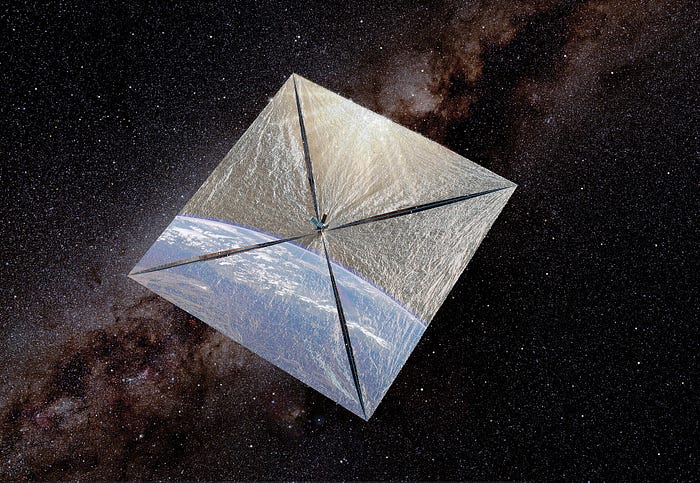
A light sail. (Image credit: The Planetary Society)
Two essays ago, I showed here that a spacecraft accelerating at the Earth’s surface gravity, 1g=9.8 meters per second squared, can bring astronauts all the way to the center of the Milky-Way, 26,000 light years away, within one decade. The main obstacle to achieving this feat is the huge amount of fuel required.
Albert Einstein’s most famous formula E=Mc² expresses the energy E associated with the rest mass M through the speed of light c. Since a payload moving at a non-relativistic speed v carries a kinetic energy E=0.5Mv², Einstein’s relation implies that it is necessary to supply about twice the rest mass energy in order to bring a payload close to the speed of light.
In other words, an astronaut with a mass of 100 kilograms would need the energy equivalent of 4 gigaton of TNT to approach the speed of light. This amount of energy is comparable to the energy stored in the global nuclear weapon arsenal worldwide. However, nuclear fuel cannot propel a rocket to the speed of light, because the energy it releases per unit mass, E/M, is much lower than c². Conventional chemical propellants are far less effective than nuclear fuel
For a chemical propellant, the square root of (E/M) is of order 0.00001c. For nuclear fuel, it is at best 0.01c for fission fuel and 0.02c for fusion fuel. For antimatter-matter annihilation, the energy released per unit fuel mass is exactly c based on Einstein’s equation.
The rocket equation implies that the terminal speed of the payload is the exhaust speed of burned fuel products (which is of order the square root of E/M for the fuel) times the natural logarithm of the ratio between the initial rocket mass of the payload plus fuel divided by the final mass of the payload. This implies that a terminal speed close to the speed of light required a fuel-to-payload mass-ratio of 3x10^{43} for a nuclear fission engine and 5x10^{21} for a nuclear fusion engine. This requires a minimum fusion fuel mass which is a tenth of the Earth mass (and much more for fission or chemical fuels) in order to propel a single astronaut to the speed of light.
The only rocket fuel that could possibly accomplish relativistic propulsion is antimatter. Unfortunately, the cost of producing antimatter is more than a quadrillion dollars per gram (as discussed here).
A decade ago, I chaired the science advisory board for the Starshot initiative (as I reviewed here) to accelerate a miniature gram-scale payload to a fraction of the speed of light using a 100-gigawatt laser that pushes a light sail attached to the payload for a few minutes. The acceleration in this case, of order 10⁵g, cannot be tolerated by the human body.
The use of light sails to accelerate astronauts to the speed of light at 1g requires an enormous radio beamer, as I suggested here on March 2017 (7 months before the first interstellar object 1I/`Oumuamua was discovered) with my then postdoc, Manasvi Lingam. We calculated that a radio beamer as big as the Earth which uses all the solar power arriving at Earth, could focus the light on a football-size (100 meters long) sail linked to a payload of a million tons (carrying many astronauts) and bring it close to the speed of light at an acceleration of 1g. Our peer-reviewed paper suggested that leakage of the resulting radio pulse can be detected across cosmological distances as a fast radio burst (FRB) with characteristics similar to observed transients. The origin of FRBs at cosmological distances is still highly uncertain, although it is commonly assumed to be associated with highly magnetized young neutron stars (as reviewed here).
Here’s hoping that a fraction of FRB events is generated by ambitious light sail projects of advanced civilizations. Discovering that will demonstrate that humanity is not at the top of the food chain, cosmologically speaking.


No comments:
Post a Comment