
Hmm. that was unexpected. just what do we not know?
I have posted that all comets are potentially inter stellar travelors doing around .5 c. It demands fusion [ower in order to keep mass m near to zero. all that could plausibly produce a deuterium signature.
do these objects accumulate frozen volitiles during passage?? This is a sensible protective strategy for manufactured large craft.
understand that we are describing manufactured large craft passing star to star as a matter of course and these objects also carry wormholes connecting them to their home planet. this really works for material transmission on an ongoing basis. even without wormholes. with wormholes ET connects every star system effortlessly.
The Anomalously High Abundance of Deuterium in 3I/ATLAS
https://avi-loeb.medium.com/the-anomalously-high-abundance-of-deuterium-in-3i-atlas-fcc677e27657
Deuterium to hydrogen (D/H) ratios in methane (CH4) and other molecules within the solar system and beyond. (Image credit: N. Roth et al. 2026)
Hydrogen is the most abundant element in the Universe, composed of an electron and a proton. Deuterium includes a neutron in addition to that proton in its nucleus. In the first twenty minutes after the hot Big Bang, a primordial abundance of one deuterium atom per 40,000 hydrogen was generated. This abundance ratio is similar to the value found in the Sun or Jupiter. Earth has a higher abundance, with about one for every 6,500 hydrogen atoms in seawater being deuterium. Deuterium can be extracted from seawater inexpensively, making it an abundant fusion fuel that could power human needs for millions of years.
In 1942, during early discussions for the Manhattan Project, Edward Teller asked whether the extreme temperatures of a fission atomic bomb explosion could cause deuterium in the oceans to undergo fusion and burn our planet. This hypothesized chain reaction was shown to be extremely unlikely by Hans Bethe who calculated that radiative energy losses would far exceed any energy gained from fusion, causing any such reaction to fizzle out.
Deuterium acts as a primary fuel source for nuclear fusion due to its high energy yield and relative ease of reaction. In fusion experiments, deuterium is commonly used in a mixture with tritium (with two neutrons in addition to the proton in its nucleus), a combination that ignites at the lowest possible temperature compared to other fusion fuels. The fusion of a deuterium nucleus with a tritium nucleus creates a helium-4 nucleus and a high-energy neutron.
What is the deuterium abundance in the interstellar object 3I/ATLAS?
Recently, two new papers used spectroscopic data from the Webb telescope to deduce exceedingly high fraction of deuterium in two molecules shed by 3I/ATLAS. They found one deuterium in 100 hydrogen atoms in water (H2O) and one deuterium in 30 hydrogen atoms in the organic molecule of methane (CH4) around 3I/ATLAS.
Press enter or click to view image in full size
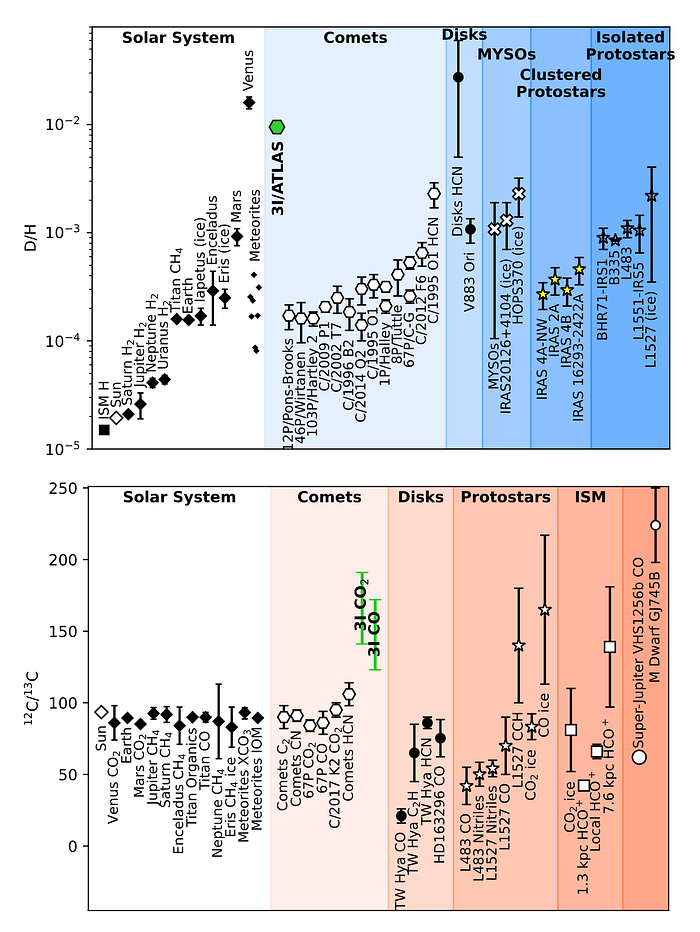
Isotopic ratios observed in water (H2O) shed by 3I/ATLAS compared with Galactic and Solar System observations for D/H (top) and 12C/13C (bottom). (Image credit: M. Cordiner et al. 2026)
The first paper on March 6, 2026 (available here) analyzed spectroscopic data on water in the gas plume around 3I/ATLAS, and derived an enrichment at a level of D/H = (0.95 ± 0.06)%, which is more than an order of magnitude higher than all known comets. In addition, the 12C/13C ratios (141–191 for CO2 and 123–172 for CO) was reported to exceed typical values found in the Solar System and nearby interstellar clouds and protoplanetary disks.
Today, March 24, 2026, a new paper (available here) reported an unexpectedly high D/H = (3.31 ± 0.34)% for the organic molecule of methane (CH4) shed by 3I/ATLAS. This abundance is three orders of magnitude higher than found in methane on solar system planets and well above the values in comets or meteorites. In particular, it is a factor of 14 higher than the value measured in comet 67P/Churyumov-Gerasimenko by the Rosetta spacecraft.
The authors of both papers suggest that the extremely high D/H ratios of water and methane in 3I/ATLAS are a natural consequence of formation in a cold environment below 30 degrees Kelvin, within a protoplanetary disk about 10–12 billion years ago.
However, as I showed in a recent paper here, the association of 3I/ATLAS with the rare population of old metal-poor stars is untenable because they do not carry a large enough reservoir of heavy elements. It should also be kept in mind that ancient proto-planetary disks could not have been cooler than the cosmic microwave background at the time they formed, which at a redshift of ~10 had a temperature of 30 degrees Kelvin.
Hence, an important question arises: since deuterium is fusion fuel, might its over-abundance in 3I/ATLAS flag a technological signature?


No comments:
Post a Comment