whatt is clear is that our measures are far from precise and assumes far too much. Assuming a natural object appears fair but why now?
I postulate that life moves between stars using these comets. This is because the removal vof dark matter outside the solar envelope causes a massive object to increase velocity to around ,5 light speed. more than enough for a resident population to travel star to star easily. Add in wormhole connectors and even residency is unnecessary.
UFOs provide ample conforming evidence that all this is possible and happening. Obviously every comet is not used, but we do not know.
The Mass of 3I/ATLAS is About a Billion Metric Tons, at Least a Hundred Thousand Times That of 1I/`Oumuamua
https://avi-loeb.medium.com/the-mass-of-3i-atlas-is-about-a-billion-metric-tons-at-least-a-hundred-thousand-times-that-of-20e9ebf82c48
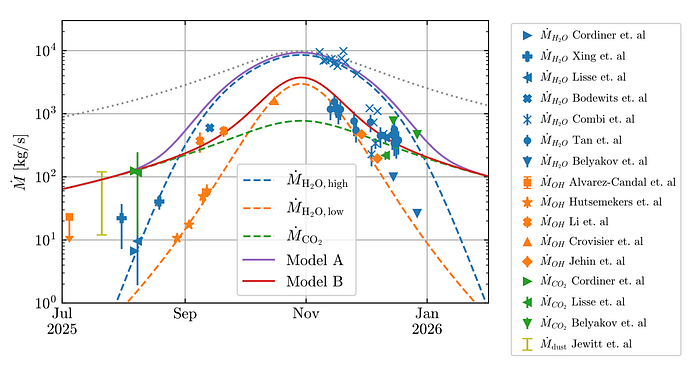
Observational data on the evolution of the mass loss rate of 3I/ATLAS dM/dt in various gasses: H2O (blue), OH (orange) and CO2 (green). The colored dashed-lines show various models for the mass loss rate. The solid pink and red curves display two preferred models to describe the combined total emission rate from water and carbon dioxide. The gray dotted line illustrates a previous model, favored in interpreting the rocket effect based on Hubble Space Telescope data (as reported here). (Image Credit: V. Thoss, A. Loeb and A. Burkert 2026)
A new paper (accessible here) that I just co-authored with the brilliant Valentin Thoss and Andi Burkert from the University Observatory Munich, provides the best assessment to date of the mass of the mysterious interstellar object 3I/ATLAS.
As I discussed here on October 31, 2025, the rocket equation can be used to evaluate the non-gravitational force acting on 3I/ATLAS. The mass of 3I/ATLAS, M, times its non-gravitational acceleration, A, should be equal to the excess mass loss in a preferred direction, ζdM/dt, times the ejection velocity of the outflowing material, V,
M×A = (ζdM/dt) × V .
This provides a way to measure the mass 3I/ATLAS. By measuring the acceleration A and the mass-loss rate dM/dt and by modeling the velocity V, it is possible to derive the mass M of 3I/ATLAS for a reasonable value of the outflow asymmetry-parameter ζ ~0.5.
The new paper uses all available observational data on the evolution of the production rate of gas and dust and the brightening of 3I/ATLAS during the months surrounding its close approach to the Sun on October 29, 2025. The outgassing from the nucleus has led to a detectable non-gravitational acceleration. Our analysis combines models for the mass loss rate of water (H2O) and carbon dioxide (CO2) to derive the non-gravitational force and estimate the mass and size of 3I/ATLAS. In addition, we take into account a conservative constraint on the nucleus size from the active surface required for sublimation. If the mass loss is dominated by the sublimation of CO2, then the nucleus diameter is 0.84 kilometers, assuming a mass density of 0.5 grams per cubic centimeter and an asymmetry-parameter ζ ~0.5. Strong water sublimation of up to 10 metric tons per second from the surface is ruled out, as the required cometary surface area is incompatible with the rocket effect. A more conservative model of water production suggests a nucleus diameter 1.48 kilometer. In this case, a lower than usual cometary density or larger outgassing velocity could make the nucleus size estimate compatible with the lower bound of Hubble Space Telescope data of 2.6 (± 0.4) kilometers (as reported here).
Our analysis adopted three parameterizations: a purely CO2-driven sublimation which scales inversely with the square of the distance to the Sun, and two models accounting
for the contribution from water sublimation. These two models were fitted to the highest (model A) and lowest (model B) reported production rates, encompassing the range of uncertainty. By combining these models with data on the motion of 3I/ATLAS in the sky, we have estimated its mass and size. There is a subtle statistical preference towards the CO2 model with an inverse-square scaling, which becomes pronounced when we only include the data from large telescopes and interplanetary spacecraft. Despite systematic uncertainties, the magnitude of the non-gravitational acceleration can be estimated quite robustly.
The derived mass of 3I/ATLAS is (M/ζ)= 0.3 × 10^{12} kilograms for a CO2-only model, where ζ is the outgassing asymmetry factor. Including the contribution from water sublimation, we obtain (M/ζ)= 1.7 × 10^{12} kilograms and (M/ζ) = 6.4 × 10^{12} kilograms for the low and high limit of water sublimation from the nucleus. All in all, the mass of 3I/ATLAS is of order a billion metric tons!
Assuming a bulk density of 0.5 gram per cubic centimeter and ζ = 0.5, we estimate the diameter of 3I/ATLAS to be 0.84 kilometers for the CO2-driven sublimation, and 1.48 kilometers or 2.3 kilometers for the low (model B) or high (model A) limit of water sublimation.
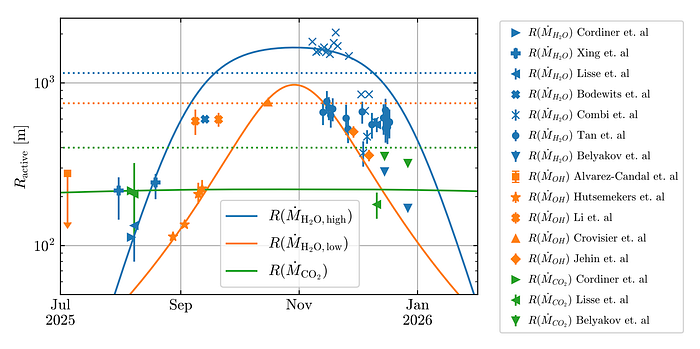
Minimum radius (half-diameter) of the nucleus of 3I/ATLAS, required to sustain the observed production rate of gas with the entire surface being active. The solid lines correspond to various outgassing models and the dotted lines are the corresponding lower limits for the radius of 3I/ATLAS based on its non-gravitational acceleration. (Image Credit: V. Thoss, A. Loeb and A. Burkert 2026)
We derive an additional constraint on the size of 3I/ATLAS by considering the surface required to sustain the sublimation. Under the most conservative assumptions, this leads to a strong tension for the model with high values of water production, requiring a diameter larger than 3 kilometers compared to the maximum value of 2.3 kilometers based on the corresponding non-gravitational acceleration. The high sublimation rate would therefore require a nucleus size that is too large to be compatible with the non-gravitational effect, even under extreme assumptions. This rules out model A and the corresponding mass and nucleus size, while the more conservative model B with lower levels of water production produces a mild tension, which could be alleviated by a lower bulk density or higher ejection velocity. This also implies that the sublimation of water (H2O) from the surface of 3I/ATLAS likely does not significantly exceed that from carbon dioxide (CO2). On the other hand, the bounds for a model which only includes CO2-sublimation is compatible with the non-gravitational estimates of the nucleus size.
The constraints from the active fraction suggest that the rocket effect of 3I/ATLAS might be dominated by CO2 sublimation throughout the orbit, with negligible contribution from water production. In this case the nucleus has an effective diameter of 0.8 kilometers, inconsistently with the Hubble data analysis that provided 2.6 (± 0.4) kilometers. Only if the production rates of CO2 have been underestimated by about an order of magnitude, could the two estimates be reconciled. If on the other hand water sublimation does contribute to the rocket effect of 3I/ATLAS, then the nucleus size would be larger. In this case, a lower than usual comet density together with larger gas velocities and collimation of the outflow could potentially push the estimated diameter as high as 2.2 kilometers, resolving the tension with the Hubble estimate and the required active fraction.
Additional data on the production rates of water and carbon dioxide would help to narrow down the range of possibilities and improve estimates of the mass and size of 3I/ATLAS.
But irrespective of the uncertainties, one conclusion is beyond any reasonable doubt: the third interstellar object 3I/ATLAS is at least 5 orders of magnitude more massive than the first interstellar object 1I/`Oumuamua — whose final mass was estimated to be of order 10⁷ kilograms here and here, assuming a natural origin for it as a hydrogen or a nitrogen iceberg without a visible cometary tail.
Based on the statistics of asteroids and comet nuclei of various sizes in the Solar System, we should have detected at least a hundred thousand 1I/`Oumuamua-mass objects before discovering a single interstellar object with the mass of 3I/ATLAS.
Does this discrepancy mean that one or both of these two mysterious interstellar objects is not natural in origin?


No comments:
Post a Comment