someone is running this war and he is not trump. so just what is happening? Iran is tossing everything on the basis of use it or lose it.
the proclaimed intent is to facilitate a local vsuccessful uprising and regime change/
just how do you do that without a reign of terror? so far i see no reason for sucess yet.
March 2: nobody to call
Guest Post by Gold & Geopolitics
Yesterday I wrote that Trump needed a knockout or technical knockout in roughly two weeks. It’s been three days. He’s already moved the goalposts from four days to “four-to-five weeks, but we have capability to go far longer”. Then, when pressed on timeline: “Whatever it takes”. (Draghi didn’t copyright it. Big mistake.)
“We will easily prevail”, he added. Four American soldiers disagree. They’re dead.
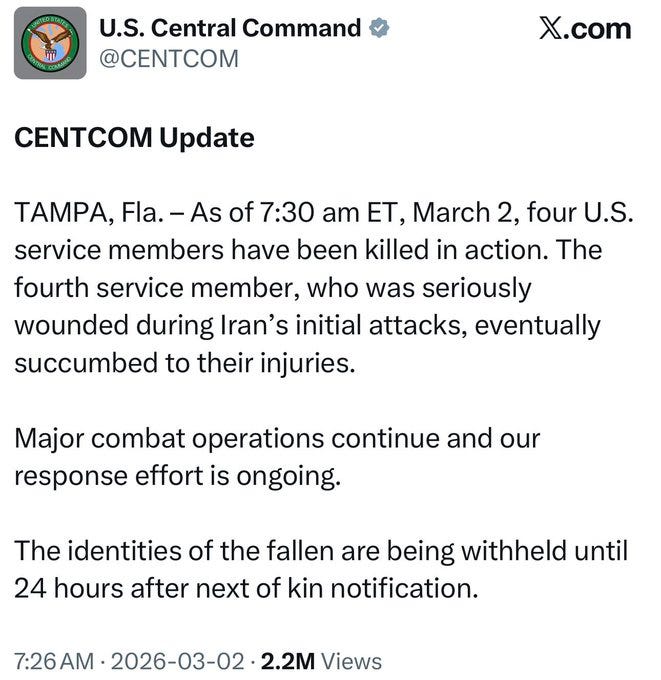
CENTCOM confirmed the fourth fatality this morning – a soldier who’d been seriously wounded during Iran’s initial strikes and succumbed overnight. The wounded count has tripled from 5 to 18. And those are just the numbers they’re releasing on day three of what was supposed to be a surgical operation.
Let’s talk about the story of the day: three F-15s shot down. CENTCOM says they were “mistakenly shot down by Kuwaiti air defenses” at 04:03 UTC. Friendly fire. An accident. These things happen in the fog of war.
Three of them. Simultaneously.
Kuwait’s own military statement said aircraft “fell” over its territory. Fell. Not “were shot down by our air defences in an accident we deeply regret”. Fell. Like they tripped. Kuwait didn’t claim responsibility for shooting them. Kuwait said they crashed.
CENTCOM’s statement included a curious detail: the jets were downed “during active combat that included attacks from Iranian aircraft, ballistic missiles, and drones”. Iranian aircraft. That’s a phrase that deserves more scrutiny than it’s getting. What Iranian aircraft? The IRGC doesn’t have stealth fighters roaming Kuwaiti airspace. Iran’s air force consists largely of F-14 Tomcats from the 70s and some MiG-29s. If those were operational and engaging US jets over Kuwait, that’s a massive escalation nobody’s discussing. And if they weren’t, then what hit those F-15s?
Video footage that circulated before the official narrative solidified showed something hitting an F-15 from behind. A heat-seeker, by the looks of it. Small warhead, maybe 15-20 kg. Effective though. One theory that’s making the rounds is that Iran used a S-300 system at a range of roughly 240 km. The timeline doesn’t help CENTCOM’s version either. The E-3G AWACS took off from Prince Sultan Air Base at 03:20, heading toward Kuwait, arriving around 04:40 – after the jets were already down. You send up your airborne early warning platform after losing three fighters?
All six aircrew ejected and were recovered alive. That’s the one piece of genuinely good news. Kuwaiti citizens helped recover at least one pilot. But CENTCOM then did something revealing: every US military aircraft in the region switched their transponders on. Publicly visible on FlightRadar24. That’s the universal sign of “please don’t shoot us, we’re broadcasting our position to everyone, including the enemy, because we’re more afraid of our own side’s air defences than we are of Iran”.
Hezbollah’s back. That ceasefire from November 2024? Well, it lasted about 15 months, which in Middle Eastern terms is roughly an eternity. On Sunday night they announced their entry by invoking Khamenei’s “pure blood” and launched rockets into northern Israel. Israel responded with strikes across southern Lebanon and Beirut’s southern suburbs. Twenty dead in Beirut, eleven in the south. Israel killed the head of Hezbollah’s intelligence office and the head of their parliamentary bloc.
Lebanon’s government immediately banned Hezbollah’s military activities and demanded the group hand over all weapons to the state. Which is a bit like your landlord sending a strongly-worded letter while the building’s on fire. Hezbollah has said it will only disarm if Israel withdraws completely from Lebanon. So, never.
For the first time ever, Israel reportedly used the Iron Beam – its laser-based interceptor – against Hezbollah rockets. Interesting timing. You do your beta-test of your newest defensive tech during an active war? Probably has nothing to do with the depleting interceptor stockpiles…
Now to the part that broke my brain.
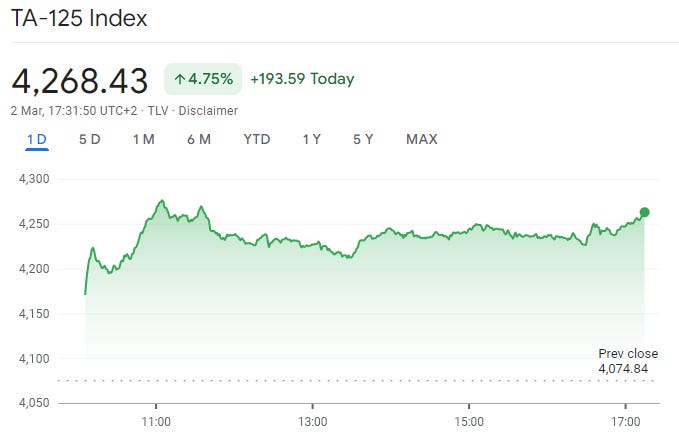
The Tel Aviv Stock Exchange closed up 4.75% on Monday. A new all-time record. The TA-125 hit 4,268. Defence stocks leading the charge, Elbit Systems up 3.4%, NewMed Energy – an offshore gas company, irony of ironies – up 11.87%.
While Iranian missiles are hitting Israeli territory. While nine people were killed at Beit Shemesh. While Ben Gurion Airport remains shut. While 100,000 reservists have been called up. While cluster warheads are falling on Tel Aviv.
Record. High.
The “logic”, such as it is, goes like this: investors believe the joint US-Israeli assault will “ultimately reduce geopolitical risk”. That’s an actual quote from a macroeconomist at Leader Capital Markets. The TA-125 has rallied 48% since Operation Rising Lion in June. War is good for business, apparently, if you’re on the side doing the bombing. Until you’re not. I guess.
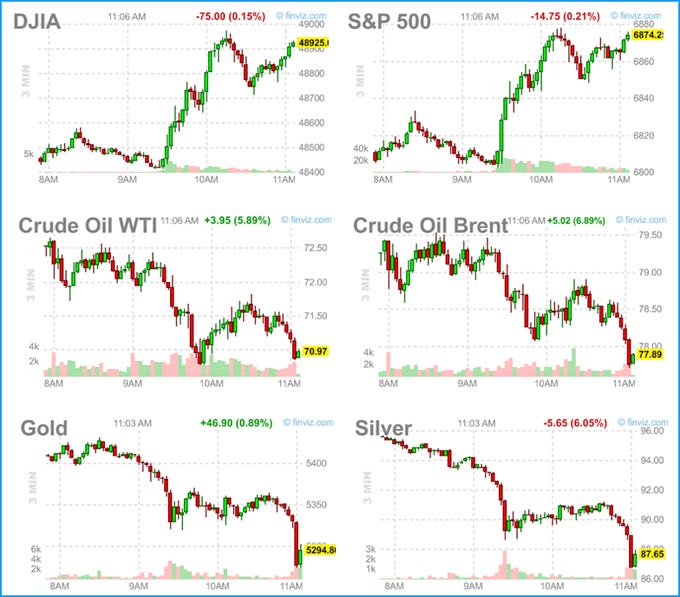
And it’s not just Israel. The entire global market complex is behaving like someone spiked the punch. Oil – with ~30% of global supply offline, the Strait of Hormuz functionally closed, Ras Tanura shut, and Qatar’s LNG production halted – somehow has BRENT glued to $77. With a shooting war across seven countries and two maritime chokepoints sealed.
Gold opened at ~$5,300, briefly tested ~$5,400, then settled back unchanged. Silver got to about $96 before being walked back to $89. Fine moves for a normal day. Barely a rounding error given the scale of what’s happening.
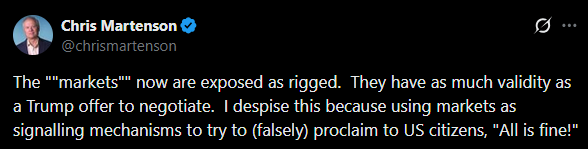
The FT ran a headline saying investors were turning to gold instead of bonds as a haven. JustDario’s response: “The FT clearly hasn’t been informed about the precious metals ongoing price manipulation”. No kidding. When 30% of global oil supply is offline and your oil market barely moves, you’re not looking at a market. You’re looking at a narrative management operation. Someone desperately needs the dials to read “everything is fine” while the world watches missiles hit hotels on the Palm.
Speaking of narratives. Iranian state TV – IRIB Channel 3, the football channel – was hacked. Trump and Netanyahu. Persian subtitles. “Rise up. Take back your country. Seize your destiny.” (needs verification)
A 36-second broadcast, then blackout.
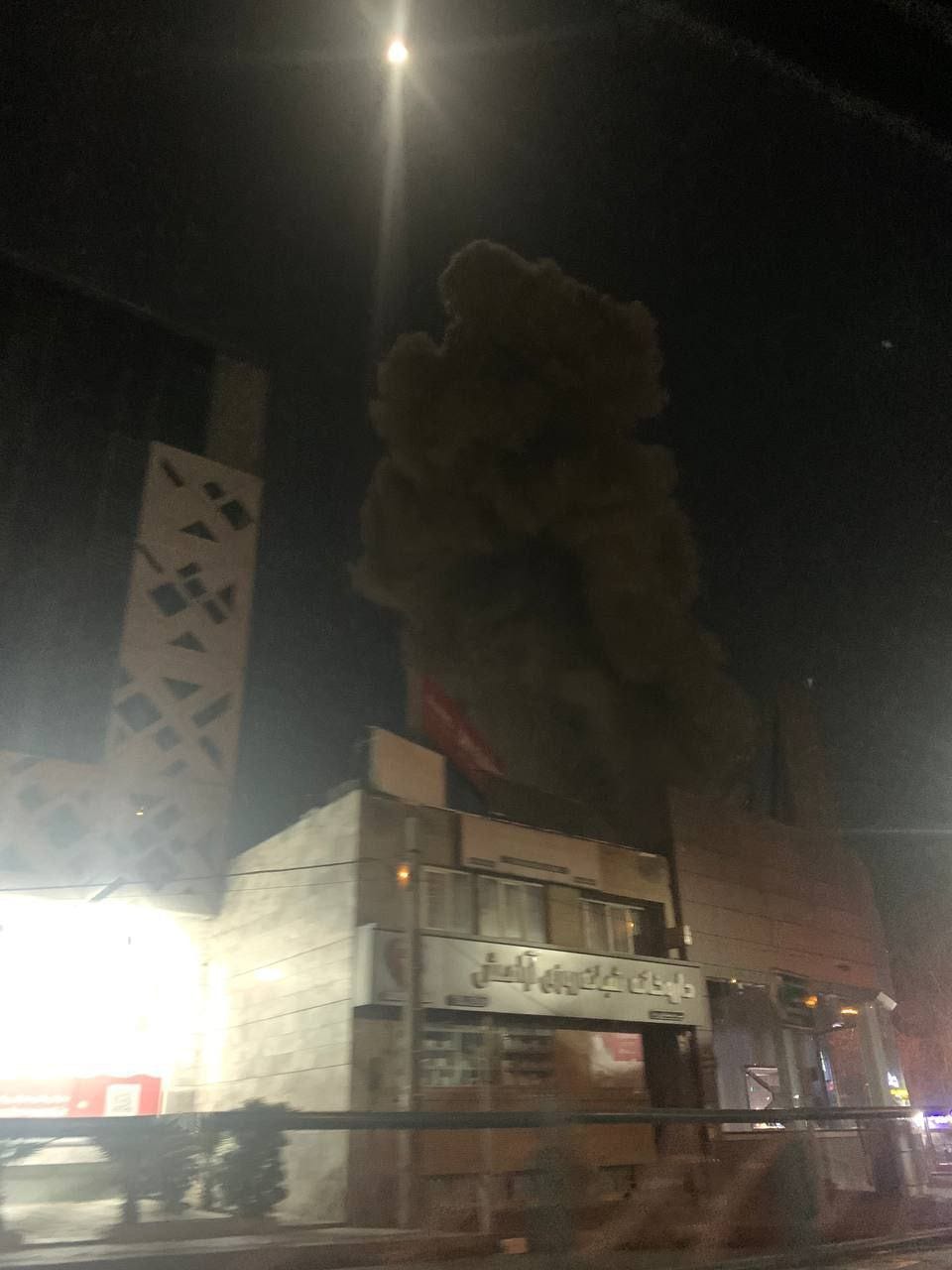
This came hours after fighter jets hit two IRIB broadcast facilities in Tehran, killing several employees. So they bombed the studio, then hacked the signal. Belt and suspenders approach to regime-change messaging.
Now, the practical question: does it work? Iran’s internet has been largely cut. The people who did see it are the ones with satellite dishes and VPNs – i.e., the people who already had access to outside information and probably already had opinions about their government. The people in the streets celebrating Khamenei’s death in Karaj, Shiraz, and Isfahan didn’t need a hacked TV broadcast to tell them what they thought. They already knew.
But this is something that matters long-term. The regime’s information monopoly is broken. Even briefly, no matter how clumsily, the ability to override a sovereign nation’s broadcast infrastructure and put the American president on their screens is a psychological operation with implications that outlast the few seconds it ran. Not because it changes minds today. But because it plants a seed. Whether that breeds hope or resentment depends entirely on how the next few weeks play out.
Ras Tanura is shut. Saudi Arabia’s largest oil refinery, processing 550,000 barrels per day, was hit by an Iranian drone strike. Except… Iran says it didn’t do it. Iranian state TV explicitly denied any attack on Aramco facilities.
An agreement reportedly exists between Iran and Saudi Arabia not to target each other’s oil infrastructure. The Saudis know it. The Iranians know it. When Ras Tanura was hit, Iran’s denial was immediate and emphatic. Multiple accounts I follow landed on the same conclusion: if Iran didn’t hit Aramco, who did?
The obvious candidate is someone who’d benefit from Saudi Arabia being dragged deeper into the conflict. Someone who’d want Riyadh’s plausible deniability about hosting US strike operations to collapse entirely. Someone who’d like the Saudis to formally declare war on Iran rather than play the awkward middle. I’ll let you fill in that blank.
There’s precedent for this kind of thing. The USS Liberty didn’t torpedo itself either. It wouldn’t be the first time a regional ally was nudged into a war through a conveniently timed provocation on their own soil. The Saudi response will be telling. If they blame Iran and escalate, the agreement was either fiction or has been deliberately sabotaged. If they stay quiet and absorb it, they know.
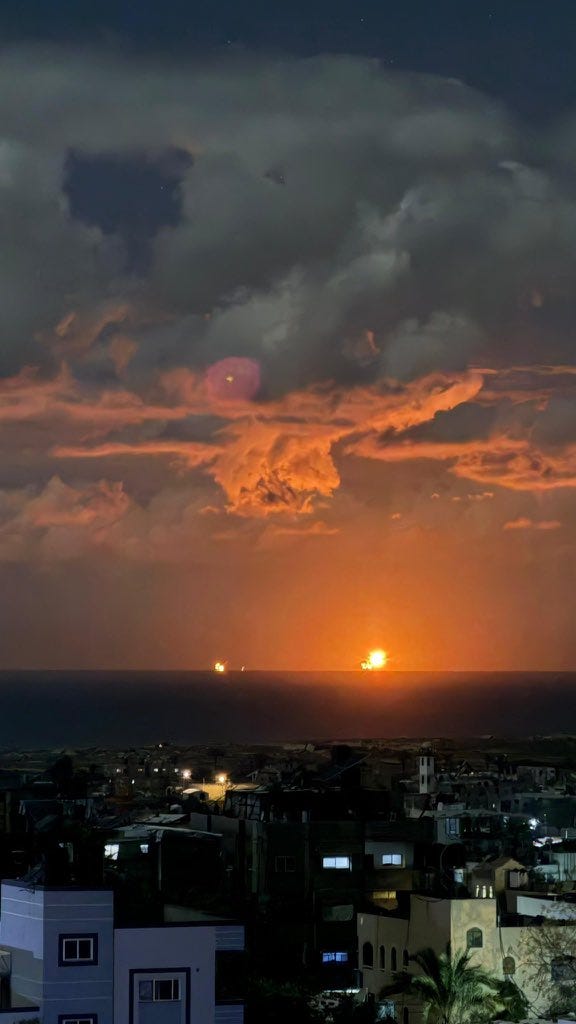
Gas platforms are burning off the coast of Gaza. Israel’s offshore gas extraction infrastructure – the ones tapping Palestinian gas reserves that international law has a few things to say about – took hits. It barely registered in the press, but it’s strategically significant. Israel depends on those platforms. They feed domestic energy consumption and LNG exports. Losing them, even temporarily, compounds the Ben Gurion shutdown, the desalination vulnerability, and the closed maritime space into a portrait of a country whose basic infrastructure is being systematically threatened.
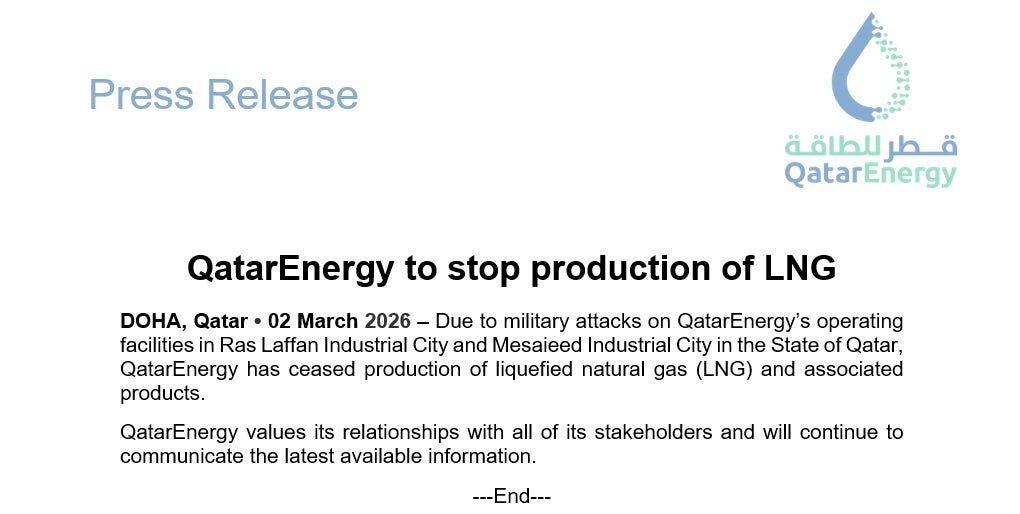
Qatar halted LNG production at Ras Laffan. Natural gas is a just-in-time business. Oil can sit in tanks. LNG needs to keep moving. It can’t.
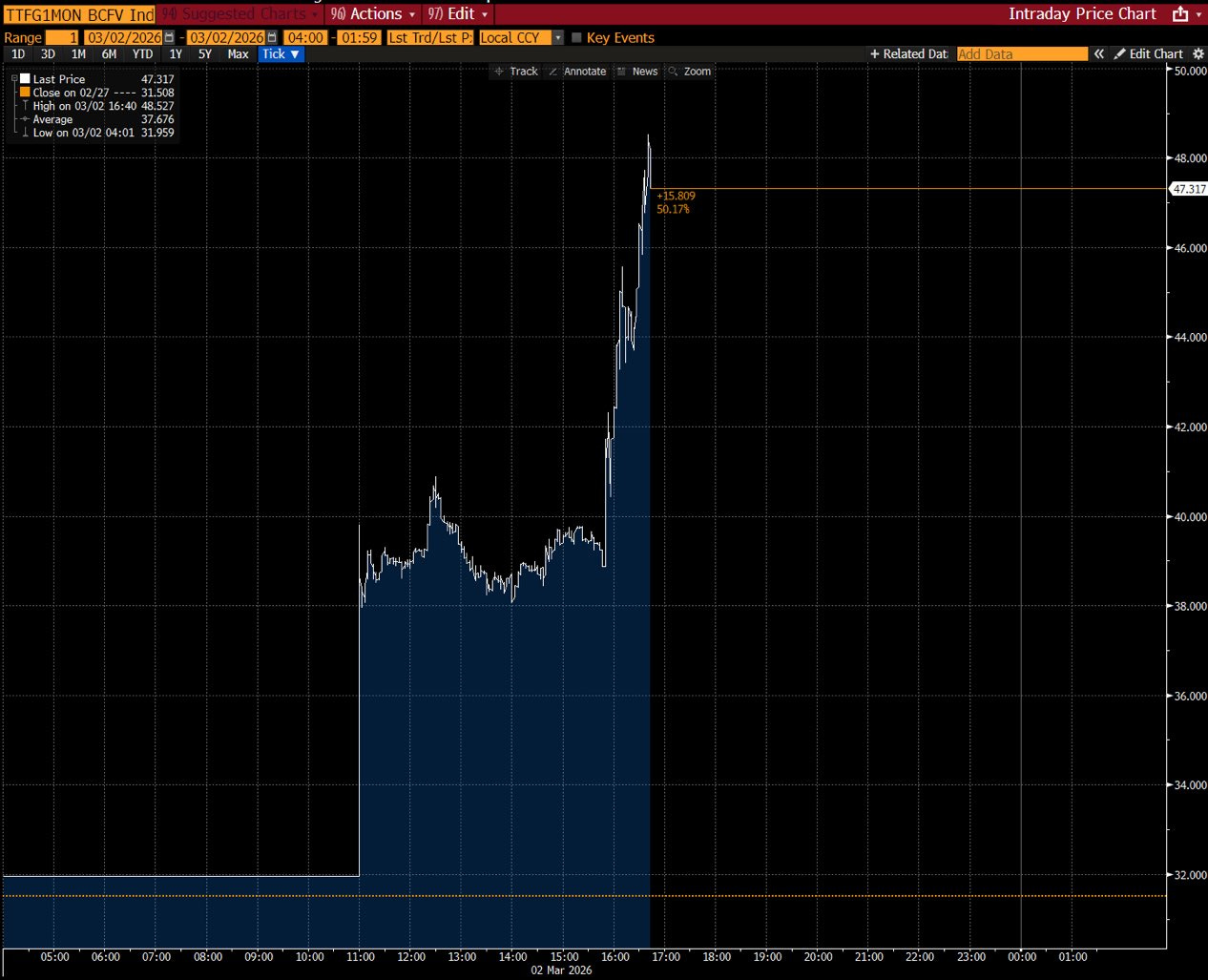
European gas prices jumped over 50% on the news. Goldman had already warned of a potential 130% upside risk for TTF if LNG flows were blocked. The market reacted with “violent short covering”, in the words of one analyst who couldn’t quite believe how many people had been short TTF with a war brewing. I can’t believe it either, but then again these are the same markets telling me oil volatility is lower today than Friday.
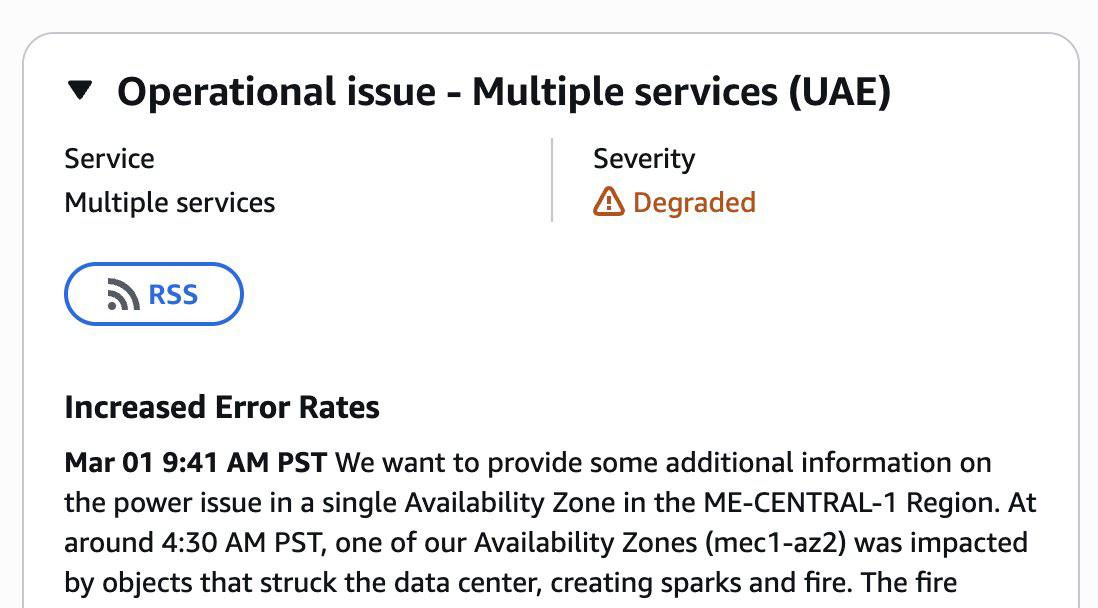
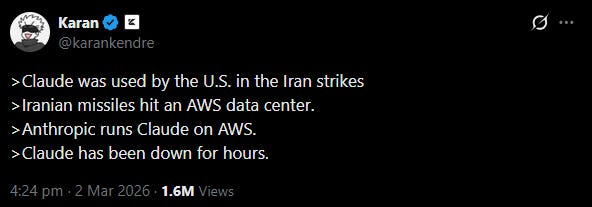
The AWS data center in the UAE took a hit. Amazon’s cloud services reported a fire and “degraded service” in one availability zone. A significant chunk of Middle Eastern and South Asian corporate infrastructure runs through UAE data centres. When your cloud provider’s physical hardware is being bombed, your disaster recovery plan probably needs an update. Patrick Henningsen’s take: “The Iranians know which servers are running US military AI platforms”. Maybe. Or maybe they just aimed at everything large and American in the UAE.
Spain banned the US from using its military bases. Rota and Moron are out. Nine tankers were spotted departing the Moron airbase – and before you ask, yes, that’s a real place, and no, we’re not talking about the one in Washington. Pedro Sánchez condemned the strikes as a breach of international law and emerged as the first Western leader to break ranks. The tankers are already in the air, headed for Istres in France – a French base that hasn’t hosted American tankers in three years. NATO’s ‘unified response’…
Meanwhile, the UK’s RAF Akrotiri took its first hit. Cyprus confirmed a Shahed-type drone struck inside the base just after midnight, causing “minor damage”. Sirens went off again Monday morning when two more drones were intercepted heading toward the facility. Typhoons and F-35s scrambled.
The UK confirmed it was allowing its bases to be used. Which means those bases are now legitimate military targets under international law. The European Journal of International Law published an analysis on this exact question today. Legal scholars are already debating it. Iran isn’t going to wait for the academic consensus.
France is repositioning the Charles de Gaulle to the eastern Mediterranean. NATO is creeping into this one “defensive redeployment” at a time.
The interceptor math is catching up.
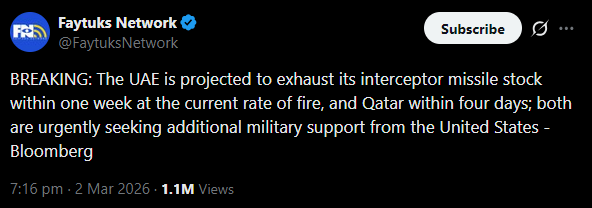
The UAE is projected to exhaust its interceptor missile stocks within one week at the current rate of fire. Qatar: four days. Both are urgently seeking additional supplies from the United States – which itself is cannibalising global stockpiles, per Trump’s own comments to the New York Times.
This is exactly the arithmetic I laid out on day one. Iran fires cheap. Defenders fire expensive. The ratio is somewhere between 14:1 and 100:1 in the attacker’s favour. A $35,000 Shahed drone costs $500,000 to $4 million to intercept. Run that equation across a “four-to-five week” campaign and it’s not just militarily unsustainable. It’s financially absurd. The IRGC knows this. Their sequencing – old stockpiles and cheap drones first, advanced systems held back – is designed to drain the magazine before the real stuff arrives.
General Jabbari wasn’t bluffing when he said they’d fired the old inventory first.
Trump said his stated objective is to “destroy Iran’s missile capabilities”. He’s succeeding. In a way. The missiles are definitely being removed from Iran. At approximately Mach 5, mostly toward US bases and Israeli cities.
Not sure that’s what the Pentagon briefing meant.
The diplomatic picture is fracturing in real time. UAE and Qatar are privately begging allies to help them convince Trump to find an off-ramp. Kuwait has a dead soldier and a burning US embassy compound. Saudi Arabia got exposed by satellite imagery showing US operations from Prince Sultan Air Base – and then got hit for it. The kingdom’s “strong condemnation” of Iranian attacks rings hollow when your runway is being used to launch the strikes that provoked them.
Iran’s FM Araghchi told Al Jazeera that “some neighbours are angry”. Understatement of the century. Those neighbours are being bombed because they host American bases, and the one thing they were promised – that US air defences would protect them – is visibly failing. The Gulf security architecture, the one built over decades of weapons sales and basing agreements, is being stress-tested to destruction in real time.
Iran prepared for decapitation strikes by pre-authorising field commanders to retaliate at will. The FM himself admitted that military units are “mostly out of command at the moment”. So you have a hydra situation. You cut the head, and the body fights on, but now without anyone at the top who can agree to stop. Nobody to call. Nobody to negotiate with. Nobody to surrender.
Trump says he had three “very good choices” for Iran’s next leader. Problematic, as they were all killed in the initial strikes. (Facepalm)
He’s now telling the New York Times he “won’t rule out ground troops”. Hegseth backed it up: “We’ll go as far as we need”. The war that was sold as an air power demonstration – clean, decisive, surgical – is three days old and they’re already floating a land invasion of a country three times the size of Iraq with a military that’s been preparing for exactly this scenario for twenty years.
Four days became four weeks. Next up …?
Still devolving…


No comments:
Post a Comment