
I have already posted that we experience our universe inside a sphere caused by the first act of creation which is consciously inducing the creation of the SPACE TIME Pendulum (neutrino)which naturally induces TIME and the next layer of neutrinos by geometric decay. Decay produces a neutrino and a decay photon to carry off surplus geometry.
this all induces an expanding surface of neutrino creation. Understand these neutrinos and photons remain interior to the surface and such objects then progressively coalese into first neutral electron pairs and then into neutral neutron pairs. empirically we observe the microwave background radiation which this obviously predicts outright.
That surface is a mirror and it reflects light back and forth now over billions of internal years inducing the illusian of an infinate universe and infinate galazies. I suspect that we are looking at only one galaxy imaged billions of times over different past eras.
So just how fast is the front exanding relative to its internal clock? our galaxy is at best a bubble 200,000 light years across. slo mo still gets you there over billions of years. My point though is that the front is moving very much at sub light speeds and plausibly even human slow. All of which makes multiple galaxies a stretch.
also understand that the surface of the front will be fractalized which allows image capture as mathematical continuity will not exist. We may be looking at billions of individual bounded mirrors.
We can attempt estimates of the expansion velocity, but will all be open to debate.
Speculations on What Could Show Physics Beyond the Standard Model
June 22, 2026 by Brian Wang
https://www.nextbigfuture.com/2026/06/speculations-on-what-could-show-physics-beyond-the-standard-model.html#more-210565
Post-spacetime physics refers to the idea that our familiar 4D spacetime is not fundamental but emerges from deeper structures—whether geometric (fiber bundles, higher-dimensional manifolds), quantum (entanglement, information), or vacuum effects. Eric Weinstein’s Geometric Unity (GU) proposes a 14-dimensional geometric framework (involving a metric bundle over 4D spacetime) from which the Standard Model forces, gravity, and our observed spacetime derive via some Shiab operator and symmetry breaking. There is no evidence for any of the higher dimension theories or speculation. Mainstream physicists as not yet a workable theory.
Mike McCulloch’s Quantized Inertia is a different proposal and theory. Inertia emerges from Unruh radiation (quantum vacuum fluctuations perceived by accelerating observers) modified by a Hubble-scale Casimir effect from cosmic horizons. This leads to acceleration-dependent inertial mass, explaining galaxy rotation curves without dark matter, certain anomalies (Pioneer, flyby), and predicting propellantless thrust in asymmetric cavities or high-acceleration setups.
The most plausible paths, ranked by near-term feasibility for some evidence of new physics.
1. Tabletop quantum gravity experiments succeed (strongest near-term candidate)
Proposals (Bose, Marletto-Vedral, Pikovski ) test whether gravity can entangle two quantum systems in superposition or mediate quantum correlations. A positive result would show gravity has quantum features and support models where classical spacetime emerges from quantum entanglement/information.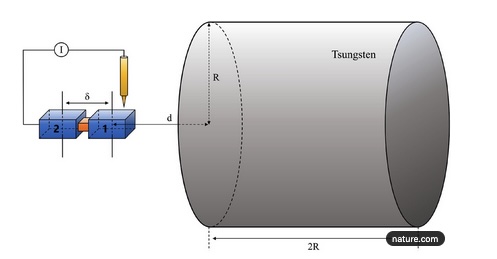 Screenshot
Screenshot2. LISA (Laser Interferometer Space Antenna) or next-gen gravitational wave detectors reveal new physics
LISA (three spacecraft in solar orbit, ~2.5 million km arms) will detect low-frequency gravitational waves from supermassive black hole mergers, extreme mass-ratio inspirals (EMRIs), and potentially a stochastic background from the early universe.
Timeline: Launch targeted for mid-2030s (~2035); science operations shortly after. Data in the 2035–2045+ window.
Signatures of post-spacetime could include deviations from classical GR in strong fields, imprints of quantum gravity (emodified dispersion or echoes), or primordial signals inconsistent with standard inflation but fitting emergent/holographic cosmologies. Ground-based detectors (LIGO/Virgo upgrades, Einstein Telescope) add complementary data.
3. Modified inertia/ emergent gravity effects with actual propulsion in orbit
Precision tests of galaxy dynamics (wide binaries, rotation curves), solar-system anomalies, or lab thrust experiments. If inertia or effective gravity depends on cosmic-scale horizons or acceleration in ways predicted by QI (or analogous emergent models), it supports spacetime/inertia as derived rather than fundamental.
4. Black hole or early-universe observations resolve information paradoxes via holography/emergence
Event Horizon Telescope upgrades (ngEHT), future X-ray or gravitational lensing missions, or cosmological surveys (Roman Telescope, CMB-S4, Euclid) could show quantum information effects or deviations better explained by emergent spacetime than standard GR + quantum fields.
Incremental data in next 10–20 years. Decisive anomalies possible but unpredictable.
5. Indirect routes via quantum simulations or analog systems
Quantum computers or condensed-matter analogs simulating black holes, horizons, or entanglement-generated geometry could demonstrate emergent spacetime phenomena. Less direct but faster to iterate.


No comments:
Post a Comment