so far, it seems that non gravitational acceleration is produced by close by solar radiation. natural enough.
This points out that way too much space junk is out there and we now need to sort it all out.
Still no real evidence that these objects are adjusting their orbits on a pass. I have shown possibility but a real adjustment has not been identified. Of course most of our objests are not extra solar as far as we can discover.
Is the `Dark Comet’ 1998 KY26 the Spacecraft Phobos 1?
https://avi-loeb.medium.com/is-the-dark-comet-1998-ky26-the-spacecraft-phobos-1-304169bce8a2
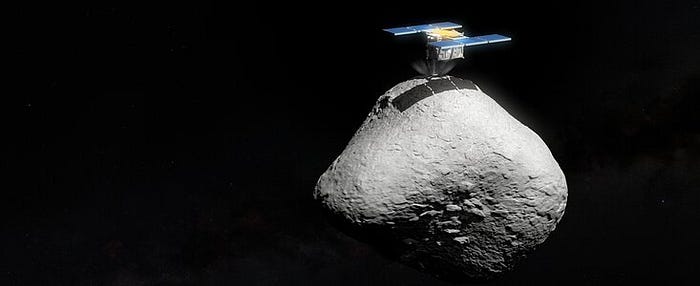
An artist’s illustration of the planned landing of JAXA’s Hayabusa2 spacecraft on the `dark comet’ labeled 1998 KY26. (Image credit: Kommesser/ESO)
Dark comets are a proposed class of curious hybrids between comets and asteroids. These objects show significant non-gravitational accelerations, yet they exhibit absolutely no sign of cometary outgassing in the form of a coma or tail. The first recognized interstellar object, 1I/`Oumuamua, showed these features and was suggested to belong to this class in a recent mainstream publication, posted here. However, based on its inferred flat shape (published here) and non-gravitational acceleration, I argued in a much earlier publication here that 1I/`Oumuamua might be technological in origin. The dark comet categorization of 1I/`Oumuamua and similar solar system objects was the mainstream response to my nontraditional suggestion.
A year ago, I wrote a paper (accessible here) with my postdoc, Richard Cloete, suggesting that the dark Comet labeled 2005 VL1 might be the Venera 2 Spacecraft, a failed Soviet mission to Venus launched in November 1965.
Another member of the proposed class of dark comets in the Solar system is 1998 KY26. The nature of 1998 KY26 is not just an academic question. The Japanese Aerospace eXploration Agency (JAXA) plans to land the spacecraft Hayabusa2 on this object in July 2031. In its original mission, Hayabusa2 explored the 900-meter-diameter asteroid 162173 Ryugu in 2018, returning asteroid samples to Earth in 2020. With fuel remaining, the spacecraft was sent on an extended mission until 2031, when it is set to encounter 1998 KY26. This will be the first time a space mission encounters a tiny object on the size scale of 10-meters. Mainstream astronomers hope that this landing will reveal the nature of outgassing from a dark comet.
1998 KY26 was observed by a number of ground-based telescopes to support the preparation of the Hayabusa2 mission, and the results were reported in a 2025 Nature Communication paper — accessible here.
Interestingly, this so-called `dark comet’ was observed to be shiny with a very high reflectance (albedo) of 0.52 (±0.08). Its inferred size of 11 (±2) meters is comparable to that of a spacecraft. In addition, it exhibits an exceedingly short rotation period of 5.3516 (±0.0001) minutes which implies a sturdy monolithic object, whereas a rubble pile asteroid would break up under the associated centrifugal force.
In a new paper that I just co-authored with the brilliant Adam Hibberd, Adam Crowl, and Carlos Olea (accessible here), we present supporting evidence that 1998 KY26 could be technological in origin. In particular, we identify it as potentially a relic of a historical Russian mission to Mars, the Phobos 1 probe, which suffered a failure 2 months after the launch in July 1988, due to upload of a faulty command.
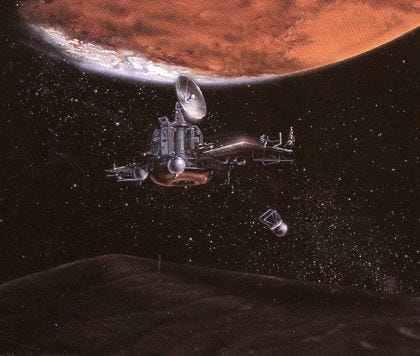 An artist’s illustration of the Phobos 1 spacecraft. (Image credit: Michael Carroll/JPL/NASA)
Our new paper shows that that two propulsive velocity thrusts (∆Vs) combined at 1.9 kilometers per second, the first just after loss of mission and the second in May 1996, allow the orbits and phases of the two bodies to align, with an arbitrarily low separation in velocity-position space. There is also evidence that 1.9 kilometers per second was within the performance envelope of Phobos 1, which had a powerful nitric acid and amine-based autonomous thruster for Mars Orbital Insertion.
Our analysis cannot unequivocally identify that 1998 KY26 is definitely the Phobos 1 probe. Nevertheless, we have shown quantitatively that
1. The Phobos 1 and 1998 KY26 orbits are similar. The two orbits converge and are statistically compatible, given the uncertainty in the orbit of 1998 KY26, which is tightly constrained due to the existence of over 230 observations of this `dark comet’.
2. The difference between these two orbits is compatible energetically with the overall velocity thrust (∆V) envelope available to Phobos 1.
3. There is a historical record in support of the hypothesis that a propulsive velocity thrust (∆V) was delivered shortly after loss of mission.
4. The Phobos 1 mission was lost early on in the probe’s transit to Mars, enabling a large ∆V capability.
5. The observational data on the physical properties of the dark comet 1998 KY26 support the association with Phobos 1. This includes the measured small size, high albedo and unusually large spin, which favors a sturdy object over a rubble pile asteroid.
6. The dark comet appears to be quite elongated based on changes in its apparent magnitude, as expected for Phobos 1.
Gladly, the verdict on our association of the `dark comet’ 1998 KY26 with the spacecraft Phobos 1 will be indisputable once JAXA’s Hayabusa2 mission gets close to it. The beauty of science is that hypotheses can be tested experimentally beyond any reasonable doubt. This is why the Vatican acknowledged publicly in 1992 (as reported here) that Galileo Galilei was right and the Sun is not moving around the Earth as they claimed for centuries. I wonder whether the mainstream of comet experts will acknowledge that 1I/`Oumuamua may have not been a natural `dark comet’ if it becomes clear that their so-called `dark comet’ 1998 KY26 is technological in origin, beyond any reasonable doubt.
My plea to the mainstream of comet experts is simple. Please extend your training data set to include not just rocks and icebergs but also the space objects launched by humans over the past 69 years. After all, we know that the truthfulness of statements made by AI systems depend sensitively on the extent of their training data sets. This is why the U.S. invests in 2026 over 700 billion dollars in data centers for training AI systems. The database on all space objects launched by humans is a rather modest addition to all the asteroids or comets we know about. Is it too much to ask that the assessments of comet experts will be trained on it as well?
On September 17, 2020, Pan-STARRS 1 — the same telescope that discovered 1I/`Oumuamua, identified another near-Earth object which showed non-gravitational acceleration without a cometary tail. Naturally, this object, labeled 2020 SO, would have been classified as another `dark comet’. However, follow-up spectroscopy by NASA’s Infrared Telescope Facility revealed that its spectrum resembles that of stainless steel, confirming that it is the Centaur upper stage used to launch in September 1966 the Surveyor 2 spacecraft towards the Moon. I rest my case.
2020 SO was pushed away from the Sun by solar radiation pressure, the same mechanism that I proposed in a 2018 publication here as the source of the non-gravitational acceleration of 1I/`Oumuamua. We know that 2020 SO has a technological origin because we launched it. The remaining question is who launched 1I/`Oumuamua?


No comments:
Post a Comment