The problem is that China is an idea, just as Islam is an idea used as a political organizing principal. It all covers continous ethnic diversification struggling with hiearchial aggrandization. Exactly who is tha tpure german? or pure Han?
All this rubbish is an artifact of political agitation and struggle to assemble power. not so good.
Again democracy has been really good so far is slowly diffusing this type of power assemblage. After all, political parties struggle to become inclusive which overrides ethnic power schemes.
China needs active provincial democratic systems and also muni councils. All possible ,but the CCP really needs to wash away without triggering another civil war.
One China, one world
China’s regime insists on national unity and international harmony. Is this anything more than an imperial posture?
China’s president Xi Jinping (front row, centre) and other leaders at the third Belt and Road Forum for International Cooperation at the Great Hall of the People in Beijing, China, on 18 October 2023. Photo by Suo Takekuma/AFP/Getty Images
is professor emeritus of history at Yale University in the US. His books include China Marches West: The Qing Conquest of Central Eurasia (2010), the co-edited collections Imperial Formations (2007) and Shared Histories of Modernity (2008), and the coauthored volumes Global Connections (2015) and Asia Inside Out (2015-19).
If you think that the People’s Republic of China is still a communist country, you are in for a shock. It is, of course, a single-party state ruled by the Chinese Communist Party. But what is the role of the CCP today? The Party celebrates billionaires, runs a capitalist economy, and depends heavily on global trade and investment. This is far from what Mao Zedong imagined when he took power in 1949. Then, the CCP claimed to lead the proletarian classes toward socialism and eventually communism. But what now justifies Communist Party rule? In the past decade or so, the CCP has defined its role in a way that would make Mao spin in his grave. China’s president Xi Jinping has endorsed the ‘great unity’ thesis, which interprets several millennia of Chinese history as the harmonious amalgamation of diverse peoples into a single culture and state, dedicated to bringing peace to ‘all under heaven’. Inconvenient concepts like the proletariat, feudalism and modes of production have vanished. Community, continuity and Confucius now prevail over class struggle, revolution and Karl Marx.
In an address to a symposium on culture on 2 June 2023, Xi Jinping declared that the ‘outstanding unity’ of Chinese culture has persisted for 5,000 years. This unity originated with the formation of the Huaxia cultural community in the 3rd millennium BCE. In Xi’s view: ‘Political unity is the prerequisite and foundation for cultural unity.’ The Qin and Han dynasties built upon this community and developed it continuously through later dynasties and into the 20th century. China consists of multiple ethnic groups whose diversity must be respected, but all have melted into a single nation bound by spiritual ties. ‘Territorial integrity, national stability, ethnic solidarity, and the continuation of civilisation’ become a single unit, ‘concentrated and centralised’ under a single state.
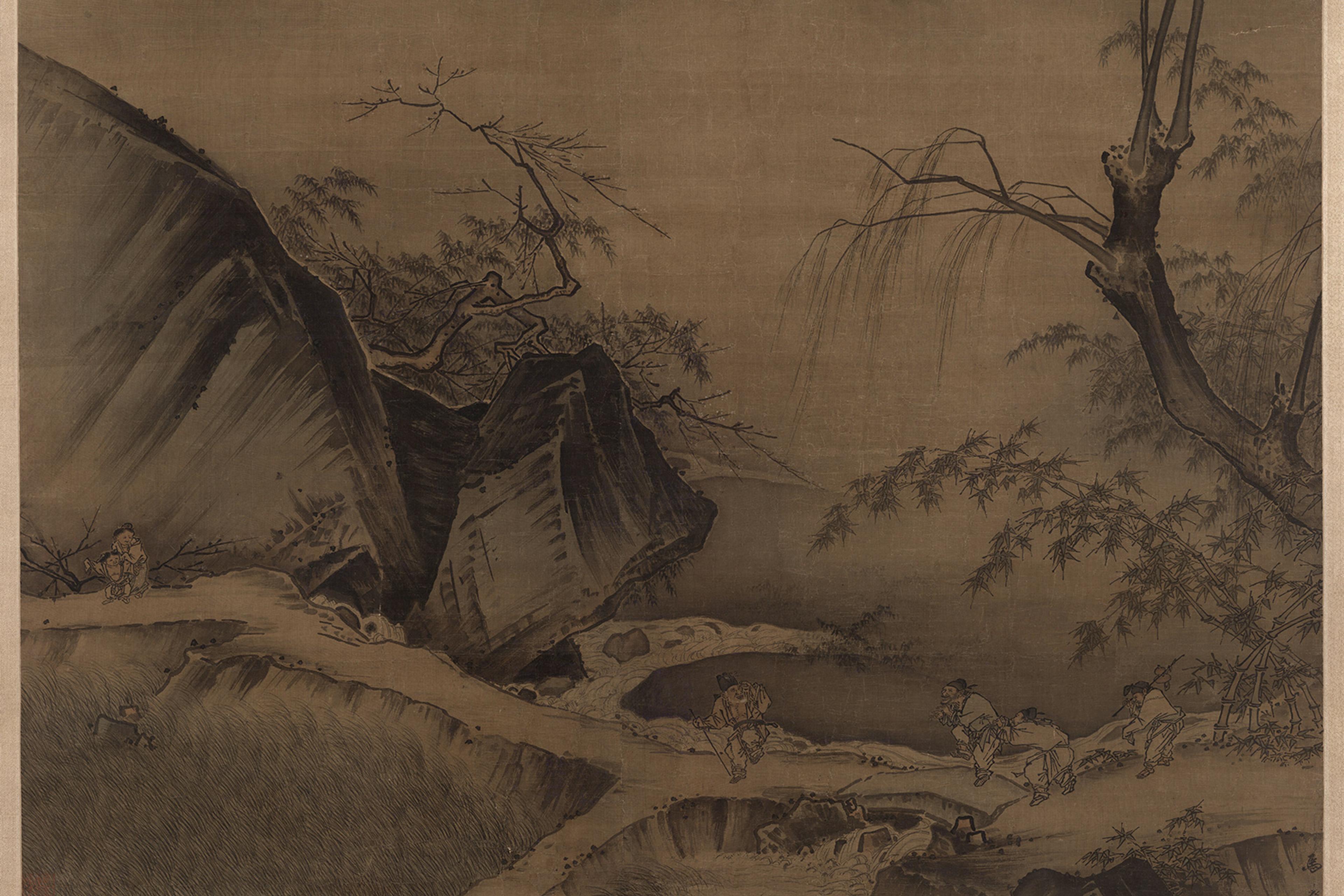
Detail from Dancing and Singing (Peasants Returning from Work) by Ma Yuan (1160-1225). Courtesy the Beijing Palace Museum/Wikipedia
Liu Yuejin, a member of the Chinese Academy of Social Sciences, responded to the statement by an interviewer from the China News Service that China was the ‘only civilisation in the form of a state that has never been interrupted’ by agreeing that for ‘more than 5,000 years … all ethnic groups in China have … jointly forged the Community for the Chinese nation.’ He added that every person who is part of the ‘big Chinese family’ must embrace territorial integrity as the basic symbol of national dignity. Great unity preserves a ‘close-knit community’ that embraces a ‘harmonious and syncretic culture’. He contrasted this culture of harmony with a Western culture that ‘takes interests as the core value, emphasises man’s natural right and law of competition [sic], [and] advocates individualism.’
For these officials and scholars, the great unity thesis provides not only an explanation of Chinese history, but also a model for geopolitical harmony. They celebrate communitarian harmony as an alternative to the Western model of great power politics. Thus, both in theory and in practice, the People’s Republic of China, guided by principles of non-interference, mutual benefit and respect, behaves differently from other states.
Zhao Tingyang, professor of philosophy at the Chinese Academy of Social Sciences, has argued that the concept of tianxia, or ‘all under heaven’, can bring peace to the modern world. Competitive nation-states, inequality and imperial exploitation can no longer resist the pressures of globalisation. As global forces undermine the sovereignty of nation-states, humanity needs a total-world view, inclusive of all peoples, rather than inevitable conflict between divergent national interests and individuals. His tianxia perspective, derived from his study of the relationship of kingdoms during the Zhou dynasty (1046-256 BCE), promotes communitarian interest, mutually beneficial relationships, and the general welfare. He rejects the individualism of Western political theory in favour of the Confucian concept of ren (‘reciprocity’). If nations and individuals respect each other’s values as part of a larger whole, they can work together to attain the ‘expansive harmony’ represented by the Confucian ideal of datong (‘great unity’). Zhao supports democracy and pluralism, but he subsumes these ideals under the larger goal of harmony.
The Yale historian Odd Arne Westad, in his foreword to Zhao’s book, notes that Zhao implicitly assumes the superiority of Chinese imperial dynasties when he draws on their political conceptions as the model for future world peace. Ignoring their real record of violent conquest, Zhao instead propagates cultural determinism: the vision of the common good represented by datong ultimately will create a peaceful global community.
The modern roots of datong spring from the Utopian tract Datongshu, completed in 1902 by the brilliant Confucian scholar Kang Youwei. The first leader of the Nationalist Party, Sun Yat-sen endorsed it, as did Sun’s successor Chiang Kai-shek, and the term occurs in the national anthem of the Nationalist Party: ‘Our party honours the three principles of the people; so as to build China and realise datong.’ This slogan of unity, which aided the Chinese people to envisage a better future during the wars and invasions of the 20th century, however, has taken on a different appearance today. The great unity thesis now celebrates the achievements of the Communist Party as the culmination of Chinese civilisation and a guide for the entire world.
Western observers, and many of China’s neighbours, look askance at these claims. For them, China practises imperialism, pure and simple. They may cite its use of economic sanctions and military force to dispute the ownership of islands in the South China Sea, in defiance of international law. It has also used trade sanctions to pressure countries like Japan and the Philippines to support China’s foreign policy goals. Many also regard the Belt and Road Initiative as a form of economic imperialism. The BRI provides capital to build railroads, ports and gas terminals connected to China, but has also taken control of assets when the loans are not paid. Border conflicts with the Soviet Union, India and Vietnam, and the refusal to renounce the use of force against Taiwan, indicate that China will project power and defend territorial gains when it is able to do so. The United States, which targets China as its key strategic rival, expects continual competition for essential resources like rare earths and computer chips.
On the other hand, the practices and ideology of the People’s Republic of China do not simply mirror the age of 19th-century imperialism. The PRC has fought border conflicts, but, except for the South China Sea, it has not occupied new territory beyond the limits of the Qing empire. Its territory is only two-thirds of the area of the Qing at its maximum extent. It fiercely defends territorial sovereignty and upholds the principle, if not always the practice, of non-interference in other states’ internal affairs. In this respect, PRC policy much more closely resembles territorial nationalism than imperial expansion. Although it has invested heavily in Africa, Central Asia and Latin America, the scale of these investments is far behind that of US and European capitalism. And the PRC’s promotion of green energy, even when offset by the building of coal plants, still contributes to mitigating climate change. A simple equation of the PRC to 19th-century imperialists will not do.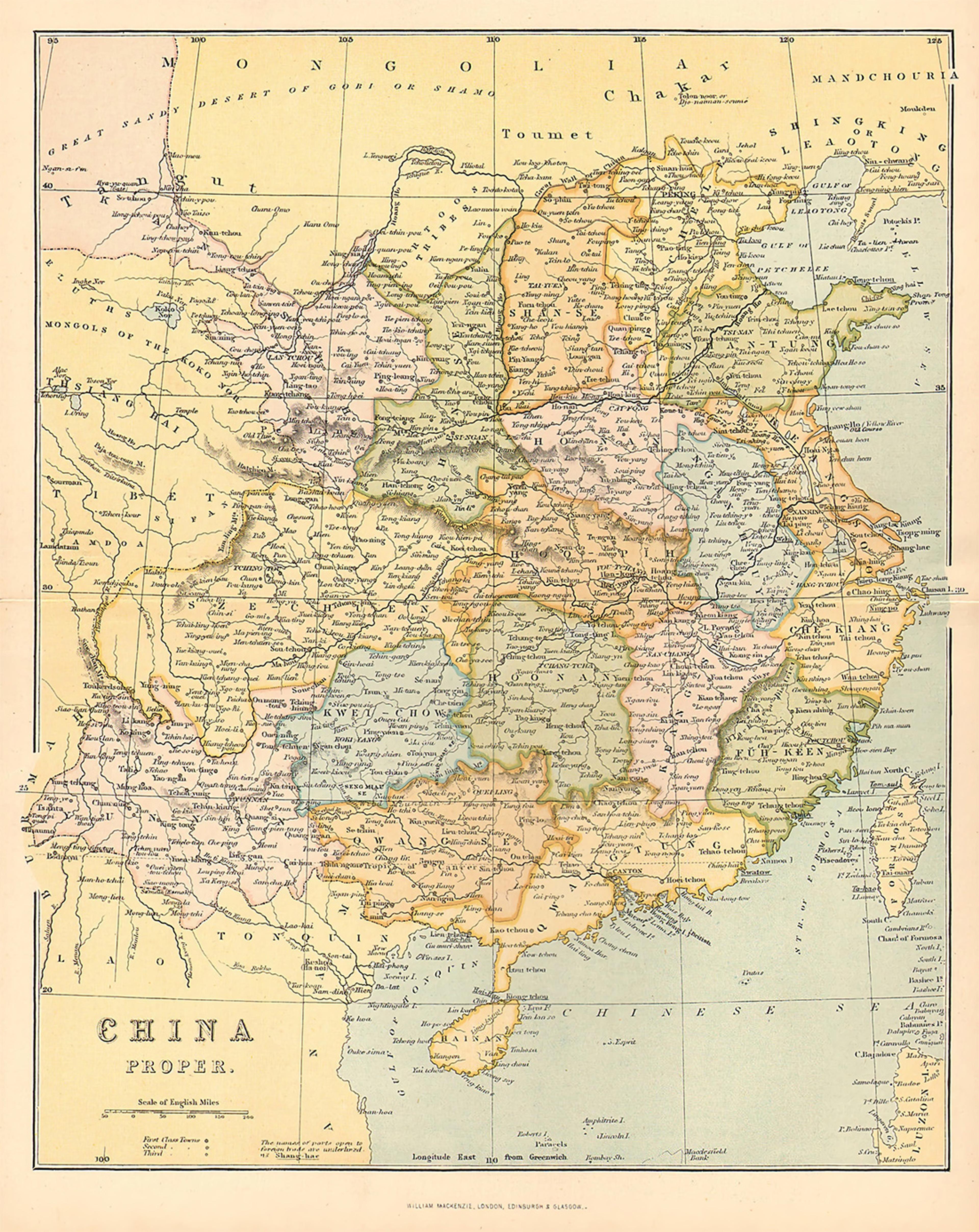
Qing dynasty China in 1866. Courtesy Wikipedia
Yet we may still ask, why have the Western and PRC versions of China’s global role diverged so sharply in the last decade? From Deng Xiaoping’s opening of the country to foreign trade and cultural contact in 1978, under the slogan of ‘hiding your light under a bushel’, to the ‘peaceful rise’ theory of Hu Jintao in the 2000s, symbolised by the accession of the PRC to the World Trade Organization in 2001, it seemed that the PRC aimed to join the global order, not to challenge it. Now it rejects wholesale the concept of a liberal ‘rules-based order’, and this ideology claims its origin from neither Adam Smith nor Marx, but from Confucius.
The great unity thesis has more grandiose goals: to make China the leading power in the world
We could dismiss the great unity thesis as mere window-dressing for great power politics, a convenient mask for a drive for economic and military dominance. Indeed, nearly all imperial powers have proclaimed a benevolent ‘civilising mission’. Is the great unity thesis the Chinese version of a civilising mission, designed to convince other powers of its altruistic intent and its own people of its exalted moral values?
This form of Confucian utopianism, however, hardly seems designed to impress foreign powers, who barely understand it, and it is difficult to tell how much traction it has gained at home. Popular interest in Confucius, formerly denounced as an agent of the feudal ruling class, has certainly exploded since the reform period. Other influences have, however, been equally important. The fastest-growing new religion in China, in fact, has been Christianity. Xi Jinping’s earlier slogan, ‘The China Dream’, meant the attainment of ‘modest prosperity’, a classical phrase for contentment among the people. The new ideology of the great unity thesis, however, has more grandiose goals: to make China the leading power in the world, dominant in all spheres as an economy, as a territorial state, and as a technological and cultural great power. We need to take this ideology seriously and understand it in its own terms.
We defenders of a liberal society may well view the great unity thesis as empirically flawed, tendentious and politically dangerous, a means of legitimising autocratic rule and imposing it on the rest of the world. One of the professional historian’s jobs is to debunk biased interpretations of the past, but we also recognise that ‘mythistory’ is itself a historical force. Westad also emphasises that, since many intellectuals in China take the thesis seriously, it offers valuable insight into the current state of Chinese cultural debate.
Historians of modern China like myself have a particular stake in the way that the great unity thesis redefines Chinese macrohistory. We certainly need to tell history on the grand scale, but with great care. Writing in 1997, the British historian Eric Hobsbawm commented that ‘history is the raw material for nationalist or ethnic or fundamentalist ideologies, as poppies are the raw material for heroin addiction.’ Our role as historians is not to support dominant ideologies; proper history critiques and subverts conventional wisdom by exploring paths not taken and alternative modes of living. The great unity thesis instead reinforces conformity. Quite a few leading Western and Chinese historians have now contributed to this discussion. Much of it supports these two points:
1. The great unity thesis is not a persuasive account of China’s premodern history. Its concepts originated in the early 20th century, when nationalist ideology crystallised. Nationalist ideology grew out of the entangled threads of Western ideology and classical Chinese theories of culture. It is scanty on empirical detail, so it is difficult to confirm or refute. It cherrypicks events from an extraordinarily diverse past. As scientists would say, it is not even wrong. This kind of history leads to an unfortunate narrowing of the mind. I certainly do not mean to imply that everyone shares this view. Historians in China have done outstanding work, but this thesis casts out much of their hard-won knowledge in favour of a parochial perspective.
2. It is also logically incoherent. Trying to graft China’s extensive, diverse past onto the demands of the modern nation-state inevitably produces impossible contradictions. All modern nation-states define themselves as unique products of territory, genealogy and history; China is no different. Benedict Anderson, in his pathbreaking theory of nationalism, Imagined Communities (1983), described this kind of official nationalism as an attempt to stretch ‘the short, tight, skin of the nation over the gigantic body of the empire’. China’s long imperial heritage, however, makes this effort particularly problematic. So many dynasties with different boundaries, rulers and cultural compositions preceded the 20th-century nation that selecting a single model is impossible. Chinese nationalists who want to revive the dream of empire now face the inverse problem: how to squeeze the gigantic body of imperial history into the tight skin of the nation-state.
Mao’s predecessor, ‘Generalissimo’ Chiang Kai-shek, chairman of the Nationalist Party (1928-49) and premier of the Republic of China (1950-75), might find the great unity thesis very congenial. In 1943, he turned his lectures into China’s Destiny, a tract expressing the basic tenets of Nationalist ideology. He, too, asserted the fundamental unity of Chinese civilisation. Since ancient times, a variety of ‘clans’, which were branches of a single race, spread out from the Yellow River Basin to embrace South China, Xinjiang, Mongolia, Manchuria and even Vietnam. Over the course of ‘5,000 years’, they blended into a single nation, and ‘the motive power of that blending was cultural rather than military, and the method of blending was by assimilation rather than conquest.’ The unifying of different customs to form a single national culture was the result of a ‘common historical destiny’ and was not merely the result of political necessity.
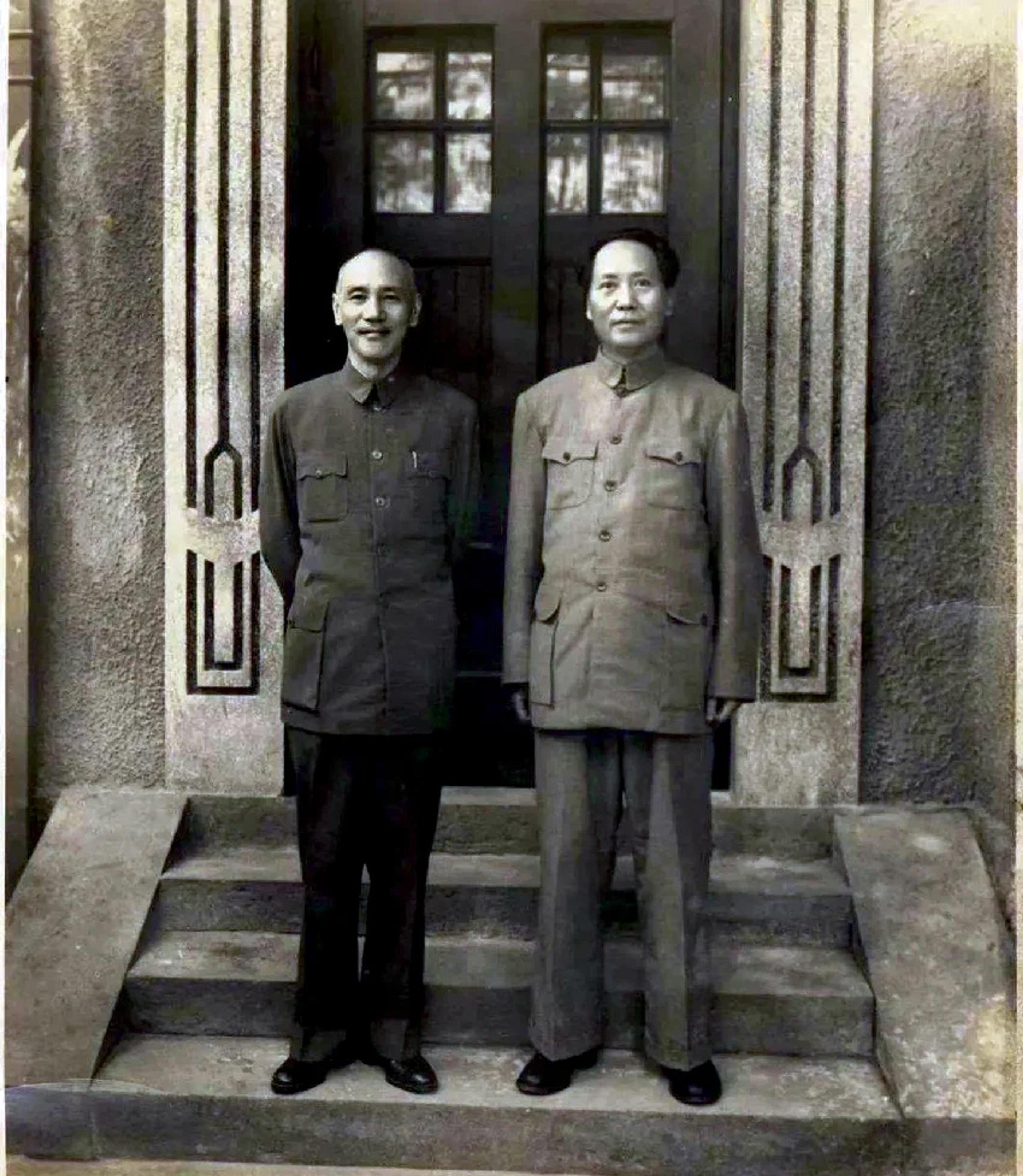
Chiang Kai-shek (left) and Mao Zedong (right) in Chongqing, China, 1945. Public Domain
In the 1940s, during the Japanese invasion, such ‘national humiliation’ required the recovery of all that the nation had lost. Mao Zedong, who ordered copies of China’s Destiny to be burned, in fact supported the same goal. Even though both Chiang and Mao were military leaders, they saw unification, rather, as a cultural or even cosmical process. Modern supporters of the great unity thesis also ignore military conquest and propagate an ineffable ‘destiny’ determined by cultural and natural processes independent of political change.
Chiang argued that the people required guidance by enlightened elites serving an autocratic ruler. He attacked Jean-Jacques Rousseau’s false doctrine of ‘natural rights of man’. In Chiang’s view, the dynasties ‘generally adopted a magnanimous attitude toward the people’, so the people had no need to fight for freedom against the state. Therefore, ‘our Chinese nation must crystallise into a solid, rocklike body of national defence, and needless to say, no individual may enjoy the “freedom” of a loose grain of sand.’ Endorsing datong as the ultimate goal, he stressed the continuity of traditional Chinese culture as the fundamental support of a unified society.
The inaccuracy of Chiang’s history and the incoherence of his ideology were bound together
During the Sino-American wartime alliance (1941-45), Chiang’s supporters praised him as a defender of freedom against Fascist aggression. The publisher Henry Luce featured Chiang and his wife on the cover of Time magazine several times. But Chiang attacked Western countries for invading China and imposing unequal treaties in the 19th century. The US State Department considered Chiang’s text to be so dangerous that it fought to suppress an English translation. In 1947, not one but two translations appeared, expressing radically opposed opinions on the nature of Chiang’s regime. The editor of one translation, Philip Jaffe, representing liberal organisations opposed to Chiang’s authoritarian rule, denounced China’s Destiny for supporting repression, hierarchy and exploitation of the common people. By contrast, the scholar Lin Yutang and the diplomat Wang Chonghui defended Chiang as a supporter of the traditional Chinese values that undergirded a democratic society. Lin praised Chiang for devotion to a single purpose, ‘that of unification of China and making her into a modern and democratic nation.’ Jaffe’s widely read critique, however, heavily damaged the credibility of Chiang’s regime.
John K Fairbank, then assistant professor of history at Harvard University, first read China’s Destiny in Chinese in 1943. He wrote in his diary: ‘I never saw a more pernicious use of history for political purposes.’ In 1947, reviewing the English translations, he gave a more substantive critique. Describing the book as the ‘skeleton in the Kuomintang closet’, a text so scandalous that English readers could not see it for four years, he concluded that Chiang’s regime, based on police terror and US support, was ‘a danger to American democracy’. Chiang claimed to support traditional Chinese values updated for the modern world. By constantly invoking benevolence, sincerity, loyalty and filial duty as necessary to building a national spirit, he demanded complete subordination to the Nationalist Party. His economic theories rejected free enterprise in favour of ‘anti-Marxist Confucian totalitarianism’. By claiming that Han, Manchus, Mongols and Tibetans had a common genetic origin, he used ‘racism for nationalistic ends’. His Chinese nation included all the territories conquered by the Qing dynasty at its maximal extent, including Mongolia, Tibet and Taiwan. His goal was to recreate imperial boundaries while assimilating the diverse peoples of the empire into a single culture. Chiang’s vision of the nation promoted ‘virtues that conduce to the subordination of the individual to the state’ and ‘a government for, but not by, the peasant masses’. Fairbank concluded: ‘One cannot avoid the question whether this ancient Confucian wine can be poured into modern bottles without turning slightly fascist.’
Resemblances of Nationalist Party ideology to Fascism are not hard to find. Some Nationalist Party leaders admired Mussolini’s paramilitary Blackshirts and tried to create the Blue Shirts Society on the same model. Liberals had good reason to oppose the Party’s repression. Yet to describe the entire Nationalist ideology as merely Fascist goes too far. It was a mixture of liberalism, authoritarianism, Confucian traditionalism and Christian moralism that does not separate easily into coherent parts. Thus, the inaccuracy of Chiang’s history and the incoherence of his ideology were bound together.
Such contradictory assessments of China’s Destiny expose the conundrums of Confucian ideologues and Western observers. Chinese officials and intellectuals write for an audience familiar with a classical tradition unknown to most Westerners, but in foreign languages their statements take on a different, more ominous tone.
Just as in the 1940s, the ambiguous implications of China’s ideology confound US observers. China fiercely asserts national sovereignty while practising imperial expansion. Assertive territorial nationalism may not threaten world order. Perhaps even the future of Taiwan could be settled if others believed that China had limited territorial ambition. But the mainland’s aggressive actions in the South China Sea, its extensive foreign investment, and its ideology of universal world order bely these modest goals.
Advocates of the great unity thesis today echo almost exactly Chiang’s version of Chinese history, but Chiang’s policies focused entirely on restoration of national sovereignty. He could not impose his vision on the rest of the world. He endorsed the repudiation of the unequal treaties as a victory against imperialism, but he intended to have China join a single world order. The current advocates of the great unity thesis cannot avoid arousing greater suspicion.
When Chiang Kai-shek lectured on unity in 1943, the nation was desperately fighting for survival. His fervent faith buoyed people’s spirits in difficult times. Liberals, however, expected only disappointment. Chiang claimed to follow Sun Yat-sen’s three people’s principles: liberalism, nationalism and socialism, but in fact supported only the second, in the form of an all-powerful state. Still, Chiang showed the courage of his convictions in stubbornly defying his main ally, the US.
The People’s Republic of China built a towering juggernaut on the ruins of the empire and the Republic. Despite the turmoil of the 20th century, two threads run through it: intense dedication to scientific and technological advance, and the insistence on preserving core cultural values. As anti-scientific attitudes and distrust of expertise infect Western societies, China and the rest of East Asia have stuck to the old-time religion of technological progress.
A confident national leadership would tolerate diversity, debate and openness to stimulate creativity
The Chinese state has survived: but what has Confucius to do with all of this? Why do the engineers of a modern technological state need an ancient moralist? This question returns us to the theme I raised in the beginning: the insecurity of a state with nothing to offer beyond economic growth and forcible bureaucratic rule. The Chinese Communist Party, with its billionaire members, hardly looks like a serious advocate of socialism. Reform leaders have critiqued Mao Zedong himself for his catastrophic ‘mistakes’. Xi Jinping’s efforts to promote his own thought as a substitute, including the usual forced recitation sessions, have not aroused enthusiasm. Confucius, when properly mummified to defang his dangerous notions of individual moral development, could be the Party’s last-best defence of its authoritarian rule. But slogans have come and gone so fast since 1949 that the new unity ideology itself may have a short shelf-life.
Today, when the PRC faces no threat of invasion and no significant internal upheaval, while dominating many sectors of the global economy, its insistence on unity seems perplexing. Beneath the repeated slogans lies a crisis of legitimacy. A confident national leadership would tolerate diversity, debate and openness to stimulate creativity. The incessant repetition of unity indicates that the PRC leadership has chosen a different path. It still acts like a ‘fragile superpower’ that constantly feels threatened from abroad and within. This psychology of resentment, insecurity and assertion of power has continued from Chiang Kai-shek’s time to now.
The late Hsu Cho-yun, a brilliant American historian originally from Taiwan, described the development of Chinese culture in terms of the course of its two great rivers – the Yellow and the Yangzi. Both rivers originate very close to each other in the Tibetan plateau and wind their way to the same sea. Nearly all historians exalt the culture founded along the Yellow River, but it winds through arid lands, has almost no tributaries in its lower reaches, and its bed, like government offices, looms far above the farmers’ fields. Today, it struggles to reach the sea. In 1988, a widely viewed TV series attacked the Yellow River and its associated culture of isolation for blocking China’s modernisation. Its authors argued that China had to follow instead the model of the blue ocean, representing the capitalist West. Furious debate ensued and the Chinese Communist Party condemned the series.
Writing in China: A New Cultural History (2012), Hsu prefers the Yangzi:
From its origins as a thin stream, Chinese culture developed like the long Yangzi River, absorbing the resources of many tributaries along the way until it became a vast torrent racing toward the great ocean – … world culture.
The Yangzi, by contrast to the Yellow River, absorbs many waters, flows through beautiful mountain scenery and prosperous paddy fields, and reaches the sea carefully channelled by canals and dykes. Its watershed is a large ecosystem of coexisting human cultures, flora and fauna, and its waters join the oceans of the world. Both rivers have united China, but in different forms.
Dusk on the Yangzi river. Courtesy Wikipedia
The southern coast of China, nourished by the Yangzi and Pearl rivers, has been the source of nearly all of China’s rapid technological and cultural progress in the past 30 years. A powerful state in Beijing, obsessed with unity, has tried to stamp out the creative forces of the blue south, but opposition persists. The students of Hong Kong joined the Umbrella Movement to protest forcible imposition of this version of patriotic history.
Which vision of unity will China choose to follow?