Tuesday, January 26, 2010

Swelling Glass


This is a surprise and there are likely many other variations that may be able to use the same strategy.  At the moment there is the art to be learned in its usage but even then we can all see the value of a product that sucks up liquid organics yet repels water.


I do not want chatter about oil spills.  There the problem is one of volume.  There is always way too much for anything to help except capture and recovery.  Yet small spills that will simply saturate are difficult and expensive to treat.  This promises to allow blending of the product directly into contaminated material to collect the pollutant, followed eventually with water separation.


That is the main advantage of what is described.  The pollutant is captured in a form that also reduces density allowing floatation.  Many other products capture pollutants without reducing density or providing any separation strategy. 


“Swelling Glass” Cleans Polluted Water Like a Sponge


Written by Tina Casey
Published on January 11th, 2010


This is the discovery that could put the College of Wooster on the map: glass that swells like a sponge.  Put together like a nano-matrix, the new glass can unfold to hold up to eight times its weight.  The glass binds with gasoline and other pollutants containing volatile organic compoundsbut it does not bind with water, so it acts like a “smart” sponge, capable of picking and choosing from contaminated groundwater.

The new material was developed by Dr. Paul Edmiston of the College of Wooster, who formed a new company, Absorbent Materials, to market the new glass under the trademark Obsorb.  A number of pilot sites are being tested in the United States, and industrialized countries are not the only ones that stand to gain.  Obsorb’s unique properties make it ideal for low tech, low-budget cleanups in developing areas as well.
Obsorb is a reactive glass.  Unlike conventional glass, it can bond with the chemicals it encounters.  However, it is also hydrophobic, meaning that it does not bond with water.  At a recent pilot demonstration in Ohio, Obsorb was used in the form of a white powder to suck up a plume ofTCE (a volatile organic compound).  TCE is particularly difficult and expensive to clean up using conventional means, which is the reason why some contaminated sites are simply shut down, allowing the vapors to dissipate naturally.  The process takes decades, so Obsorb could provide a low-cost means of recovering sites more quickly.  The venture development group JumpStart Inc.saw the potential and has just committed a $250,000 investment to Absorbent Materials.

Once full, Obsorb floats to the surface, where it can be skimmed off with something as simple as a coffee filter.  After that the pollutants can be retrieved and the glass can be reused hundreds of time.  Nanoparticles of iron can also be added to convert TCE or PCE (another volatile organic compound) into harmless substances.  As a low cost form of cleanup, swelling glass could provide site remediators with yet another in the growing list of non-conventional cleanup tools along with lactate, vitamin B-12, and even cattails.

Calcium Hydride Heat Storage


This is another incremental improvement on the business of operating thermal heat systems driven by solar sources in particular.  We have identified a superior storage medium that is well known and readily available at low cost.  All solar systems need a working fluid to grab the heat energy even it the intent is to shove it immediately into an engine.  Having a working fluid that nicely enters into a chemical reaction giving off a mobile gas avoids reaction reversal and truly stores the energy in a safe form for later convenient consumption.  It can all get cold even.


In fact it means that a solar thermal plant can be engineered to be a standby energy source that sells its energy during peak demand and will fit nicely into a photovoltaic system were no such storage may be practical.


This is a major advance for solar thermal power and likely makes the high temperature designs presently been deployed economically feasible.  It will possibly work best in the extremes of the desert plants such as the tower system built in Spain.


It might even be possible to divert heat output at an ordinary thermal plant with this method although it is likely an expensive diversion of effort.


 EMC Solar Claims Calcium Hydride Has Ten times the density of conventional molten salt solar storage


http://nextbigfuture.com/2010/01/emc-solar-claims-calcium-hydride-has.html


https://blogger.googleusercontent.com/img/b/R29vZ2xl/AVvXsEg5FST6Fmrvwn0m_mUkIgq9fw7Lw_JYRpC2AtYlVUboevX3g7nSBkeNfaTdwOOrL6WLzmV3Th400_NwADo90OIn-NNccKQBSpnDcOpebbmQk-3Z0cmRjtUuTR6EfFq8J1OuYdp6WWDLEya_/s1600/100-kw-system.jpg


A cheap and effective way to store solar power is needed to increase the usability and adoption of solar power. Molten salt storage has been seen as one of the best ways to create solar power storage that is scalable to megawatt hours or more.


Calcium hydride is chosen due to its ability to be broken apart using a thermal heat source, such as the sun. Calcium hydride provides up to 0.90 kW-hr/kg of heat when it converts to calcium and hydrogen.


Hydrogen is stored in a separate low temperature hydride tank. Two heat exchangers are used to extract the thermal energy from the hydrogen before storage in the low temperature hydride. The heat exchangers are required to extract the remaining 20% of the total system energy still in the 1100 C hydrogen before it is cooled to near room temperature.

A central triple walled reaction chamber holds both Calcium and Calcium hydride as liquids between 1000 C and 1100 C. Heat is extracted from the reaction chamber to drive one or multiple 100 kW high temperature Dual Shell Stirling engines operating at 50% conversion efficiency.


The thermal storage costs are substantially lower than a nitrate salt system and reflect both the simplicity of the calcium hydride system and the significant increase in power density. In the calcium hydride system the two liquids, calcium and calcium hydride, remain in the central reaction chamber. Only hydrogen is pumped between tanks


Proposed 100 kW solar system:

* Store 18 hours of thermal energy 

* Down mirror focuses sunlight from heliostat field
* 4,690 kg Calcium
* 234 kg Hydrogen
* Reaction chamber insulated with a quartz window for solar heat input
* Two tank boron oxide high temperature heat exchanger for hydrogen
* Two tank nitrate salt low temperature heat exchanger for hydrogen
* Low temperature Sodium aluminum hydride tank holds 5% hydrogen by weight 

The system uses a new low cost wire braced heliostat field with 50 square metres per panel at $100/metre squared in production. The new heliostat configuration eliminates the cosine effect, common with power tower designs, by utilising a parabolic mirror aligned with the sun throughout the day. The parabolic mirror is integrated with a quartz lens and side mirror which provides a 0.1 metre constant diameter focused light beam. The heliostat design has the added advantage of eliminating the power tower and replacing it with a small down mirror located directly above the reaction chamber.

Sunlight is focused through a quartz window, into the reaction chamber, onto an inverted molybdenum cone submerged in the liquid calcium which absorbs the solar energy. Major cost reductions occur due to the use of a down mirror system which allows the power head to be immersed within the reaction chamber inside the liquid calcium. This allows a significant increase in heat transfer capability. An insulated cover is placed between the quartz window and power head at night minimizing thermal losses.


The advantage of this system is that it is a completely reversible closed cycle. The intermittent sunlight can be chemically stored and released at a controlled rate for electric power production. The system uses materials which are low cost and provide a competitive electrical production facility for very large scale application.


The storage of thermal energy in the form of sensible and latent heat has become an important aspect of energy management with the emphasis on efficient use and conservation of the waste heat and solar energy in industry and buildings. Latent heat storage is one of the most efficient ways of storing thermal energy. Solar energy is arenewable energy source that can generate electricity, provide hot water, heat and cool a house, and provide lighting for buildings. Paraffin waxes are cheap and have moderate thermal energy storage density but low thermal conductivity and, hence, require a large surface area. Hydrated salts have a larger energy storage density and a higher thermal conductivity. In response to increasing electrical energy costs and the desire for better lad management, thermal storage technology has recently been developed. The storage of thermal energy in the form of sensible and latent heat has become an important aspect ofenergy management with the emphasis on the efficient use and conservation of the waste heat and solar energy in the industry and buildings. Thermal storage has been characterized as a kind of thermal battery.

Monday, January 25, 2010

Pope Proclaims: Go Forth and Blog


What I find most remarkable about this decision is how fast it has come and that is opens to door for thousands of professional voices to be heard on the Blogosphere.  Imagine, if you like, the Chinese communist party telling its cadres to do this, or perhaps the US officer corps, or perhaps the managers of Microsoft been given this license. 

Amazingly, the Catholic Church is leading on this.  The Pope has chosen to trust his priesthood, obviously a good bet, but it still blows the door open for a public debate and real public participation.  I suspect that it will work out just fine.

The press loves to take cheap shots at the Church over its famously slow response to change, though that has waned in resent years as more are coming to respect the nature of the Church not just as another institution, but as almost the only institution that must make definitive moral decisions and those policies are always the standard for others.  Other churches and religions have dabbled in this and have typically been found wanting.

In fact, the modern age has seen the disappearance of some of the most egregious anti Catholic propaganda commonly deployed by a lot of other Christian faiths, or perhaps I simply am too successful at avoiding such people.

For the nonce, the Church has decided that its thousands of priests can and will blog and compete with each other for attention and ultimately reach their own audience of believers.

This is very powerful.  No longer does a believer have to accept whoever is at the alter to provide their spiritual instruction.  They can choose a priest who speaks successfully to them personally.

There are presently 400,000 priests worldwide, each typically providing service to an average of 3,000 believers.  I can from my own experience, can say that without the use of a blog, it is impossible to properly reach out to that many people.  The truth is that you reach ten percent and rely on family and the rest to maintain the rest.

With a blog, a gifted writer can communicate with and even develop a much larger effective audience than otherwise possible.

Pope To Priests: go Forth and Blog

By Associated Press

Saturday, January 23, 2010


VATICAN CITY — Pope Benedict XVI has a new commandment for priests struggling to get their message across: Go forth and blog.


The pope, whose own presence on the Web has heavily grown in recent years, urged priests on Saturday to use all multimedia tools at their disposal to preach the Gospel and engage in dialogue with people of other religions and cultures.


And just using e-mail or surfing the Web is often not enough: Priests should use cutting-edge technologies to express themselves and lead their communities, Benedict said in a message released by the Vatican.


"The spread of multimedia communications and its rich ’menu of options’ might make us think it sufficient simply to be present on the Web," but priests are "challenged to proclaim the Gospel by employing the latest generation of audiovisual resources," he said.


The message, prepared for the World Day of Communications, suggests such possibilities as images, videos, animated features, blogs, and Web sites.


Benedict said young priests should become familiar with new media while still in seminary, though he stressed that the use of new technologies must reflect theological and spiritual principles.
"Priests present in the world of digital communications should be less notable for their media savvy than for their priestly heart, their closeness to Christ," he said.


The 82-year-old pope has often been wary of new media, warning about what he has called the tendency of entertainment media, in particular, to trivialize sex and promote violence, while lamenting that the endless stream of news can make people insensitive to tragedies.


But Benedict has also praised new ways of communicating as a "gift to humanity" when used to foster friendship and understanding.


The Vatican has tried hard to keep up to speed with the rapidly changing field.


Last year it opened a YouTube channel as well as a portal dedicated to the pope. The Pope2You site gives news on the pontiff’s trips and speeches and features a Facebook application that allows users to send postcards with photos of Benedict and excerpts from his messages to their friends.


Many priests and top prelates already interact with the faithful online. One of Benedict’s advisers, Cardinal Crescenzio Sepe, the archbishop of Naples, has his own Facebook profile and so does Cardinal Roger Mahony, archbishop of Los Angeles.


In Saturday’s message — titled "The priest and pastoral ministry in a digital world: new media at the service of the Word" — Benedict urged special care in contacts with other cultures and beliefs.


A presence on the Web, "precisely because it brings us into contact with the followers of other religions, nonbelievers and people of every culture, requires sensitivity to those who do not believe, the disheartened and those who have a deep, unarticulated desire for enduring truth and the absolute," he said.


Monsignor Claudio Maria Celli, who heads the Vatican’s social communications office, said that Benedict’s words aimed to encourage reflection in the church on the positive uses of new media.


"That doesn’t mean that (every priest) must open a blog or a Web site. It means that the church and the faithful must engage in this ministry in a digital world," Celli told reporters. "At some point, a balance will be found."


Celli, 68, said that young priests would have no trouble following the pope’s message, but, he joked, "those who have a certain age will struggle a bit more

Raw Milk


The consumer has been brainwashed for fifty years to avoid raw milk or alternately to trust only pasteurized milk.  I grew up with this even though I drank fresh milk my entire childhood.  The truth is that every farmer is fastidious over healthy cows and clean milking equipment.  The consumer would be astonished to see the care maintained as a matter of course.


The problem begins with the need to blend product in tankage and to transport it to a processing facility.  Obviously a blended product hugely increases risk and pasteurization is designed to remove the risk.  One cannot disagree with that protocol.  In fact I personally want nothing to do with milk that must be days old at least by the time it arrives in my home, if it is not pasteurized.   Recall that it is stored at the producer at least a couple of days even before shipping.


Fresh milk directly from the producer will be from a known healthy herd with the personal guarantee of the owner and likely hours old simply because that will be the easiest way to sell it.


The quality of the product will be hugely superior to anything you can imagine.  In fact the best thing commercial milk has going for it is no one has ever tasted fresh milk.


Fresh milk delivery has to be a same day proposition and the blending needs to be avoided.  The customer can order directly from the herd.  There is likely a viable business here with modern refrigeration.


However, it is also time to rethink the whole process of milk handling and pasteurization.  There are better ways that can surely be now perfected and plausibly applied at farm level.


Using EM waves to knock out foreign bacteria is possible on small processing systems.  So it may be possible to satisfy the health department with a neat technological fix.


By the bye, If you have never drank raw milk, you are in for a treat. The difference is night and day.


Ont. farmer toasts victory in raw milk trial with glass of the contentious drink

Thu Jan 21, 6:55 PM
By Ciara Byrne, The Canadian Press
NEWMARKET, Ont. - Clutching a glass of raw milk, an emotional Michael Schmidt toasted what he called a victory for the local food movement Thursday after the Ontario dairy farmer was found not guilty of 19 charges related to selling unpasteurized milk.
"People need to learn how to stand up even when it seems it's impossible to achieve change in our interpretation of the law," said Schmidt, who was often depicted by supporters as the small farmer fighting for consumer food rights against an established milk industry.
In a legal battle that played out over three years, Schmidt fought to continue the operation of his 150-member raw milk co-operative in Durham, Ont., and defended himself against the charges for dispensing milk straight from the cow.
Schmidt was charged under the Health Protection and Promotion Act and the Milk Act after an armed raid by about two dozen officers and government officials at his farm in 2006.
While raw milk is legal to drink, it's illegal to sell in Canada. Officials consider it a health hazard.
Under Schmidt's cow-share program each member of his co-operative owns a part of the cow. By owning the cow members were drinking milk from their own animal, he says.
On Thursday, justice of the peace Paul Kowarsky ruled that Schmidt's method of distribution made the group exempt from the legislation. He also found the operation did not violate the province's milk-marketing or public-health regulations.
Kowarsky said the Crown could not prove that Schmidt had tried to market the milk. It was made clear on signs at the farm and at the blue bus where Schmidt set up shop at a Vaughan, Ont., market that only members could purchase products made from raw milk, he added.
"The undisputed evidence of the defendant is that there is no advertising or selling," said Kowarsky.
The legislation was originally created to protect the vulnerable, but the cow-share members were not vulnerable and were cognizant of all concerns associated with drinking unpasteurized milk, he added.
"They consume the milk at their own risk," said Kowarsky, adding the product had been thoroughly tested and was shown not to be contaminated.
At trial, food scientists and health experts testified that mandatory pasteurization laws are needed to protect public health.
Schmidt argued that government officials and food scientists could not guarantee the safety of any food, and suggested informed consumers should be able to buy raw milk if they want.
At the culmination of the detailed verdict, Kowarsky said the cow-share program was a "legitimate and lawful" enterprise and called the case part of a "search for contemporary justice."
A Ministry of Agriculture spokesman was not able to say if the ministry would be reviewing the Milk Act.
"We're disappointed in the court's ruling," said Brent Ross. "The government will review the court's decision and determine next steps."
Thrilled supporters, some wearing sweaters emblazoned on the back with "Team Raw Dairy," gasped and clapped as the justice of the peace handed down his verdict. The courtroom, packed with so many supporters that dozens were left standing, flocked to a teary-eyed Schmidt, as they flung their arms around him.
"He's giving us all a chance for the small farmer to enter into private contracts such as cow-share or farm-share agreements where we can decide what we buy, eat and how we behave," said a jubilant Judith McGill, a cow-share member who has helped rally support for Schmidt.
Outside of the court, two women poured and passed around creamy glasses of raw milk to people as children perched on signs reading "protect our food."
During the verdict, Kowarsky also acknowledged the growing trend towards the local food movement, and said he found many cow-share programs existed around the world.
This was a message not lost on Schmidt, who said the verdict had opened the door to new kind of conversation.
"It was never a war. It was a Shakespearean drama," Schmidt said coyly. "We tried to get into a dialogue."
Schmidt has not ruled out entering the political scene so he can push for the full legalization of raw milk.
"Like (former prime minister Pierre Elliot) Trudeau said, the government has no business in the bedroom of the people, and here I say the government has no business in the stomach of the people either."
For Allyson McMullen, Schmidt's win is also a win for consumer choice.
"It's so much more about milk. It's about food. It's about us having the choice to put what we want in our bodies and I think that this is incredible," she said.

Haitian Fault


One thing about major active faults is that there are not too many of them. In fact they are rather uncommon and easily detected if you have your eyes open.  If faults are active, the ground bends and warps forming a scarred landscape.  It is easily recognized around LA or San Francisco.

There are also better hidden ones out in flat country that way more tricky to spot or well eroded old ones that sometimes come back to life.

However, the majority of quakes come from the same well known faults as we have just seen in Haiti.

The first problem is that people build along them.  This can not be properly avoided because a decent exclusion zone would be fifty miles to either side of the fault.  Yet San Francisco has shown that building codes can sharply curtail damage and death rates.

Their last quake was the same magnitude as the Haitian quake and their death toll was 68.  That starts been within an acceptable range for that level of disturbance.

The absolute key to it all are building codes that minimize the collapse threat.  That is what has killed possibly 200,000 in Haiti.  We see pictures of piles of concrete and almost no rebar.  Those buildings actually crumbled.

The first rule is to stop building unreinforced concrete structures at all.  Even better, adopt wood frame construction for housing up to three stories.  A quake will still tear them apart but they are fighting it all the way.  In Kyoto a few western build structure were noticeably still standing.

I can go further than that.  I can produce stress skinned panels that have perhaps half the weight and twice the strength for about the same end cost after construction.  It has not been made to happen yet, but it is feasible and is the future of global housing for that and superior energy retention and ease of construction.

Nothing is ever bullet proof but Haiti’s quake was survivable.  There was little ground damage suggesting foundations could survive.  Once the building is able to avoid collapse, the remaining threat is land movement and that is local and rare enough to ignore.

Haiti would be well served to switch totally to termite treated wood frame housing even if stress skin is not available. 

My point remains.  It is possible to build out a completely new Haiti using stress skin panel construction presently unavailable, at similar cost to other options, able to withstand a magnitude 7 quake and withstand a level 4 hurricane and possibly much more with negligible loss to human life.  A friend put several years of his life into perfecting the necessary art and I spent many months confirming and analyzing the economic model to an optimum solution.

Fault Responsible For Haiti Quake Slices Island's Topography

by Staff Writers  Washington DC (SPX) Jan 18, 2010


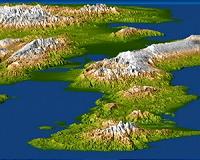
The sharp diagonal line exactly at the image center is the Enriquillo fault. Port-au-Prince is immediately to the left (north) at the mountain front and shoreline.


A magnitude 7.0 earthquake occurred on January 12, 2010, at Port-au-Prince, Haiti, with major impact to the region and its citizens. This perspective view of the pre-quake topography of the area clearly shows the fault that is apparently responsible for the earthquake as a prominent linear landform immediately adjacent to the city.


Elevation is color coded from dark green at low elevations to white at high elevations, and the topography is shaded with illumination from the left. The topography in this image is exaggerated by a factor of two.


The sharp diagonal line exactly at the image center is the Enriquillo fault. Port-au-Prince is immediately to the left (north) at the mountain front and shoreline.


The Enriquillo fault generally moves left-laterally (horizontally, with features across the fault shifting to the left when the fault breaks in an earthquake), but vertical movements occur along the fault where irregularities in the fault line cause local compression or extension of the earth.


Meanwhile, movements of the topography at the Earth's surface can falsely appear to be vertical where mountain slopes are cut and misaligned by horizontal shifts of the fault.


Additionally, differing erosion rates on the two sides of the fault, due to the juxtapositioning of differing rock types by the fault, can give the appearance of vertical offsets of the current topographic surface. All of these real and apparent horizontal and vertical offsets of the topographic surface may (and likely do) occur here, making the fault easily observed in the topographic data.


The elevation data used in this image were produced by the Shuttle RadarTopography Mission (SRTM), flown aboard Space Shuttle Endeavour in February 2000. SRTM acquired elevation measurements for nearly all of Earth's landmass between 60 degrees North and 56 degrees South latitudes.


For many areas of the world, SRTM data provide the first detailed three dimensional observation of landforms at regional scales.


The mission was a cooperative project between the National Aeronautics and Space Administration (NASA), the National Geospatial-Intelligence Agency (NGA) of the U.S. Department of Defense (DOD), and the German and Italian space agencies. It was managed by NASA's Jet Propulsion Laboratory, Pasadena, Calif., for NASA'sScience Mission Directorate, Washington, D.C.


View Width: One degree latitude (111 kilometers, or 69 miles)
View Distance: Five degrees longitude (525 kilometers, or 325 miles)
Location: 18 to 19 degrees North latitude, 70 to 75 degrees West longitude
Orientation: View east, 5 degrees below horizontal
SRTM Data Acquired: February 2000


Haiti Quake Occurred In Complex Active Seismic Region

by Staff Writers
Woods Hole MA (SPX) Jan 21, 2010


The magnitude 7.0 earthquake that triggered disastrous destruction and mounting death tolls in Haiti this week occurred in a highly complex tangle of tectonic faults near the intersection of the Caribbean and North American crustal plates, according to a quake expert at the Woods Hole Oceanographic Institution (WHOI) who has studied faults in the region and throughout the world.


Jian Lin, a WHOI senior scientist in geology and geophysics, said that even though the quake was "large but not huge," there were three factors that made it particularly devastating: First, it was centered just 10 miles southwest of the capital city, Port au Prince; second, the quake was shallow-only about 10-15 kilometers below the land's surface; third, and more importantly, many homes and buildings in the economically poor country were not built to withstand such a force and collapsed or crumbled.


All of these circumstances made the Jan. 12 earthquake a "worst-case scenario," Lin said. Preliminary estimates of the death toll ranged from thousands to hundreds of thousands. "It should be a wake-up call for the entire Caribbean," Lin said.


The quake struck on a 50-60-km stretch of the more than 500-km-long Enriquillo-Plantain Garden Fault, which runs generally east-west through Haiti, to the Dominican Republic to the east and Jamaica to the west.


It is a "strike-slip" fault, according to the U.S. Geological Survey, meaning the plates on either side of the fault line were sliding in opposite directions. In this case, the Caribbean Plate south of the fault line was sliding east and the smaller Gonvave Platelet north of the fault was sliding west.


But most of the time, the earth's plates do not slide smoothly past one another. They stick in one spot for perhaps years or hundreds of years, until enough pressure builds along the fault and the landmasses suddenly jerk forward to relieve the pressure, releasing massive amounts of energy throughout the surrounding area. A similar, more familiar, scenario exists along California's San Andreas Fault.


Such seismic areas "accumulate stresses all the time," says Lin, who has extensively studied a nearby, major fault , the Septentrional Fault, which runs east-west at the northern side of the Hispaniola island that makes up Haiti and Dominican Republic. In 1946, an 8.1 magnitude quake, more than 30 times more powerful than this week's quake, struck near the northeastern corner of the Hispaniola.


Compounding the problem, he says, is that in addition to the Caribbean and North American plates, , a wide zone between the two plates is made up of a patchwork of smaller "block" plates, or "platelets"-such as the Gonvave Platelet-that make it difficult to assess the forces in the region and how they interact with one another. "If you live in adjacent areas, such as the Dominican Republic, Jamaica and Puerto Rico, you are surrounded by faults."


Residents of such areas, Lin says, should focus on ways to save their lives and the lives of their families in the event of an earthquake. "The answer lies in basic earthquake education," he says.


Those who can afford it should strengthen the construction and stability of their houses and buildings, he says. But in a place like Haiti, where even the Presidential Palace suffered severe damage, there may be more realistic solutions.


Some residents of earthquake zones know that after the quake's faster, but smaller, primary, or "p" wave hits, there is usually a few-second-to-one-minute wait until a larger, more powerful surface, or "s" wave strikes, Lin says. P waves come first but have smaller amplitudes and are less destructive; S waves, though slower, are larger in amplitude and, hence, more destructive.


"At least make sure you build a strong table somewhere in your house and school," said Lin. When a quake comes, "duck quickly under that table."


Lin said the Haiti quake did not trigger an extreme ocean wave such as a Tsunami, partly because it was large but not huge and was centered under land rather than the sea.


The geologist says that aftershocks, some of them significant, can be expected in the coming days, weeks, months, years, "even tens of years." But now that the stress has been relieved along that 50-60-km portion of the Enriquillo-Plantain Garden Fault, Lin says this particular fault patch should not experience another quake of equal or greater magnitude for perhaps 100 years.


However, the other nine-tenths of that fault and the myriad networks of faults throughout the Caribbean are, definitely, "active."


"A lot of people," Lin says, "forget [earthquakes] quickly and do not take the words of geologists seriously. But if your house is close to an active fault, it is best that you do not forget where you live."


The Woods Hole Oceanographic Institution is a private, independent organization in Falmouth, Mass., dedicated to marine research, engineering, and higher education. Established in 1930 on a recommendation from the National Academy of Sciences, its primary mission is to understand the oceans and their interaction with the Earth as a whole, and to communicate a basic understanding of the oceans' role in the