
to start with, put it all in space. This trick is a tall order and just how are you targeting? At least the shade needs to be in geosyncreous orbit.
and then you want to stay on target.
This is a stretch too far
Ground-based Telescopes and a Shared Orbiting Starshade Can Directly See Earth-like Exoplanets
April 14, 2026 by Brian Wang
https://www.nextbigfuture.com/2026/04/ground-based-telescopes-and-a-shared-orbiting-starshade-can-directly-see-earth-like-exoplanets.html
A Nature paper predicts the performance of a hybrid space–ground approach that combines a large ground-based telescope, such as the Extremely Large Telescope (ELT), the Thirty Meter Telescope (TMT) or the Giant Magellan Telescope (GMT), with a shared orbiting starshade in space. This integration should be able to image Earth-like exoplanets around Sun-like stars with deep-contrast imaging and an unmatched angular resolution. The starshade forms a deep shadow above Earth’s atmosphere. However, the presence of atmospheric turbulence requires compensation with adaptive optics to sharpen the images to the diffraction limit.
The expected image plane contrast of the three large telescopes operating with a shared orbiting 99-meter-diameter starshade, with a detailed analysis focusing on the ELT to measure the reflected light spectra of a Solar System analogue, from Venus to Saturn, orbiting a Sun-like star.
The studies show that the ELT adaptive optics effectively corrects for these effects, demonstrating minimal impact on sensitivity with different Strehl ratios and throughout the full 300–1,000-nm bandpass. This should enable observation of the major molecular signatures for life, such as oxygen and water on an exo-Earth, leading to a promising avenue for future hybrid space–ground observatories to revolutionize the search for Earth-like planets. Near-term advancements for the implementation of this concept towards deployment are also discussed.
Astronomers have identified over 6,000 exoplanets, spanning a wide range of sizes and masses, many of which orbit nearby stars. Imaging habitable exoplanets is exceptionally challenging because these planets are extremely faint and orbit their host stars at very close angular separations (<100 mas), making them difficult to distinguish from the stars’ bright glare. The starshade features 48 petals, each 24.5-m long, and a 50-m-diameter central disk. The deep shadow is formed above Earth’s atmosphere and is not degraded by atmospheric turbulence. [caption id="attachment_209622" align="alignnone" width="482"]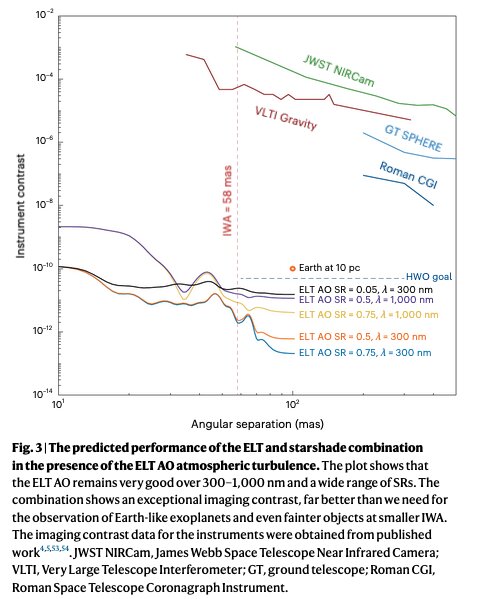 Screenshot[/caption]
Screenshot[/caption]Path forward
Recent advances in starshade optical performance, and deployable and adjustable starshade technologies, developed by NASA centres, NIAC-funded initiatives and industry partners, are making this challenge increasingly tractable. Laboratory demonstrations of scaled starshades have achieved contrast levels exceeding 10^−10
(1 in 10 billion) in testing facilities. Origami-inspired and furled starshade structures, such as those demonstrated in the starshade projects, have
achieved the approximately 100-μm-level deployment precision required for high-performance starlight suppression. Experiments in formation sensing to better than 1-m lateral tolerance have also been reported.
The key remaining challenge in realizing this concept is the mechanical design and successful deployment of a 99-m starshade into space. The design should meet the tolerance, mass, error budget and shape accuracy requirements—although recent work suggests that the shape tolerance may be relaxed compared with the HWO. Inflatable and furled designs under development at NASA Goddard and Jet Propulsion Laboratory’s (JPL’s) Advanced Large Precision Structures (ALPS) lab further support scalable deployment. Alternative approaches include robotic assembly techniques. Current efforts are focused on optimizing the 99-m, 36-petal starshade design for simplified mechanical deployment. Finally, the team received an award from the Caltech Keck Institute for Space Studies (KISS) to develop a roadmap for implementing this concept over the coming years.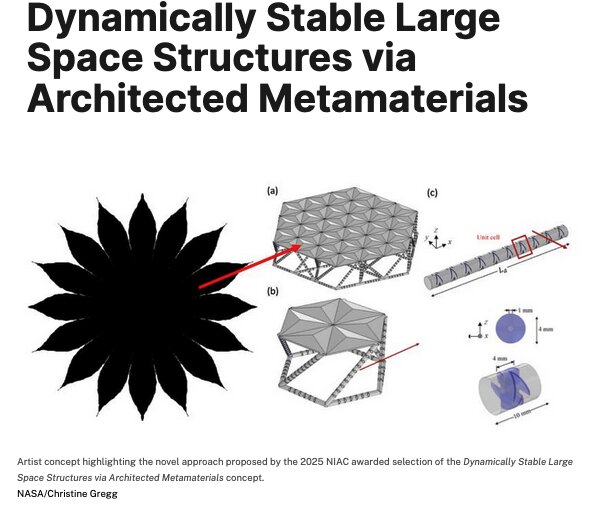 Screenshot
Screenshot

No comments:
Post a Comment