Friday, January 22, 2010

Bravo Obama


Anyone who has read my posts on the banking situation, particularly this one:


knows where I stand on the present banking situation.  I was actually astonished to see Glass Steagall repealed in the first place.  What happened was completely predictable and was worsened by its ability to spread into the global financial system also.  The time frames for the debacle was also completely predictable in that I though a collapse was likely just before the end of Bush’s presidency.  Bush himself did not have the insight and knowledge to lead on this and besides they were preoccupied with a difficult war.

Putting Glass Steagall back into full force and effect is totally necessary.  My only regret comes from waiting an extra year, but then the economy itself had to settle down and we certainly had the time.

The breakup of the banking combine system is completely necessary also for the exact reason outlined.  Failure must mean a trip through bankruptcy courts without including the taxpayer.  This can be safely done if no one bank has less than perhaps twenty same size competitors.  Canada gets away with six such general retail banks who are tightly constrained in the type of gross risk they can accept.  Three more would be welcome.  The US would be well served with possibly sixty to one hundred large retail banks.

In that environment failure becomes no big thing.

Large financings will still get done, but as before they will be distributed to the banks and others.

Of course this does not yet solve the real problem dragging on the US economy.  The mortgage market needs a major innovative reform of the foreclosure laws to jump start the market and to clean out the inventory overhang.  Maybe we will get that also before this is done.

Banks also have to figure out how to manage commercial property risk better than has been apparent. They are walking out on deals almost at a whim and merely making the market impossible.  After all a market setback will put the whole market underwater and without bank participation, it cannot be resolved.

In the event, this is the first truly positive step made by the Obama regime to right the financial ship and it is welcome, if perhaps a bit early because of the need to over come the kick in the pants provided by Mr. Brown.


European bank stocks drop on Obama plans

US President Barack Obama: "I am proposing simple, common sense reforms"


European banking shares have dropped following President Barack Obama's far-reaching plans to curb the activities of the biggest banks in the US.

In London, Barclays shares dropped 3.5% and the London Stock Exchange fell by 2.2%.
Deutsche Bank led banking falls in Europe, down 3.4%. France's BNP Paribas and other banks also dropped.

Mr Obama - who said he was "ready for a fight" with banks - plans to limit their size and restrict risky trading.

"Never again will the American taxpayer be held hostage by banks that are too big to fail," Mr Obama said.

Overnight, the US Dow Jones industrial average fell 2% - its worst fall since October - while Japan's Nikkei closed at a three-week low.

Shares in major US banks Goldman Sachs and Bank of America also fell.

Politicians in the UK were quick to sign up to Mr Obama's proposals.

The Treasury said it would consider the US bank reform plans "very carefully," while City Minister Lord Myners said the US proposals were "very much in accordance with the direction we have been setting".

Shadow chancellor George Osborne said that the Conservatives would impose an identical dismantling of UK banks if elected.

But he said he would want to see international agreement before implementing any change in the UK.

BBC business editor Robert Peston said Mr Osborne's comments would "generate profound fear in the boardrooms of Barclays and Royal Bank of Scotland".

"Banking reforms do not come bigger than those proposed by President Obama," he added.

Limiting risk taking

"While the financial system is far stronger today than it was one year ago, it is still operating under the exact same rules that led to its near collapse," Mr Obama said.

His proposals may mean that some of the biggest US banks have to be broken up.

What this means for foreign banks working in the US is still unclear.

They also include a ban on retail banks using their own money in investments - known as proprietary trading. Instead, banks would be limited to investing their customers' funds.

The moves follow popular anger at financial institutions, who have been paying large bonuses to staff even as they accepted government bail-outs to keep them going.
Mr Obama's move is also a political risk.

It is his first proposal since Republican Scott Brown's shock victory in Massachusetts to win a Senate seat.

Banks have also been lobbying against more stringent regulation.

"If these folks want a fight, it's a fight I'm ready to have," Mr Obama vowed.

He has already proposed a $117bn (£72bn) levy on banks to recoup money US taxpayers spent bailing out the banks.

The tax will claw back some of the losses from a $700bn taxpayer bail-out of US banks known amid the financial crisis last year.

Giant Carp Threaten Great Lakes


It is a pretty good bet that the carp will be in the Great Lakes, if not already, very soon.  My attitude is to get over it.  We eat catfish and I suspect carp is a lot better.  Besides it is a staple in China.  Obviously they have been unable to fish them out either.

If anything we need to investigate what else may be added to the mix to enhance production and perhaps also give other species a chance.

The Great Lakes can produce thousands of tons of carp, all of which will have a ready market.

I have recently observed that the lakes of the boreal forest are also natural pens for the fresh water production of Coho.  Escapement will end up in the Arctic or the Great Lakes.

In time, these will be the two greatest single commercial fisheries on earth likely employing millions.

Giant, leaping Asian carp threaten US Great Lakes

by Staff Writers

Chicago (AFP) Jan 19, 2010


Asian carp were originally imported to the southern United States in the 1970s to help keep retention ponds clean at fish farms and waste water treatment plants. Heavy flooding helped them escape into the Mississippi in the 1990's and they have since migrated into the Missouri and Illinois rivers. Should they make it into Lake Michigan in large numbers it would be extremely difficult to stop their spread throughout the five interconnected Great Lakes and up into the St. Lawrence Seaway.


Huge Asian carp, which act like "aquatic vacuum cleaners" and leap into the air when spooked by motorboats, may have invaded the US Great Lakes despite a massive effort to block them, officials said Tuesday.


Researchers analyzing water samples have discovered fragments of Asian carp DNA in Lake Michigan, although there is still no evidence that that fast-breeding fish have breached electric barriers set up along Chicago-area waterways.


"Clearly this is not good news," said Major General John Peabody, commanding general of the US Army Corps of Engineers' Great Lakes and Ohio River division.


The Corps is one of a host of state and federal agencies working to stop the spread of the voracious carp which can grow up to seven feet long (2.1 meters) and weigh 150 pounds (68 kilos).


Federal officials have warned that Asian carp - which have no natural predators - could have a "devastating effect on the Great Lakes ecosystem and a significant economic impact" on the seven-billion-dollar sport and commercial fishing industry.


"From what we have seen in other parts of the country, Asian carp could out-compete our native, sport and commercial fish in southern Lake Michigan," Charlie Wooley, deputy regional director of the US Fish and Wildlife Service (FWS), said in a statement.


"We call them an aquatic vacuum cleaner because they filter important food resources out of the water and turn it into carp biomass."


It's possible that the DNA discovered in two different samples could come from a decomposed carp which was carried through the electric barriers, officials said.


Or it could come from eggs that were transported on the belly of a bird. Another possibility is that flooding may have allowed the carp may to swim around the barriers.


"The short answer is we just don't know," said FWS spokeswoman Ashley Spratt.


"We have not actually seen live carp above the barrier," she told AFP. "The information we currently have does not suggest they're there in sustainable populations."


Teams will set out on boats as soon as weather allows to search the lake for signs of live carp, and the regional coordinating committee will accelerate its efforts to block their spread, she said.


Officials are considering a number of options including another mass kill through poisoning, sterilizing males to slow breeding, building new electrical barriers and researching other "biological controls."


The test results were released hours after the fight to block the carp was dealt a blow by the US Supreme Court, which refused to force the closure of the Chicago shipping canal system as an emergency measure to stop the invasion.


"The motion of Michigan for preliminary injunction is denied," the Supreme Court wrote in a single line ruling.


Michigan Attorney General Mike Cox called upon President Barack Obama to use his executive powers to close the locks and said he hoped the Supreme Court would consider the issue more carefully in another pending case.


"I am extremely disappointed the Supreme Court did not push the pause button on this crisis until an effective plan is in place," Cox said in a statement.


"While the injunction would have been an extraordinary step by the court, Michigan and the other Great Lakes states are facing an extraordinary crisis that could forever alter the lakes, permanently killing thousands of jobs at a time when families can least afford it.


Asian carp were originally imported to the southern United States in the 1970s to help keep retention ponds clean at fish farms and waste water treatment plants.


Heavy flooding helped them escape into the Mississippi in the 1990's and they have since migrated into the Missouri and Illinois rivers.


Should they make it into Lake Michigan in large numbers it would be extremely difficult to stop their spread throughout the five interconnected Great Lakes and up into the St. Lawrence Seaway.

A Carp Recipe
Ingredients

2 pounds carp fillets

1 cup milk
 
1 cup biscuit mix or pancake mix
 
2 teaspoonss 
salt
lemon wedges
 
 
  paration

Remove the skin of the carp and take out all the brownish-redish-colored part of the meat, the "mud vein"; discard.

Chunk up the rest of the carp fillets. Place fillet pieces in a shallow dish. Pour the milk over them and let it stand for half an hour, turning the fillets over once during that time.  Stir the
salt into the biscuit mix. 
 
Take fillets out of the milk and pat them into the biscuit mix, covering both sides. Fry fillets in deep fryer or in medium hot oil in fry-pan for 5 - 10 minutes until cooked through and browned on both sides. Use tongs or slotted spoon to turn them. 
 
Drain on paper towels. Serve with lemon wedges if available. 
Serves 4-6

USA Less Free


An interesting shift however it is calculated.  That Canada is ranked sixth is no recommendation either.  We should all be tied at number one.  It is noteworthy that Australia, New Zealand, Hong Kong, and Singapore carry the top spots and Ireland and Switzerland fill out the list.


It is worth it to peruse the list.  Obviously economic success is liberating and I am surprised to see India as low as it is.  That may be changing because they have the rules and a system for enforcement that is not run by a communist party.


The US has supported a range of naïve solutions to perceived threats at the expense of personal freedoms.  It is wrong and worse, it does not work.  I expect that a general assertion by the electorate for leaders who can show more sense has begun with Brown’s success.


Of course we have now pursued legal prohibition of recreational drugs for a full fifty years.  This has financed bloated police departments and a bloated criminal underworld and an optimized black market in the drugs.  We import the drugs form Mexico, Columbia and Afghanistan thus financing their underworld and more critically financing the Afghan insurgency as well as low level insurgency else where.


It should be obvious to the blind, dumb and stupid that regulating the industry and its production would slice the legs of all these threats.  We would in fact bring it totally onshore.


That several states have cracked the ice by legalizing marijuana is a start at least.


Personally, I am death on the abuse of drugs in almost any form, but only a fool today would think prohibition can ever work after fifty years of counter proof.  Even Islam seems unable to stop it and they do execute over it.


Perhaps the electorate is not yet feeling the pain yet, but the trend is down and it is the electorate who must correct this drift.


The U.S. Isn't as Free as It Used to Be

Canada now boasts North America's freest economy.


By TERRY MILLER

The United States is losing ground to its major competitors in the global marketplace, according to the 2010 Index of Economic Freedom released today by the Heritage Foundation and The Wall Street Journal. This year, of the world's 20 largest economies, the U.S. suffered the largest drop in overall economic freedom. Its score declined to 78 from 80.7 on the 0 to 100 Index scale.

The U.S. lost ground on many fronts. Scores declined in seven of the 10 categories of economic freedom. Losses were particularly significant in the areas of financial and monetary freedom and property rights. Driving it all were the federal government's interventionist responses to the financial and economic crises of the last two years, which have included politically influenced regulatory changes, protectionist trade restrictions, massive stimulus spending and bailouts of financial and automotive firms deemed "too big to fail." These policies have resulted in job losses, discouraged entrepreneurship, and saddled America with unprecedented government deficits.
In the world-wide rankings of economic freedom, the U.S. fell to eighth from sixth place. Canada now ranks higher and boasts North America's freest economy. More worrisome, for the first time in the Index's 16-year history, the U.S. has fallen out of the elite group of countries identified as "economically free" by the objective measures of the Index. Four Asia-Pacific economies now sit atop the global rankings. Hong Kong stands in first place for the 16th consecutive year, followed by Singapore, Australia and New Zealand. Every region of the world maintains at least one country among those deemed "free" or "mostly free" by the Index.
Columnist Mary O'Grady discusses the Heritage Foundation's Index of Economic Freedom for 2010.
Some countries, notably Britain and China, have followed America's poor example and curtailed economic freedom. But many others—such as Poland, South Korea, Mexico, Japan, Germany and even France—have maintained or expanded economic freedom despite the global crisis. Ignoring the pressures of recession, these enlightened nations have continued to liberalize their economies, granting their entrepreneurs and consumers greater freedom. As a result, the average Index score dropped only 0.1 point in 2010. Eighty-one countries out of the 179 ranked recorded higher scores than in 2009.
These trends are important because study after study shows a strong correlation between economic freedom and prosperity. Citizens of economically freer countries enjoy much higher per-capita incomes on average than those who live in less free economies. Economic freedom also has positive impacts on overall quality of life, political and social conditions, and even on protection of the environment. Perhaps of most significance in these hard times, Index data indicate that freer economies do a much better job of reducing poverty than more highly regulated economies.
The public sector can't match the vitality of the private sector in promoting growth. Governments, even those that promise change, are primarily agents of the status quo. They tend to reflect the views and needs of those already holding political or economic power. Even democratic nations have their vested interests. Real change, however, can happen when those outside the mainstream have the freedom to try new things: new production processes, new technologies and new methods of organizing workers and capital.
It is common these days to dismiss as simpletons or ideologues those who speak in favor of the free market or capitalism. An honest assessment shows otherwise. Economic freedom, as represented in the Index of Economic Freedom, is a philosophy that rejects economic dogma, championing instead the diversity that follows when entrepreneurs are free to choose their own paths to prosperity.
The abiding lesson of the last few years is that the battle for liberty requires perpetual vigilance. President Obama professes desire to foster prosperity, environmental protection, poverty reduction and better health care. How ironic, then, that his economic proposals so consistently ignore or even undermine the one system—free enterprise capitalism—that has proven best able to achieve those goals.
Now America's once high-flying economy is barely crawling forward. Americans deserve better, and they can do better—as soon as they reverse course and start regaining the economic freedom that made America the most prosperous country in the world.
Mr. Miller is director of the Center for International Trade and Economics at the Heritage Foundation. He is co-editor, with Kim R. Holmes, of the "2010 Index of Economic Freedom" (471 pages, $24.95), available at heritage.org/index.

Variable Truths On Wind


We revisit this particular debate.  At present, enlarging connectivity is a best strategy with the current state of the technology.  However, I think that industrial grade energy storage and electric car storage is almost upon us.  Once that is added to the mix, this issue simply goes away.


A previous post also noted that the advent or cheap solar power nicely compliments both the wind power profile and consumer demand.  Again adding storage makes all problems go away.


It is still impressive that the mega build out in Europe has been so successively integrated into their power grid and this makes waiting for the pending fixes to come on stream completely unnecessary.


Wind is working, and solar is now cheap enough to also compete directly.  Since neither requires any fuel whatsoever to operate, they will necessarily dominate the power grid needed for the electrification of transport.  It will always be cheaper to have local production to support local demand.


And no one objects to a windmill storing up power for his and his neighbors’ cars.


Variable truths on wind


http://environmentalresearchweb.org/blog/2010/01/variable-truths-on-wind.html


The debate over how to deal with the variable energy output from wind turbines continues to rumble on. Some say that, when wind availability is low, there will be a need for extensive back up from conventional plant to maintain grid reliability. However, this backup may already exist: we have a lot of gas-fired capacity, much of which is used regularly, on a daily basis, to balance variations in conventional supply and in demand. Balancing wind variations means this will just have to be used a few times more often each year, adding a small cost penalty and undermining the carbon savings from using wind very slightly. But some say we will need much more that that. A report from Parsons Brinckerhoff (PB) claims that “the current mix of generating plant will be unable to ensure reliable electricity supply with significantly more than 10 GW of wind capacity. For larger wind capacity to be managed successfully, up to 10 GW of fast response generating plant or controllable load will be needed to balance the electricity system”.
www.pbpoweringthefuture.com


“Controllable load” includes the idea of having interactive smart grids which can switch off some devices when demand is high or renewable supplies are low.
However even if that option is available, some say that, with more wind on the grid, to meet peak demand, we will still need more backup plants than we have. By contrast, wind energy consultant David Milborrow claims we have enough, and that some fossil-fired plants can actually be retired when wind capacity is added. That depends on the “capacity credit” of wind – how much of the wind plant capacity can be relied on statistically to meet peak demand. Milborrow puts the capacity credit of wind at around 30% with low levels wind on the grid, falling to 15% at high levels (at say 40% wind on the grid). That indicates how much fossil plant can be replaced. 

PB see it very differently: “A high penetration of intermittent renewable generation drastically reduces the baseload regime, undermining the economic case for more-efficient plant types with lower carbon emissions.”
Milborow admits that balancing wind variations has the effect of reducing the load factor for thermal plant, but says that this only costs ~£2.5/MWh at 20% wind, or ~ £6/MWh at 40%. PB will have none of this: “Very high early penetration of wind generation is likely to have adverse effects on the rest of the generating fleet, undermining the benefits of an increased contribution of renewable electricity.”
PB also seems to slam the door on a possible way out, importing power from continental Europe, the wider footprint then helping to balance variations across a much larger geographical area. It says: “Electricity interconnection with mainland Europe would offer some fast-response capability, but would be unlikely to offer predictable support. Without additional fast-response balancing facilities, significant numbers of UK electricity consumers could regularly experience interruptions or a drop in voltage.”
Addressing the interconnector issue, among others, TradeWind, a European project funded under the EU’s Intelligent Energy-Europe Programme, looked at the maximal and reliable integration of wind power in Trans European power markets. It used European wind power time series to calculate the effect of geographical aggregation on wind’s contribution to generation. And it looked ahead to a very large future programme, with its 2020 Medium scenario involving 200 GW – a 12% pan-EU wind power penetration. It found that aggregating wind energy production from multiple countries strongly increased the capacity credit. www.trade-wind.eu

It also noted that “load” and wind energy are positively correlated – improving the capacity factor – the degree to which energy output matches energy demand. For the 2020 Medium scenario the countries studied showed an average annual wind capacity factor of 23–25 %, rising to 30–40 %, when considering power production during the 100 highest peak load situations – in almost all the cases studied, it was found that wind generation produces more than average during peak load hours.
Given that “the effect of windpower aggregation is the strongest when wind power is shared between all European countries”, cross-EU grid links were seen as vital. If no wind energy is exchanged between European countries, the capacity credit in Europe is 8%, which corresponds to only 16 GW for the assumed 200 GW installed capacity. But since “the wider the countries are geographically distributed, the higher the resulting capacity credit” if Europe is calculated as one wind energy production system and wind energy is distributed across many countries according to individual load profiles, the capacity credit almost doubles to a level of 14%, which it says corresponds to approximately 27 GW of firm power in the system.
Clearly then, with very large wind programmes you do get diminishing returns and need more backup, but it seems that can be offset to some extent by wider interconnectivity – the supergrid idea, linking up renewables sources across the EU.
That is already underway. The UK’s National Grid has agreed with its Norwegian counterpart Statnett to draw up proposals for a £1 bn grid-interconnector grid link-up, to be funded on a 50:50 basis, which could help solve the problem of winds intermittency, given that Norwegian hydro could act as back-up for the UK, in return for electricity from the UK on windy days. As yet no UK landfall site has been indicated, but it could include connection nodes along the route with spurs taking power from offshore wind farms and become the backbone of a new North Sea “supergrid”: the UK and eight other North West EU countries have now agreed to explore interconnector links across the North sea and Irish sea. National Grid said: “Greater interconnection with Europe will be an important tool to help us balance the system with large quantities of variable wind generation in the UK.” 

Thursday, January 21, 2010

El Dorado Located


As I have posted on extensively, the creation of terra preta soils permitted dense urbanized Stone Age populations.  Present day clearing activity is now exposing their presence for the archeological record.


It is noteworthy that these cities show dates only as early as 200 AD.  This is likely a result of limited sampling.  The tool set necessary was already a couple of thousand years old.  This is common though for such dating because most samples come from areas representing the maximization of the culture and likely miss the long early development.


The late dates support the idea that the whole society was extent when the new world was discovered.  Once again Europeans did not so much as miss these antique civilizations so much as their pathogens got there first and threw these societies down.  The nastiest pathogen was the slave trade of course.


With out question, these were states and they certainly fit the story of El Dorado.  They most likely decorated buildings with gold and this enhanced the story.  We are not seeing stone structures but we did not see them in Mesopotamia either.  We have mounds and these were certain to hold wood frame structures of the leaders.


Terra preta made possible an Amazonian population in the tens of millions.  The culture itself most likely prevented it from happening except for locales like this.


Amazon explorers uncover signs of a real El Dorado


Satellite technology detects giant mounds over 155 miles, pointing to sophisticated pre-Columbian culture


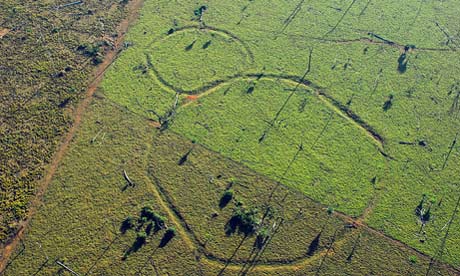
An aerial picture of traces of earthworks built by a lost Amazonian civilisation dating to 200AD. Photograph: National Geographic
It is the legend that drew legions of explorers and adventurers to their deaths: an ancient empire of citadels and treasure hidden deep in theAmazon jungle.
Spanish conquistadores ventured into the rainforest seeking fortune, followed over the centuries by others convinced they would find a lost civilisation to rival the Aztecs and Incas.
Some seekers called it El Dorado, others the City of Z. But the jungle swallowed them and nothing was found, prompting the rest of the world to call it a myth. The Amazon was too inhospitable, said 20th century scholars, to permit large human settlements.
Now, however, the doomed dreamers have been proved right: there was a great civilisation. New satellite imagery and fly-overs have revealed more than 200 huge geometric earthworks carved in the upper Amazon basin near Brazil's border with Bolivia.

Spanning 155 miles, the circles, squares and other geometric shapes form a network of avenues, ditches and enclosures built long before Christopher Columbus set foot in the new world. Some date to as early as 200 AD, others to 1283.
Scientists who have mapped the earthworks believe there may be another 2,000 structures beneath the jungle canopy, vestiges of vanished societies.
The structures, many of which have been revealed by the clearance of forest for agriculture, point to a "sophisticated pre-Columbian monument-building society", says the journal Antiquity, which has published the research.

The article adds: "This hitherto unknown people constructed earthworks of precise geometric plan connected by straight orthogonal roads. The 'geoglyph culture' stretches over a region more than 250km across, and exploits both the floodplains and the uplands … we have so far seen no more than a tenth of it."
The structures were created by a network of trenches about 36ft (nearly 11 metres) wide and several feet deep, lined by banks up to 3ft high. Some were ringed by low mounds containing ceramics, charcoal and stone tools. It is thought they were used for fortifications, homes and ceremonies, and could have maintained a population of 60,000 – more people than in many medieval European cities.
The discoveries have demolished ideas that soils in the upper Amazon were too poor to support extensive agriculture, says Denise Schaan, a co-author of the study and anthropologist at the Federal University of Pará, in Belém, Brazil. She told National Geographic: "We found this picture is wrong. And there is a lot more to discover in these places, it's never-ending. Every week we find new structures."
Many of the mounds were symmetrical and slanted to the north, prompting theories that they had astronomical significance.
Researchers were especially surprised that earthworks in floodplains and uplands were of a similar style, suggesting they were all built by the same culture.
"In Amazonian archaeology you always have this idea that you find different peoples in different ecosystems," said Schaan. "So it was odd to have a culture that would take advantage of different ecosystems and expand over such a large region." The first geometric shapes were spotted in 1999 but it is only now, as satellite imagery and felling reveal sites, that the scale of the settlements is becoming clear. Some anthropologists say the feat, requiring sophisticated engineering, canals and roads, rivals Egypt's pyramids.

The findings follow separate discoveries further south, in the Xingu region, of interconnected villages known as "garden cities". Dating between 800 and 1600, they included houses, moats and palisades.
"These revelations are exploding our perceptions of what the Americas really looked liked before the arrival of Christopher Columbus," said David Grann, author of The Lost City of Z, a book about an attempt in the 1920s to find signs of Amazonian civilizations. "The discoveries are challenging long-held assumptions about the Amazon as a Hobbesian place where only small primitive tribes could ever have existed, and about the limits the environment placed on the rise of early civilisations."
They are also vindicating, said Grann, Percy Fawcett, the explorer who partly inspired Conan Doyle's book The Lost World. Fawcett led an expedition to find the City of Z but the party vanished, bequeathing a mystery.

Many scientists saw the jungle as too harsh to sustain anything but small nomadic tribes. Now it seems the conquistadores who spoke of "cities that glistened in white" were telling the truth. They, however, probably also introduced the diseases that wiped out the native people, leaving the jungle to claim – and hide – all trace of their civilisation.
• This article was amended on Wednesday 6 January 2010. Percy Fawcett's experiences in the Amazon were said to have partly inspired Arthur Conan Doyle's book The Lost World, but Fawcett's disappearance did not, contrary to a suggestion in the original article - he vanished after the book was published. This has been corrected.


Fish Memory


So the take home lesson here is that if fish have a memory, they may learn to associate disturbance with danger.  That possibly gives another reason why one can drop a baited hook near a visible school of fish and be ignored.


This is of course common sense, disturbed fish certainly do not bite and that surely suggests memories a lot better that three seconds.


I always had though that I was facing a battle of wits with fish once the river water cleared in the spring.  Perhaps we now know why.  This was really one of those idle questions that had never been deemed worth the trouble of answering along with the idea that earth worms do not feel pain which is also rubbish.


Fish can remember things for months: Scientists


LONDON: Australian scientists have claimed that fish can remember things for months, dismissing the myth that the aquatic animal have 
three-second memory. 

According to the researchers at the Charles Sturt University, the traditional view that fish lack the brain power to retain memories is "absolute rubbish". 


"Fish can remember prey types for months. They can learn to avoid predators after being attacked once and they retain this memory for several months. And carp that have been caught by fishers avoid hooks for at least a year," lead author Kevin Warburton said. 

"That fish have only a three second memory is just rubbish but nobody knows where the three-second myth comes from," Warburton was quoted as saying by The Telegraph. 

Ashley Ward, a fish biologist at Sydney University, said: "It seems to come from an advert many years ago, but nobody is sure what it was for." 


Fish can also learn to improve how to catch food, said Warburton, carry out acts of deception and modify their behaviour, for example, in reef environments cleaner fish who eat parasites off 'client' fish act on best behaviour when they spot a larger patron. 

Warburton said: "What's fascinating is that they co-operate more with clients when they are being observed by other potential clients. This improves their 'image' and their chances of attracting clients". 


The team came to this conclusion after studying the behaviour of Australian freshwater fish. 

Golden Mean and Cognition


Some thoughts here about the golden mean.  I suspect that his suggested linkage is actually a bit of a stretch but then why not?  The golden mean falls out of simple geometric manipulation rather too easily to take very seriously.  It is sort of like been overly excited about the circle without a background in geometry.


Any way it is easily constructed and thus a convenient way to pleasingly shape rectangular image frames from a chosen dimensionality.  It is thus no surprise it is commonly used.


For that reason it is suspect to read more into it than totally necessary.


The headline is a touch too ambitious, but the speculations are of some interest.


Researcher explains mystery of golden ratio

December 21, 2009


This is Adrian Bejan of Duke University. Credit: Duke University

The Egyptians supposedly used it to guide the construction the Pyramids. The architecture of ancient Athens is thought to have been based on it. Fictional Harvard symbologist Robert Langdon tried to unravel its mysteries in the novel The Da Vinci Code.


"It" is the golden ratio, a geometric proportion that has been theorized to be the most aesthetically pleasing to the eye and has been the root of countless mysteries over the centuries. Now, a Duke University engineer has found it to be a compelling springboard to unify vision, thought and movement under a single law of nature's design.

Also know the divine proportion, the golden ratio describes a rectangle with a length roughly one and a half times its width. Many artists and architects have fashioned their works around this proportion. For example, the Parthenon in Athens and Leonardo da Vinci's painting Mona Lisa are commonly cited examples of the ratio.

Adrian Bejan, professor of mechanical engineering at Duke's Pratt School of Engineering, thinks he knows why the golden ratio pops up everywhere: the eyes scan an image the fastest when it is shaped as a golden-ratio rectangle.

The natural design that connects vision and cognition is a theory that flowing systems -- from airways in the lungs to the formation of river deltas -- evolve in time so that they flow more and more easily. Bejan termed this the constructal law in 1996, and its latest application appears early online in the International Journal of Design & Nature and Ecodynamics.


"When you look at what so many people have been drawing and building, you see these proportions everywhere," Bejan said. "It is well known that the eyes take in information more efficiently when they scan side-to-side, as opposed to up and down."

Bejan argues that the world - whether it is a human looking at a painting or a gazelle on the open plain scanning the horizon - is basically oriented on the horizontal. For the gazelle, danger primarily comes from the sides or from behind, not from above or below, so their scope of vision evolved to go side-to-side. As vision developed, he argues, the animals got "smarter" by seeing better and moving faster and more safely.

"As animals developed organs for vision, they minimized the danger from ahead and the sides," Bejan said. "This has made the overall flow of animals on earth safer and more efficient. The flow of animal mass develops for itself flow channels that are efficient and conducive to survival - straighter, with fewer obstacles and predators."

For Bejan, vision and cognition evolved together and are one and the same design as locomotion.The increased efficiency of information flowing from the world through the eyes to the brain corresponds with the transmission of this information through the branching architecture of nerves and the brain.

"Cognition is the name of the constructal evolution of the brain's architecture, every minute and every moment," Bejan said. "This is the phenomenon of thinking, knowing, and then thinking again more efficiently. Getting smarter is the constructal law in action."

While the golden ratio provided a conceptual entryway into this view of nature's design, Bejan sees something even broader.

"It is the oneness of vision, cognition and locomotion as the design of the movement of all animals on earth," he said. "The phenomenon of the golden ratio contributes to this understanding the idea that pattern and diversity coexist as integral and necessary features of the evolutionary design of nature."

In numerous papers and books over past decade, Bejan has demonstrated that the constructal law (www.constructal.org) predicts a wide range of flow system designs seen in nature, from biology and geophysics to social dynamics and technology evolution.

Provided by Duke University (news : web)