Application of muons has been on our radar for decades not least because Russians were also playing. even ran into a spook r two with real enthusiasm.
The real problem is that application needs to be large scale to generate depth and cross section, while the obvious prospect are already owned and broken up.
I do suspect that the global copper demand can be solved by tapping the stikine which is on eastern slopes of the Alaska Panhandle in BC. this copper rich belt actually runs south all the way to the USA border. all needs a muon scan applied. At least we now have the mega processing power.
Mining companies are using cosmic rays to find critical minerals
April 14, 2026
As rich ore gets harder to find, the mining industry is using subatomic particles to map rock deep underground
By Adam Bluestein edited by Eric Sullivan
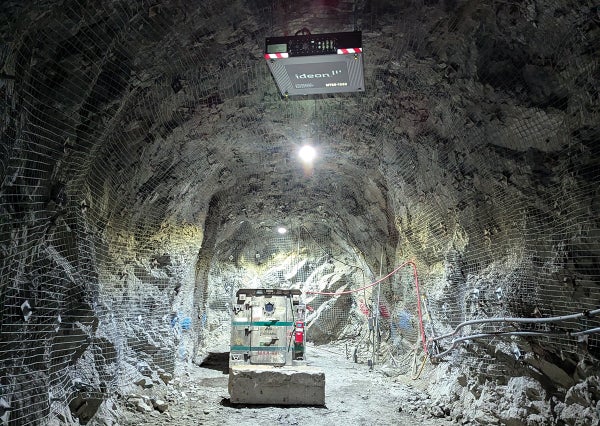
An Ideon muon detector scans for hidden ore deep inside a Nevada mine tunnel.
Alan Madsen/© Ideon Technologies
May 2026 Issue
Fossil Fuels
Operating since 1903, Rio Tinto’s Kennecott Mine near Salt Lake City remains one of the most productive mines in the world, where workers pulled 134,000 metric tons of copper from the earth last year, along with significant amounts of gold, silver and molybdenum.
That doesn’t come close to keeping up with demand, though. Prices of copper and other critical minerals surged to record highs last year, driven by supply shortages and aggravated by trade wars. The shortages show no signs of easing. According to J. P. Morgan, the global refined-copper shortfall will hit 330,000 tons this year and could widen to as much as eight million tons by 2035. The United Nations predicts that demand for critical minerals could triple by 2030. To meet its Net Zero 2050 goals, the International Energy Agency estimates that annual production of these minerals will need to increase sixfold.
A top-tier copper mine can be productive for many decades, but longevity comes at a cost. The Kennecott Mine, the deepest open-pit mine in the world, is the biggest human excavation ever—more than four kilometers wide and more than a kilometer deep. Its impact on the environment and landscape is massive. And the ore coming out of the mine today is lower grade than it used to be, meaning miners must extract a lot more waste rock to get the same amount of processed ore. Meanwhile the search for new deposits has stagnated; for every 1,000 precious-metal prospects worldwide, it’s estimated that fewer than five will ever become productive mines.
Meeting current and future supply shortfalls requires progress on two fronts simultaneously: finding new deposits and extracting material more efficiently from existing ones. Underlying both efforts is the need for better tools to tell us what we’ll find when we start digging—so-called subsurface intelligence. If it works, the tech could lead to less trial-and-error drilling. The risk is that better intelligence could just accelerate extraction in an industry whose impacts remain enormous.
Mineral exploration has always been an exercise in inference. Geologists work from surface clues—mineral outcroppings, soil samples, magnetic anomalies—to make educated guesses about what lies underneath. To improve success rates in finding new “greenfield” mineral reserves—previously unexplored sites where no mining infrastructure yet exists—companies such as Earth AI and KoBold Metals are using novel artificial-intelligence models to find patterns in decades’ worth of existing geological and survey data. The companies say early results are promising, yielding new discoveries of copper and palladium. But any large deposit discovered today will take years—often decades—to become an active mine. A 2023 S&P Global analysis found that from 2002 to 2023, new mines took an average of 15.7 years to develop from discovery to production; in the U.S., the average is 29 years.
Those massive timelines are driving mining companies to expand older “brownfield” surface mines by going underground, using a method called block caving—a brute-force technique that makes the need for subsurface intelligence more urgent than ever. Widely used in copper and gold mining, block caving is suited to lower-grade ore deposits that are more or less vertically oriented. It works a little like open-pit mining in reverse. Engineers dig underground tunnels, then blast an undercut below the ore body, forming an artificial cavern. Large rock funnels called drawbells are built below the undercut to channel rubble into loaders. Once the setup is complete, the undercut removes the ore body’s support, and the rock above starts to fracture and cave in under its own weight, crushing itself as it funnels into the drawbells.
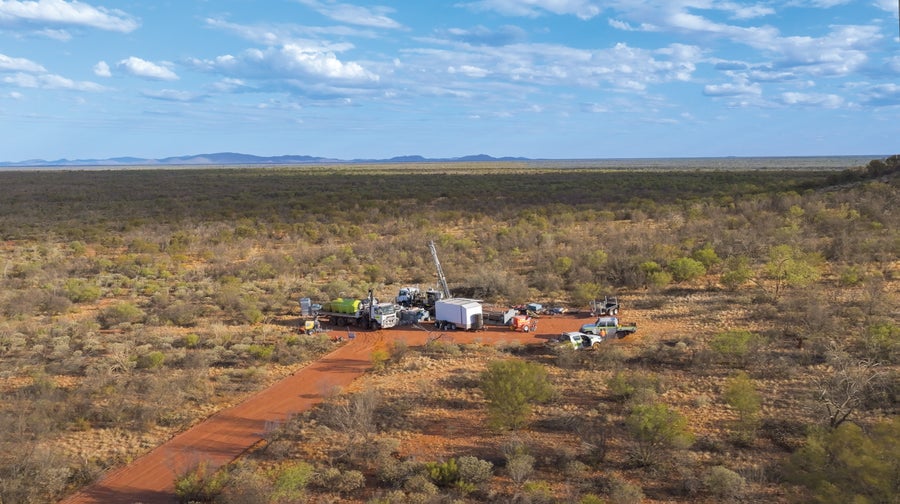
AI models guide Australia-based Earth AI's drill rigs to unexplored "greenfield" sites.
Earth AI, MLD
In theory, once a block cave is established, no additional blasting or construction should be required. As the funnels empty, broken ore continues to drop away from the “roof” above the undercut—picture coffee beans pouring out of a clear bulk dispenser when you open a slot at the bottom. As material is removed, the collapse progresses upward through the ore body until it is exhausted.


No comments:
Post a Comment