Friday, April 3, 2009

US Advisers Enter AfPak Conflict Theatre

This article is worthwhile for describing a string of interpretations clouding decision making and achieving ineffective results. It does not make for optimistic reading.

I will make a couple of comments however. Tribal loyalties run deep but money runs deeper. It is absolutely necessary to legalize the opium trade, even if it is to fill warehouses in Antarctica. With that the crop value can be reduced to that of any other grain crop by sheer over production. That pauperizes the enemy combatants. In fact this insurgency should then die of its own weight and contradictions.

Consider creating a Pashtun state out of the Pashtun portion of Southern Pakistan in particular and the southern portion of Afghanistan. Forcibly transport Pashtun populations into the new state. Not anyone’s first choice but certainly ends the ethic aspect of this area of historic conflict and fully secures the borders of the two countries. It is also quite clear that both countries would prosper without having to deal with a hostile proto state in their bosoms. The rest of Afghanistan has already settled down and would clearly love to be free of this distraction. The point that I am making is that the present boundary divisions are historically unsuccessful and the two countries are resisting the hidden agenda of Pashtun political independence. Combining the multiple ethnic polities and establishing a confederation style constitution is way too much to hope for.

Then confront the Islamic leadership and demand their active efforts in suppressing the propagation of Islamic militarism. It is no different than Nazism and must be suppressed internally.

There are even more radical methods to reshape civil society but I hardly wish to go there at this time. I do ask you to note that what I have just described requires a minimal application of the use of the rifleman. In fact, there is no military solution so long as you allow the fanatic fools continuing access to money and horny young men.

In the meantime, the build up of troops will be swiftly suppressing organized Pashtun resistance again.

Military Escalation and Obama's "War on Terrorism"

US Officials "Rediscover" ISI-Taliban Nexus

By Tom Burghardt

URL of this article:
www.globalresearch.ca/index.php?context=va&aid=12943

March 29, 2009

Long considered the realm of "conspiracy buffs" The New York Times,
citing anonymous "American government officials," have belatedly "discovered" that Pakistan's Inter Services Intelligence agency (ISI) is aiding the Taliban and al-Qaeda.

That ISI operatives were reportedly involved in planning the 9/11 attacks, the ostensible reason for the 2001 U.S. invasion and occupation of Afghanistan remains as they say, "off the table." Yet, as The History Commons
reports, Operation Diamondback uncovered a 2001 plot jointly-run by ISI operatives and organized crime figures to illegally purchase weapons, including Stinger missiles and nuclear components, for the Taliban and al-Qaeda. According to The History Commons, citing The Washington Post and MSNBC:

Informant Randy Glass plays a key role in the sting, and has thirteen felony fraud charges against him reduced as a result, serving only seven months in prison. Federal agents involved in the case later express puzzlement that Washington higher-ups did not make the case a higher priority, pointing out that bin Laden could have gotten a nuclear bomb if the deal was for real. Agents on the case complain that the FBI did not make the case a counterterrorism matter, which would have improved bureaucratic backing and opened access to FBI information and US intelligence from around the world. ("Sting Operation Exposes Al-Qaeda, ISI, and Drug Connections: Investigators Face Obstacles to Learn More," The History Commons, no date)

In 1999, ISI operative Rajaa Gulum Abbas is recorded telling Glass as he gestures towards the World Trade Center in New York during an earlier phase of Operation Diamondback, "those towers are coming down." Yet authorities fail to stop the plot and two years later, 3,000 people are murdered by terrorists in New York and Washington.

The appearance of these reports in the corporate media arrive as the United States prepares a "surge" of some 17,000 American troops into Afghanistan and as the Obama administration escalates CIA drone attacks inside Pakistan. On March 18, The New York Times
reported that the Pentagon is contemplating "broadening the target area" to include "a major insurgent sanctuary in and around the city of Quetta."

Extending military operations into the Pakistani province of Baluchistan, with the potential for "surging" CIA paramilitary officers and Special Operations troops to "kill or capture" senior Taliban and al-Qaeda operatives represents a significant escalation of the conflict.

In a March 27 announcement outlining America's new regional strategy in the "Afpak theatre," President Obama vowed to send an additional 4,000 troops under cover of "training" recruits for the Afghan National Army. The Pentagon plans to raise the total strength of the Afghan army to 134,000 by 2011.

Echoing Bush administration pronouncements, Obama told diplomats and soldiers headed to Afghanistan, "I want the American people to understand that we have a clear and focused goal: to disrupt, dismantle and defeat al-Qaeda in Pakistan and Afghanistan." Employing rhetoric designed to sell the war to a sceptical public, Obama went on to say: "Multiple intelligence estimates have warned that al-Qaeda is actively planning attacks on the US homeland from its safe havens in Pakistan."

As I
reported March 7, with a recently concluded agreement amongst Pakistani Taliban fighters and their Afghan counterparts, the prospects for a bloody spring offensive are a nettlesome reminder that U.S. regional plans are so many illusions soon to be cast to the four winds.

Orchestrated by Afghan Taliban chieftain Mullah Mohammed Omar in coordination with Baitullah Mehsud's Tehrik-e-Taliban Pakistan (TTP), North Waziristan commander Hafiz Gul Bahadur and South Waziristan "emir" Maulvi Nazeer--grouped under the banner of the Shura Ittihad-ul-Mujahideen (Council of United Holy Warriors, SIM)--the United States and their NATO allies face the prospect of ferocious multi-front attacks.

According to the Times, ISI support "consists of money, military supplies and strategic planning guidance to Taliban commanders." Despite billions of dollars in military assistance to the corrupt Musharraf regime and the equally venal Zardari administration, Pakistan's search for "strategic depth" against their geopolitical rival India has only resulted in a furtherance of ISI/Army connivance with the Islamist far-right. The Times avers:

"Support for the Taliban, as well as other militant groups, is coordinated by operatives inside the shadowy S Wing of Pakistan's spy service, the Directorate for Inter-Services Intelligence, the officials said. There is even evidence that ISI operatives meet regularly with Taliban commanders to discuss whether to intensify or scale back violence before the Afghan elections. (Mark Mazzetti and Eric Schmitt, "Afghan Strikes by Taliban Get Pakistan Help, U.S. Aides Say," The New York Times, March 26, 2009)
Citing "electronic surveillance and trusted informants," anonymous Pakistani officials have denied these ties "were strengthening the insurgency." While publicly denying state links to Islamist insurgents, the Army and ISI have historical ties--as does the CIA--to organizations such as the Taliban and the Afghan-Arab database of disposable Western intelligence assets known as al-Qaeda.

As readers of Antifascist Calling and websites such as
Global Research and the World Socialist Web Site are well aware, for three decades the United States has pursued a ruthless policy in pursuit of its own narrow interests. Far from being concerned with the economic and social well-being of the people of Central and South Asia, America's imperialist project is designed solely for regional military domination and resource extraction vis-à-vis their geopolitical rivals Russia and China.

Indeed, since the fall of Kabul's socialist government, the United States has single mindedly pursued policies to control the vast petrochemical resources of Eurasia.

As researcher and analyst Michel Chossudovsky
pointed out, anticipating the current political demonization of the Pakistani people as a selling-point to secure the giant oil and natural gas reserves of Central Asia for American corporations,

"Demonization serves geopolitical and economic objectives. Likewise, the campaign against "Islamic terrorism" (which is supported covertly by US intelligence) supports the conquest of oil wealth. The term "Islamo-fascism," serves to degrade the policies, institutions, values and social fabric of Muslim countries, while also upholding the tenets of "Western democracy" and the "free market" as the only alternative for these countries.

The US led war in the broader Middle East-Central Asian region consists in gaining control over more than sixty percent of the world's reserves of oil and natural gas. The Anglo-American oil giants also seek to gain control over oil and gas pipeline routes out of the region. ...

The ultimate objective, combining military action, covert intelligence operations and war propaganda, is to break down the national fabric and transform sovereign countries into open economic territories, where natural resources can be plundered and confiscated under "free market" supervision. This control also extends to strategic oil and gas pipeline corridors (e.g. Afghanistan)." ("The 'Demonization' of Muslims and the Battle for Oil," Global Research, January 4, 2007)

All of the features described above are in play today. That media outlets such as The New York Times and The Wall Street Journal have discovered ISI-Taliban-al-Qaeda "connections"--while glossing over and suppressing--America's operational links to these same terrorist and narcotrafficking networks, is indicative of the dire straits faced by an economically depleted and politically bankrupt empire.

Drawing (false) distinctions amongst the welter of jihadist groups that American and Pakistan have cultivated since the 1980s, Obama's Director of National Intelligence, retired admiral Dennis Blair, told Congress that the CIA's counterparts in crime, the ISI, believe there are some that "have to be hit and that we should cooperate on hitting, and there are others they think don't constitute as much of a threat to them and that they think are best left alone."

While pursuing Mehsud and others who threaten the state's writ, the Army has been loathe to run to ground proxies such as Jalaluddin Haqqani and Gulbuddin Hekmatyar, veteran narcotrafficking jihadists' who were key Pakistani-linked commanders during the anti-Soviet jihad. Considered "strategic assets" by ISI, Haqqani and Hekmatyar's networks direct fire inside Afghanistan and are therefore considered candidates "best left alone" in Blair's laconic phrase.

However, according to anonymous officials it was none other than the Haqqani network, in collusion with ISI operatives who helped plan last summer's Indian Embassy bombing in Kabul that killed 54 and wounded dozens of others.

While American and European officials are hell-bent on finding (or manufacturing) "good Taliban" with whom they can negotiate a climb down, Pentagon analysts are far-less sanguine of the prospects.

A March 1, 2009
presentation for deploying troops prepared by the U.S. Army Training and Doctrine Command (TRADOC) G-2 and the TRADOC Intelligence Support Activity (TRISA), posted by the intelligence and security website Cryptome, lays out the formidable problems posed by the insurgency--and the extent of Pakistani involvement. Under the heading, "Insurgent Syndicate Characteristics," TRISA analysts aver:

The nature of the enemy in AF HAS NOT CHANGED:

* This enemy is primarily Pashtun in nature and Sunni Muslim (Wahhabi and Deobandi).
* This enemy is funded by the drug economy and Gulf Arab money (for religious reasons).
* This enemy is trained and assisted by ISID or ISID affiliated elements (Kashmiris/HuJI/LeT/HuM, with some Uzbeks.
* They are assisted by AQ [al-Qaeda] in terms of funding, foreign fighters, and other assistance.
* Logistics is the Achilles heel of ISAF operations in AF. Pak control of FATA and the Torkhum Gate. ("HB 9 Paramilitary Terrorist Insurgent Groups: Afghanistan," U.S. Army Training and Doctrine Command, March 1, 2009, p. 5)

As if to drive home the point that "logistics is the Achilles heel" of U.S. and NATO operations in Afghanistan, Dawn
reported March 29 that "hundreds of suspected Taliban armed with rockets and Kalashnikovs entered the Farhad terminal at about 2am and set on fire four vehicles, three cranes, a mini-truck and six power generators." The Al-Faisal terminal near Peshawar is a major jump-off point supplying NATO troops in Afghanistan.

TRISA's "Threat Lay Down" (p. 7) estimates that some 60,000 insurgent fighters are currently arrayed against U.S. and NATO forces. Estimating Afghan Taliban strength at 30,000 fighters, fully half of the estimated number of insurgents are Pakistani. These include: TTP, 15,000; TNSM, 5,000; Lashkar-e-Toiba, 3,000; Lashkar-e-Jhangvi, 2,000.

With 2,000 Al-Qaeda commandos (Brigade 055) and smaller contingents drawn from the former Islamic Movement of Uzbekistan (IMU) and other Central Asian and Middle Eastern factions, it becomes clear that Pakistan's intelligence services, given continued support to "moderates" such as Gulbuddin Hekmatyar as well as to terrorist outfits such as LET and LEJ are a major source of support behind the insurgency.

This is all the more remarkable considering that LET commandos, operating in close coordination with ISI and Dawood Ibrahim's organized crime-linked
D Company carried out last November's attacks in Mumbai, whilst LEJ was reportedly behind the assault on Sri Lanka's national cricket team in Lahore earlier this month.

Significantly, TRISA analysts claim that amongst the "Warlord Militias" (p. 10) currently backing Hamid Karzai's government, their operations unsurprisingly, are also financed through "crime, narco-trafficking, smuggling, illegal taxation, including illegal road checkpoints for taxation." One might reasonably infer that U.S. operations amount to little more, despite the role of the narcotics trade on both sides of the "Afpak" divide, than a battle for control over lucrative drug manufacturing and smuggling routes.

Ironically enough, despite the grave threat to Pakistani citizens in Swat Valley, indeed throughout the entire country, the Zardari administration cut a deal last month with local TTP commander Maulana Fazlullah.

The sociopathic son-in-law of Tehrik Nifaz Shariat-i-Muhammadi (Movement for the Enforcement of Islamic Law, TNSM) leader Maulana Sufi Mohammed, a close ally of Mullah Omar, Fazlullah's criminal network has instituted a reign of terror in Swat under the banner of "Sharia law." Despite the truce, TTP militants continue to murder Swat residents and enhance the reach of various criminal enterprises, ranging from extortion, kidnapping and illegal logging through heroin processing for export.

Pakistani workers and farmers continue to pay a heavy price for the state's move to mollify the jihadist Frankenstein. For decades, having proven themselves politically useful when it comes to murdering leftists, trade union activists or uppity women and cultural workers, reactionary forces such as the TTP or the ever-pliant Lashkar-e-Toiba and Jaish-e-Mohammed are a shadowy "third force" that can be counted on by "Military Inc." to "keep the rabble in line."

In this context, "holy warriors" linked to the TTP carried out a horrific suicide bombing inside a mosque packed with worshipers in the Khyber region on Friday, killing 50 people and wounding 158 others.

Dawn
reported that the two-storey structure collapsed onto the heads of worshipers after a suicide bomber "jumped into the Friday congregation and blew himself up just when the prayers were about to begin."

Eyewitnesses told Dawn they believe the casualty figures are being under-reported by authorities and that upwards of 70 people may have been killed by the blast and the subsequent collapse of the mosque's ceiling.

The News
reported Saturday that upwards of 76 people had been killed in the vicious blast, including the prayer leader, his brother, as well as truck drivers carrying goods to neighboring Afghanistan.

There were tragic scenes at the site of the explosion. Many of the dead were mutilated beyond recognition. Rescuers and grief-stricken relatives of the missing and the dead were collecting pieces of bodies in the hope of locating their near and dear ones. A goat killed by the blast was also lying near the destroyed mosque. ...

Meanwhile, some residents and injured belonging to the villages of Rekalay and Kufar Tangi said they saw aircraft flying above the area since Friday morning. They feared the blast at the mosque could have been caused by a missile fired by a US drone. (Daud Khattak & Nasrullah Afridi, "76 killed in Jamrud mosque bombing," The News, March 28, 2009)

While eyewitness accounts describe a suicide bomber as the party responsible for the horrendous attack, part and parcel of SIM's campaign to cut NATO supply lines into Afghanistan, America's escalating robot drone wars are a reminder of growing anti-American sentiment amongst Pakistanis who are the overwhelming victims of the CIA's death-from-above air campaign.

If the Swat truce is an indication of what Pakistani citizens will now face at the hands of Mehsud's TTP and their minions, the prospects for a "normal" life--short of smashing the medievalists' and their ISI handlers--are grim.

Even as CIA and Pakistani intelligence officials "are drawing up a fresh list of terrorist targets for Predator drone strikes along the Pakistan-Afghanistan border," The Wall Street Journal
reports that ISI officials are "directly supporting the Taliban and other militants in Afghanistan, even as the U.S. targets those groups."

Indeed, as the Times avers, "when the Haqqani fighters need to stay a step ahead of American forces stalking them on the ground and in the air, they rely on moles within the spy agency to tip them off to allied missions planned against them."

An unspoken subtext to the Times and Journal reportage is the continued utilization of these terrorist networks--by the CIA and U.S. Special Operations Command--for covert war against Iran--even as the Obama administration seeks Tehran's assistance in battling the Taliban and al-Qaeda. As investigative journalist Seymour Hersh reported last July in
The New Yorker the Pentagon funded the narcotrafficker Baluchi-based Jundullah organization to attack security personnel inside Iran.

While an open secret in Washington, Obama's new product roll-out in the form of an ill-conceived plan to "disrupt, dismantle and defeat" al-Qaeda and the Taliban has everything to do with the construction of the $7.6 billion dollar "Turkmenistan-Afghanistan-Pakistan-India (TAPI) pipeline that would cross western Afghanistan east of Herat and advance south through Taliban-controlled territory towards Pakistani Balochistan province,"
according to Asia Times. As the World Socialist Web Site points out,

Afghanistan and Pakistan stand at a nexus of pipeline and trade routes between the Middle East, Russia, China and the Indian subcontinent, and US domination of the countries would give it decisive influence over developments in trade and strategic relations between many of Eurasia's largest and fastest-growing economies. In particular, it would cement the US' ability to mount a blockade of oil supplies for China and India in the Indian Ocean. (Alex Lantier, "Obama announces escalation of war in Afghanistan, Pakistan," World Socialist Web Site, March 28, 2009)

And with the imperialist military project going off the rails in Afghanistan as the Taliban's spring offensive looms ever-larger on the horizon, the prospects for a deadly confrontation between nuclear-armed world powers over control of oil and gas will inevitably increase.

Tom Burghardt is a researcher and activist based in the San Francisco Bay Area. In addition to publishing in Covert Action Quarterly and
Global Research, an independent research and media group of writers, scholars, journalists and activists based in Montreal, his articles can be read on Dissident Voice, The Intelligence Daily, Pacific Free Press and the whistleblowing website Wikileaks. He is the editor of Police State America: U.S. Military "Civil Disturbance" Planning, distributed by AK Press.

Thursday, April 2, 2009

Paul Kragman and Failure of Securitization

The message for all of us here is that the global financial system tried to squeeze far more growth out of the financial system than it was ever capable of providing. In the end it all turned into liar’s poker until that fateful day that the music stopped. A few got rich and many will be now hunted down as governments begin to discover that their tax revenues are in decline.

This is a pretty fair analysis and what is disturbing is that our political leaders simply have not understood what else is in store financially. The taxpayer has now got capital loses to claw back past taxes with. The economy is shrinking. It is not even faking it behind inflation. Everyone is going to be buying cheaper cars and everyone’s asset based credit has hugely shrunk. That means everyone is rebuilding their credit and free cash.
Fortunately, a lot of that economy is not leveraged and will come through fine. So the blood is beginning to flow again.

The financial system has been destroyed and is been recapitalized by the government printing press. This is not over yet. The banks must make good on all the money they owe while praying that their assets begin performing. It will not get worse only because the banks cannot sell their assets. Any refinance is focused on keeping what is already on the books afloat.

The way that the system is leveraged, the majority of assets are now worth less that the debt they collateralize. When this occurs, the bank is in the position were a forced sale actually revalues the balance of the portfolio at an even lower price. In other words they not only collect a fraction of the specific debt, they crystallize the direct loss as a hit on capital and then they absorb a massive additional write down on their asset base as an additional hit on capital.

So right now, the banks are zombies because they have no free capital to lend and they cannot improve balance sheets by sale of assets. And while we are at it, these banks will not be ever playing with reckless 40 to 1 ratios ever again. They are going back to 12 to 1 and learning to like their boring business. This all demands much more capital.

And as I have repeated many times, do not worry about inflation because that has already been put into the system. Now we must restore the massive losses of bank and industrial capital inflicted.

In the meantime, we are also about to start buying cheaper government, like it or not. And as Paul Krugman recognizes, the financial sector is been forcibly down sized and reengineered. It is not over yet, and the apparent lack of imagination is scary.

Paul Krugman: The market mystique

http://www.iht.com/articles/2009/03/27/opinion/edkrugman.php

On Monday, Lawrence Summers, the head of the National Economic Council, responded to criticisms of the Obama administration's plan to subsidize private purchases of toxic assets. "I don't know of any economist," he declared, "who doesn't believe that better functioning capital markets in which assets can be traded are a good idea."
Leave aside for a moment the question of whether a market in which buyers have to be bribed to participate can really be described as "better functioning." Even so, Mr. Summers needs to get out more. Quite a few economists have reconsidered their favorable opinion of capital markets and asset trading in the light of the current crisis.


But it has become increasingly clear over the past few days that top officials in the Obama administration are still in the grip of the market mystique. They still believe in the magic of the financial marketplace and in the prowess of the wizards who perform that magic.

The market mystique didn't always rule financial policy. America emerged from the Great Depression with a tightly regulated banking system, which made finance a staid, even boring business. Banks attracted depositors by providing convenient branch locations and maybe a free toaster or two; they used the money thus attracted to make loans, and that was that.

And the financial system wasn't just boring. It was also, by today's standards, small. Even during the "go-go years," the bull market of the 1960's, finance and insurance together accounted for less than 4 percent of G.D.P. The relative unimportance of finance was reflected in the list of stocks making up the Dow Jones Industrial Average, which until 1982 contained not a single financial company.

It all sounds primitive by today's standards. Yet that boring, primitive financial system serviced an economy that doubled living standards over the course of a generation.

After 1980, of course, a very different financial system emerged. In the deregulation-minded Reagan era, old-fashioned banking was increasingly replaced by wheeling and dealing on a grand scale. The new system was much bigger than the old regime: On the eve of the current crisis, finance and insurance accounted for 8 percent of G.D.P., more than twice their share in the 1960's. By early last year, the Dow contained five financial companies — giants like A.I.G., Citigroup and Bank of America.

And finance became anything but boring. It attracted many of our sharpest minds and made a select few immensely rich.

Underlying the glamorous new world of finance was the process of securitization. Loans no longer stayed with the lender. Instead, they were sold on to others, who sliced, diced and puréed individual debts to synthesize new assets. Subprime mortgages, credit card debts, car loans —
all went into the financial system's juicer. Out the other end, supposedly, came sweet-tasting AAA investments. And financial wizards were lavishly rewarded for overseeing the process.

But the wizards were frauds, whether they knew it or not, and their magic turned out to be no more than a collection of cheap stage tricks. Above all, the key promise of securitization — that it would make the financial system more robust by spreading risk more widely — turned out to be a lie. Banks used securitization to increase their risk, not reduce it, and in the process they made the economy more, not less, vulnerable to financial disruption.

Sooner or later, things were bound to go wrong, and eventually they did. Bear Stearns failed; Lehman failed; but most of all, securitization failed.

Which brings us back to the Obama administration's approach to the financial crisis.

Much discussion of the toxic-asset plan has focused on the details and the arithmetic, and rightly so. Beyond that, however, what's striking is the vision expressed both in the content of the financial plan and in statements by administration officials. In essence, the administration seems to believe that once investors calm down, securitization — and the business of finance — can resume where it left off a year or two ago.

To be fair, officials are calling for more regulation. Indeed, on Thursday Tim Geithner, the Treasury secretary, laid out plans for enhanced regulation that would have been considered radical not long ago.

But the underlying vision remains that of a financial system more or less the same as it was two years ago, albeit somewhat tamed by new rules.

As you can guess, I don't share that vision. I don't think this is just a financial panic; I believe that it represents the failure of a whole model of banking, of an overgrown financial sector that did more harm than good.
I don't think the Obama administration can bring securitization back to life, and I don't believe it should try.

Here we have an anecdote for the worst of the doom and gloom. If you ever get really nervous, recall that today it is all about cash in you pocket and there is little likelihood of that disappearing. What governments have failed to recognize is that cash must be fed to the people who are now having their credit destroyed by busted banks.

Sorry Collapsitarians, Doomers and Dystopians a Full Collapse Will Not Happen

Collapsitarians are described the Technium.

Former President Reagan defined a recession as when your friend lost his job, and a depression as when you lost your job. Collapse is when no one has a job; in fact there are no longer any such things as jobs to be had.

Various types of doomers/collapsitarians/dystopians:

* Luddites, anarchists, and anti-civilization activists who are trying the hasten collapse as soon as possible.
* Survivalists: collapse as the penalty for modern liberalism.
* Radical environmentalists who see ecological and environmental collapse
* Anti-globalists who see collapse as the penalty for globalism.
* Anti-Americans rooting for collapse of America and developed world
* Financial doomers: who see the never ending Depression
* Peak Everythingers who see all resources running out

Plenty of other places online describing these scenarios of decline, war, and collapse to 0 to 2 billion people starting as early as this year and usually by 2025 but no later than 2100. One thing of note is that most people usually think that Hitler and Stalin were bad guys for killing or causing the death of about 100 million people. Most of the civilization die off scenarios are that level of death each and every year for 70 years. 1000 times the number of deaths in the holocaust. Why is there the belief that significant mitigation efforts would not be made ?

Why it Won't Happen

1. Efficiency, conservation and an
energy plans can be enhanced beyond current levels with minimal strain. There has been partially voluntary reductions in energy demand during the credit crisis. 10% reductions with minimal effort and 20% reductions with more austerity.

2.
Rationing of food, fuel and clothes was successfully maintained in many countries during World War 2. Any resource decline or environmental situation can have governments use rationing to buy time for a transition.

Thus it shows that oil and food supplies can be greatly reduced while maintaining a war-level mobilization.

90% reductions can be handled in this way and possibly more.

3. Some simple and rapid transitions are possible. Ban or confiscate large gas guzzling vehicles and only allow light weight all electric or super-efficient vehicles other than freight trucks and heavy delivery trucks. In less than one year a mobilized effort with shifts in the weight of vehicles permitted and loosened safety and bureaucratic regulations to speed the changes.

4. Rapid switchover for the electricity generation infrastructure. A war-time level mobilized switchover for electricity generation could be achieved quickly. Lift regulatory restrictions on nuclear power. Weld together containment domes to get around production limitations on large forgings. Use the staff of coal plants for the new nuclear plants. The staff of early nuclear plants did come from the coal plants. Nuclear staffing levels were 200 or less originally.

5. In regards to global warming and environmental concerns:

* a rapid switchover to totally clean power would stop the air pollution of coal and most oil and would greatly reduce any additional CO2
* geoengineering can be used to reduce global temperatures if necessary
* if the beliefs of climate change being from man-made sources are right then we are already geoengineering by accident as a side effect of our industry. It will be cheaper and easier to geoengineer to cancel those accidental side effects with intentional reversal efforts

7. If there was a global war over resources. There would be clear winners. In all out war there would be clear losers. The US would not lose.

8. There is plenty of technology now and
a lot more that will be available soon to innovate away doomer scenarios.

* biofuels and synthetic fuels are already at about 10% of total fuel levels. If there was a need to replace all oil tomorrow a combination of world war 2 level rationing and biofuels and synthetics would be sufficient (Germany invented to coal to liquid fuel technology back in World War 2.)
* There are significant levels of hydroelectric, wind, and nuclear power
* If any of the challenges can be staved off for ten years or so there will be significant transitions to new technology (electric and hybrid vehicles) and the availability of more new technology

9. Financial doom scenarios

* Mandated resets of debt forgiveness, re-issuing script etc... can be used to reboot a country or a financial system
* People and systems for production would still exist even if there was 1000 trillion in debt 10.
All out nuclear war would kill less than 50% of the population. Current nuclear arsenals are reduced by ten times from the peak.

Generally the extinction effects have to be so rapid that their is no time to mitigate or adapt. Space based phenomena like massive asteroid or a nearby gamma ray burster are the kind of situation that we currently could not handle. This is why there is need to stop pissing around with penny ante crap and get serious about moving civilization to full Kardashev level II. At that level there is no known threat other than all out super-war that would be a risk to such a civilization. Even things like the sun going nova could be detected and handled as such a civilization would have its own highly efficient nuclear fusion and other power sources.

Rampaging Wind Power Bull

Sometimes it is necessary to go to the financial press to discover what is happening out in the field in maturing technologies. Wind is on a tear. The regulatory issues are long since mastered and the economic models are tested and a banker’s dream. And if you had been fully invested in wind based utilities, you could have ignored the bear market now rampaging across the globe.

What is happening though is that the wind industry is on its way to grabbing at least twenty percent of the global energy market. It is safe, it is reliable and it is deliverable. It is now the solution of choice for utilities needing to expand capacity and reduce reliance on carbon based fuels.

Geothermal will also share in this capital investment boom but it is still years away from developing anything like present wind industry capacity.

Technically, this will stiffen the drive for two other technologies. The first is industrial battery storage. Right now we are improving flexibility in load adjustment, but been able to simply dump all your surpluses into a battery farm means that you can expand from the present wind optimal of 20% of total capacity to close to 80% if thought desirable.

The second technology is the implementation of a national high voltage trunk system that permits power transfers on a continental scale. Wind, and geothermal cannot be planned and built adjacent to their markets. The power must be moved efficiently and cheaply.

We have already posted a bit on that, but the gimmes are from the West and North Texas into the Southeast and the Heartland. I would also see Nevada linked to California to jump start the geothermal industry.

Common sense suggests that the absolute best use of stimulus money is in this particular sector. It is getting financed at breakneck speed but can handle much greater demand and can be financed through government guarantees. This is a continental infrastructure project that will pay for itself and will also supply the necessary electricity for the onrushing electrical automotive age. It will also create the maximum industrial jobs. A lot of metal must be cut.

This is from the Energy and Capital newsletter which can be located through my links list.

It's hard to believe we're in a recession when you look at the recent performance of the wind industry.

And while I've seen numerous claims of "recession-busting profits," I'd have to say that crown belongs exclusively to the wind sector.

Last year -- in the face of the worst economic times in decades -- the wind industry delivered revenue well over $45 billion.

But that's not even the best part...

Even though $45 billion in revenue is impressive, it's nothing compared to wind's 28% growth rate last year.

I can think of several industries that contracted by 28% or more, but I can't think of one that grew that much.

Wind energy has truly been a safe haven in the face of recession... and the next few years will be even better.

The industry is expected to grow 27% annually through 2015. And annual revenues are slated to more than double in the same time.

If you want to take advantage of this easy profit opportunity, I've singled out three must-own wind stocks in the report below.

As you'll read in the report, I think following this advice could net you an easy double in the next 18 months.

Call it like you see it,
Nick
Dear Reader,
You just don't hear a story like this every day...
Late last year, as global markets spiraled downward, NACEL Energy Corporation - a little-known wind energy company based out of Denver - was approached by its former CEO - Dan Leach - with a very unusual proposition...

...To buy 1,250,000 shares of NACEL's common stock.

You see, before Mr. Leach left the company, he was instrumental to the startup of four wind energy projects for NACEL...

Two small projects in the Texas panhandle,
Another project in Kansas (for which a location hasn't even been secured yet), and
A proposed three-phase project in the Dominican Republic.

Now here's a guy who's made a career in wind energy, having served as senior wind energy development consultant for Duke Energy since 1995. So he knows the drill.

And although he left NACEL to pursue other interests, he wanted those four wind energy projects back.

He even made a formal proposal to have the rights to all four wind projects transferred back to his name - in exchange for 1,250,000 shares of the company's common stock.

Now, if that seems a bit strange, consider this:

This tiny wind company refused Mr. Leach's offer.

That's right. Rather than cash in on an outright purchase of over one million shares, NACEL decided to hold fast to their projects...

Why?

Because the offer Leach made will look like chump change... once those turbines start generating revenue!

$47.5 Billion In One Year

Actually, NACEL's decision isn't very shocking at all when you take a look at the facts:

* The global wind energy market has grown 482% over the last seven years.

* Global capacity will grow over 27% annually from 2000 to 2015.

* Wind-generated revenues exceeded $47.5 billion in 2008 alone.

That's right. In just one year, the wind energy industry generated more than $47 billion.

And in less than a decade - even as we head face first into a full-blown recession - that number is expected to reach nearly $90 billion in revenue. . . each and every year.

In a moment, I'll tell you exactly how you can get some of this early action with 3 very specific wind energy stocks.

But first, let me show why...

Wind Energy Just Got A Major Shot Of Steroids

Earlier this year, the Global Wind Energy Council released wind industry statistics for 2008--the most up-to-date and authoritative numbers available.

Despite a global recession, the wind industry turned in its best yearly performance ever. Over 27,000 megawatts of new wind installations were put in place. . .delivering an unheard-of 28.8% annual growth rate during the most uncertain market times in decades.

But here's where it really gets good.

According to the GWEC, "the global wind market for turbine installations in 2008 was worth $47.5 billion." With 27,000 megawatts installed, that works out to about $1.76 million per megawatt!

By 2015, global installed capacity is expected to grow to 294,221 MW for 143% growth in the next six short years. Put another way, there will be an additional 173,208 MW installed in the next five years.

At an average cost of $1.76 million per megawatt, you're looking at a $304.9 billion market-in just the next five years.

That's why we've already taken positions in three small wind energy stocks that are about to begin a very long and profitable ride.

In fact, we believe that all 3 of these stocks will deliver gains in excess of 28% by the end of the year, and are...


I'm completely serious.

Given wind's forecast momentum and the incentives given to the industry via the recently-passed stimulus, the three wind stocks I've hand-picked for you are going to deliver blockbuster gains over the next few years.

But Congress' love-affair with clean energy has only just begun . .

They've already extended the production tax credit for wind through 2012, and have loosened the restrictions on it so the cash can be claimed up front.

They are also making it easier to transport wind energy by investing billions in transmission lines and smart grid improvements.

And bills could be passed by the end of the year that would require a certain percentage of our electricity to come from renewable resources, like wind energy.

These stocks are going to explode when that happens, so you need to lock in a low price today, while they are still undervalued in the face of recession.

In fact, all three of the stocks are already on the rise in anticipation of the wind industry's future success.

So just imagine what's going to happen when the broader market rebounds and as billions of dollars continue to pour into the sector.

I'll tell you what's going to happen.

Alternative energy stocks are heading straight up - and wind energy stocks are going to lead the charge.

An easy double is certainly in the cards.

And the 3 wind stocks you'll read about in my report actually give you an opportunity to profit from every aspect of the industry.

From turbines to transmission, you can profit from every angle when the rest of Wall Street comes running.

And I'll show you how in my free report, Wind Energy: 3 Stocks To Own NOW.

In this report, you'll not only get the names of these 3 wind energy stocks, but you'll also see exactly why these are the most lucrative wind energy plays in the market. You'll even get very specific entry points so you can...

Deep Solar Minimum

Right on time the sunspot cycle is establishing minima. This time it appears to be as deep as last seen in 1913. Otherwise it is essentially good news as business as usual. A number of commentators have made contrarian predictions, but I see no reason to do that. Present evidence supports a rapid rise starting this year culminating in a peak three years hence on schedule. There is no reason to read anything whatsoever into present evidence.

We have seen the first few cycle 24 sunspots, and we can expect that come Christmas we will be seeing plenty more.

A number of commentators have pushed hard to police up the link between this cycle and global temperatures. My sense is that the link is real enough but been one of those factors whose effect is almost within the error range, it is devilishly difficult to separate. The fact that we seem to have decadal cycles in global climatic conditions is very suggestive but a little like trying to measure variable input heat flux in a pot by observing the boiling porridge. And yes, we are the boiling porridge.

The new news is simply that this minima is deeper than any recorded since the minima recorded in 1913. This means that we can compare the weather of the 1913 to 1924 with the weather of the next eleven years and properly determine comparability to perhaps winkle out specific variables not possible or convincing otherwise.

It is a decadal program but it should allow us to propose testable variables and outputs to test against all other sunspot cycles.

Deep Solar Minimum

04.01.2009

April 1, 2009: The sunspot cycle is behaving a little like the stock market. Just when you think it has hit bottom, it goes even lower.

2008 was a bear. There were no sunspots observed on 266 of the year's 366 days (73%). To find a year with more blank suns, you have to go all the way back to 1913, which had 311 spotless days:
plot. Prompted by these numbers, some observers suggested that the solar cycle had hit bottom in 2008.

Maybe not. Sunspot counts for 2009 have dropped even lower. As of March 31st, there were no sunspots on 78 of the year's 90 days (87%).
It adds up to one inescapable conclusion: "We're experiencing a very deep solar minimum," says solar physicist Dean Pesnell of the Goddard Space Flight Center.

"This is the quietest sun we've seen in almost a century," agrees sunspot expert David Hathaway of the Marshall Space Flight Center.

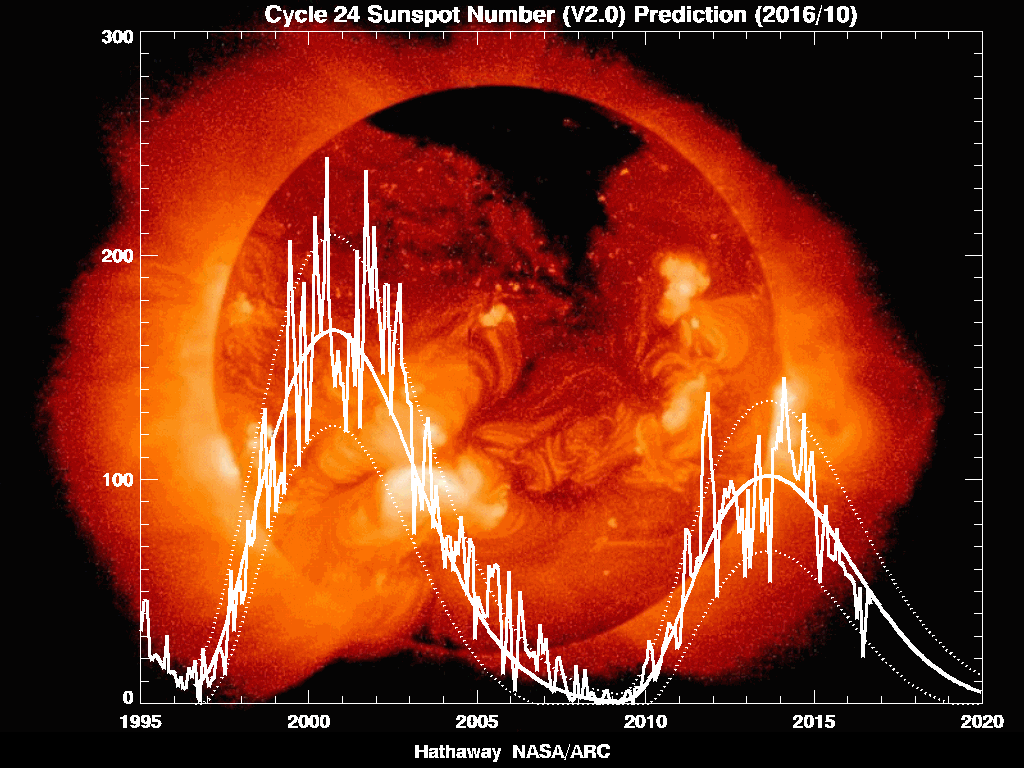
http://solarscience.msfc.nasa.gov/images/ssn_predict_l.gif


Above: The sunspot cycle from 1995 to the present. The jagged curve traces actual sunspot counts. Smooth curves are fits to the data and one forecaster's predictions of future activity. Credit: David Hathaway, NASA/MSFC.


Quiet suns come along every 11 years or so. It's a natural part of the sunspot cycle, discovered by German astronomer Heinrich Schwabe in the mid-1800s. Sunspots are planet-sized islands of magnetism on the surface of the sun; they are sources of solar flares, coronal mass ejections and intense UV radiation. Plotting sunspot counts, Schwabe saw that peaks of solar activity were always followed by valleys of relative calm—a clockwork pattern that has held true for more than 200 years:
plot.

The current solar minimum is part of that pattern. In fact, it's right on time. "We're due for a bit of quiet—and here it is," says Pesnell.

But is it supposed to be this quiet? In 2008, the sun set the following records:

A 50-year low in solar wind pressure: Measurements by the Ulysses spacecraft reveal a 20% drop in solar wind pressure since the mid-1990s—the lowest point since such measurements began in the 1960s. The solar wind helps keep galactic cosmic rays out of the inner solar system. With the solar wind flagging, more cosmic rays are permitted to enter, resulting in increased health hazards for astronauts. Weaker solar wind also means fewer geomagnetic storms and auroras on Earth.

A 12-year low in solar "irradiance": Careful measurements by several NASA spacecraft show that the sun's brightness has dropped by 0.02% at visible wavelengths and a whopping 6% at extreme UV wavelengths since the solar minimum of 1996. These changes are not enough to reverse the course of global warming, but there are some other, noticeable side-effects: Earth's upper atmosphere is heated less by the sun and it is therefore less "puffed up." Satellites in low Earth orbit experience less atmospheric drag, extending their operational lifetimes. That's the good news. Unfortunately, space junk also remains longer in Earth orbit, increasing hazards to spacecraft and satellites.

http://science.nasa.gov/headlines/y2009/images/deepsolarminimum/irradiance.jpg


Above: Space-age measurements of the total solar irradiance (brightness summed across all wavelengths). This plot, which comes from researcher C. Fröhlich, was shown by Dean Pesnell at the Fall 2008 AGU meeting during a lecture entitled "What is Solar Minimum and Why Should We Care?"

A 55-year low in solar radio emissions: After World War II, astronomers began keeping records of the sun's brightness at radio wavelengths. Records of 10.7 cm flux extend back all the way to the early 1950s. Radio telescopes are now recording the dimmest "radio sun" since 1955:
plot. Some researchers believe that the lessening of radio emissions is an indication of weakness in the sun's global magnetic field. No one is certain, however, because the source of these long-monitored radio emissions is not fully understood.

All these lows have sparked a debate about whether the ongoing minimum is "weird", "extreme" or just an overdue "market correction" following a string of unusually intense solar maxima.

"Since the Space Age began in the 1950s, solar activity has been generally high," notes Hathaway. "Five of the ten most intense solar cycles on record have occurred in the last 50 years. We're just not used to this kind of deep calm."

Deep calm was fairly common a hundred years ago. The solar minima of 1901 and 1913, for instance, were even longer than the one we're experiencing now. To match those minima in terms of depth and longevity, the current minimum will have to last at least another year.

In a way, the calm is exciting, says Pesnell. "For the first time in history, we're getting to see what a deep solar minimum is really like." A fleet of spacecraft including the Solar and Heliospheric Observatory (SOHO), the twin STEREO probes, the five THEMIS probes, ACE, Wind, TRACE, AIM, TIMED, Geotail and others are studying the sun and its effects on Earth 24/7 using technology that didn't exist 100 years ago. Their measurements of solar wind, cosmic rays, irradiance and magnetic fields show that solar minimum is much more interesting and profound than anyone expected.

Modern technology cannot, however, predict what comes next. Competing models by dozens of top solar physicists disagree, sometimes sharply, on when this solar minimum will end and how big the next solar maximum will be. Pesnell has surveyed the scientific literature and prepared a "
piano plot" showing the range of predictions. The great uncertainty stems from one simple fact: No one fully understands the underlying physics of the sunspot cycle.

Pesnell believes sunspot counts will pick up again soon, "possibly by the end of the year," to be followed by a solar maximum of below-average intensity in 2012 or 2013.

But like other forecasters, he knows he could be wrong. Bull or bear? Stay tuned for updates.

Wednesday, April 1, 2009

Guardian Angels

This is a great story. I do not think it is an April fool’s tale but I think posting on the first is appropriate. That way if you do the test and fail, you can blame my mischievousness. Ed Conrad is a chronic poster on a forum or two that I occasionally follow and I suspect that he at least is real and a newspaperman.

Since he is for real, perhaps we can take this all at face value and run the simple test ourselves. That means following the protocol. This is science in action.

What I want you to do though, if you run this test and it works for you, I want you to email me with Guardian Angel in the subject line, and report your guardian angel’s name. I do not know if this will lead to anything, but if a decent group of folks confirm this phenomena, then we at least know that. Our interpretation may be surpassed by superior knowledge down the road, but welcome to scientific endeavor.

If you try several times and fail, report the same way with a note listing the attempts. I know that most failed attempts will not be reported but the data is still welcome.

Use my email address arclein@yahoo.com.

With an independent data base, we can also accept Ed’s story. That then allows us to actually discuss the phenomena and speculate on its characteristics in good faith. If enough folks are interested, we can even construct experiments to explore this phenomena.

Guardian Angels

This is a column by Ed Conrad that appeared in the Hazleton (Pa.) Standard-Speaker on March 31, 2002 -- Easter Sunday morning. It had the greatest favorable reaction, by far, than anything written in his entire newspaper career.
By ED CONRAD
It's Easter morning -- Happy Easter, everyone -- and what a great morning to touch on a subject that's very, very close to your heart..
Your guardian angel!
You've heard mention of guardian angels for years and years -- associated with different religions (naturally), in movies, in books, on TV- - but few folks, I'm sure, have really given serious thought that they HAVE a guardian angel.
Most undoubtedly figure it's nothing more than the figment of someone's imagination -- and perhaps a bit of wishful thinking.
But, based on a novel experiment conducted right here at the Standard - Speaker, it appears that the reality of guardian angels is more than we could ever imagine.
For example, it appears that our guardian angels can communicate with us -- letting us know his or her name.
Still a skeptic, huh? Then read on.
. It all began about 10 years ago when my late mother visited the Shrine of Our Lady of Czestochowa near Doylestown (Pa.).
Upon returning home, Mom excitedly revealed that she had met an Italian woman -- a senior citizen like herself -- and they clicked instantly.
During one of their numerous conversations, the woman asked my mother: "Anna, what's your guardian angel's name?"
My mother was flabbergasted, shocked at the question, for which she obviously had no answer.
The woman then explained that everyone can learn the name of his or her guardian angel simply by asking, then told my mother: "Before you fall asleep tonight, just say, 'Guardian angel, I know you're with me all the time but I don't know your name. Please let me know your name.' "
Simple! And perhaps a bit far-fetched. Still, my mother tried it.
The next day, Mom enthusiastically phoned and excitedly told me she had learned that her guardian angel's name was Noel. She said the name was solidly embedded in her head when she woke up.
Rather skeptical that it would work for me, I attempted the experiment myself that very night. Lo and behold, I awoke the next morning with the name "Girard" ringing in my ears.
. Well, that might've well been the end of the story -- but it wasn't!
About two weeks ago -- after 10 long years -- I casually mentioned the incident in the Standard-Speaker newsroom when the subject of guardian angels came up and, I admit, my story undoubtedly sounded quite hokey to most who were listening.
But the next morning, Annette Rusnock, the newspaper's editorial librarian, was wearing a broad smile when she strolled into the news room and proudly announced that she had tried the "experiment" to get her guardian angel's name and awoke "with Isabella, Isabella, Isabella."
"Hmmm!" said Rosella Walker, who works near her. "I'm going to try it tonight." Rosella did and came in the next morning happily revealing that it had worked for her as well, getting the name Gertrude.
"And, the thing is, I don't know any Gertrude's," Rosella said. "The only Gertrude I know is Gertrude's Chocolates."
Well, strange things kept happening in the newspaper building.
Joanna Marsicano of the classified advertising department tried it and happily revealed that her guardian angel's name: also was Isabella.
She said when she saw her name in lage, bright lights when she woke up, the last letter "a" in Isabella kept flashing and flashing, emphasizing that the "a" is to be pronounced.
"Just like I'm not Joann but JoannA, my guardian angel undoubtedly wanted me to be sure I knew her name was IsabellA and not Isabell," she remarked.
"To learn I have a guardian angel and, especially, to know her name has made me very happy," said Joanna. "It really made my day."
Mark Katchur, a staff writer, said he wanted to know if he could also get his guardian angel's name and said he woke up knowing positively it is Daniel.
Joanne Suglia, also from classified department, also tried it and beamed while telling everyone that she earned her guardian angel's name is Estelle.
As the story circulated throughout the building, Lois Ann Hall and Nadine Kubilus of the business office, Kathy Breznak and Al Danko of the advertising department, and Vicki Gennaro of the newsroom all tried it as well -- and enthusiastically said it worked!
Lois Ann excitedly said she had requested the name of her guardian angel when she went to bed.
"But I awoke about 6:30 the next morning and was sort of disappointed that nothing happened," she said. "But I laid down again and fell asleep and, when I got up, the name Marjorie was *everywhere.*"
Kathy said she was afraid to try the experiment but, while about to fall asleep one night last week, finally did so. She awoke with the name Michael indelibly impressed upon her.
Danko couldn't believe it when he tried the experiment and learned his guardian angel's name is Justin.
Vicki said her question also had been answered when she awoke with a name ringing in her ears. At first, she admitted she was reluctant to reveal it but then - eventually -- she told the newsroom staff the name she came up with was Azriel.
The latest to attempt the experiment and discover it really works was George Fetchko of the composing room.
He tried it and learned his guardian angel's name is Adam.
The experiment has worked in the majority of cases but, to be perfectly honest, didn't work for two or three people and the answer escapes us. Perhaps these Standard-Speaker staffers hadn't made their request with sincerity.
If there's a fly in the ointment -- to readers still skeptical -- it would be the name of the guardian angel of Nadine Kubilus, the third to say she came up with Isabella.
It means a guardian angel named Isabella popped up three times to women working at the Standard-Speaker and it's anybody's guess if there are three guardian angels named Isabella or one Isabella is working three shifts, for three gals here at the S-S.
Someone suggested that Nadine -- the third Isabella -- probably heard that Annette Rusnock and Joanna Marsicano both had come up with Isabella, independent of each other.
But Nadine insisted that she hadn't been aware of the names that Annette and Joanna had come up with.
"In fact, I learned my guardian angel's name before Joanna because it happened to me last Thursday morning (a day before Joanna learned her guardian angel's name)," said Nadine. "I just didn't say anything when I came to work Friday morning."
One last word: These are sound, sensible people who have held responsible positions, most for many, many years. There is no reason they'd be lying or be part of any type of con job.
You, too, are invited to learn your guardian angel's name, and your belief -- or disbelief -- in an existence beyond our physical realm appears to have nothing whatsoever to do with it.
"Ask and you shall receive," a Very Wise Man once said.
In the case of learning the name of your guardian angel, apparently all you have to do is ask.
(PS: You DO NOT get your guardian angel's name while asleep. It hits you like a thunderbolt as soon as you wake up.) Now, a most unusual follow-up.
George Fetchko, who got his guardian angel's name, attended a wake (a funeral service) a few nights after the above column appeared in the newspaper.

"It seemed everyone at the wake was huddling around me, asking me how I did it)," he remarked at work the next morning.
It -- and countless letters and e-mails from readers who performed the experiment and succeeded -- prompted me to write a follow-up column which began....

"George Fetchko attended a wake the other night and was astounded that he was more popular than the corpse."
PROOF OF LIFE AFTER DEATH
http://www.edconrad.com/pics/Miracle.jpg http://edconrad.com/lifeafterdeath/index.html Ed Conrad
http://www.edconrad.com

Newt Gingrich Sounds Alarum on EMP

I have already posted to this subject and have made the same warming but perhaps less focused on the real vulnerability that we now face. Our principal deterrence is Trident submarine deployment program. Hardly a comfort when our likely enemies are possible candidates from central casting for a staring role in ‘Megalomaniac XVII’

The threat is worse than described. All our electrical devices will be fried. The internet disappears and all our household devices likely catch fire. They have wonderful coils to overload. All the replacement parts are also fried in our warehouses. And do you really think that the military has gotten off their duffs and provided shielding for the replacement parts at least? They have protected operation equipment were really necessary.

Actual shielding should take little more that an excessive enthusiasm for aluminum foil to create Faraday cages around vulnerable equipment. A new building standard needs to be implemented by which all wall board and other paneling has a layer of aluminum foil. That simple and that cheap will in time protect most of our infrastructure.

What Newt is quite rightly saying, is that this is something that we want to be proactive about. The threat is not immediate, but the obvious solution is not immediate either. The potentiality of the threat is not going to go away so long as a nation state retains the desire and ability to make nukes. So change the building codes nationally as a federal mandate to protect the country.

Newt Gingrich: A Single Nuke Could Destroy America

Sunday, March 29, 2009 4:23 PMBy: Newt Gingrich and William Forstchen

There is a sword of Damocles over our heads. It is a threat that is real but has been all but ignored.

On February 3rd, Iran launched a “communications satellite” into orbit. At this very moment, North Korea is threatening to do the same. The ability to launch an alleged communications satellite belies a far more frightening truth. A rocket that can carry a satellite into orbit can also drop a nuclear warhead over any location on the planet in less than forty-five minutes.

Far too many timid or uninformed sources maintain that a single launch of a missile poses no true threat to the United States given our retaliatory power. A reality check is in order and must be discussed in response to such an absurd claim:

One small nuclear weapon, delivered by an ICBM can, in fact, destroy the United States by maximizing the effect of the resultant electromagnetic pulse upon detonation.

An electromagnetic pulse (EMP) is a by-product of detonating an atomic bomb above the Earth’s atmosphere. When a nuclear weapon is detonated in space, the gamma rays emitted trigger a massive electrical disturbance in the upper atmosphere. Moving at the speed of light, this overload will short out all electrical equipment, power grids and delicate electronics on the earth’s surface. In fact, it would take only one to three weapons exploding above the continental United States to wipe out our entire grid and transportation network. It might take years to recover from, if ever.

This is not science fiction. If you doubt this, spend a short amount of time skimming the Report of the Commission to Assess the Threat to the United States from Electromagnetic Pulse (EMP) Attack from April 2008. You will come away sobered.

Even as the new Administration plans to spend trillions on economic bail outs, it has announced plans to reduce funding and downgrade efforts for missile defense. Furthermore, the reluctance by the United States to invest in a modern and credible traditional nuclear deterrent is a serious concern. What good will a bailout be if there is no longer a nation to bail out?

Fifty years ago it was not Sputnik itself that sent a dire chill of warning around the world; it was the capability of the rocket that launched Sputnik. The rocket that lofted Sputnik into orbit could also serve as an ICBM.

Yet for all its rhetoric, the Soviet Union was essentially a rational power that recognized the threat of mutual destruction and thus never stepped to the edge.

The world is different today. Intercontinental range missiles tipped with nuclear weapons in the hands of leaders driven by fanaticism, leaders that support global terrorism, leaders that have made repeated threats that they will seek our annihilation. . .can now at last achieve their dream of our annihilation in a matter of minutes.

Those who claim that there is little to fear from Iran or North Korea because “at best” they will only have one or two nuclear weapons, ignore the catastrophic level of threat we now face from just “a couple” of nuclear weapons.

Again: One to three missiles tipped with nuclear weapons and armed to detonate at a high altitude—to achieve the strongest EMP over the greatest area of the United States—would create an EMP “overlay” that triggers a continental-wide collapse of our entire electrical, transportation and communications infrastructure.

Within weeks after such an attack, tens of millions of Americans would perish. The impact has been likened to a nationwide Hurricane Katrina. Some studies estimate that 90% of all Americans might very well die in the year after such an attack as our transportation, food distribution, communications, public safety, law enforcement and medical infrastructures collapse.

It is a blow we most likely would never recover from.

Two things need to be done now and without delay.

1. Make clear in the strongest of terms that if a rocket is launched by either Iran or North Korea on a trajectory headed towards the territory of the United States, we will shoot it down. The risk of not doing so is beyond acceptable. And if they construe this as an act of war, so be it, for they fired the first shot. The risk of sitting back for thirty minutes and praying it is not an EMP strike is beyond acceptable, beyond rational on our part.

2. Funding for EMP defense must be a top national priority. To downgrade or halt our missile defense program, which after twenty five years of research is at last becoming viable, would be an action of criminal negligence.

Surely, with such a threat confronting us, a fair and open debate, with full public access and the setting aside of partisan politics, is in order. In the meantime, a policy must be stated today that we will indeed shoot down any missile aimed towards the United States that is fired by Iran or North Korea. America’s survival, your survival, and your family’s survival might very well depend on it.

Former House Speaker Newt Gingrich is a Senior Fellow at the American Enterprise Institute. William Forstchen is the author of "One Second After," an account of a town struggling to survive after an EMP weapon is used against the United States.
Some Technical input:

LOW COST EMP/EMI TEMPEST SHIELDING TECHNOLOGY

The Problem

Dependence on electronic systems for military and other national security command, communications, control, computing, data processing, and intelligence continues to increase. The state-of-the-art electronics components used in most systems are susceptible to upset or damage from Electromagnetic Interference (EMI), including the Electromagnetic Pulse (EMP) from nuclear weapons. Further, to ensure communications security (TEMPEST), it is often necessary to prevent compromising emanations. Many defense-related facilities require EMI, EMP, or TEMPEST protection. Historically, a metallic liner or shield has provided protection by completely enclosing the electronics systems. The conservative designs typically provide more shielding than required and are very expensive to design, construct, test, and maintain.

The Technology

The U.S. Army Construction Engineering Research Laboratories (CERL) has been experimenting with low-cost electromagnetic shielding designs for several years. These studies can be categorized as follows:

1. New Materials Development: Materials included are conductive polymers and advanced coatings for use on shield components. Materials being considered include amorphous metals and intercalated graphites. Consideration is also being given to making concrete electrically conductive.

2. Use of Inherent Shielding of Standard Construction Materials: Examples include aluminum-foil-backed gypsum board, aluminum-foil-backed insulating sheathing, metallic-clad siding, copper foils (normally used for vapor barriers), wire meshes, and sheet metal roofing.

3. Adaptation of Application Techniques: These techniques include the use of thermal spraying (primarily arc-spraying) of metals in which molten metal is sprayed in much the same manner as paint is sprayed. This metal bonds to most construction surfaces. Another technique is the use of laser welding to allow efficient welding of thinner sheet metals than conventional methods.

4. New Construction Assembly Techniques: This effort includes an investigation of seam-joining techniques for thin sheet metals, such as galvanized steel, metal meshes, aluminum panels, and copper sheets.

Benefits/Savings

This research is expected to result in significant cost-reductions for electromagnetically shielded rooms or buildings. Cost reductions will result in more widespread use of shielding, thus improving overall communications security, resistance to electromagnetic interference upset, and increased probability of surviving nuclear events.

Status

1. CERL has completed numerous arc-spray experiments and several arc-sprayed rooms and has obtained TEMPEST certification for them. One room used a unique design of copper sprayed onto fiberglass, and the project resulted in an Army Research and Development Achievement award. Current and future studies include evaluation of varying arc-spray parameter effects on the quality of coatings, investigation of the use of electromagnetic propulsion for arc spray, and use of highly flexible arc-sprayed substrates. In addition, two rooms have been installed as field-demonstrations.

2. Several candidates for advanced coatings have been identified to improve shield penetration designs.

3. A relatively new commercial design that uses snap-together joints and galvanized sheet steel has been evaluated in the laboratory and found to be acceptable for most TEMPEST designs.

4. In a current study, laser welding using fiber-optic delivery of laser-welding power is being investigated. This approach will allow for construction of large shielded volumes with non-portable welders and the use of much thinner steel than that used in conventional welded steel shields.

5. Additional details are available in the following CERL technical reports: M-86/11, Development, Design, Construction, and Testing of a Copper Arc-Sprayed Shielded Enclosure, July 1986; M-86/19, Electromagnetic Shielding Tests on a Room Shielded with Foil-Faced Foam Board, September 1986; and M-88/02, Low Cost Electromagnetic Shielding Using Drywall Composites: Results of RFI Testing of Shielding Effectiveness, October 1987; and M-92/06, Effectiveness of Low-Cost Electromagnetic Shielding Using Nail-Together Galvanized Steel: Test Results, September 1992.

Point of Contact

CERL POC is Paul Nielsen, COMM 217-373-7243; toll-free 800-USA-CERL; FAX 217-373-6732; e-mail
p-neilsen@cecer.army.mil; or CERL, ATTN: CECER-FL-E, P.O. Box 9005, Champaign, IL 61826-9005.

Visit the CERL homepage at
http://www.cecer.army.mil

Magnetic Refrigeration Advance

This discovery leaps to the heart of the major technical hurdle facing the development of a low cost Eden Machine. As previously stated it is feasible to produce a device able to meet the parameters established for the Eden Machine from current off the shelf technology. It is unfortunately too expensive to be useful in the market place in any great volume. It is still good enough to shake out and refine operating protocols and markets.

This development put magnetocalorics back into the driver’s seat in the development of new refrigeration tools. We cannot tell yet if this particular alloy will permit a simple cheap system yet, but it must be thought promising. At least the material cost component is starting cheap.

The problem with all refrigeration systems, including the advanced methods, is the need to do technical handstands in order to arrive at the necessary temperature points for the operating conditions. It sounds easy enough, but a study of the history will quickly end that notion. Right now we are discovering excellent starting materials with the correct temperature profiles necessary to make this all work. After that is settled, we are still in the business of trucking heat around a device that can easily become a Rube Goldberg monstrosity.

Technically, we want to parallel developments in the household refrigeration industry to quickly access the economics of mass production. This particular development is likely to be grabbed by that industry. This is very good news for the Eden Machine (check posts late 2008).

New Refrigeration System Based On Magnetics More Economical And Quieter Than Current Technology

ScienceDaily (Feb. 12, 2009) — Your refrigerator’s humming, electricity-guzzling cooling system could soon be a lot smaller, quieter and more economical thanks to an exotic metal alloy discovered by an international collaboration working at the National Institute of Standards and Technology (NIST)’s Center for Neutron Research (NCNR).

The alloy may prove to be a long-sought material that will permit magnetic cooling instead of the gas-compression systems used for home refrigeration and air conditioning. The magnetic cooling technique, though used for decades in science and industry, has yet to find application in the home because of technical and environmental hurdles—but the NIST collaboration may have overcome them.
Magnetic cooling relies on materials called magnetocalorics, which heat up when exposed to a powerful magnetic field. After they cool off by radiating this heat away, the magnetic field is removed, and their temperature drops again, this time dramatically. The effect can be used in a classic refrigeration cycle, and scientists have attained temperatures of nearly absolute zero this way. Two factors have kept magnetic cooling out of the consumer market: most magnetocalorics that function at close to room temperature require both the prohibitively expensive rare metal gadolinium and arsenic, a deadly toxin.

But conventional gas-compression refrigerators have their own drawbacks. They commonly use hydrofluorocarbons (HFCs), greenhouse gases that can contribute to climate change if they escape into the atmosphere. In addition, it is becoming increasingly difficult to improve traditional refrigeration. “The efficiency of the gas cycle has pretty much maxed out,” said Jeff Lynn of NCNR. “The idea is to replace that cycle with something else.”

The alloy the team has found—a mixture of manganese, iron, phosphorus and germanium—is not merely the first near-room-temperature magnetocaloric to contain neither gadolinium nor arsenic—rendering it both safer and cheaper—but also it has such strong magnetocaloric properties that a system based on it could rival gas compression in efficiency.

Working alongside (and inspired by) visiting scientists from the Beijing University of Technology, the team used NIST’s neutron diffraction equipment to analyze the novel alloy. They found that when exposed to a magnetic field, the newfound material’s crystal structure completely changes, which explains its exceptional performance.

“Understanding how to fine-tune this change in crystal structure may allow us to get our alloy’s efficiency even higher,” says NIST crystallographer Qing Huang. “We are still playing with the composition, and if we can get it to magnetize uniformly, we may be able to further improve the efficiency.”

Members of the collaboration include scientists from NIST, Beijing University of Technology, Princeton University and McGill University. Funding for the project was provided by NIST.

Journal reference:

1. D. Liu, M. Yue, J. Zhang, T.M. McQueen, J.W. Lynn, X. Wang, Y. Chen, J. Li, R.J. Cava, X. Liu, Z. Altounian and Q. Huang. Origin and tuning of the magnetocaloric effect for the magnetic refrigerant MnFe(P1-xGex). Physical Review B, Vol. 79, 014435 (2009)

Geither's Problem

When Glass - Steagall was repealed at the end of Clinton’s presidency, I wondered what the hell they were thinking. That was the one law that had prevented a repeat of the 1920 to 1929 credit bubble for seventy years. Without it, or a robust regulatory structure to replace it, a credit bubble will rise and collapse every twenty years or so. It does not stop healthy secondary equity bubbles from developing and collapsing like the dot com bust which was a natural outcome of the extraordinary success of that sector.

It did prevent the necessary collusion between lenders and borrowers in producing a short lived credit bubble that destroys the credit system. Perhaps you can understand why I am angry and label the whole charade as treason. All knowledgeable players understood this and watched the global credit balloon expand to twice its prior proportional size outside the world of regulatory oversight. It could never have ended well and the music played out for far longer than I imagined it was possible. Yet it took no longer than it took in the twenties.

There are a lot of things seriously wrong with our cobbled together financial system, but that was never one of them. It is fitting that the principal players were few and today are essentially dead. Been owned by banks that have rediscovered prudence is just what they deserve. A complete dissolution of the assets into the large next tier of banks and brokers with a competent regulatory regime back in force is what we need.

The USA has been handed an opportunity that should be grasped. It needs to dissolve as many corporate combines as possible. They appear to make economic sense in the short term, but always weaken over the long term. Not just financial, but industrial combines like GM.

To make my point, consider GM. It is many independent car companies under one corporate roof. It has been forced to shed manufacturing to suppliers for decades because it has no leverage over its union. The union has grasped privileges and revenue to itself that now has placed the combine in a non competitive position.

Let me make this as plain as possible. You and I with financial backing can create a car company, headquartered and operated in Detroit, and have a $2,000 advantage on each car we build. Hmm, that sounds just like Magna’s business plan.

If Gm were seven independent car companies without the $2,000 union surcharge, they would kick our ass.

The point that I will continue to make is that a combine reduces management productivity in exchange for financial engineering that is itself vulnerable over the long term.


Geithner's ‘Dirty Little Secret': The Entire Global Financial System is at Risk

When the Solution to the Financial Crisis becomes the Cause


By F. William Engdahl

URL of this article:
www.globalresearch.ca/index.php?context=va&aid=12953

Global Research, March 30, 2009

US Treasury Secretary Tim Geithner has unveiled his long-awaited plan to put the US banking system back in order. In doing so, he has refused to tell the ‘dirty little secret' of the present financial crisis. By refusing to do so, he is trying to save de facto bankrupt US banks that threaten to bring the entire global system down in a new more devastating phase of wealth destruction.


The Geithner Plan, his so-called Public-Private Partnership Investment Program or PPPIP, as we have noted previously is designed not to restore a healthy lending system which would funnel credit to business and consumers. Rather it is yet another intricate scheme to pour even more hundreds of billions directly to the leading banks and Wall Street firms responsible for the current mess in world credit markets without demanding they change their business model. Yet, one might say, won't this eventually help the problem by getting the banks back to health?

Not the way the Obama Administration is proceeding. In defending his plan on US TV recently, Geithner, a protégé of Henry Kissinger who previously was CEO of the New York Federal Reserve Bank, argued that his intent was ‘not to sustain weak banks at the expense of strong.' Yet this is precisely what the PPPIP does. The weak banks are the five largest banks in the system.


The ‘dirty little secret' which Geithner is going to great degrees to obscure from the public is very simple. There are only at most perhaps five US banks which are the source of the toxic poison that is causing such dislocation in the world financial system. What Geithner is desperately trying to protect is that reality. The heart of the present problem and the reason ordinary loan losses as in prior bank crises are not the problem, is a variety of exotic financial derivatives, most especially so-called Credit Default Swaps.

In 2000 the Clinton Administration then-Treasury Secretary was a man named Larry Summers. Summers had just been promoted from No. 2 under Wall Street Goldman Sachs banker Robert Rubin to be No. 1 when Rubin left Washington to take up the post of Vice Chairman of Citigroup. As I describe in detail in my new book, Power of Money: The Rise and Fall of the American Century, to be released this summer, Summers convinced President Bill Clinton to sign several Republican bills into law which opened the floodgates for banks to abuse their powers. The fact that the Wall Street big banks spent some $5 billion in lobbying for these changes after 1998 was likely not lost on Clinton .

One significant law was the repeal of the 1933 Depression-era Glass-Steagall Act that prohibited mergers of commercial banks, insurance companies and brokerage firms like Merrill Lynch or Goldman Sachs. A second law backed by Treasury Secretary Summers in 2000 was an obscure but deadly important Commodity Futures Modernization Act of 2000. That law prevented the responsible US Government regulatory agency, Commodity Futures Trading Corporation (CFTC), from having any oversight over the trading of financial derivatives. The new CFMA law stipulated that so-called Over-the-Counter (OTC) derivatives like Credit Default Swaps, such as those involved in the AIG insurance disaster, (which investor Warren Buffett once called ‘weapons of mass financial destruction'), be free from Government regulation.

At the time Summers was busy opening the floodgates of financial abuse for the Wall Street Money Trust, his assistant was none other than Tim Geithner, the man who today is US Treasury Secretary. Today, Geithner's old boss, Larry Summers, is President Obama's chief economic adviser, as head of the White House Economic Council. To have Geithner and Summers responsible for cleaning up the financial mess is tantamount to putting the proverbial fox in to guard the henhouse.

The ‘Dirty Little Secret'

What Geithner does not want the public to understand, his ‘dirty little secret' is that the repeal of Glass-Steagall and the passage of the Commodity Futures Modernization Act in 2000 allowed the creation of a tiny handful of banks that would virtually monopolize key parts of the global ‘off-balance sheet' or Over-The-Counter derivatives issuance.

Today five US banks according to data in the just-released Federal Office of Comptroller of the Currency's Quarterly Report on Bank Trading and Derivatives Activity, hold 96% of all US bank derivatives positions in terms of nominal values, and an eye-popping 81% of the total net credit risk exposure in event of default.

The five are, in declining order of importance: JPMorgan Chase which holds a staggering $88 trillion in derivatives (Euro66 trillion!). Morgan Chase is followed by Bank of America with $38 trillion in derivatives, and Citibank with $32 trillion. Number four in the derivatives sweepstakes is Goldman Sachs with a ‘mere' $30 trillion in derivatives. Number five, the merged Wells Fargo-Wachovia Bank, drops dramatically in size to $5 trillion. Number six, Britain 's HSBC Bank USA has $3.7 trillion.

After that the size of US bank exposure to these explosive off-balance-sheet unregulated derivative obligations falls off dramatically. Just to underscore the magnitude, trillion is written 1,000,000,000,000. Continuing to pour taxpayer money into these five banks without changing their operating system, is tantamount to treating an alcoholic with unlimited free booze.


The Government bailouts of AIG to over $180 billion to date has primarily gone to pay off AIG's Credit Default Swap obligations to counterparty gamblers Goldman Sachs, Citibank, JP Morgan Chase, Bank of America, the banks who believe they are ‘too big to fail.' In effect, these five institutions today believe they are so large that they can dictate the policy of the Federal Government. Some have called it a bankers' coup d'etat. It definitely is not healthy.

This is Geithner's and Wall Street's Dirty Little Secret that they desperately try to hide because it would focus voter attention on real solutions. The Federal Government has long had laws in place to deal with insolvent banks. The FDIC places the bank into receivership, its assets and liabilities are sorted out by independent audit. The irresponsible management is purged, stockholders lose and the purged bank is eventually split into smaller units and when healthy, sold to the public. The power of the five mega banks to blackmail the entire nation would thereby be cut down to size. Ooohh. Uh Huh?

This is what Wall Street and Geithner are frantically trying to prevent. The problem is concentrated in these five large banks. The financial cancer must be isolated and contained by Federal agency in order for the host, the real economy, to return to healthy function.

This is what must be put into bankruptcy receivership, or nationalization. Every hour the Obama Administration delays that, and refuses to demand full independent government audit of the true solvency or insolvency of these five or so banks, inevitably costs to the US and to the world economy will snowball as derivatives losses explode. That is pre-programmed as worsening economic recession mean corporate bankruptcies are rising, home mortgage defaults are exploding, unemployment is shooting up. This is a situation that is deliberately being allowed to run out of (responsible Government) control by Treasury Secretary Geithner, Summers and ultimately the President, whether or not he has taken the time to grasp what is at stake.

Once the five problem banks have been put into isolation by the FDIC and the Treasury, the Administration must introduce legislation to immediately repeal the Larry Summers bank deregulation including restore Glass-Steagall and repeal the Commodity Futures Modernization Act of 2000 that allowed the present criminal abuse of the banking trust. Then serious financial reform can begin to be discussed, starting with steps to ‘federalize' the Federal Reserve and take the power of money out of the hands of private bankers such as JP Morgan Chase, Citibank or Goldman Sachs.

F. William Engdahl is author of A Century of War: Anglo-American Oil Politics and the New World Order; and Seeds of Destruction: The Hidden Agenda of Genetic Manipulation (
www.globalresearch.ca). His newest book, Full Spectrum Dominance: Totalitarian Democracy in the New World Order (Third Millennium Press) is due out at end of April. He may be reached through his website, www.engdahl.oilgeopolitics.net

Tuesday, March 31, 2009

Soldier Fly Eco Warrior

Someone has woken up to the fact that the maggot is an efficient converter of just about every imaginable organic waste. They get to tackle the obvious technical problems.

They focus on obvious waste streams in the urban environment. There are major waste streams in the agricultural industry that could also be economically handled with this process. One serious attraction is that there is no need to maintain continuous processing. It is nicely tailored to batch processing in which you operate only over the short season typical of agriculture.

One thing not obvious is that the feedstock does impact on the use of the product. That suggests that high quality farm waste will produce a better quality protein meal.

A lot of effort has gone into designing an industrial process for converting organic waste and sewage sludge particularly into usable chemical feedstocks. Having an efficient interim organic step will make that feasible.

Converting sewage and digestible organic waste into fat maggots that may even self propel themselves into a processor is a pretty neat use of natural methodology. Most important, the end product is uniform and certainly easy to work with in terms of various upgrading strategies

It may even make sense to use the dry protein portion as a feedstock in the algae business. The point is that by introducing this intermediary non energy consuming step in the processing cycle we open up options where energy can be spent.

Worst case scenario, we have a biofuel and a perfectly good fertilizer.

EcoSystem’s technologies rely on a number of organisms, one of which is Hermetia Illucens – the Black Soldier Fly.

Hermetia are clean, energy-efficient and voracious. They rapidly consume large quantities of feed during maturation, without regard for the chemicals, toxins, bacteria and pathogens that would cripple algae and other bioreactor technologies.

Hermetia’s natural life cycle allows for the following important benefits:
Rapid conversion of waste into biomass.

Low energy demand, favorable carbon footprint and reduces the carbon footprint of the targeted feedstock source.

High tolerance to contamination equates to increased caloric uptake and survival until harvesting.

Works by itself or with other organisms in an engineered food/product chain.

EcoSystem Unveils MAGFUEL™ Feedstock for Biodiesel

Process Converts Food Scrap Waste into Natural Oils with Greater Yields than Soy

NEW YORK--(
BUSINESS WIRE)--EcoSystem Corporation (OTC Bulletin Board: ESYM) today announced its MAGFUEL™ biofuel feedstock model. EcoSystem will apply its bioreactor technology to convert food scrap waste into natural oils for biodiesel feedstock and specialty chemical applications.

The key to EcoSystem’s bioreactor technology is the use of the Black Soldier Fly. When at full capacity, Black Soldier Fly food scrap waste conversion technology could yield up to 190,000 gallons of crude (non-food) natural oils per acre of bioreactor surface area annually. In comparison, soybean yields an average of 40 gallons of oil per acre annually. EcoSystem’s integrated bioreactor is estimated to be deployed at a cost of less than $100 per square foot with minimal use of utilities for other than periodic cleaning and heating.

According to the Environmental Protection Agency (EPA), the annual food scrap waste generated per capita in the U.S. is 1,678 pounds, of which 11% are food scraps. 40% to 50% of nearly all food harvested never gets consumed according to the University of Arizona’s Bureau of Applied Research in Anthropology. Nationwide, household food waste adds up to $43 billion per year. Residential households waste an average of 14% of their food purchases, and fifteen percent of that includes products still within their expiration date but never opened.

EcoSystem estimates that 25% of the volume of retail, restaurant, and industrial generated food waste could be converted into Black Soldier Fly larvae. Based upon U.S. 2010 Census data, up to 100 million gallons per year of MAGFUEL™ natural oils could be produced and sold to U.S. biodiesel producers using EcoSystem technology.

“Competitively-priced feedstock has always been a challenge for the biodiesel industry” says Glen Courtright, President and CEO of EcoSystem. “We are excited to develop this competitively priced, high quality feedstock to the biodiesel industry by diverting food scrap waste from landfills. We are in discussions now with a number of very interested early-adopter partners for co-location of our bioreactor technology.”

EcoSystem will market the MAGFUEL™ into the existing biodiesel industry as a blending agent for lower grade biodiesel feedstocks (e.g., choice white grease, tallow, and yellow grease) which have poor cold flow properties and high cetane values. The larvae dry weight consists of about 42% protein and 35% natural oils. The natural oil derived from the Black Soldier Fly Larvae is comprised of the following constituents: 1.6% capric acid; 53.2% lauric acid, 6.6% myristic acid, 8.4% palmitic acid, 1.7% stearic acid, 12.4% oleic acid, and 8.8% linoleic acid.

EcoSystem’s revenue model will be driven by tipping fees for accepting and processing food scrap waste, MAGFUEL™, and other product sales.

EcoSystem’s Black Soldier Fly bioreactor technology can convert a diverse array of feedstocks, including poultry and swine manure, livestock processing wastes, and food scrap waste. Black Soldier Flies are clean, energy-efficient and voracious. They rapidly consume large quantities of feed during maturation and have a high tolerance against contaminants that would cripple algae and other bioreactor technologies.

About EcoSystem Corporation

EcoSystem is innovating industrial-scale applications of bioreactor technology that are designed to resolve compelling ecological challenges while producing valuable products. Additional information is available online at
www.eco-system.com.