Ah yes. light flashes are common is space and they are sensibly cosmic ray interactions. The massi8ve increase in image resolution pretty well places putative UFOs out of the discussion.
also any known UFO knows we are about and uses cloaking. surprise is impossible.
there is ample conforming evidence of UFO traffic on Earth ,but all of it includes evidence of cloaking. It is not perfect ,but more than good enough to make obervation rare. You have to be at the right location and distance to make an observation and then it disappears.
Realistically all such are based on Earth in underground refugia and traffic is likely to other bases in our solar system. This gives us the traffic and the reason for cloaking.
We Should Not Mistake Cosmic-Rays for UFOs!
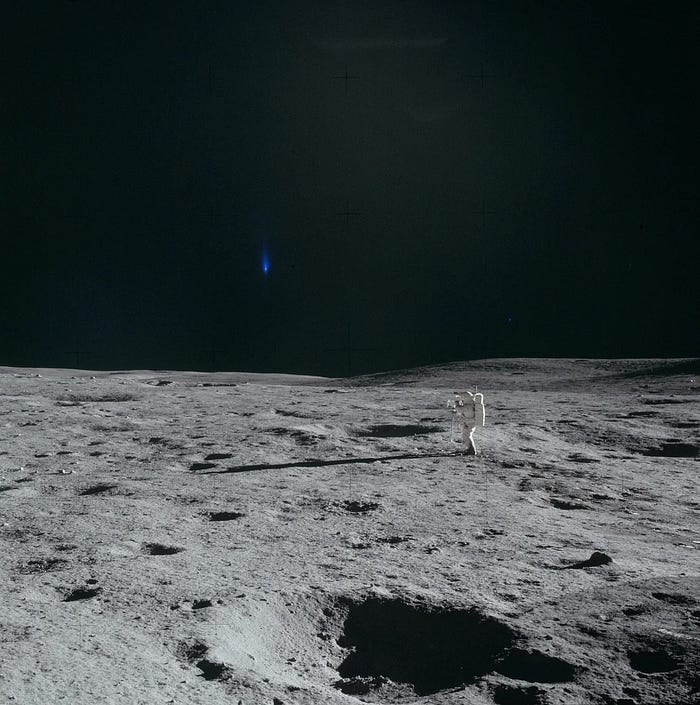
Mysterious blue lights above the lunar surface were recorded in cameras used by the Apollo mission astronauts.
The UFO files released here by the U.S. Department of War on May 8, 2026 included images from the Apollo 12 and 17 missions which show unexplained lights above the lunar horizon.
Mysterious blue lights above the lunar surface were recorded in cameras used by the Apollo mission astronauts.
The UFO files released here by the U.S. Department of War on May 8, 2026 included images from the Apollo 12 and 17 missions which show unexplained lights above the lunar horizon.
Avi Loeb
However, as a sanity check we should remember that the Artemis II astronauts took last month thousands of photographs of the dark side of the Moon which did not show any strange lights around it. The astronauts noticed 6 flashes of light which are likely the result of impacts of meteoroids on the surface of the Moon. Indeed, the statistics of such impacts, as documented here, forecasts 6 impacts of objects more massive than 100 grams during the hour-long flight of the Orion capsule over the lunar dark side. Such impacts would have generated exactly the energy output of about 10^{11} ergs recorded by the Artemis II astronauts at the typical impact speed of tens of kilometers per second. Since nothing anomalous was recorded by the Artemis II astronauts using cameras that are far better than those used by the Apollo astronauts, it is most reasonable to conclude that there are no UFOs around the Moon.
In that case, what was the origin of the lights recorded near the Moon by the Apollo cameras?
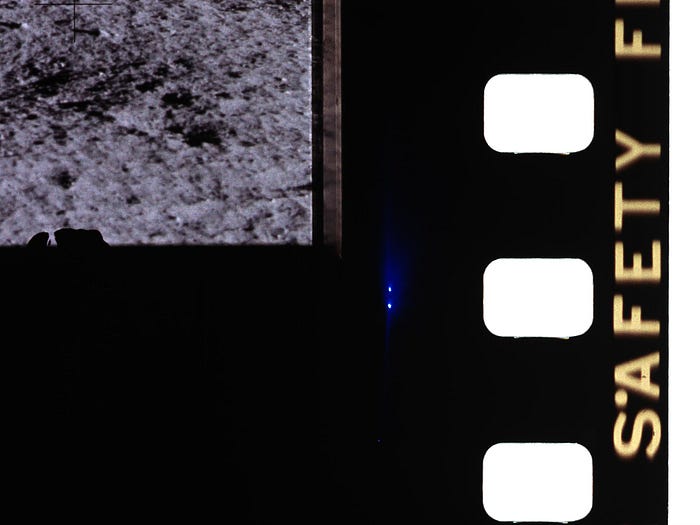
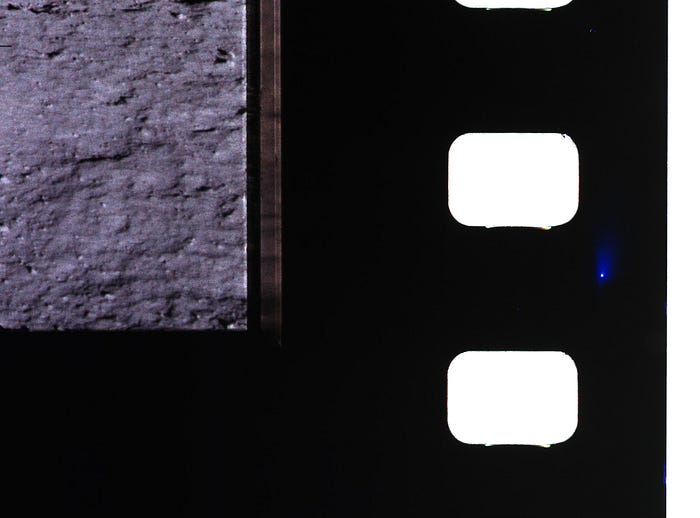
This question can be easily answered by looking through the rich set of Apollo images documented in a dedicated website here. Some of these images show that the same blue lights recorded above the lunar surface appear also on the film in regions outside of the lens coverage area. This suggests cosmic-rays as the origin of the blue lights. The lunar camera film must have been exposed to energetic particles which left a mark on it. The Moon lacks an atmosphere or a magnetosphere and so its surface is exposed to a cosmic-ray flux which is 200 times larger than the surface of Earth.
Press enter or click to view image in full size
Press enter or click to view image in full size
Blue light sources, similar to those recorded above the lunar surface by the Apollo mission astronauts, were also recorded on the photographic films outside regions exposes to the camera lens. This suggests that the blue lights are generated by energetic particles. The cosmic-ray flux on the Moon is 200 times more intense than on the surface of Earth because of the lack of a protective atmosphere or magnetosphere on the Moon. (Image credit: NASA)
The newly declassified UFO files also include a technical crew debriefing transcript from 1969 Apollo 11, where astronaut Buzz Aldrin reports seeing “little flashes inside the cabin, spaced a couple of minutes apart” while trying to sleep. These are likely sourced by cosmic-rays or micrometeoroids, as well.
Similarly, cosmic-rays might have also been confused with UFOs in orbit around the Earth. Two recent papers (posted here and here) reported transient sources of light in historical photographic plates taken by the Palomar Sky Survey in the early 1950s, before the human Space Age. The Palomar photographic plates have a characteristic area of about a thousand squared centimeters. During the typical exposure of order an hour, the number of cosmic-ray impacts on this area is about 60,000. In order for a cosmic-ray impact to appear as a point source (star-like) rather than a streak, its incidence angle must be aligned to within a degree from the direction perpendicular to the plate surface. Given that a hemisphere covers 20,627 square degrees, the number of point sources associated with cosmic-ray impacts would be of order ten per photographic plate. This census could potentially account for the observed population of transient point sources in the photographic plates of the Palomar Sky Survey, rather than being UFOs.
Energetic particles from the solar wind could also induce chemical and physical alterations in photographic plates, identical to the effects of visible light. When these particles strike the emulsion, they ionize silver halide crystals. The solar wind excess could lead to the reported deficit in the number of recorded transient point sources on the Palomar plates within the shadow of the Earth, when the Earth blocks the Solar wind particles.
Any UFOs in orbit around the Earth would have been easily noticed by the surveillance apparatus of the U.S. intelligence agencies. Anomalous satellites would have been flagged as not belonging to the known fleet of satellites launched by the U.S. or other nations. Their existence would have raised a major alarm within the U.S. Intelligence agencies because of the suspicion about spy satellites potentially launched unnoticeably by adversarial nations. The Director of National Intelligence, Tulsi Gabbard, would have surely been aware of such an alarm. As of now, there is no evidence for a major national security concern on that front.
In conclusion, we should be careful not to confuse UFO sightings near Earth or the Moon with impacts by energetic particles on historical recording devices. As of now, the statistics of cosmic-ray impacts could potentially account for the number of anomalous lights recorded by traditional substrates, such as photographic plates or films.


No comments:
Post a Comment