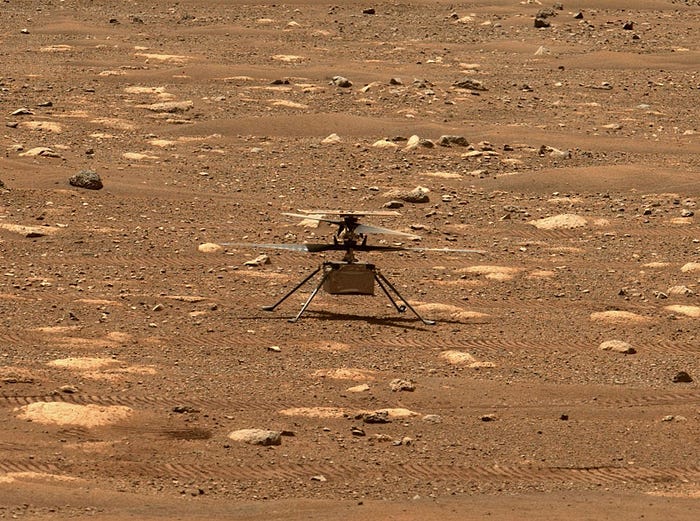
A helicoptor landing device makes good sense in thin atmospheric planets. You still have to eliminate entry velocity and reduce descent speed using a parachute ,but then counter rotating blades allows managed descent.
So retro rockets to stall velocity, parachute deployment to near surface and then chopper descent. This can be managed by .ai on board
We can do this. Even Venus or Jupiter. A worthy challenge folks.
Are Interstellar Helicopters Possible?
https://avi-loeb.medium.com/are-interstellar-helicopters-possible-b19850dcf5f9
The Ingenuity helicopter on Mars. (Image credit: NASA)
Helicopters fly by using an engine to spin rotor blades, which create lift and thrust by pushing air away, similarly to a bird flapping its wings or a swimmer moving limbs in water. The spinning blades act as rotating wings, generating low net pressure above and high pressure below to produce lift. A tail rotor or a counter-rotating blade system is essential to cancel torque, preventing the body from spinning in the opposite direction. Forward motion is triggered by tilting the blade plane.
Press enter or click to view image in full size
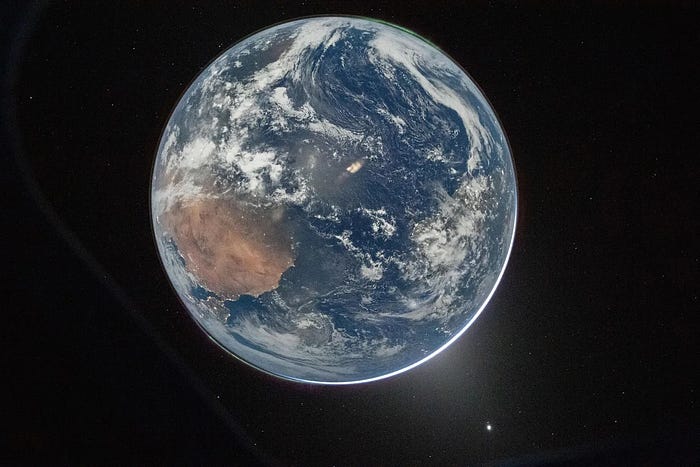
An image taken from the Orion capsule on April 3, 2026, showing the thin atmosphere of Earth against the blackness of space. (Image credit: Reid Wiseman, NASA)
Helicopter propulsion relies on an ambient medium. The blades gain thrust by pushing the surrounding medium in the opposite direction. The typical speed acquired by air around the blades is of order hundreds of meters per second. Momentum conservation implies that the blades can propel the helicopter body to a speed of this magnitude only if they push an air mass comparable to the body’s mass. Since the mass density of air at sea-level is a few hundred times smaller than the average mass per unit volume of a helicopter, the vehicle must push a volume of air that is at least a hundred times larger than the volume of its body in order to move forward at a speed of a hundred meters per second.
Press enter or click to view image in full size
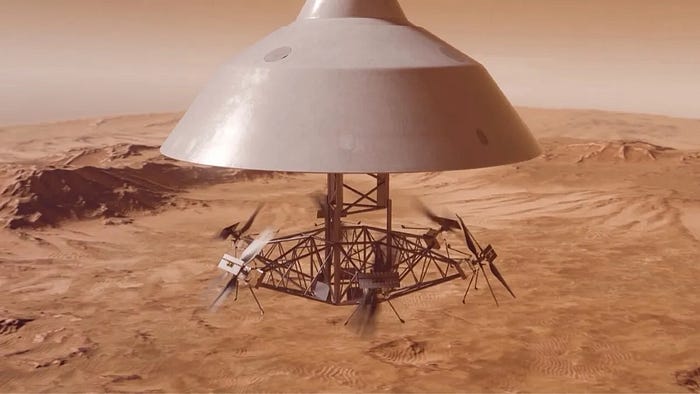
An artist’s illustration of NASA’s “Skyfall” helicopter mission to Mars in 2028. (Image credit: AeroVironment)
NASA had just announced a plan to launch the first nuclear-powered interplanetary spacecraft before the end 2028 on a mission to Mars called Skyfall. This Space Reactor-1 Freedom will carry three small helicopters to explore a possible human landing site on the Martian surface.
The same principle of momentum conservation applies to helicopters flying in the thin atmosphere of Mars. This dilute atmosphere, 95% of which is carbon dioxide (CO2), has a mass density that is 1.6% of the Earth’s atmosphere at sea-level. This implies that a Martian helicopter must process a volume of ambient gas that is about 60 times larger than in Earth’s atmosphere, in order to gain a comparable thrust. If CO2-breathing birds had existed in the Martian atmosphere, they would have needed wings that are roughly 8 times larger than oxygen-breathing counterparts on Earth in order to fly at the same speed. The lift of these hypothetical wings would have benefitted from the lower Martian surface gravity, only 38% of that on Earth.
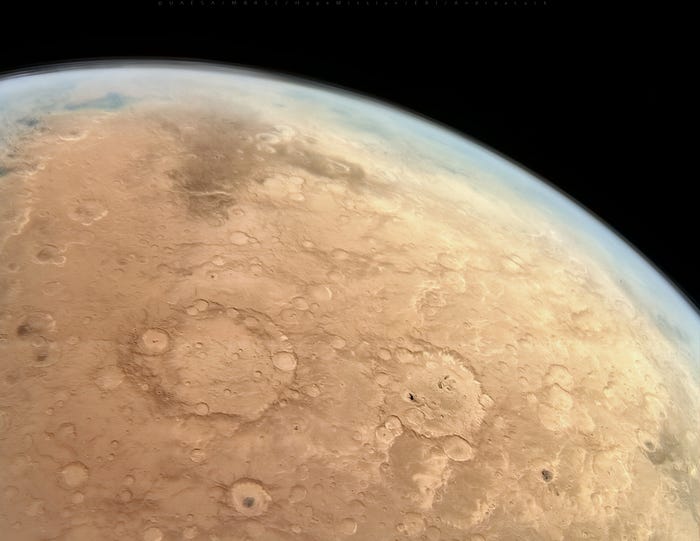
Image of Mars and its thin atmosphere. (Image credit: Emirates Mars Mission).
But there are Solar System objects with even thinner atmospheres, as announced today in a paper published here in Nature magazine. The Kuiper belt object 2002 XV93 with a diameter of about 500 kilometers was discovered to possess an extremely thin atmosphere with a density that is ten million times smaller than Earth’s atmosphere at sea-level, based on observations of a stellar occultation from 2024. This delicate atmosphere may have been created by volcanic eruptions or a comet strike. In such a thin atmosphere, a helicopter would struggle to push enough gas in order to move around.
Press enter or click to view image in full size
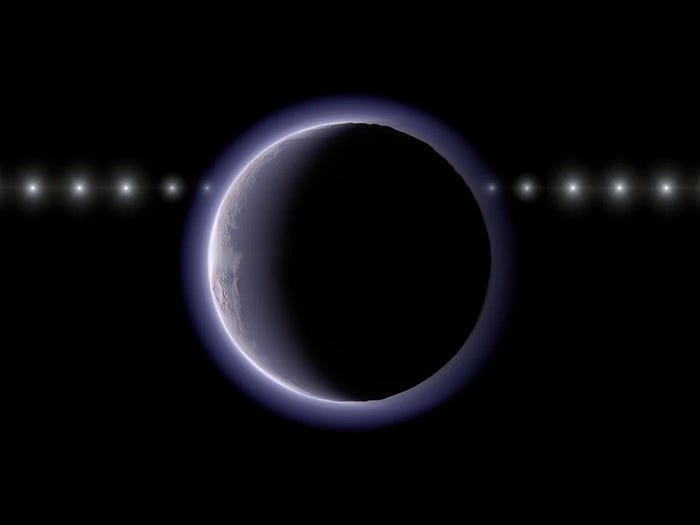
An artist’s illustration of the Kuiper belt object 2002 XV93 occulting a background star, an event which provided in 2024 evidence for a very thin atmosphere around the object. (Image credit: Ko Arimatsu/NAOJ)
As we consider even more dilute environments, one might wonder: are interstellar helicopters feasible?
The average gas density in interstellar space is sextillion (10^{21}) times smaller than in the Earth’s atmosphere. This means that a helicopter would need to cross the entire Milky-Way disk before encountering enough gas mass to push its body to a speed of 100 meters per second. Such a journey would take more than the age of the Universe.
Intergalactic helicopters are even more impractical, because the mean density of the intergalactic medium is a million times smaller than the interstellar medium. On average, the Universe contains a single proton per cubic meter.
This is bad news for cosmic travelers who enjoy helicopter rides. But it is good news for those who enjoy rocket rides, because interstellar space is so dilute that any rocket will not be slowed down by friction on the surrounding medium. Interstellar rockets can reach Earth without much resistance. In contrast to a helicopter, a rocket ejects its burnt fuel gas from its exhaust and does not rely on the ambient medium for propulsion.


No comments:
Post a Comment