this is early days in terms of disclosure and at least it has started. Avi has the resources to review the mass of material quickly which is good. Understand that the first flap occured in 1947, one year before i was born. i began tracking the press output when i was a teenager. So here we are.
two things are clear. The first and most important is that the pentagon was clueless and remained so, at least with this body of disclosure. Yet they made it all black and surely compartamentalized it all. conforming evidence supports this as the ongoing protocol.
The second is that high resolution flybyes show nothing special around the Moon while picking up on impactors producing light flashes which is something we understand.
Nothing to see here folks is the msot likely outcome from a close in lunar exploratin. What is also true is that landing remains a high risk proposition needing much better tech and even underground protection. We can all live with that reality, so why the half century of non disclosure?
`Serious Matter’: Avi Loeb Reveals Two Crucial UFO Interpretations
: The Hill’s Rising, 2.14M subscribers)
https://avi-loeb.medium.com/serious-matter-avi-loeb-reveals-two-ufo-interpretations-e3fc24506f54
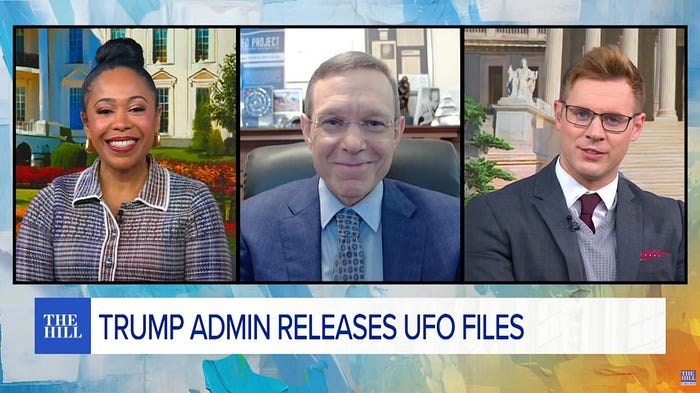
Below is a transcript of the latest interview I had today with The Hill’s Rising, one out of the 30 interviews I had over the past three days, available in video form here. The questions are marked below with the label Q, and my answers with A, respectively. In an hour, I will be boarding a plane to New-York City to appear in a cameo playing myself on the movie set of “Sol Hershkowitz’s Guide to Extraterrestrial Life”. It should be straightforward for me to play myself, as you may tell from the interview appended below.
***
Q: The Trump administration released the first batch of so-called UFO files last week. Some of the highlights include obscure images of what could be anything in former astronaut Buzz Aldrin observing a fairly bright light source while on Apollo 11 and a 1963 government memorandum showing the Kennedy administration’s concern that the government wasn’t prepared for human to alien contact, however unlikely the possibility.
Joining us now to make sense of these files is Harvard University physicist and head of the Galileo project, Professor Avi Loeb, a frequent guest on The Hill’s Rising, one of our favorites. Welcome back, Professor. Nice to see you.
A: Thanks for having me.
Q: Well, let’s just get right to it. What were you most intrigued by, as these files became available?
A: Well, as we go back in time, we could see documents dating all the way to 1947 where high-level officials are communicating about unusual objects in the sky. All in all, there is no clear evidence for an object that is produced by some alien civilization. Some of the data is redacted. We have inconclusive images or videos. But the release serves a very important psychological purpose of bringing the conversation to the public domain both regarding the general public but also within science.
Clearly, the Pentagon and the intelligence agencies are unable to identify the nature of some objects. There are two possible interpretations. One way to explain it is if the objects are human-made, they are produced by adversarial nations and they show the vulnerability of our defense system so this is a serious matter. We all know about the Chinese spy balloon as an example. But then the other possibility is that maybe it’s a mixed bag and one in a million objects is indeed from beyond this Earth, representing some advanced technologies that we do not possess. In that case, its detection constitutes the biggest discovery ever made by humanity. So, it’s a win-win situation to attend to this data seriously and try to figure out what it means.
Unfortunately, the first release does not include enough information on some of the images or the videos, and many of them could be explained in simple ways. The flashes of light that Buzz Aldrin described might be cosmic rays. There are eyewitness testimonies of an ellipsoidal object that was reported to the FBI but we don’t have data from instruments about this object. I went over the data with my research team and we just couldn’t infer the distance, velocity or acceleration of objects that they’re exhibiting.
This happens to be a goal of the Galileo Project that I’m leading. We have three observatories and we are looking at each object from different directions so we can infer the altitude, velocity and acceleration, to inform us whether it lies outside the performance envelope of human-made technologies. That’s essential.
However, this release is just the first step. We will have additional releases in the coming weeks and months and presumably the more sensitive data the higher quality data takes more time to declassify. We would see it coming out.
Regarding the Apollo mission images, I should note that flares on the Moon can originate from the impact of rocks. The Artemis II astronauts noticed six flares when they hovered over the dark side of the Moon. They had an excellent view, much better than the Apollo missions were on the surface of the Moon and they didn’t notice anything unusual. They took thousands of images just last month and these images did not show any lights orbiting the Moon in an unusual way. So, I would argue that based on the latest Artemis II data, there is nothing peculiar on the Moon. What we are seeing in these Apollo images are either impacts of asteroids on the surface or some optical artifacts from the camera that was taking these images.
Q: So — Avi, this was the first release and like you said, you comb through the data and some people were expecting to see something about little green men. They didn’t get that exactly, but what did you get from combing through the data about how much people’s curiosity should be satisfied when they think about other life forms existing out there?
A: What we have are documents and videos and images from military personnel and the intelligence agencies that discuss objects they cannot understand. These are serious people. We should not dismiss those reports, especially because some of them were collected by instruments. What we should do is try to figure out what these objects are. Of course, data from past reports is limited.
I assume that the government has much better data. For example, right now the U.S. government employs an array of satellites that were very helpful in noticing the infrared flashes coming from ballistic missile launches in Iran, for example. We can get images of Earth with a spatial resolution of a few inches and they can easily monitor objects that look unusual and measure their velocity or acceleration relative to features on the ground. But that’s the most sensitive data that will not be easily released because the sensors being used right now are classified. Nevertheless, I am really curious to see a high-resolution image or a high-quality video that can demonstrate beyond any reasonable doubt that we’re dealing with something that is not human-made. I haven’t seen that as of yet. In addition, there is also the issue of whether the government has access to materials from crash sites and if so, such materials can be analyzed. In the laboratory that I operate within the Galileo project, we analyzed materials from an expedition to the Pacific Ocean after we were trying to retrieve materials from an interstellar meteor. That’s an object that collided with Earth back in 2014 and exploded over the Pacific Ocean. We went there and collected materials and found clear evidence for an extra-solar origin. We can do the same thing with any materials that the U.S. government collected.
I don’t expect members of the Pentagon or the intelligence agencies to become scientists. Their day job is focused on national security and so if they see unusual things that they cannot figure out, they put it aside because they don’t want to be scrutinized that they’re not doing their job. Also, they don’t want adversarial nations to know about the vulnerability of our defense system so they would classify all that data.
However, I do think that scientists should look into that data and help the Pentagon, all the intelligence agencies figure it out because we want to know which objects are in our sky. It’s really important for national security and also for science. And that’s what we are trying to do in the Galileo Project. I’m happy to help members of the Pentagon or the intelligence agencies in working through additional data as it comes along in the future.
I should also mention that there are 46 videos that were requested by Congresswoman Anna Paulina Luna from the Pentagon and hopefully they will be released in the next batch that will come out within the next month. Congresswoman Luna visited my office at Harvard University a few weeks ago and I had an extended discussion with her about the Galileo Project and other matters related to unidentified objects.
Q: And I so much appreciate that approach and her approach because I want, you know, as much of the information that the government has declassified as possible and the secretive way the government has proceeded is not encouraging. But as a more skeptical person of some of these claims I confront, I often end up in this frustrating position where someone who has, you know, very unimpeachable credibility as a pilot or a scientist described some image and you say we have no rational explanation for this image, but I went to Las Vegas a month ago and I saw a magic show and I have no rational explanation for any of the things I saw. But that doesn’t mean magic is the most likely explanation. It just means it’s something that I can’t explain. But just because I can’t explain it doesn’t mean, like you said, was it a lens flare? Is it a smudge on the lens? Is it similar to the first people who looked through a telescope and saw the red in their own eyes reflected back on them and thought it was canals on Mars. Very, you know, smart, well-meaning people. No one is trying to deceive us. And I can’t help but get past some of that, as we look through these things. But obviously evidence of crashes, recovered technological things of that nature that some people have claimed the government has would be so definitive proof. And that’s the thing that never shows up in any of these declassified documents.
A: I completely agree with you and I think that it’s important for scientists to look at the data and try to make sense of it if indeed it represents anomalies. You would expect the government to be the first to notice rare events because the defense budget for 2026 is nearly a trillion dollars, about a hundred times bigger than the science budget of NASA. Astronomers are not really monitoring the sky as much as the intelligence agencies of the U.S. and one would expect that if there are rare events they would be the first to notice them. However, it’s not their day job to keep analyzing the anomalous data because they have other duties which are more pressing.
New knowledge in science was always a result of detecting anomalies, things that do not line up with what we expected. A very distinguished physicist, Albert Michelson gave a speech at the University of Chicago in 1894, and said that fundamental physics is pretty much over. All we need now is to measure the fundamental constants to the fifth decimal point. That was one decade before Albert Einstein came up with special relativity, two decades before Einstein came up with general relativity — explaining gravity as curvature of spacetime, and it was three decades before quantum mechanics was discovered. Just to show you that as much as scientists may be proud of their craft, there is a lot for us to learn and we should attend to anomalous data. However, anomalies are a mixed bag and most of the unidentified objects that we see probably have mundane explanations. But the government needs some help on that and that is why I am leading the Galileo Project. We are doing our best and we are in communication with the All-domain Anomaly Resolution Office (AARO) in the Pentagon.
Q: I always appreciate the historical perspective of the certainty of experts in past stages of our history who said: “Yes, we’ve answered all the questions”, which is a very useful perspective because the questions were not all answered. Professor Avi Loeb, thank you so much for being with us. We appreciate it.
A: Thanks for having me. I should mention that the best is yet to come. I think that the better, more intriguing data will come in the coming months. So, let’s stay tuned and see what it includes.
Q: Great. We’ll have you back to discuss that. Thank you so much.


No comments:
Post a Comment