Ample energy, shade inducing robust biology and integrated animal husbandry can produce a full on blanket of quality soils. While employing Chinas entire population.
The same for india ,all the middle East and the Sahara and half the USA. space enough for well over 10,000,000,000 folks.
understand folks will mostly live in tower satacks using an acre of land usuzally integrated with ample undergroung refugia as well all of which husbands a thousand acres. along with multilayered greenhouses. it is all there and inputs can be minimal
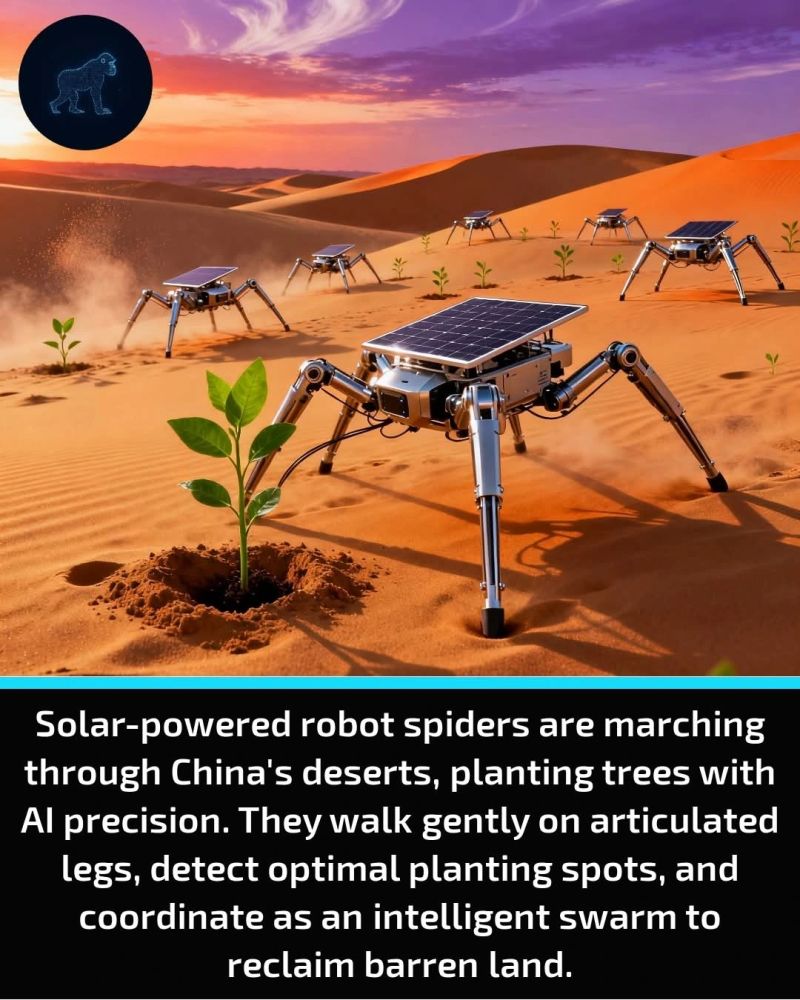
Spider-like robots are literally walking across China's deserts planting trees with every step.
Powered entirely by the sun, these AI-driven machines are doing something no human army could achieve at this scale. They're turning one of Earth's harshest landscapes green again, one sapling at a time.
This is what happens when cutting-edge technology meets climate action.
These ecological warriors are rewriting the rules of desert restoration.
Each robot uses ground-sensing technology to identify ideal planting locations, measuring moisture levels and sand composition before deploying seeds with protective capsules. The AI systems allow them to adapt in real-time, adjusting planting depth and spacing based on terrain conditions that change with every gust of wind.
In Inner Mongolia and other vulnerable regions, desertification has been advancing at an alarming rate, swallowing farmland and threatening communities. Traditional reforestation efforts require massive human resources and often yield low survival rates in extreme conditions. These robots flip that equation completely. They can work through sandstorms, extreme heat, and terrain too dangerous for human teams, all while running on clean solar energy with zero emissions.
The swarm intelligence is perhaps the most fascinating aspect. Multiple robots communicate wirelessly, sharing data about soil conditions, coverage patterns, and successful planting zones. They coordinate like a digital ecosystem, ensuring no area is over-planted or missed entirely. Early pilot programs have shown survival rates exceeding 80% for saplings planted by these machines, compared to 40-50% with conventional methods.
China's goal is ambitious but achievable with this technology. The Green Great Wall initiative aims to plant nearly 90 billion trees across 4,500 kilometers by 2050. With these solar-powered planters scaling up production, what once seemed impossible is becoming reality. Every step these robots take is a step toward reversing decades of environmental damage.
📌Sources and References:
South China Morning Post coverage of desert reforestation robots, Chinese Academy of Sciences environmental technology reports, Green Great Wall Project documentation, IEEE Spectrum robotics innovation features.
✓Read and learn more:
✓Peer-Reviewed Scientific Publication:
📌 "Note: The image is AI-generated and intended for illustrative purposes only. It is not to scale."


No comments:
Post a Comment