Anomolies keep teasing us as this object appears to head back out to Deep Space. And this could be it.
However, i really wdo want it to shift mass and alter it orbit ro stat awhile. The changes claimed so far are indications of operational management. It really could be an artifact because those claimed changes are non Newtonian at best.
yet real claims were made and then silence. In fact this last news blast was all about nothing to see here folks.
As Posted. if 3I Atlas is an artifact. it will be able to move internal DARK MATTER in order to alter velocity and even direction. Imagine the consternation if it swings into close earth or Venus orbit. and obviously, i have a pretty good idea how to do this..
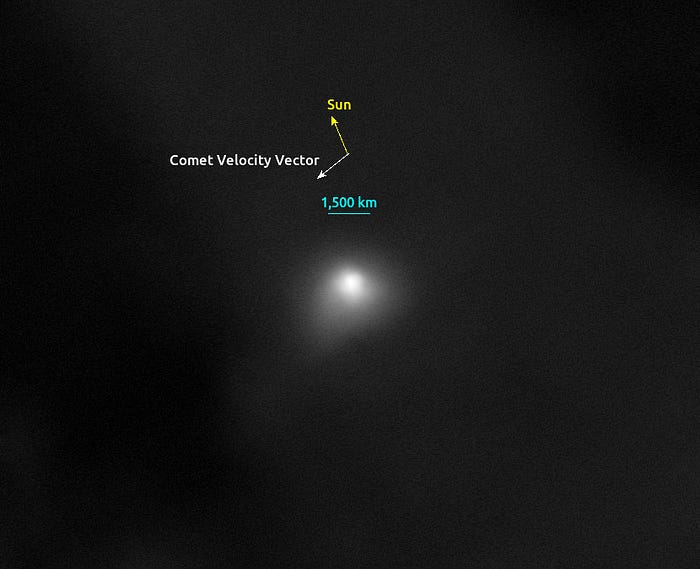
Orientation of the Plume Around 3I/ATLAS in the HiRISE Image
https://avi-loeb.medium.com/orientation-of-the-plume-around-3i-atlas-in-the-hirise-image-6e7f95759aa4
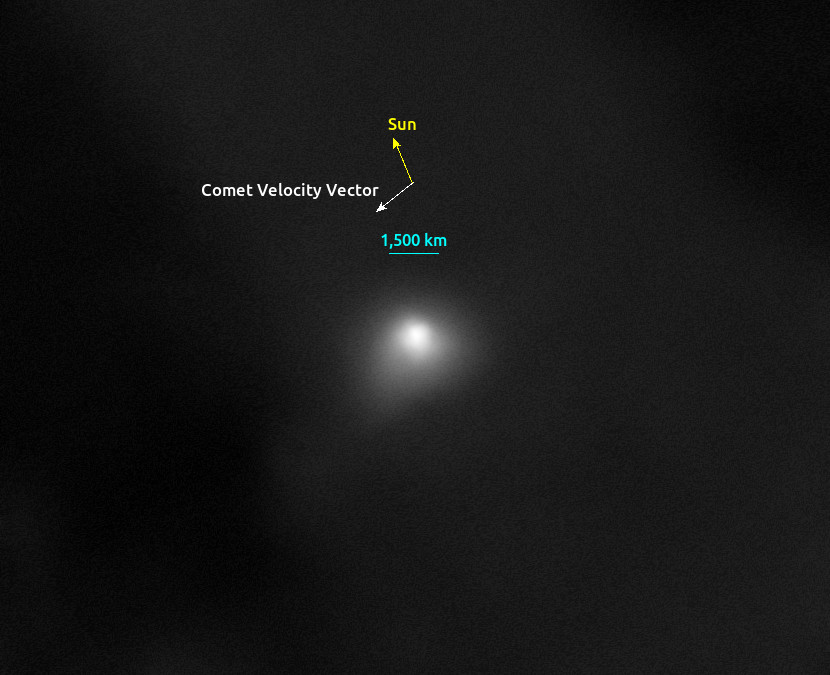
A 3.2 second exposure of 3I/ATLAS on October 2, 2025 by the HiRISE camera onboard the Mars Reconnaissance Orbiter. The directions of the Sun and 3I/ATLAS’ motion are indicated by arrows. (Credit: NASA/JPL-Caltech/University of Arizona)
The newly released HiRISE image of the interstellar object 3I/ATLAS available here, shows an extension of the glowing plume in the direction of motion ahead of 3I/ATLAS. It appears like there is something preceding the object that was previously confused with being in the direction of the Sun but is actually in the direction of motion. In previous images like the Hubble Space Telescope image here, the two directions were similar when 3I/ATLAS was heading towards the Sun from far away.
It is easy to explain a plume of gas and dust extended towards the Sun as a result of the illumination of pockets of ice by sunlight or away from the Sun as a result of radiation pressure or the solar wind. It is also possible to explain a trailing stream that the object leaves behind as the drag on the solar wind slows it down relative to the object. But it is much more difficult to account for a plume extended perpendicular to the direction of the Sun and ahead of the object. The scale of the extension in the HiRISE image is ~3,000 km. At the typical thermal speed of volatiles which sublimate from the surface of a natural comet, it takes only a day to cross that distance.Could this be a technological signature of illuminating or clearing the path from any hazardous micrometeorites that may cause damage to a technological object?
For now, we can only hope that the mysteries of 3I/ATLAS will be cleared by data in the next few weeks when large ground-based telescopes as well as the Hubble and Webb telescopes will be able to characterize the jets of 3I/ATLAS by measuring their composition, speed and mass loading rate. These details will inform us without a doubt whether the jets are produced by natural pockets of ice that are warmed by sunlight or by technological thrusters. Upcoming data can be used to search for any additional objects that came out of 3I/ATLAS, be it fragments of ice for a natural object or mini-probes for a technological object.
This morning, I received the following inspiring messages.
Letter 1
“Dear Mr Avi Loeb…
Never in a million years did I think I would be in a position to message someone as high up in the hierarchy of speaking the ‘truth’ as you…
You are such an inspiration to many….
You haven’t backed down…
You have used your words…your knowledge…your wisdom…very carefully…and you have empowered many people to stand by their own beliefs…
I just want to thank you so much for the dedication…the passion…and the truth that you put into your work…
I am looking forward to hearing more about your research…
I wish you well…all my support…
From one of your biggest fans…
Kayleigh”
Letter 2
“Dear Professor Loeb,
I hope this message finds you well.
I wanted to write to you after following your work on 3I/ATLAS these past months, and especially after yesterday’s NASA briefing.
Although I am not a scientist by profession, I have a deep interest in astrophysics and in how we interpret evidence when something unfamiliar enters our Solar System. Your approach to 3I/ATLAS has been a source of clarity and intellectual honesty in a time when many prefer convenient explanations over confronting genuine anomalies.
What I appreciate most is that your arguments are not speculative; they are calculated.
You consistently present the numbers, the physics, and the probabilities without forcing a conclusion. As a non-scientist, I can still recognize how rare that is. You unite rigor with openness, which is exactly what scientific curiosity should be.
I have been following the unusual features of 3I/ATLAS closely: the sunward jet that persists far longer than natural models predict, the highly unusual nickel-to-iron ratios, the unprecedented negative polarization, the extreme CO₂ dominance, and the improbably aligned trajectory through the inner Solar System. Even without a scientific background, it is clear that these are not trivial details, and your willingness to treat them seriously is something I deeply respect.
I must admit that yesterday’s NASA presentation left me uneasy. The absence of the long-anticipated HiRISE images, along with explanations that seemed more like public-relations language than scientific clarity, reminded me of how important it is to have independent voices who are willing to ask the difficult questions. Your calm, measured commentary stands in sharp contrast to the defensiveness we sometimes see in institutional communication.
I simply want to thank you.
Your work has reignited my curiosity, and more importantly it restored my belief that science can still be courageous. You have a remarkable ability to speak plainly without oversimplifying, to explore the unknown without sensationalizing it, and to hold fast to the principles of evidence and inquiry even when criticism is loud.
Please continue exactly as you are.
Your voice is inspiring to many of us who are watching closely and hoping that the scientific community can remain open-minded when faced with something genuinely new.
With respect and gratitude,
Giovanni Carbonella
from Belgium”
Letter 3
“Dear Professor Loeb,
My name is Reuben Daniel, writing from India. I’ve followed the evolution of the 3I Atlas not just as a scientific project, but as a philosophical attempt to re anchor humanity in a universe we barely understand. Most scientific work expands knowledge; very little expands perspective. Your work does both and that is what compels me to reach out.
In the past months, I’ve read through every accessible discussion, interview, analysis, and fragment of information surrounding the Atlas. What drew me in was not just the possibility of new discoveries, but the underlying principle, that humanity must investigate its uncertainties with rigor rather than imagination, with humility rather than spectacle.
The 3I Atlas, to me, is more than a map of objects or anomalies. It is a map of intellectual discipline, a reminder that truth is not found through authority or noise, but through patterns, data, and the willingness to confront the uncomfortable. At a time when societies are shaped by opinion more than evidence, this kind of work becomes quietly revolutionary.
Coming from India, a place where multiple worlds, beliefs, and narratives coexist, I’ve always been fascinated by how humans make meaning out of ignorance. The questions you pursue have existed in mythology, philosophy, and religion for thousands of years. But for the first time, we stand in an era where these questions can finally be approached with scientific instrumentation rather than mythic intuition. Your research, in many ways, represents that transition.
If the Atlas or your broader investigations ever require assistance analytical, technical, coordination based, or exploratory, I would be honored to contribute from here. I bring a mindset shaped by curiosity, skepticism, and a strong sense of the social responsibility attached to scientific transparency.
Humanity has always looked upward, but rarely with clarity. You are attempting to give the world something it has never had: a disciplined framework for investigating the unknown.
Thank you for the work you are doing professor and for reminding people across the world that progress begins not with answers, but with better questions.
With respect,
Reuben Daniel”
Letter 4
“Dear Professor Loeb,
Thank you for your latest analysis of NASA’s press event and for continuing to approach 3I/ATLAS with scientific honesty and independence. Many of us appreciate that you do not force a natural explanation where the data does not yet support one. Your openness to unresolved anomalies and your persistence in following the evidence make a real difference.
Please continue your work. Many people value your voice and rely on your careful, unbiased approach so that nothing important is overlooked.
With appreciation,
Eric Schmidt”
Letter 5
“Dear Professor Loeb,
I am writing to express my deep appreciation for your work, your courage, and your open-mindedness in exploring the mystery of the interstellar object 3I/ATLAS. For months I have been following every one of your posts, analyses, and interviews, and what you have done has become not only an intellectual inspiration for me, but also a genuine emotional experience.
Reading your articles on Medium often feels like going through the chapters of an absorbing thriller — one that keeps a person awake late into the night. This year, it is you who has brought me the greatest fascination with our place in the Universe. Your willingness to consider hypotheses that lie outside the comfort zone of mainstream science is something extraordinarily rare among contemporary researchers.
The anomalies associated with 3I/ATLAS are astonishing. The fact that they all appear simultaneously makes me feel that we are witnessing something historic. Your scientific approach — rooted in evidence rather than in attachment to established dogmas — is invaluable to me. I have always loved science fiction and have read nearly all of its major works, and what is happening now reminds me very strongly of the atmosphere of Arthur C. Clarke’s Rendezvous with Rama. The difference is simply that I am not reading about this in a book — I am watching it unfold in reality.
When 3I/ATLAS began glowing an intense blue at perihelion, I felt something I had never felt before: a mixture of awe and concern. It made me think of the film Don’t Look Up and the character played by Leonardo DiCaprio — a man who saw what others refused to acknowledge. In that moment, I genuinely began to wonder whether the trajectory of 3I/ATLAS would remain stable.
I would like to share something personal as well. I am a father to a nine-year-old daughter, whom I have inspired with a passion for space thanks to your work. Every day I tell her about your latest posts, the surprising anomalies, and the possibilities surrounding 3I/ATLAS. I see her curiosity growing week by week, and her questions becoming deeper. This is because of you. Perhaps you have planted in her the seed of a future astrophysicist.
I also watched your conversation with Joe Rogan, and I was genuinely impressed by your calm, rational approach and your intellectual integrity. It is disappointing to see how many in the scientific community dismiss anything that lies outside conventional assumptions — often without providing any substantive counterargument. None of your critics have been able to address the twelve anomalies you have described, yet they persist in their position. Sometimes I feel that even if 3I/ATLAS changed course and headed straight toward Earth, some of them would still insist that it was just a comet.
I admire your bravery and intellectual honesty. I believe that future generations will look back on this period as a turning point — a moment when someone dared to ask the questions others were afraid even to form.
I sincerely hope that through your work, your determination, and your scientific insight, the mystery of 3I/ATLAS will one day be fully understood.
With profound respect and gratitude,
Adam Dziedzic”
On November 19, 2025, NASA broadcasted a press conference here in which new data on the interstellar object 3I/ATLAS was shared for the first time after the U.S. government shutdown.
An hour earlier, I was asked by a reporter what I expect from the press conference and I replied: “I do not expect big news. NASA will repeat the official mantra that 3I/ATLAS is a natural comet and that they were unable to process the data until this week because of the government shutdown. Both are boring messages. The HiRISE image will probably show a fuzzy ball of light, like the Hubble image here. But I hope to be surprised.”
I was not surprised. There was no big news. NASA repeated the official mantra that 3I/ATLAS is a natural comet and that they were unable to process the data until recently because of the government shutdown.
The image taken by the HiRISE camera onboard the Mars Reconnaissance Orbiter on October 3 and available here, shows a fuzzy ball of light. The image features a spatial resolution of 30 kilometers per pixel at 3I/ATLAS’ distance of about 30 million kilometers. Due to spacecraft jitter during the observation period, the light from 3I/ATLAS is smeared by several pixels. In the coming days I will analyze this data quantitatively to extract the most important information out of it.
The collection of other new images from other space telescopes is available here. The new data includes fuzzier images that that of HiRISE and a UV spectroscopic detection of hydrogen by MAVEN that adds slightly to what we already learned this summer about 3I/ATLAS from the Hubble (here), Webb (here) and SPHEREx (here) space telescopes.
NASA’s representatives should have emphasized what we do not understand about 3I/ATLAS rather than insist that it is a familiar comet from a new birth environment. They stated that 3I/ATLAS does what comets do, namely shed gas and dust and responds to gravity. But a spacecraft that collected dust and CO2, CO & H2O ices on its surface by traveling through the cold interstellar medium could have also developed an outer layer of dust mixed with ices that sublimate when illuminated by sunlight. We should not “judge a book by its cover,” because we all know about the Trojan Horse which appeared unthreatening to the guardians of the City of Troy. When monitoring an interstellar visitor, we should not fall prey to traditional thinking but scrutinize new interpretations. The public resonates with science as a learning experience, where the collection of evidence leads the way to new knowledge rather than reinforces variants on past knowledge.


No comments:
Post a Comment