We all know that the global drug trade has long been captured by the CIA and this surely includes chinese fentanal production. just why would they ever compete when they do not have to create distribution chanels.?
It is all ilegal anyway and this nicely props up the pricing structures. The obvious solution is to supply victims free in order to collapse the market.
do you think that will happen.
The Taliban Does It Again
Nov 16, 2025
by James Corbett
corbettreport.com
November 16, 2025
https://corbettreport.substack.com/p/the-taliban-does-it-again
The United Nations Office on Drugs and Crime (UNODC) just came out with their latest survey of opium poppy cultivation in Afghanistan, and you’ll never guess what it says. . . .
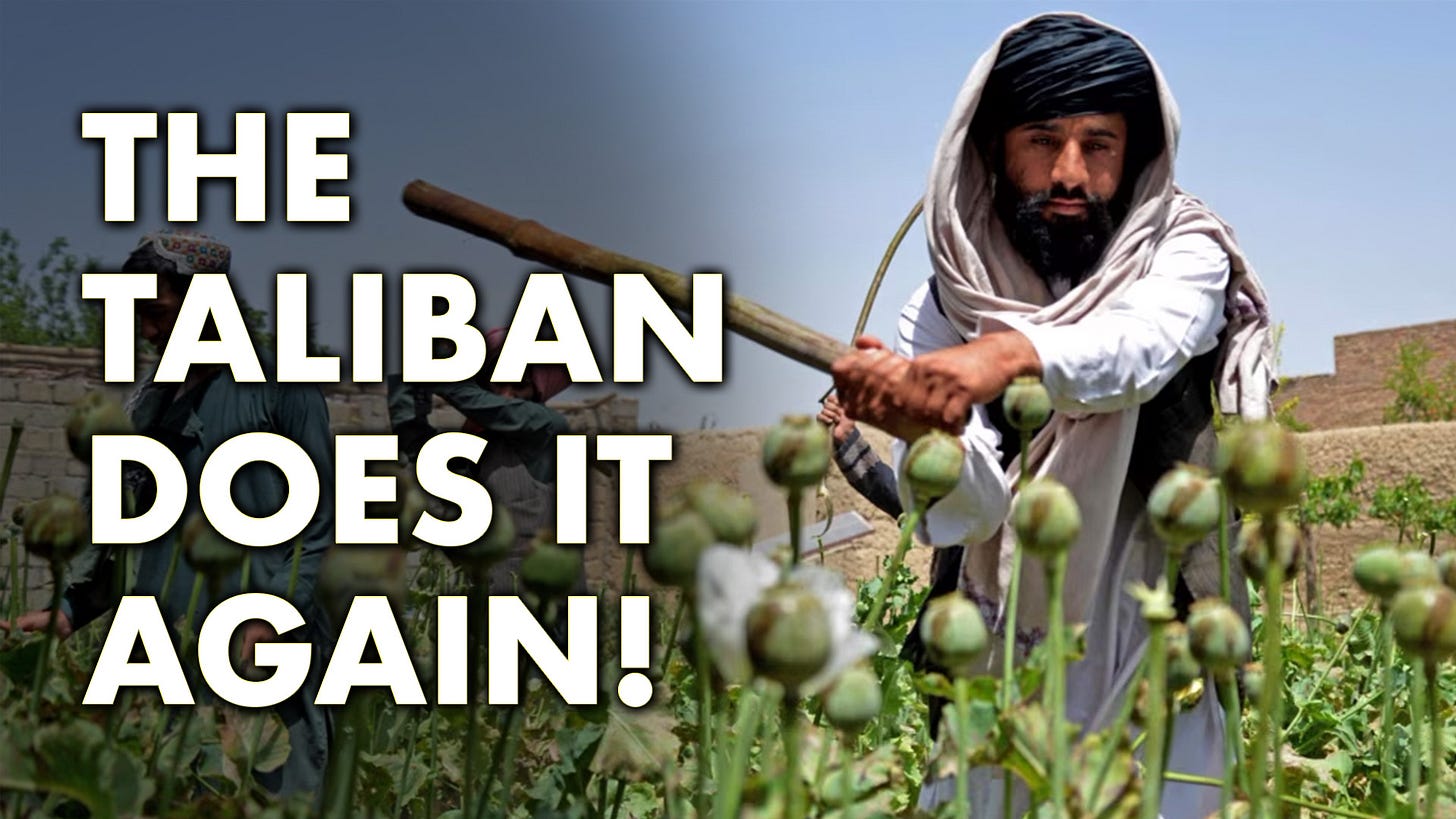
. . . Oh wait, you totally will. It turns out the Taliban’s ban on poppy cultivation has been remarkably successful!
Specifically, the UNODC is estimating the total area in Afghanistan under opium poppy cultivation to be 10,200 hectares, down 20% from last year’s total of 12,800 hectares. While the new total may still sound like a lot, it’s a mere fraction of the 232,000 hectares that were estimated to be cultivated in the year before the US military’s spectacular pullout from the country in 2021.
In other words, the Taliban have somehow or other succeeded in doing what NATO was unable to do in two decades of de facto occupation: decimate Afghanistan’s share of the global heroin trade.
So, what’s happening here? What does this tell us about the true nature of the global drug trade? And what does all this have to do with the United States’ coming (real) war on Venezuela’s (fake) fentanyl trade? Let’s find out.
This Substack is reader-supported. To receive new posts and support my work, consider becoming a free or paid subscriber.
Subscribe
TALIBAN 2 NATO 0
As I have had cause to point out before, the tale of the Afghan opium cultivation and heroin trade is one best told by the UNODC.
In 1999, for example, they warned that Afghanistan’s raw opium production had risen to the unprecedented level of 4,600 metric tons.
Their 2001 survey, however, showed that that number had plummeted to a mere 185 metric tons—a whopping 96% drop.
It isn’t hard to identify the plummet in the graph of opium poppy cultivation in Afghanistan. Here, let me show you:
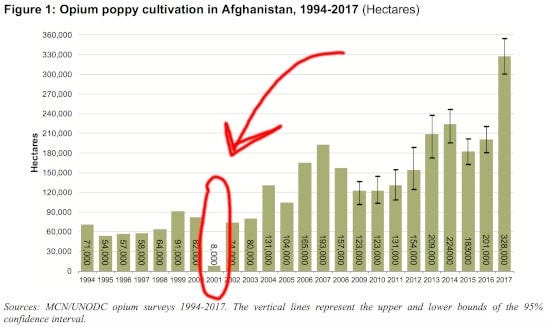
So, what happened in 2001, you ask? The Taliban happened, of course! Or, more specifically, in July 2000 Taliban leader Mullah Mohammad Omar issued a fatwa declaring the cultivation or trafficking of poppies to be “haram” (forbidden under Islamic law). As even the lying liars at The New York Times were forced to admit, in a single year the Taliban were able to do what “just say no” couldn’t do in decades.
And what happened after 2001, where the chart shows a steady increase in opium poppy cultivation in Afghanistan? The US-led NATO invasion happened, that’s what!
As we all know, that invasion was a travesty based on a secret lie. One of the fully intended effects of the NATO invasion was the revivification of Afghanistan’s heroin trade, a tale told, as I said, in the annals of the UNODC.
By 2007 the once-nearly-eradicated Afghan opium poppy was back in full bloom. That year, the UNODC documented a record 8,200 tons of opium production.
That record was surpassed in 2013, when the UNODC showed a fresh record high of opium cultivation.
The 2013 record was surpassed yet again. In 2017, the UNODC survey recorded 9,000 tons of opium production in the country.
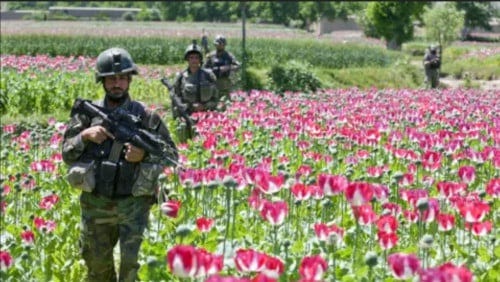
Along the way, this wild ride of opium-producing and heroin-running—all taking place under the supervision of US/NATO forces—saw some eye-opening reports, like when Geraldo Rivera interviewed USMC Lt. Col. Brian Christmas, who was forced to admit that the troops were there in Afghanistan not to destroy the poppy crop or to stop the heroin trade, but to guard the poppy fields.
Ah, poor guy! It grinds his gut, I tell ya!
But a strange thing happened after the US military’s mad scramble to exit the country in 2021. The Taliban returned to power and re-instituted its opium poppy cultivation ban. And, as documented above, that has now resulted in opium production levels falling to pre-invasion levels.
So, everyone is ecstatic, right? Surely all those politicians who talk about the scourge of the international drug trade are over the moon that Afghanistan—once the undisputed world leader of the heroin trade, accounting for more than 90% of the entire global supply of heroin—has been effectively removed from the global drug trade altogether. Right? . . .
IT WAS NEVER ABOUT ENDING THE DRUG TRADE
. . . Yeah, of course not. As Corbetteers (and other well-informed conspiracy realists) know all too well, NATO and the intelligence agencies and their politician puppets were never interested in ending the global drug trade. Rather, they’ve only ever been interested in controlling that trade.
Perhaps no better demonstration of that fact is to be found than the way in which the deep state’s mockingbird mouthpieces have reported on the joyous news that a major global supplier of heroin has been removed from the equation.
William Byrd of Lawfare Media laments: “The Taliban’s drug ban, remarkably successful in curbing opium poppy cultivation for three years in a row, has devastated poor rural households that depended on opium to make ends meet.”
Rupert Stone of Nikkei Asia, meanwhile, informs us that the successful poppy crackdown in Afghanistan is actually expanding the narcotics trade (somehow).
And, not to be outdone, the crack journalists at The Washington “Democracy Dies in Darkness” Post have discovered the decline in poppy cultivation might not be the doing of the Taliban after all!
No, of course the same mockingbird mouthpieces that dutifully repeated the US/NATO spokesmen’s lies about the Afghanistan war are not going to suddenly sing the praises of the Taliban. In fact, they’re not even going to say that ending the drug trade in Afghanistan is a net good for the country or for the world.
Why not? Because the international drug trade is run by and for the deep state, of course. This is an old verity, one that hearkens back to at least the 19th century, when Skull & Bones was founded on opium trade profits.
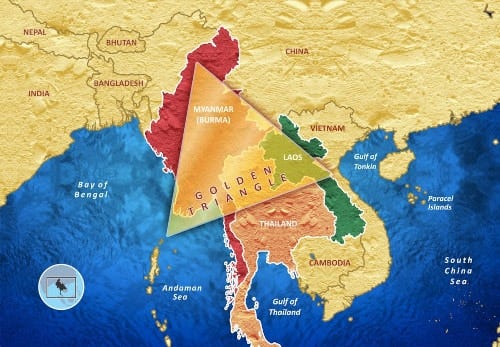
This deep state tradition obviously extended into the 20th century. If you’re unfamiliar with the role that the drug trade played in the US empire’s Cold War-era wars, you may want to familiarize yourself with The Politics of Heroin in Southeast Asia, the seminal work by historian and professor Alfred W. McCoy, as well as my own work documenting how “The CIA Ships in the Drugs.”
But, as I say, this is not news to anyone who has been paying attention to deep politics of the past century. For students of history, the real question is: what does the past reveal about where the global drug trade—and the phony global “war on drugs”—is heading from here.
In case you haven’t heard by now, the Trump administration would like you to know about the next great scourge that is threatening the shores of America.
No, not the intelligence-run pedophilia ring that has blackmailed countless politicians, financiers, celebrities, scientists and other slimeballs! That’s all a hoax, apparently.
No, the real threat is . . . brace yourself . . . Venezuelan drug boats!
Yes, indeed! According to top secret information that can only be shown to certain high-ranking congressmen behind closed doors, Venezuela (and maybe some other assorted Latin American nations to be determined later) have a veritable armada of drug boats scurrying to and fro, ferrying fentanyl into the US with impunity!
Never mind that fentanyl doesn’t come from Venezuela.
Never mind that this fearsome drug boat armada consists of speedboats operated by truck drivers, fishermen, military cadets and petty crooks rather than seasoned narcoterrorists bent on the destruction of America.
Never mind that even Uncle Sam’s partners in war crime are calling out the blatantly illegal nature of these strikes.
Trump has gotten the Justice Department’s Office of Legal Counsel (OLC)—the same OLC that produced the infamous John Yoo torture memo—to use war-of-terror-era legal precedent to rule these Venezuelan narcoterrorists as “unlawful enemy combatants” and thus fair game for US strikes.
But still, for those of us who are aware of the fact that the deep state controls the international drug trade and who saw how the US military was used to keep the drugs flowing from Afghanistan, there is good reason to doubt the Trump administration’s sincerity in this war on Venezuelan drug boats.
Could it possibly be that the drug trade is simply being used as a convenient excuse for launching a regime change operation on a State Department enemy?
Could it be that the unwarranted attack on Venezuelan speedboats is part of a broader effort by the US to cast its rivals—like, say, I dunno, China—as evil narcoterrorists hell-bent on subduing the US by doping up its population (exactly as the East India Company doped up the Chinese with opium, leading to China’s “century of humiliation“)?
I’ll leave you to answer these non-rhetorical questions for yourself. In the meantime, we should note that the “Chinese fentanyl menace” narrative can be raised or lowered like a sword of Damocles over Beijing’s head any time the narrative controllers in Washington deem it appropriate.
So, where does all this leave the people of Afghanistan? Sadly, it leaves them in much the same position they’ve been in for decades: struggling to eke out an existence in a country that has been torn apart by decades of civil war, foreign occupation and brutal authoritarian regimes. For them—as for us—the shifting of the locus of the global drug trade does little to alleviate the burdens of that struggle.
Meanwhile, those of us subjected to the global stage play put on by the deep state for the benefit of the rubes need to constantly remind ourselves (and our neighbours) that the blame for the US opioid epidemic lies with the US military, their NATO collaborators and the intelligence agencies, not with the Afghanistan poppy farmers or the Venezuelan speedboat operators.


No comments:
Post a Comment