Wednesday, April 30, 2025

Michael Kratsios: “Our Technologies Permit Us To Manipulate Time And Space”


he may have access to pertinant infromation vand this is how he starts a conversation.  now understand that I have creeated Cloud Cosmology out of the SPACE TIME pendulum.  i know that Space and Time can be manipulated.  It is just not easy to do and demands extensive lab work to master and manage.

it is completely plausible that folks are working on it, just like they are working of gravty  with ufos.

I have see evidence posted reflecting future penetration of our present.


Michael Kratsios: “Our Technologies Permit Us To Manipulate Time And Space”

April 26, 2025

https://www.activistpost.com/michael-kratsios-our-technologies-permit-us-to-manipulate-time-and-space/


Perhaps as the 13th director of the White House Office of Science and Technology Policy and the Science Advisor to the President, his brain is stuck on the non-existent 13th floor. In other words, is he mad? The transcript of his speech is on the White House website.

The speech, The Golden Age of American Innovation, was delivered on April 14, 2025 at the Endless Frontiers Retreat in Austin, Texas, which was sponsored by the infamous Council on Foreign Relations.

The Golden Age needs “a renewal that will require the reinvigoration of American science and industry”, according to Kratsios. Something went wrong with scientific progress, he says, “stagnation was a choice.” But now we can supercharge science to take us to Utopia.


Then the bombshell dropped, “Our technologies permit us to manipulate time and space. They leave distance annihilated, cause things to grow, and improve productivity.”

This was not an off-the-cuff misspeak: the transcript was submitted BEFORE he spoke. This means that he said what he meant and he meant what he said.

Is Kratsios mad? Unplugged from reality? Or just a typical Technocrat who mixes his own Kool Aid? This is a serious breach of personal sanity AND of public policy that will be predicated on such nonsense.

Kratios’ government career has focused on advancing national strategies in artificial intelligence, quantum information science, 5G, and other emerging technologies. He is credited as the architect of the American AI Initiative and led the U.S. response to technological challenges during the COVID-19 pandemic.

According to multiple sources, Kratsios owes his career to Arch-Technocrat Peter Thiel:

Michael Kratsios has a well-documented and close professional relationship with Peter Thiel, the prominent Silicon Valley entrepreneur and venture capitalist:

Thiel Capital and Clarium Capital: After graduating from Princeton, Kratsios worked for Peter Thiel, first as Chief Financial Officer at Clarium Capital Management (a Thiel-founded investment firm) and then as Principal and Chief of Staff at Thiel Capital.

Chief of Staff to Thiel: Kratsios served as Thiel’s chief of staff for several years, managing Thiel’s business interests and helping coordinate his ventures.

Thiel Protégé: Multiple sources describe Kratsios as a protégé or top aide to Thiel, highlighting the mentorship and influence Thiel had on his career trajectory.

Transition to Government: Kratsios’s close relationship with Thiel is widely seen as instrumental in his entry into the Trump administration. Thiel was an early and influential supporter of Donald Trump, and Kratsios’s appointment to senior technology roles in the White House and Department of Defense is often linked to Thiel’s network and advocacy.

Do you see the problem here? These Technocrats are taking over our government and governance in one smooth sweep. Technocracy is re-framed as the Golden Age of abundance made possible by the unbridled deregulation of all technology (accelerationism).

No, Micheal. You cannot manipulate time and space. Not now, not then, not here, not there, not ever.

Magnetic confinement advance promises 100 times more fusion power at half the cost


Well maybe this will help.  The Tokamak needs to get much better than its original conceppt.  Again they bring up boron but have no method for pullinng power.

what makes focus fusion so attractive is that energy production is drawn off as electrical energy without an intermediate heat engine.

Space applications in particular are never heat freindly.  Again, tokamaks simply look impossible to down size.  Recall that we never really downsized steam engine tech.  After a full century of effort to do so.  The gasoline engine put all that out of its misery. .


Magnetic confinement advance promises 100 times more fusion power at half the cost

by Bob Yirka 

https://phys.org/news/2025-04-magnetic-confinement-advance-fusion-power.html

Machine configuration evolution: the Norm configuration (top) with pure neutral beam injection field-reversed configuration (FRC) generation and Norman configuration (bottom) with theta pinch FRC formation tubes. Credit: Nature Communications (2025). DOI: 10.1038/s41467-025-58849-5

A team of fusion researchers at TAE Technologies, Inc., in the U.S., working with colleagues from the University of California, has developed a new type of fusion technology that the company claims produces 100 times the power of other designs while costing just half as much to run. Their study is published in the journal Nature Communications.

Over the past several decades, scientists around the world have been trying to find a way to produce electricity using fusion reactors. Despite recent advancements, commercial electricity produced by fusion reaction power plants is still likely years away, due mainly to inefficiencies and cost. The team working in California claims that they have made significant inroads into solving both problems.


Their work was focused mostly on improving the field-reversed configuration (FRC), a magnetic confinement technique. As the researchers note, generating fusion reactions involves first generating plasma, which has to be contained. Because it is so hot, it cannot simply be contained; instead, it is held in place by a magnetic field.


Current efforts involve generating the magnetic field around the area where the plasma is generated using conventional techniques, which use a lot of electricity. The FRC works by generating its own magnetic field to hold the plasma, instead of using a housing. Unfortunately, prior efforts to build a working FRC did not pan out as hoped.


In this new study, the team claims they have solved previous problems with the technique, which may eventually allow for a working fusion reactor. This will allow such a reactor to produce 100 times as much power as other reactors, such as tokamaks.


The researchers also note that their approach improves the possibility of using hydrogen boron as a fuel for the reactor, which they claim is safer and cleaner than the fuels being used in other research studies. Also, because the FRC substantially reduces the need for external magnets, the reactor could run at a far lower cost.


The team at TAE also claims their design is simpler than others and that building it will be easier and less costly. They call the proposed design Norm, in a nod to previous attempts to use similar technology in a device that was called Norman.

Advice For Ivy League Universities: Take The Trump Deal, Before It's Too Late


Yes1  take it and run.  Decades of clever accounting never smells good when turned over.  the opportunity was there and no oversight in sight.  Human nature does what it does best which is take care of itself first.  

Not too suprising, admin expands forever as coin is redirected,.


The big problem is that the available student population is now dropping.  Let us see just how good that so called admin is able to handle a mmassive decline in saqles.

Advice For Ivy League Universities: Take The Trump Deal, Before It's Too Late


Friday, Apr 25, 2025 - 02:40 PM

https://www.zerohedge.com/political/advice-ivy-league-universities-take-trump-deal-its-too-late


We’ve talked about higher education before, but now it’s come into sharper focus with the Trump administration’s deadlock with Harvard University over its unwillingness or inability—whatever term we like to use—to meet the administration’s demands that it ensures an antisemitic-free campus that does not allow people to disrupt classes.

It doesn’t use race, after the Supreme Court decision that went against Harvard and said that affirmative action was no longer legal.

Columbia had the same type of disagreement, other campuses are.


I don’t think it’s a wise thing for them to get into a fight with the federal government.

If they are dependent on federal funding, these big private marquee universities—Columbia, Harvard, Princeton, Yale, Stanford, Duke—and they want federal money, then the federal government is going to ask for some transparency. And we, the public, really don’t know much about it.

It’s like a rock, a traditional rock on moist ground. You don’t wanna turn it over because there’s going to be things underneath there that you would better not—it would be better not to be seen. And that’s what the public is going to learn about higher education.

Now, what do I mean? I mean loans.

These universities are raising tuition higher than the rate of inflation. And that started when the federal government said, “We will ensure these loans for students.”

Once that happened, the moral hazard shifted away from the university.

So, they have been gouging students for room and board.

I’ll give you an example.

Hillsdale College, its room, board, and tuition is about $45,000 a year. It takes no money.

Harvard gets about $9 billion in total. Its room, board, and tuition is about $95,000.

Same with Stanford. They’re about double what Hillsdale charges. And one of the reasons is that they’re so dependent on federal money and therefore they can spend like drunken sailors.

Remember, of that 1.7, about 10%, 8% are nonperforming and about maybe 14% are late. The public doesn’t know all that. But they’re paying for it—especially kids, the half of the cohort 18 to 30 that’s not going to college, they’re subsidizing this university boondoggle.

The second thing is the university doesn’t really obey the first 10 amendments of the Constitution. If you get accused of particular crimes as a student, faculty member, let’s say, sexual harassment or untoward speech, hate speech—whatever the term they use—it’s very unlikely you’re going to get Fourth and Fifth, maybe Sixth Amendment protection. That is, you’re not going to have an open hearing. You’re not going to be tried by a jury of your peers. You’re not going to necessarily have legal counsel. You’re not necessarily going to know who your accusers are.

The affirmative action ruling by the Supreme Court outlawed the use of race in admissions. And we have civil rights statutes that also do that. But the universities do something funny. They have safe spaces. They have theme houses. And they have auxiliary graduations. But the common denominator, they’re predicated on race. So, a black theme house, a Latino theme house has almost very few people.

Nobody would want a European, so-called white theme house or an alternate white graduation. And you would say, “Why not, Victor?” Because it would be considered racist, I suppose.

But at Stanford, only 22% of the student body is white. Are they going to say, “Well, we’re one of the minorities now. Why don’t we do this?” That’s where it will lead if you enhance tribalism.

There’s no intellectual diversity. The National Association of Scholars did a study not long ago. They found not one of the 133 faculty members at Bryn Mawr was a Republican. At Williams, I think they found one or two. They found a lot of elite universities where there was nobody who openly acknowledged that they were a Republican.

There are a couple of other things that are disturbing too. And that is the universities get individual faculty grants—Department of Energy, National Institutes of Health. And usually, in most private foundations, the university is not following their model.

What I mean is, a private scholar at a think tank, they might deduct 15% for the use of the phone or office that they would get out of that federal grant. But universities like Stanford, Harvard, Princeton, they can go from 40% to 50% to 60% and they’re relying on that multimillion-dollar—I guess we’d call it—price gouging from the federal government.

And finally, these universities don’t have multimillion-dollar endowments anymore. They have multibillion-dollar—$30 billion, Stanford $53 billion. And they’re predicated—the income—on that. And sometimes they get almost 10%. They’re very good in investing. This $5 or $6 or $7 or $4 billion a year in income is tax-free, for the most part. Tax-free. And that’s predicated that they’re nonpolitical, they’re nonpartisan. But when you look at the makeup of the faculty and the use of race and gender, contrary to federal law, you can see they’re very partisan.

So, let me just sum up.


Does the university really want to get in a fight with the Trump administration and then bring all of this information about their endowments; their lack of intellectual diversity; their segregation; their lack of due process for people who undergo inquiries or accusations; their separate racial graduations, safe spaces, theme houses; the use of student loans?

I don’t think they want to do that. The public would be shocked. And it’s a losing proposition.

If I were the presidents of these major universities, I would do this: I would make a deal with the Trump administration.

And I would welcome it because then I would tell my radical students, “You can’t wear a mask. I’d like you to, but the federal government won’t let me.” Or, “We can’t have racially segregated dorms anymore, theme houses. I’d like to, but it’s against the law.” And that would be their way out.

Is that going to happen? I don’t think so. And I think we’re going to see some accountability. And the universities are not going to like the consequences.

<iframe width="560" height="315" src="https://www.youtube.com/embed/Ix5Bq23gCMg" title="Advice for Ivy League Universities: Take the Trump Deal, Before It’s Too Late | Victor Davis Hanson" frameborder="0" allow="accelerometer; autoplay; clipboard-write; encrypted-media; gyroscope; picture-in-picture; web-share" referrerpolicy="strict-origin-when-cross-origin" allowfullscreen></iframe>

Take Control Of Their Food Supply": Tractor Supply CEO Says Backyard Chicken Demand Skyrockets


Anyone with any form of a back yard, can raise shickens and produce eggs of superior quality to anything produced by our factory farms.  all it ever took was a price signal and everyone has the time and energy to do so,  just like that.


And really, why not.  Quality chickens and quality eggs were the family staples when half the population were farmers.  beef and pork was harvested once a year, Lamb as needed for a feast, and only chicken was to hand almost daily.  milk and cheese filled in the spaces.


Refrigeration has allowed availability to be fully extended ,but agan ,this is something we can do locally as well.


"Take Control Of Their Food Supply": Tractor Supply CEO Says Backyard Chicken Demand Skyrockets


by Tyler Durden

Saturday, Apr 26, 2025 - 03:00 AM

https://www.zerohedge.com/personal-finance/take-control-their-food-supply-tractor-supply-ceo-says-backyard-chicken-demand

President Trump's swift action to combat soaring egg prices, caused by the Biden-Harris regime's mass culling of egg-laying hens just before he took office, has been nothing short of spectacular.

Egg prices have since collapsed, forcing Democratic strategists to abandon their propaganda warfare efforts with corrupt leftist corporate media to blame "egg-flation" on Trump when, in reality, it was a crisis of Biden's making through improper culling practices and no countermeasures to offset loss production. It's almost as if the prior administration wanted consumers to feel pocketbook pain.

Trump saves the day.


Earlier this year, as egg prices spiked to record highs during the tail end of the Northern Hemisphere's winter season, we urged readers to purchase backyard chicken coops and take control of their own food supply chains:


Months later, with the latest USDA retail egg prices down 62% from record highs of more than $8 per dozen, Tractor Supply CEO Hal Lawton confirmed to investors on an earnings call this week that the nationwide egg shortage sparked an unbelievable surge in chick demand at stores nationwide.

Here's more from Bloomberg:


Tractor Supply Co., a rural retailer best known for its animal feed and ranching equipment offerings, expects to sell a record amount of chicks this year as customers expand their broods and first-timers seek to avoid record-setting egg prices.

Those novice poultry farmers are attempting to "take more control of their food supply," Tractor Supply Chief Executive Officer Hal Lawton said during the company's first-quarter earnings call Thursday, after egg prices more than doubled this year.

Mizuho Securities Director David Bellinger wrote in a note earlier this month that 7 million to 8 million of Tractor Supply's loyalty members now own chickens.


In return, Lawton noted that Tractor Supply customers securing their own backyard chicken supply chains drive more recurring trips to store locations.

"Chick days is like an annuity for Tractor Supply as birds typically live five to seven years," Lawton said, adding, "One chicken can eat over 75 pounds of feed a year, which keeps customers coming back again and again."


A broader theme is unfolding within the "Make America Healthy Movement"—Americans are being encouraged to source their food from local farms or, in some cases, as with chickens, to build backyard coops and plant 'America First' gardens to break free from the toxic food supply chain controlled by the corrupt processed foods industrial complex.


. . .

Tuesday, April 29, 2025

What’s Going On Inside Io, Jupiter’s Volcanic Moon?


Io is a little larger than the moon but is obviously subjected to a far greater tidal force that can produce heat.  It turns out that our initial guesses as to mechaisms do not work.

Recall that the Moon had an early round of surely molten maria making events with little since.  We do not understand why and it is night and day when compared to the backside.

Of course a mass of conforming evidence posits that the Moon is a terraforming machina allowing all those issues to go away.

Yet the crust is rock and subjected to continous application of cracking forces.  All this cracking will produce a lot of heat and heat driven chemical disassociation as well.  all of which will produce plumes but scant lava.

jupiter has a harsh gravity regime.


What’s Going On Inside Io, Jupiter’s Volcanic Moon?

Recent flybys of the fiery world refute a leading theory of its inner structure — and reveal how little is understood about geologically active moons.


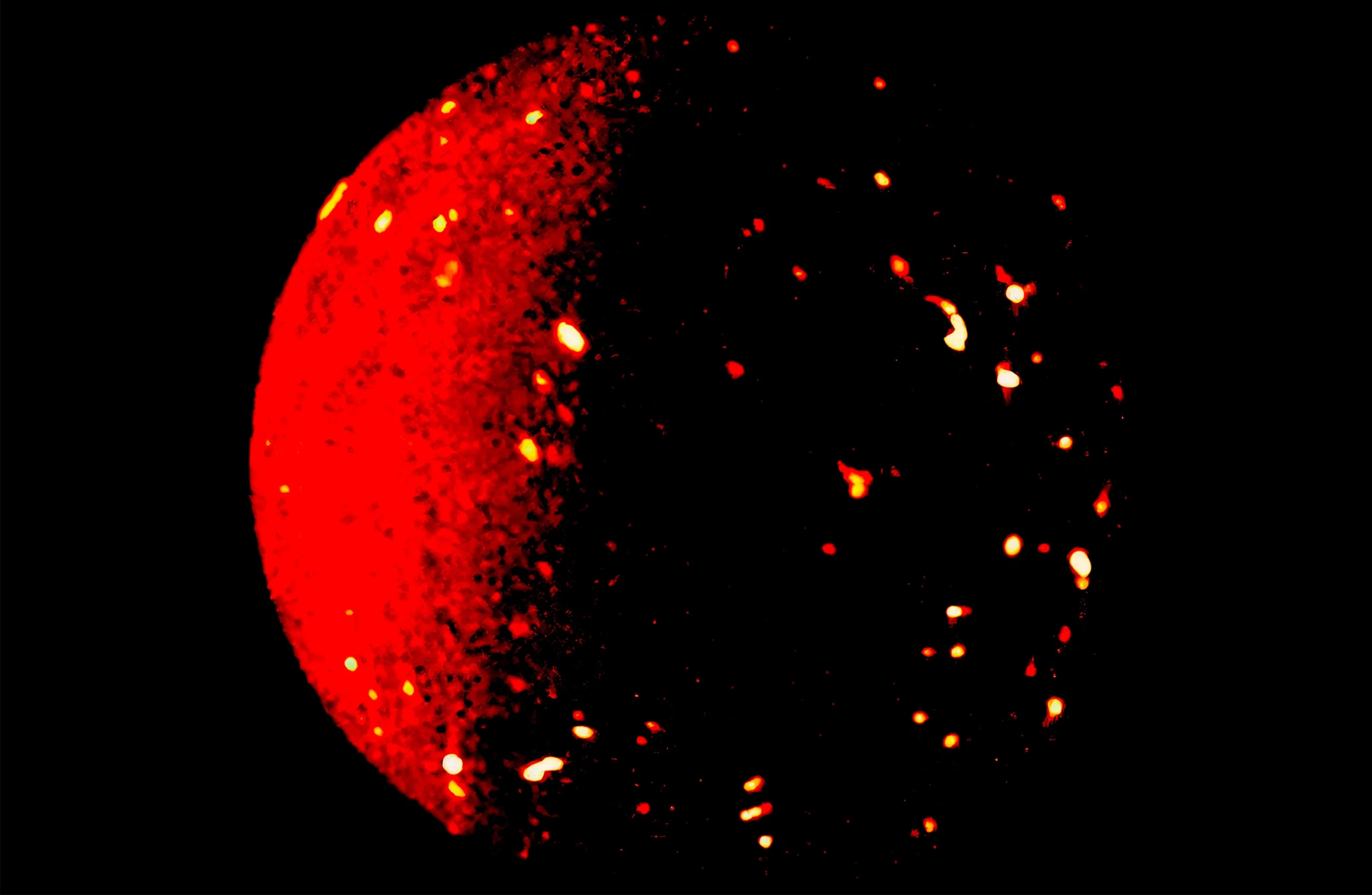
White-hot volcanoes pockmark Io in this infrared image captured by NASA’s Juno probe.


ByRobin George Andrews


April 25, 2025


Scott Bolton’s first encounter with Io took place in the summer of 1980, right after he graduated from college and started a job at NASA. The Voyager 1 spacecraft had flown past this moon of Jupiter, catching the first glimpse of active volcanism on a world other than Earth. Umbrella-shaped outbursts of magmatic matter rocketed into space from all over Io’s surface. “They looked amazingly beautiful,” said Bolton, who is now based at the Southwest Research Institute in Texas. “It was like an artist drew it. I was amazed at how exotic it looked compared to our moon.”

Scientists like Bolton have been trying to understand Io’s exuberant volcanism ever since. A leading theory(opens a new tab) has been that just below the moon’s crust hides a global magma ocean, a vast contiguous cache of liquid rock. This theory dovetails neatly with several observations, including ones showing a roughly uniform distribution of Io’s volcanoes, which seem to be tapping the same omnipresent, hellish source of melt.

But now, it appears that Io’s hell has vanished — or rather, it was never there to begin with. During recent flybys of the volcanic moon by NASA’s Juno spacecraft, scientists measured Io’s gravitational effect on Juno, using the spacecraft’s tiniest wobbles to determine the moon’s mass distribution and therefore its internal structure. The scientists reported in Nature(opens a new tab) that nothing significant is sloshing about just beneath Io’s crust.

“There is no shallow ocean,” said Bolton, who leads the Juno mission.

Independent scientists can find no fault with the study. “The results and the work are totally solid and pretty convincing,” said Katherine de Kleer(opens a new tab), a planetary scientist at the California Institute of Technology.

The data has reopened a mystery that spills over into other rocky worlds. Io’s volcanism is powered by a gravity-driven mechanism called tidal heating, which melts the rock into magma that erupts from the surface. Whereas Io is the poster child for this mechanism, tidal heating also heats many other worlds, including Io’s neighbor, the icy moon Europa, where the heat is thought to sustain a subterranean saltwater ocean. NASA launched the $5 billion Clipper spacecraft(opens a new tab) to search Europa’s sky for signs of life in the proposed underground ocean.
Share this article


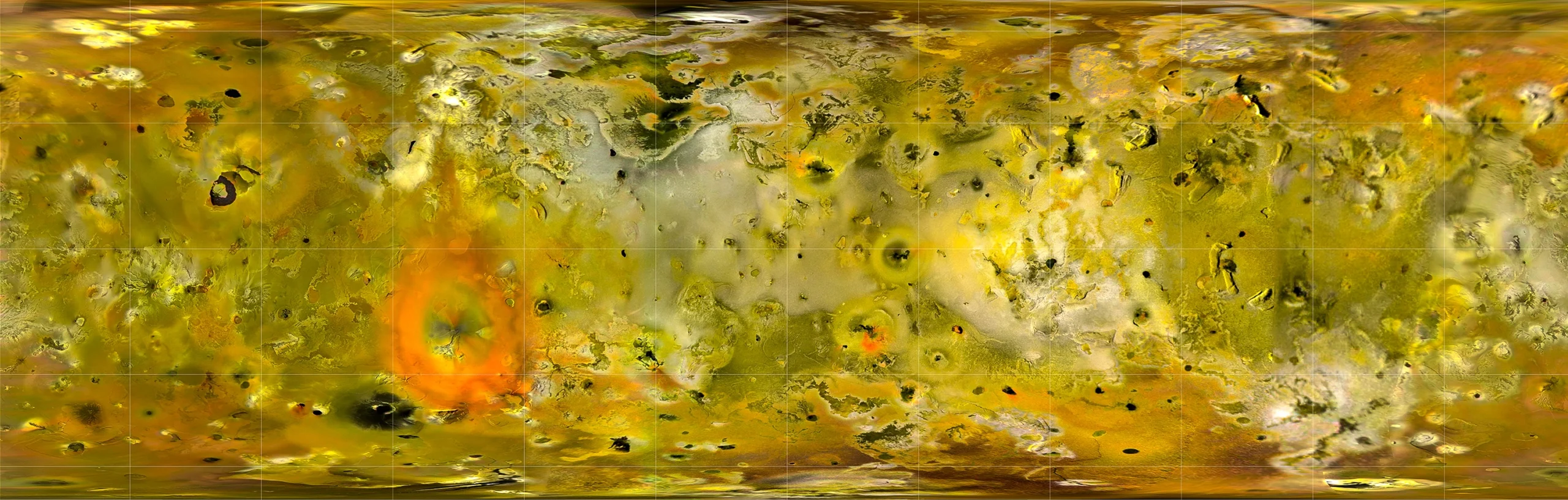
A map of Io’s surface, created with images from the Voyager 1 and Galileo missions, shows the wide distribution of the moon’s volcanoes. The large red ring is sulfurous fallout from the plume of the Pele volcano.


U.S. Geological Survey


But if Io doesn’t have a magma ocean, what might that mean for Europa? And, scientists now wonder, how does tidal heating even work?

Melting Magma

Heat drives geology, the rocky foundation upon which everything else, from volcanic activity and atmospheric chemistry to biology, is built. Heat often comes from a planet’s formation and the decay of its radioactive elements. But smaller celestial objects like moons have only tiny reserves of such elements and of residual heat, and when those reserves run dry, their geological activity flatlines.

Or, at least, it should — but something appears to grant geologic life to small orbs throughout the solar system long after they should have geologically perished.

Io is the most flamboyant member of this puzzling club — a burnt-orange, crimson and tawny Jackson Pollock painting. The discovery of its over-spilling cauldrons of lava is one of the most famous tales in planetary science, as they were predicted to exist before they were discovered.


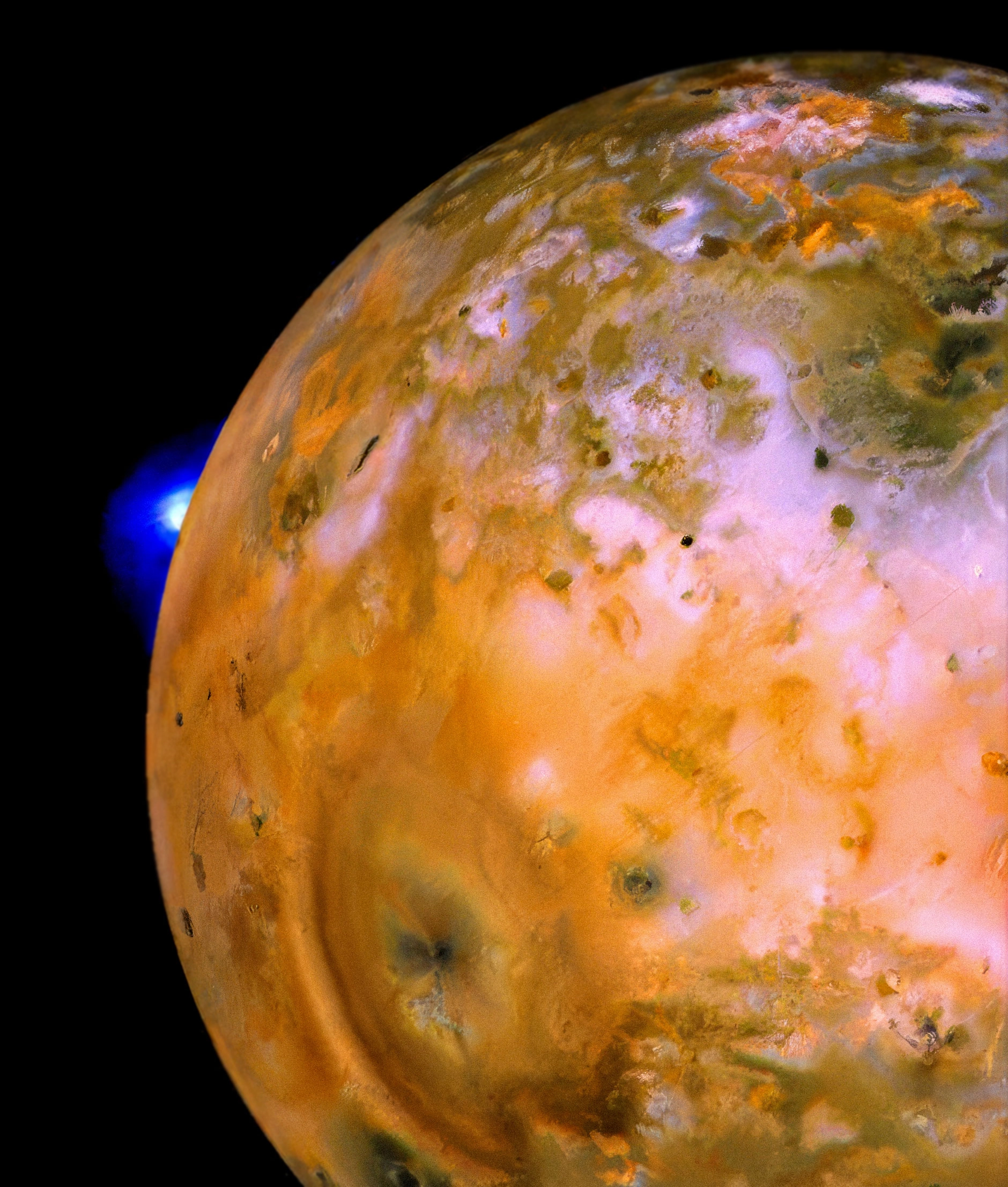
NASA’s Voyager 1 probe photographed Io in 1979, revealing the first glimpse of volcanism beyond Earth. In this photo mosaic, a lava plume is seen emanating from Loki Patera, now known to be the moon’s largest volcano.


NASA/JPL/USGS


On March 2, 1979, a paper in Science(opens a new tab) ruminated on Io’s strange orbit. Because of the positions and orbits of neighboring moons, Io’s orbit is elliptical rather than circular. And when Io is closer to Jupiter, it experiences a stronger gravitational pull from the gas giant than when it is farther away. The study authors figured that Jupiter’s gravity must therefore be constantly kneading Io, pulling its surface up and down by up to 100 meters, and, per their calculations, generating a lot of frictional heat within it — a mechanism they described as “tidal heating.” They conjectured that Io may be the most intensely heated rocky body in the solar system. “One might speculate that widespread and recurrent surface volcanism would occur,” they wrote.

Just three days later, Voyager 1 flew by(opens a new tab). An image taken on March 8 documented two gigantic plumes arching above its surface. After ruling out all other causes, NASA scientists concluded that Voyager had seen an alien world’s volcanic eruptions. They reported their discovery in Science(opens a new tab) that June, just three months after the prediction.

The planetary science community quickly coalesced around the idea that tidal heating within Io is responsible for the never-ending volcanism on the surface. “The unknown part that’s been an open question of decades is what that means for the interior structure,” said Mike Sori(opens a new tab), a planetary geophysicist at Purdue University. Where is that tidal heating focused within Io, and just how much heat and melting is it generating?


NASA’s Galileo spacecraft studied Jupiter and several of its moons around the turn of the millennium. One of its instruments was a magnetometer, and it picked up a peculiar magnetic field emanating from Io. The signal appeared to be coming from an electrically conductive fluid — a lot of fluid, in fact.

After years of study, scientists concluded(opens a new tab) in 2011 that Galileo had detected a global magma ocean just below Io’s crust. Whereas Earth’s mantle is mostly solid and plasticky, Io’s subsurface was thought to be filled with an ocean of liquid rock 50 kilometers thick, or almost five times thicker than the Pacific Ocean at its deepest point(opens a new tab).

A similar magnetic field was coming from Europa, too — in this case, apparently generated by a vast ocean of salty water. The implications were profound: With a lot of rocky material, tidal heating can make oceans of magma. With plenty of ice, it can create oceans of potentially habitable liquid water.
Volcanic Vanishing Act

By the time the Juno spacecraft started swinging around Jupiter in 2016, the belief that Io had a magma ocean was widespread. But Bolton and his colleagues wanted to double-check.


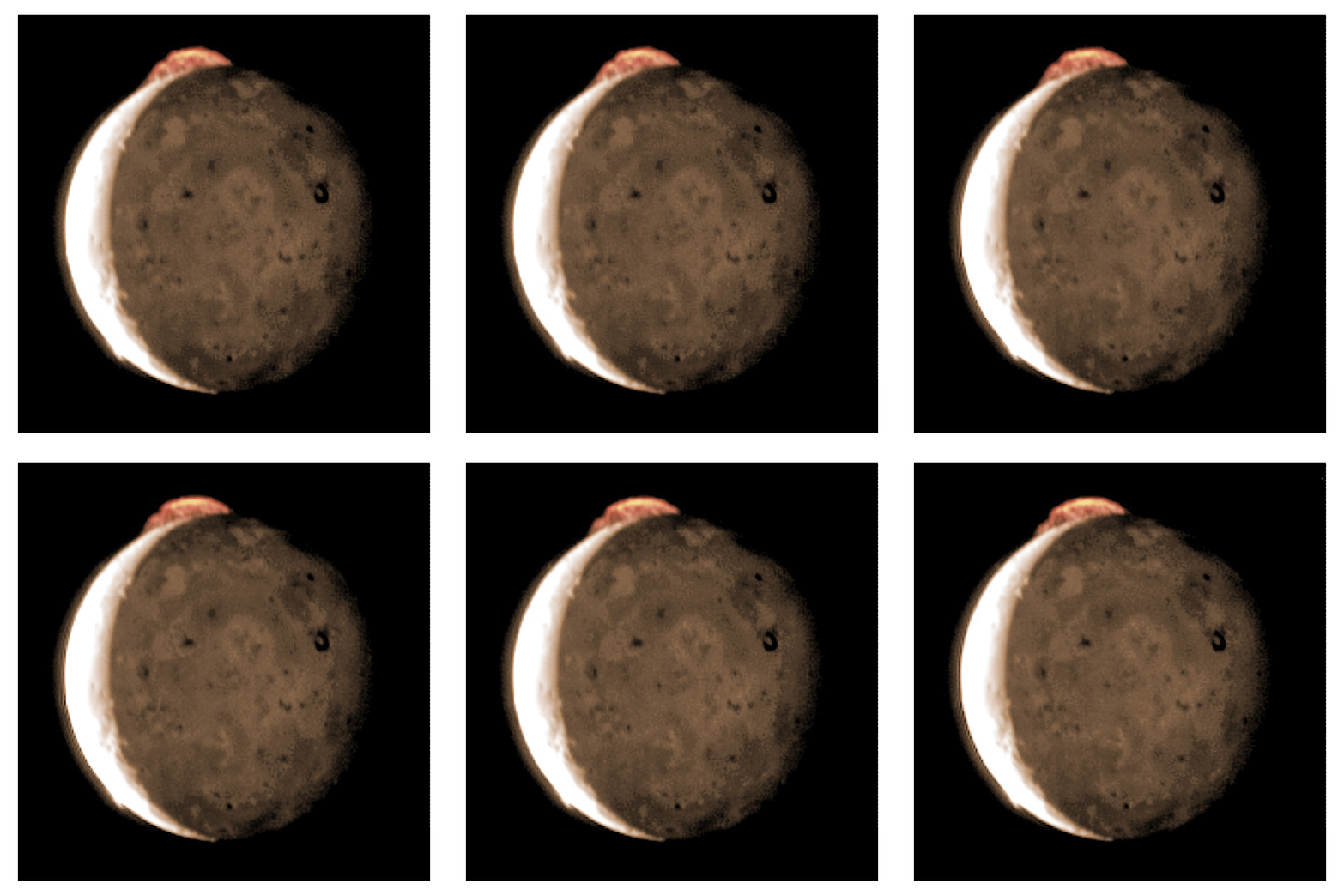
A sequence of images taken over the course of eight minutes by NASA’s New Horizons probe in 2007 shows an eruption by the Tvashtar Paterae volcanic region. The plume in this false-color image rises 330 kilometers from the moon’s surface.


NASA/Johns Hopkins University Applied Physics Laboratory/Southwest Research Institute


During flybys in December 2023 and February 2024, Juno came within 1,500 kilometers of Io’s scorched surface. Although the remarkable images of active volcanoes drew everyone’s attention, the goal of these flybys was to find out if a magma ocean truly lay beneath the moon’s rocky skin.

To investigate, the team used an unlikely tool: Juno’s radio transponder(opens a new tab), which communicates with Earth, sending and receiving signals. Because of Io’s unevenly distributed mass, its gravitational field isn’t perfectly symmetrical. That uneven gravitational field subtly alters the motion of Juno as it flies by, causing it to accelerate or decelerate a little.

That means Juno’s radio transmissions will experience the Doppler effect, where the wavelength shifts slightly in response to Io’s uneven gravitational field. By looking at the incredibly small shifts in the transmissions, Bolton’s team was able to create a high-fidelity picture of Io’s gravitational field and use that to determine its internal structure. “If there were indeed a global magma ocean, you’d see a lot more distortion as Io orbited around Jupiter and as the tidal forces flexed it and changed its shape,” said Ashley Davies(opens a new tab), a volcanologist at NASA’s Jet Propulsion Laboratory who wasn’t involved with the new study.

But Bolton’s team did not find this level of distortion. Their conclusion was clear. “There cannot be a shallow magma ocean fueling the volcanoes,” said study co-author Ryan Park(opens a new tab), a Juno co-investigator at the Jet Propulsion Laboratory.


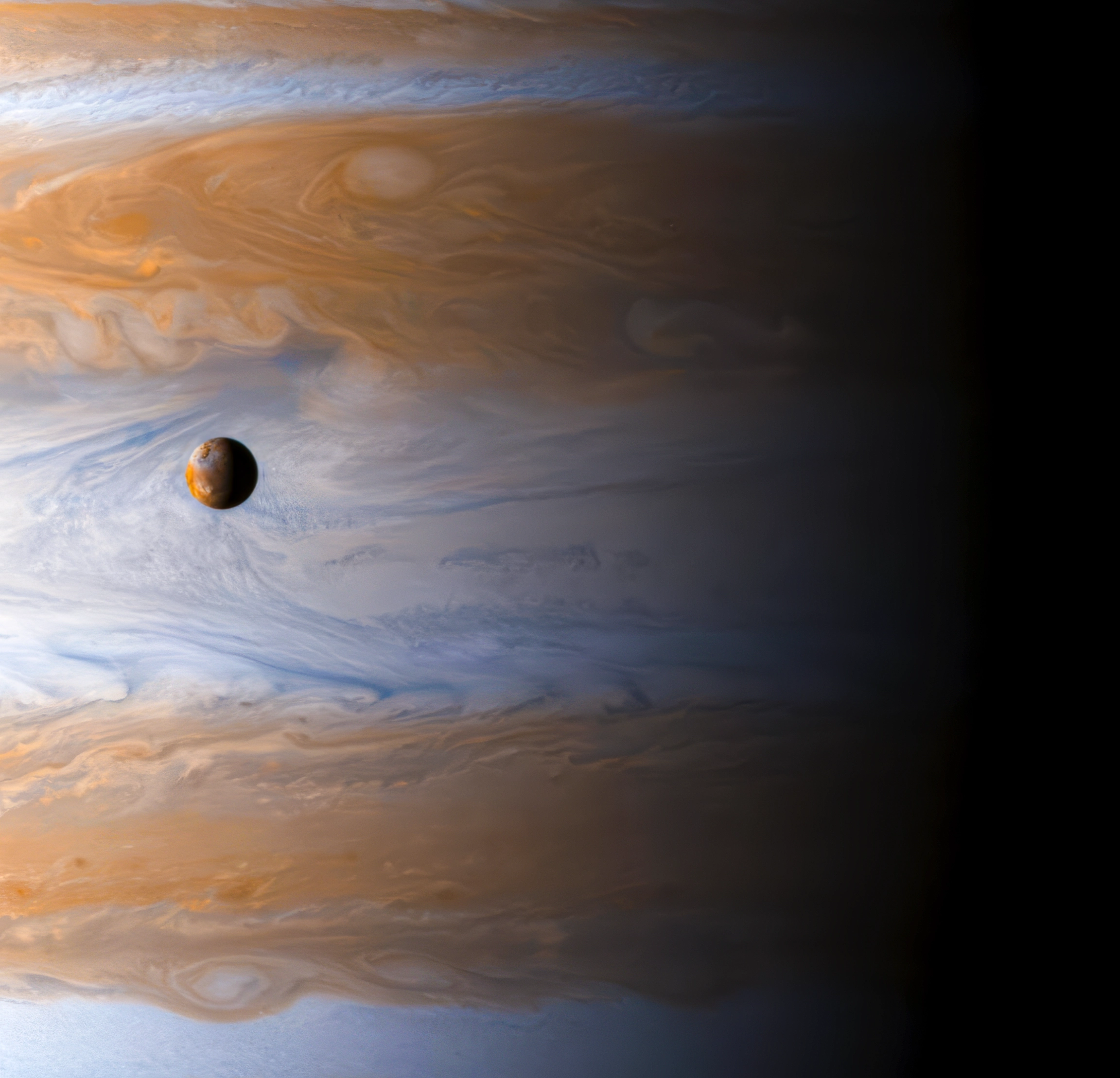
The Cassini-Huygens mission photographed Io against the backdrop of Jupiter in 2001.


NASA/JPL/University of Arizona


So what else might be powering Io’s volcanoes?

On Earth, discrete reservoirs of magma of different types — from the tarlike viscous matter that powers explosive eruptions to the runnier, honey-esque stuff that gushes out of some volcanoes — are located within the crust at various depths, all created by the interactions of tectonic plates, the moving jigsaw pieces that make up Earth’s surface. Io lacks plate tectonics and (perhaps) a diversity of magma types, but its crust may nevertheless be peppered with magma reservoirs. This was one of the original lines of thought until Galileo’s data convinced many of the magma ocean theory.

The new study doesn’t rule out a far deeper magma ocean. But that abyssal cache would have to be filled with magma so iron-rich and dense (because of its great depth) that it would struggle to migrate to the surface and power Io’s volcanism. “And at some depth, it becomes tricky to distinguish between what we would call a deep magma ocean versus a liquid core,” Park said.

For some, this raises an irreconcilable problem. Galileo’s magnetometer detected signs of a shallow magma ocean, but Juno gravity data has emphatically ruled that out. “People are not really disputing the magnetometer results, so you have to make that fit with everything else,” said Jani Radebaugh(opens a new tab), a planetary geologist at Brigham Young University.

Researchers disagree on the best interpretation of the Galileo data. The magnetic signals “were taken as probably the best evidence for a magma ocean, but really they weren’t that strong,” said Francis Nimmo(opens a new tab), a planetary scientist at the University of California, Santa Cruz and a co-author of the new study. The induction data couldn’t distinguish between a partly molten (but still solid) interior and a fully molten magma ocean, he said.
Heavy Water

Perhaps the main reason scientists study Io is because it teaches us about the fundamentals of tidal heating. Io’s tidal heating engine remains impressive — there’s clearly a lot of volcano-feeding magma being generated. But if it’s not producing a subsurface magma ocean, does that mean tidal heating doesn’t generate water oceans, either?

Scientists remain confident that it does. Nobody doubts that Saturn’s moon Enceladus, which is also tidally heated, contains an underground saltwater ocean; the Cassini spacecraft not only detected signs of its existence but directly sampled some of it erupting out of the moon’s South Pole. And although there is some light skepticism(opens a new tab) about whether Europa has an ocean, most scientists think it does.
4


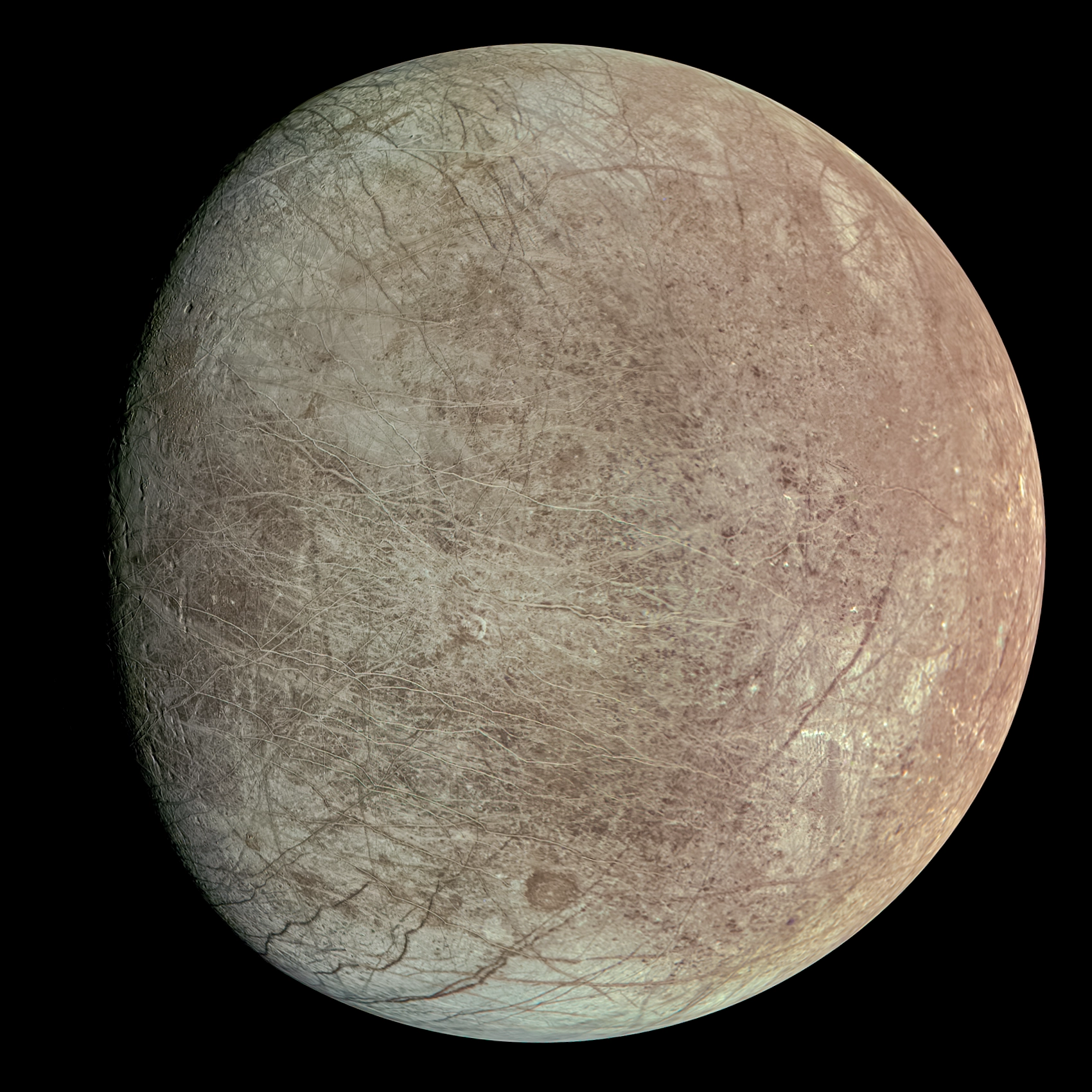
The smooth, lightly scratched surface of Jupiter’s icy moon Europa, photographed by the Juno spacecraft in 2022, shows no sign of what lies beneath: in all likelihood, a vast saltwater ocean.


NASA/JPL-Caltech/SwRI/MSSS


Crucially, unlike Io’s odd magnetic field, which seemed to indicate that it concealed an ocean’s worth of fluid, Europa’s own Galileo-era magnetic signal remains robust. “It’s a pretty clean result at Europa,” said Robert Pappalardo(opens a new tab), the Europa mission’s project scientist at the Jet Propulsion Laboratory. The icy moon is far enough from Jupiter and the intense plasma-flooded space environment of Io that Europa’s own magnetic induction signal “really sticks out.”

But if both moons are tidally heated, why does only Europa have an inner ocean? According to Nimmo, “There’s a fundamental difference between a liquid-water ocean and a magma ocean. The magma wants to escape; the water really doesn’t.” Liquid rock is less dense than solid rock, so it wants to rise and erupt quickly; the new study suggests that it doesn’t linger at depth long enough inside Io to form a massive, interconnected ocean. But liquid water is, unusually, denser than its solid icy form. “Liquid water is heavy, so it collects into an ocean,” Sori said.

“I think that’s the big-picture message from this paper,” Sori added. Tidal heating might struggle to create magma oceans. But on icy moons, it can easily make watery oceans due to the bizarrely low density of ice. And that suggests life has a multitude of potentially habitable environments throughout the solar system to call home.
Hell’s Poster Child

The revelation that Io is missing its shallow magma ocean underscores just how little is known about tidal heating. “We’ve never really understood where in Io’s interior the mantle is melting, how that mantle melt is getting to the surface,” de Kleer said.

Our own moon shows evidence of primeval tidal heating, too. Its oldest crystals formed 4.51 billion years ago from the stream of molten matter that got blasted off Earth by a giant impact event. But a lot of lunar crystals seem to have formed from a second reservoir of molten rock 4.35 billion years ago. Where did that later magma come from?


Nimmo and co-authors offered one idea in a paper(opens a new tab) published in Nature in December: Maybe Earth’s moon was like Io. The moon was significantly closer to Earth back then, and the gravitational fields from the Earth and the sun were battling for control. At a certain threshold, when the gravitational influence of both were roughly equal, the moon might have temporarily adopted an elliptical orbit and gotten tidally heated by Earth’s gravitational kneading. Its interior might have remelted, causing a surprise secondary flourish of volcanism.

But exactly where within the moon’s interior its tidal heating was concentrated — and thus, where all that melting was happening — isn’t clear.

Perhaps if Io can be understood, so too can our moon — as well as several of the other satellites in our solar system with hidden tidal engines. For now, this volcanic orb remains maddeningly inscrutable. “Io’s a complicated beast,” Davies said. “The more we observe it, the more sophisticated the data and the analyses, the more puzzling it becomes.”

New Poll Data Confirms The Democrats' Worst Fears


Folks who work for a living and expect to work for a living once upon a time found common ground with the DEMs.  then along came Trump who understood that that majority was been ignored.  so he paid attention and has destroyed the DEMs for a long time.

Recovery is long and difficult, particularly when he is addressing long standing problems head on.  Of course it hurts but a strongly recovering USA will support MAGA for generations just as Roosevelt carried the DEMS for generations until Trump.

So yes a slice of the electorate has left permanently to follow convincing performance.  Just like the NEW DEAL.


New Poll Data Confirms The Democrats' Worst Fears

Thursday, Apr 24, 2025 - 07:40 AM


Can you believe it? The Democrats, once the supposed champions of the working class, have exposed themselves as nothing more than elitist snobs who couldn't care less about real Americans. Recent polling has confirmed what conservatives have known all along: the Democratic Party is now the domain of overeducated, snobby, wealthy liberals who look down on anyone who doesn't share their "enlightened" worldview.


Remember when Democrats at least pretended to care about the working class? Those days are long gone, replaced by a woke agenda that caters to the most unhinged elements of society. Now, they're more interested in slobbering over MS-13 gangbangers than addressing the real concerns of everyday Americans.


Democratic strategist Doug Sosnik didn’t sugarcoat the situation during a conversation with Mark Halperin on 2WAY. The latest poll numbers, he explained, confirm what many on the Left have feared for months: the Democratic Party is in serious trouble. In a blunt, unflinching analysis, Sosnik laid out a series of hard truths that paint a grim picture of the party’s standing with American voters and underscore just how deep the erosion has become.

First, Sosnik pointed to the seismic shift in party affiliation.

“The electorate in 2024 was 6% less Democratic than compared to four years ago,” Halperin noted, asking if that level of movement was historically significant. Sosnik didn’t mince words: “The shift is significant, but more importantly… I can’t remember the last time that people who voted on Election Day — the majority, uh, plurality of them — were Democrats.” He continued, “It shows a real erosion for the Democratic Party,” noting that many of the Democrats who backed Biden in 2020 simply didn’t show up this time around.

That drop-off was made even more glaring when coupled with the latest favorability ratings.

“Lowest net favorable rating since the ’90s,” Halperin remarked, prompting Sosnik to outline a trifecta of disasters driving the collapse in support: inflation, immigration, and cultural arrogance.

On the economic front, Sosnik admitted, “We had the worst inflation in America since the early 1980s.”

He added that by the time Election Day arrived, “everything… was on average 20% higher than when Biden took office.” That kind of economic pain, Sosnik argued, doesn’t just dent a party; it shatters its credibility.

But the damage didn’t stop there.

Immigration, Sosnik said, became both a practical problem and a symbol.

“There’s a concern that people, uh, for their own personal… safety and security… the immigration issue was sort of both a real problem for Democrats, but also… a proxy for just a general sense that there was a lawlessness with a Democratic administration.” That perception of disorder extended into the cities, where “these big cities around America that were largely… governed by Democrats” seemed unable — or unwilling — to maintain control."

Then came the cultural disconnect, the sense that Democrats had abandoned everyday Americans in favor of elite ideologies.

“A lot of people in America in the middle of the country thought Democrats were looking down on them,” Sosnik said bluntly. He attributed part of that disconnect to “how they talked, issues they cared about, all the DEI programs.” The result? A broadening sense among voters that Democrats “weren’t competent to govern.”


Taken together, the conversation was less a diagnosis than an autopsy. The Democrats aren’t just facing a messaging problem; they’re grappling with a wholesale rejection from swaths of the electorate they once considered safe. The warnings have been mounting for years. Now, with favorability cratering and voters fleeing, the party is watching those warnings come to life.

More-than-human science


I totally disagree although quite rightly, it is easy to imagine a calculated result well beyond our desire to redo. just why bother unless the precission matters and then we find shortcuts.

understand that most of our work is done to no more than three significant digits, not least because error distribution makes better unlikely.

And all our sciece is built on inferance even when chasing error.

More-than-human science

When AI takes over the practice of science we will likely find the results strange and incomprehensible. Should we worry?


Photo by weestend/Getty Images


is associate professor of philosophy at Morningside University, Iowa. He lives in Omaha, Nebraska.

https://aeon.co/essays/when-ais-do-science-it-will-be-strange-and-incomprehensible


The science of our age is computational. Without models, simulations, statistical analysis, data storage and so on, our knowledge of the world would grow far more slowly. For decades, our fundamental human curiosity has been sated, in part, by silicon and software.

The late philosopher Paul Humphreys called this the ‘hybrid scenario’ of science: where parts of the scientific process are outsourced to computers. However, he also suggested that this could change. Even though he began writing about these ideas more than a decade ago, long before the rise of generative artificial intelligence (AI), Humphreys had the foresight to recognise that the days of humans leading the scientific process may be numbered. He identified a later phase of science – what he called the ‘automated scenario’, where computers take over science completely. In this future, the computational capacities for scientific reasoning, data processing, model-making and theorising would far surpass our own abilities to the point that we humans are no longer needed. The machines would carry on the scientific work we once started, taking our theories to new and unforeseen heights.

According to some sources, the end of human epistemic dominance over science is on the horizon. A recent survey of AI researchers offered a 50 per cent chance that, within a century, AI could feasibly replace us in every job (even if there are some we’d rather reserve for ourselves, like being a jury member). You may have a different view about whether or when such a world is possible, but I’d ask you to suspend these views for a moment and imagine that such artificial superintelligences could be possible eventually. Their development would mean that we could pass over the work of science to our epistemically superior artificial progeny who would do it faster and better than we could ever dream.

This would be a strange world indeed. For one thing, AI may decide to explore scientific interests that human scientists are unincentivised or unmotivated to pursue, creating whole new avenues of discovery. They might even gain knowledge about the world that lies beyond what our brains are capable of understanding. Where will that leave us humans, and how should we respond? I believe we need to start asking these questions now, because within a matter of decades, science as we know it could transform profoundly.


Though it may sound like the stuff of science fiction novels, Humphreys’s automated scenario for science would be yet another step in a centuries-long trend. Humans have never really done science alone. We have long relied on tools to augment our observation of the world: microscopes, telescopes, standardised rulers and beakers, and so on. And there are plenty of physical phenomena that we cannot directly or precisely observe without instruments, such as thermometers, Geiger counters, oscilloscopes, calorimeters and the like.

The introduction of computers represented an additional step towards the decentring of humans in science: Humphreys’s hybrid scenario. As one prominent example documented in the book Hidden Figures (2016) by Margot Lee Shetterly (and subsequent film), the first United States space flights required computations to be done by human mathematicians including Katherine Johnson. By the time of the US lunar missions, less than a decade later, most of those computations had been passed off to computers.

Our contribution to science remains critical: we humans still call the shots

The following decades witnessed continual, logarithmic growth of computational processing and power, and a correlated decrease in the price of computation. We are now at what we might call an advanced hybrid stage of science with an even greater reliance on computational systems. As one example, the philosopher Margaret Morrison explained how computational simulations were essential to the discovery of the Higgs boson – helping scientists know what to look for and sorting through the data from high-energy collisions.

And now AI has begun to have a large impact on science. AlphaFold, for example, is an AI designed to help predict how proteins will fold, given their chemical makeup. While humans can do this work independently of computers, it is time-consuming, labour-intensive and expensive. The creators of AlphaFold – Google DeepMind – claim that it has saved ‘hundreds of millions of years in research time’. Similar benefits can be seen across the sciences: the analysis of extremely large data sets in astronomy and genomics, the development of novel proofs in mathematics, predicting the weather, developing new pharmaceuticals, and more.

When the contributions of computational AI begin to be measured in ‘hundreds of millions of years’, it starts to feel a bit like we humans are the underperforming members of the group project. So, we might wonder whether we are already in the automated scenario. However, we are not yet there. Our contribution to science remains critical: we humans still call the shots – we identify the scientific questions, we interpret the results and we, ultimately, determine its progress.

If we follow Humphreys’s trajectory, the full abdication of our epistemic throne of science would occur only at a later stage. At this point, artificial superintelligences would not only be capable of completing tasks we set for them (a continuation of the hybrid scenario) but would also be capable of setting their own tasks: their own research agenda, data collection, modelling and theories, according to their own independently identified set of theoretical virtues and values – a science all their own.

It’s worth pausing here to marvel at the possibilities open to an artificial superintelligence unbound by human physical and epistemic limitations. Many scientific tasks sit outside the scope of human possibility, because there would never be funding to pursue the question or because there is simply not enough human interest. As I write this, for example, I am looking at a partially decayed leaf in my yard. Perhaps an artificial superintelligence would be interested in developing a predictive model that explains, with exacting particularity down to the second, the decaying processes and rates of any given leaf, depending on the species of tree, size of leaf, historical contact with various microbial life, presence or absence of sunlight and moisture, and so on and so forth – an extremely complex question for which such detail offers no obvious value. Or, in fulfilment of a question my son once asked me, perhaps a superintelligence would be able to develop a model that predicts precisely when the water molecules of a snowball he left in the mountains will flow by our house in the river that drains that mountain system. Such a prediction would require an extremely complex and detailed model of the river basin, fluid dynamics, the climate and a whole range of other features of the system.

It’s not that we humans couldn’t ever answer these questions. With sufficient focus and funding, I suspect that scientists could develop effective predictive models of these and other esoteric phenomena. But the reality is that we won’t. For better and for worse, science today is shaped by strongly human factors: economic value, political priorities, career prospects, cultural trends, and a range of human biases and beliefs. Imagine the science if all that baggage could be abandoned.

As the superintelligences execute their own research agendas, their work would become unintelligible for us

The automated scenario does not just permit the efficient exploration of scientific projects we cannot or would not pursue. Though the artificial superintelligences might continue to work within the paradigms of our current theories, there is no reason they would have to do so – they may quickly choose to begin afresh with a new theory of the world. Similarly, though they may use mathematics and symbols familiar to human scientists, they would not be bound by these conventions – they may quickly develop new mathematics and systems for expressing those.

Given the possibility (and, in my view, likelihood) that such AIs would quickly abandon human epistemic baggage, we may choose to follow a Wittgensteinian line of reasoning and think of the automated scenario as the stage at which they would begin to speak and develop an independent and new scientific language. Ludwig Wittgenstein famously (and, true to form, enigmatically) says in Philosophical Investigations (1953): ‘If a lion could talk, we wouldn’t be able to understand it.’ Though the statement feels contradictory, Wittgenstein’s point is that the meaning of language is deeply embedded and intertwined with the internal experience of being human. So, too, for science. As the superintelligences begin to set and execute their own research agendas, the work they do would therefore become unintelligible for us because we would lack the internal perspective necessary to understand their science. From our view, their research would be a science created for theoretical-aims-we-know-not-what, with purposes-we-know-not-what, to be interpreted in ways-we-know-not-what.

It is at least possible that there are limits to our human epistemic capabilities: untold mathematics we can never understand or multidimensional concepts that are beyond our three-dimensional experiences. The fact that there are limitations to the intellectual capacities of other animals (try explaining general relativity to the smartest chimpanzee to ever exist) is reason to think that there are possible limitations to our own intellectual capacities too: ideas too complex to understand. Even supposing that we are not subject to limited epistemic capacities, there is also the problem that the reasoning of artificial superintelligence may be in practice beyond our capacities. Understanding the science of the automated scenario may require, for example, the simultaneous consideration of hundreds of complex models, each with hundreds of parameters, none of which links up to a familiar human concept. While it may be that we could understand the parameters (and maybe even the models) individually, we would lack the capacity to hold them all together at once.

Depending on your predilections about technology, AI, and the singularity, the above may all read to you as either incredibly bleak or extremely exciting. If you are like me, it all strikes you as simply strange. If the results of the completely automated scenario are outside of our understanding, then why would we want to devote economic resources and intellectual talent towards its development? Though this question is often swept away by flattening assertions that the future will come, whether we like it or not, I think it is worth our time identifying what reasons we may have for such a future, before we begin our wilful abdication of the epistemic throne of science.

One such reason may be that we think that positive advancements will follow. Perhaps the superintelligences would occasionally create things: pieces of technology, resources or new ways of solving problems. Since I’ve already used up far more than my allotted quota of speculation in this essay, I will remain open to what exactly these products might be, simply noting that the superintelligences may occasionally send us products it decides would be good for humans to have. Human engineers (if there are any remaining who haven’t themselves been replaced) may then take these new technologies and identify uses for them, even if they don’t understand exactly how they work. It would be akin to the way I don’t understand the process by which my monitor or word processor can create and display visual documents, but I can put them to use in writing this essay. This task will be less like today’s science and engineering and much more like simple discovery, the sort of primitive recognition that, for instance, a vine works well to tie tree branches together when building a shelter. It would be similar to stumbling upon some resource or substance in the world (as we stumbled upon coal or penicillin). There may indeed be a second kind of science that springs up as well: a form of backwards engineering of what an AI gifts us, to advance and modify our own theoretical understanding of the world.

Perhaps we might think that it is our moral responsibility or destiny to spread intelligence across the Universe

A different reason for enabling artificially superintelligent science would be aesthetic. Aesthetic reasons already hold a strong motivating factor when I, personally, think about the funding we as a society give to science. Though I do not have the time nor capacity to understand all of science (who possibly could?), I find it beautiful and good that there are so many smart scientists pursuing their human curiosities – even if they do not all positively impact my life or my understanding of the world. There is something aesthetically pleasing in knowing that the world is being known, studied and understood. Might that translate to nonhuman scientists? Perhaps not overnight. However, future generations, who have learnt to live alongside AI, may even take it as a mark of a good society that it would be willing to enable this extrahuman understanding.

Alternatively, humanity might pursue the automated scenario out of beneficence: because we think it would be good for the artificial superintelligences to pursue their own advanced science. While we might find it frustrating – perhaps even upsetting – that the artificial superintelligences will know things that we don’t, we may pursue it all the same out of a moral obligation or feeling of goodwill towards our artificial progeny.

There are other motivations that may result in the automated scenario as an unintended consequence. Perhaps, for example, we think that it is our moral responsibility or destiny to spread intelligence across the Universe. If that intelligence just so happens to pursue automated science on its interstellar journey, then so be it.

Equally as numerous are those reasons why we might decide not to pursue the automated scenario. Perhaps the discoveries the artificial superintelligence makes and passes on to us would yield new and terrible weapons. Or maybe we think that, since they would require some internal and unchecked agency, it would increase the risk of a doomsday scenario such as human enslavement or annihilation. Perhaps it’s simply the concern that some of the superintelligences will begin to operate with an uncannily human hubris, experimenting in ways that are dangerous, unethical or contrary to humanity’s shared values.

But, despite these concerns, it seems unlikely that we will be able to stop its development, if it becomes technically possible. Arguably, the most likely reason we will end up with the automated scenario is because we simply cannot escape the forces of capital and competition. We may arrive there without much thought, simply because we can or because someone wants to build it first. The future may simply happen to us, whether we reflectively want it or not.

We will be stuck with our curiosity to understand and explain the natural world around us

Careful readers will note that there are several motivations that are absent from the litany of possible reasons for pursuing the automated scenario: most notably, all the reasons we currently pursue science. We would not pursue the automated scenario out of a desire to enhance our own knowledge and understanding of the world, to be able to give better explanations of phenomena, or exhibit greater interventional control over the natural world. These cannot be the reasons for pursuing the automated scenario because they are ruled out by the kind of science it is. Automated science takes the epistemic throne from humans, excluding us from the internal perspectives on the new and likely complex-beyond-our-ken discoveries. It would not, therefore, fulfil our human desires for understanding, explanation, knowledge or control. Perhaps with time we could learn to give up these desires – become a species uninterested and incurious. But I doubt it. Like the future, I suspect that these desires will come whether we like them or not.

So, what will we do? In his original presentation of the automated scenario, Humphreys suggested that the automated scenario would replace human science. I disagree. Since our desires for understanding, explanation, knowledge and control will remain, we cannot help but take actions to address those desires – to continue to do science. We humans create beautiful things, pursue interhuman connection in friendship and romance, and find and construct meaning in life. The same holds true for our motivations for science. We will be stuck with our curiosity to understand and explain the natural world around us.

If the automated scenario comes to pass, it seems that it will have to be as some new, alternative, secondary path – not a replacement, but an addition. Two species, pursuing science side by side, with different motivations, interests, frameworks and theories. Perhaps there will also be parts of science that artificial superintelligence is simply less interested in, such as the human quest to better understand our own minds, choices, relationships and health.

Indeed, if we are to remain human (and I cannot but hope that we will), we must continue to pursue science. What are we, really, if we are not beauty-seeking, friendship-making, meaning-constructing, hopelessly curious animals? Perhaps it is my limited powers of imagination that prevent me from conceiving of a future world in which we have abandoned these human desires. There are plenty of transhumanists who may think so. But I do not count it as a lack of creativity to see the goodness in beauty, in love, in meaning, and in science. Quite the contrary. I, for one, take hope in our hopeless curiosity.

Just a pale blue dot


So what?  The real question is human consiousness bounded by the Earth?  Or the universe?  just how is consciousness bounded?

At best we do not know.  I can imagine an act of creation in which scale declines exponentially while i watch.  this nicely avoids imagining expansion at all.  And neither exists except to produce TIME.

So what is this Earth which we are so into?

Just a pale blue dot

When we see the Earth as ‘a mote of dust suspended in a sunbeam’ what do we learn about human significance?


‘Look again at that dot. That’s here. That’s home. That’s us.’ From Pale Blue Dot (1994) by Carl Sagan. Photo courtesy NASA/JPL-Caltech


is professor of philosophy at Monash University in Melbourne, Australia and co-director of the Brain, Mind, and Consciousness programme of the Canadian Institute for Advanced Research (CIFAR). He is the author of The Unity of Consciousness (2010), Thought: A Very Short Introduction (2013), Philosophy of Religion: A Very Short Introduction (2018), and Philosophy of Mind: An Introduction (2022).


https://aeon.co/essays/why-pale-blue-dot-generates-feelings-of-cosmic-insignificance?u


On St Valentine’s Day 1990, NASA’s engineers directed the space-probe Voyager 1 – at the time, 6 billion kilometres (3.7 billion miles) from home – to take a photograph of Earth. Pale Blue Dot (as the image is known) represents our planet as a barely perceptible dot serendipitously highlighted by a ray of sunlight transecting the inky-black of space – a ‘mote of dust suspended in a sunbeam’, as Carl Sagan famously put it. But to find that mote of dust, you need to know where to look. Spotting its location is so difficult that many reproductions of the image provide viewers with a helpful arrow or hint (eg, ‘Earth is the blueish-white speck almost halfway up the rightmost band of light’). Even with the arrow and the hints, I had trouble locating Earth when I first saw Pale Blue Dot – it was obscured by the smallest of smudges on my laptop screen.

The striking thing, of course, is that Pale Blue Dot is, astronomically speaking, a close-up. Were a comparable image to be taken from any one of the other planetary systems in the Milky Way, itself one of between 200 billion and 2 trillion galaxies in the cosmos, then we wouldn’t have appeared even as a mote of dust – we wouldn’t have been captured by the image at all.

Pale Blue Dot inspires a range of feelings – wonderment, vulnerability, anxiety. But perhaps the dominant response it elicits is that of cosmic insignificance. The image seems to capture in concrete form the fact that we don’t really matter. Look at Pale Blue Dot for 30 seconds and consider the crowning achievements of humanity – the Taj Mahal, the navigational exploits of the early Polynesians, the paintings of Georgia O’Keeffe, the inventions of Leonardo da Vinci, John Coltrane’s A Love Supreme, Cantor’s theorem, the discovery of DNA, and on and on and on. Nothing we do – nothing we could ever do – seems to matter. Pale Blue Dot is to human endeavour what the Death Star’s laser was to Alderaan. What we seem to learn when we look in the cosmic mirror is that we are, ultimately, of no more significance than a mote of dust.

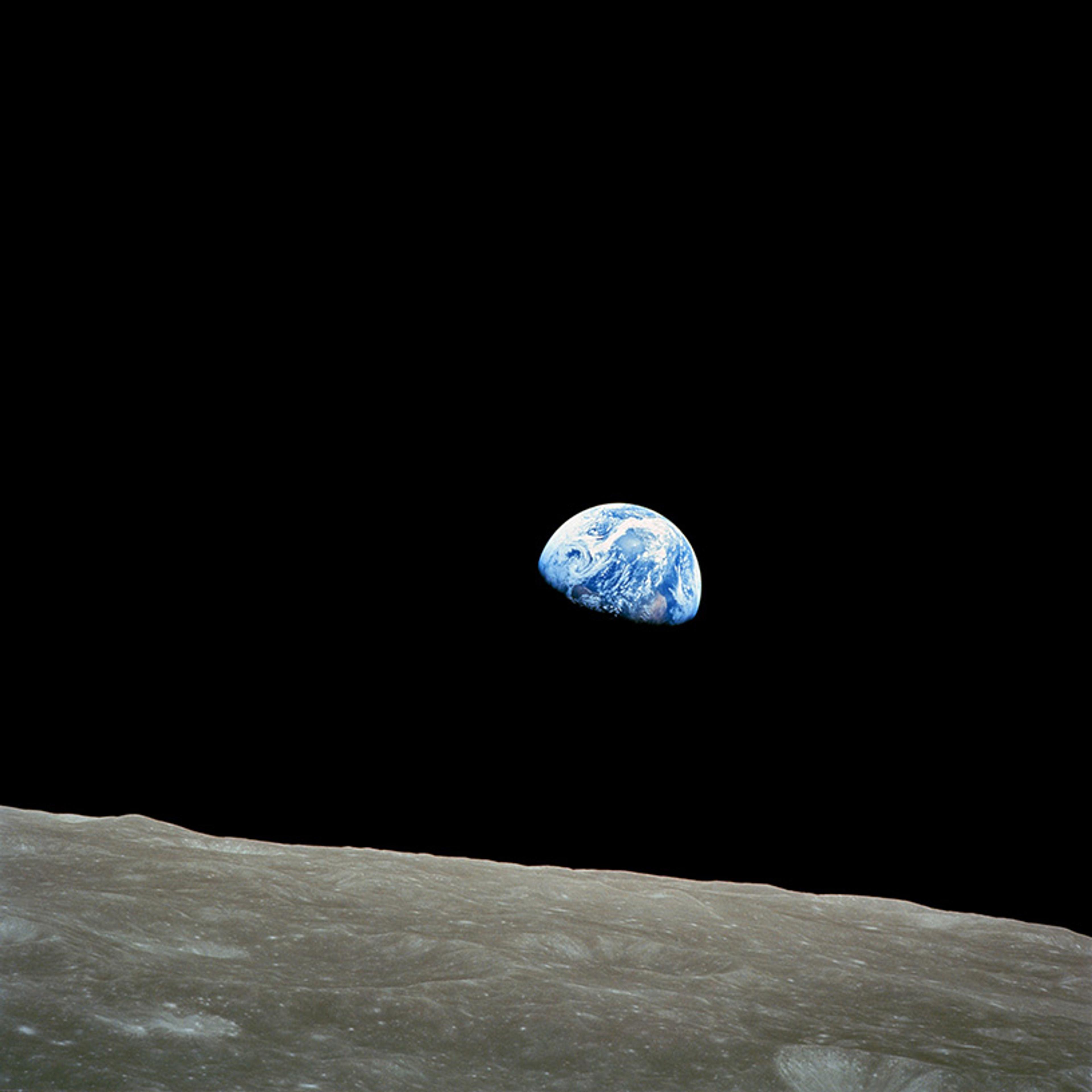
Contrast the feelings elicited by Pale Blue Dot with those elicited by Earthrise, the first image of Earth taken from space. Shot by the astronaut William Anders during the Apollo 8 mission in 1968, Earthrise depicts the planet as a swirl of blue, white and brown, a fertile haven in contrast to the barren moonscape that dominates the foreground of the image. Inspiring awe, reverence and concern for the planet’s health, the photographer Galen Rowell described it as perhaps the ‘most influential environmental photograph ever taken’. Pale Blue Dot is a much more ambivalent image. It speaks not to Earth’s fecundity and life-supporting powers, but to its – and, by extension, our – insignificance in the vastness of space.


Earthrise, taken on 24 December 1968 by Apollo 8 astronaut William Anders. Courtesy NASA

But what, exactly, should we make of Pale Blue Dot? Does it really teach us something profound about ourselves and our place in the cosmic order? Or are the feelings of insignificance that it engenders a kind of cognitive illusion – no more trustworthy than the brief shiver of fear you might feel on spotting a plastic snake? To answer that question, we need to ask why Pale Blue Dot generates feelings of cosmic insignificance.


One account of the feelings elicited by Pale Blue Dot begins in the 17th century, with the French scientist and philosopher Blaise Pascal. Pascal was born in 1623, a mere 14 years after Galileo directed the first telescope heavenwards. Galileo’s observations not only confirmed Copernicus’s heliocentric conception of the solar system and revealed ‘imperfections’ in the celestial bodies (such as the Moon’s craters and mountains), they also revealed countless stars invisible to the naked eye. It was a moment of profound upheaval for humanity’s self-understanding, and many of the reflections recorded in Pascal’s Pensées – a series of notebook jottings published only after Pascal’s death – seem to have been prompted by the new astronomy:

When I consider the short span of my life absorbed into the preceding and subsequent eternity … the small space which I fill and even can see, swallowed up in the infinite immensity of spaces of which I know nothing and which know nothing of me, I am terrified, and surprised to find myself here rather than there, for there is no reason why it should be here rather than there, why now rather than then. Who put me here? On whose orders and on whose decision have this place and time been allotted to me?

(from the Honor Levi translation of Pascal’s Pensées, 1995)

But it is this line from the Pensées – ‘The eternal silence of these infinite spaces terrifies me’ – that perhaps best captures the feeling of cosmic insignificance. Indeed, the line could well serve as a caption for the Pale Blue Dot. For Pascal, the night sky wasn’t merely awe-inspiring – it was terrifying. And it was terrifying not (just) because it was infinite, but because it was ‘silent’.

Pascal doesn’t tell us what he meant by the silence of space, but there is reason to suspect that at least part of the answer is theological. The cosy, well-ordered universe of the Middle Ages had been replaced by a universe that was not only vastly bigger but seemed to be ruled by chance and contingency. ‘Who put me here?’ Pascal asks. ‘Perhaps no-one,’ one can almost hear him answer. The silence of space is the silence of the Universe in response to the question of God.

It is Pascal’s terror of space that has reverberated down the ages

Of course, Pascal himself was no atheist, and there are passages in the Pensées that suggest a very different attitude to the vastness of space:

So let us contemplate the whole of nature in its full and mighty majesty, let us disregard the humble objects around us, let us look at this scintillating light, placed like an eternal lamp to illuminate the universe. Let the earth appear a pinpoint to us beside the vast arc this star describes, and let us be dumbfounded that this vast arc is itself only a delicate pinpoint in comparison with the arc encompassed by the stars tracing circles in the firmament.

Pascal goes on to suggest that the very fact that our imagination ‘loses itself’ in the face of such thoughts is itself ‘the greatest perceivable sign of God’s overwhelming power’.

But it is Pascal’s terror of space that has reverberated down the ages. One can hear its echo in Joseph Conrad’s novel Chance (1913), in which the narrator describes ‘one of those dewy, clear, starry nights, oppressing our spirit, crushing our pride, by the brilliant evidence of the awful loneliness, of the hopeless obscure insignificance of our globe lost in the splendid revelation of a glittering, soulless universe.’

So here is one account of why Pale Blue Dot elicits the feelings it does. It indicates (reminds us?) that we are on our own. The Universe is not the product of divine plan; or at least, if it is, it is not a plan that takes our interests seriously.

Let’s suppose – if only for the sake of argument – that this account goes at least some way towards explaining why Pale Blue Dot elicits the feelings that it does. What, then, should we make of those feelings?

That, of course, turns on the question of how God’s inexistence would bear on human significance. Some assume that God is required for cosmic significance. Nothing could really matter in a world without God, and if nothing really matters then we don’t matter. If that’s right, then the feelings elicited by Pale Blue Dot wouldn’t be illusory. Instead, they would reveal a profound – and perhaps deeply unsettling – truth: from a cosmic point of view, we really are insignificant.

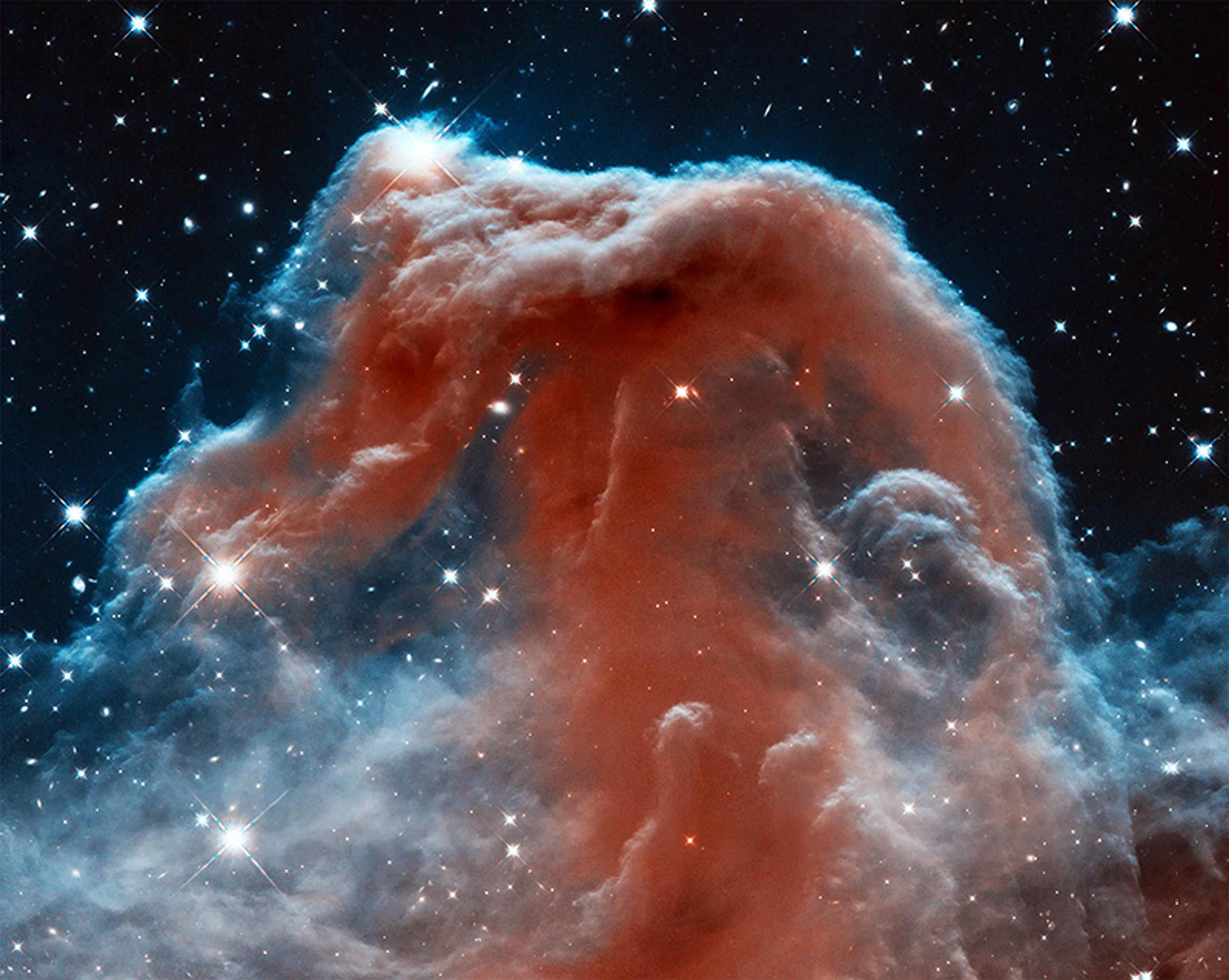
But the idea that significance requires God is deeply puzzling. If the beauty, knowledge and creativity that we see around us don’t really matter in and of themselves, how could the addition of God help? Indeed, it’s surely more plausible to suppose that it’s God’s presence rather than God’s absence that poses the more serious threat to human significance. After all, the beauty, knowledge and creativity that we’ve produced surely pales in comparison with that traditionally ascribed to God. As a 21st-century psalmist might put it, what is the sum total of human knowledge when set against God’s wisdom? What is the beauty of the Taj Mahal, A Love Supreme or the paintings of O’Keeffe when placed against the grandeur of the Horsehead Nebula in the Orion constellation?


The Horsehead Nebula captured by the Hubble Space Telescope. Courtesy NASA, ESA and the Hubble Heritage Team

Theology provides one lens through which to view the sense of cosmic insignificance; accounts of our experience of space provide another. Not the space of astronomy and inter-planetary probes, but the space of ordinary perceptual terrestrial environment.

It’s a familiar thought that ordinary modes of experiencing space (and, indeed time) are structured in terms of the human body and its capacities. One sees a door as 10 steps away and the fence as 20 steps away. As we grow and our limbs lengthen, the sense of the space around us also changes. This explains the common experience of visiting one’s childhood home and neighbourhood, and finding them much smaller than expected. Distances that had required 10 steps to traverse as a child can now be crossed in only five; doorframes that once towered high above one’s head can now be reached with ease.

The bodily structure of perceptual experience is reflected in our units of measurement. Ancient Mesopotamian builders used the cubit, determined by the length of the forearm from the elbow to the tip of the middle finger. More familiar to us is the foot, a central unit of measurement in Ancient Rome, Greece and China, and based of course on the length of the human foot. Sometimes, of course, we trade the dimensions of the human body for those of other animals. In the world of children’s books, skyscrapers are measured in terms of giraffes (‘the Burj Khalifa is 166 giraffes tall’) and the weight of construction vehicles is given in terms of elephants (‘the Bagger 293 weighs 2,580 elephants’). Giraffes and elephants may not make for good units of scientific measurement, but they do provide young children with a sense of an object’s properties.

One wants to ask how far a light year or astronomical unit is in real money

Our perceptual faculties enable us to grasp the scale of most built environments, but they are ill-equipped to capture the enormity of nature. To fully appreciate the size of the Grand Canyon, you need to hike down into it – simply looking won’t do the trick. The towering peaks of the Karakoram, the endless sand dunes of the Empty Quarter, the vast glaciers of Antarctica speak to nature’s ability to overwhelm our perceptual capacities. In James Joyce’s novel Ulysses (1920), Buck Mulligan, gazing out over Dublin Bay, refers to ‘the scrotumtightening sea’.

But to fully appreciate the limitations of the human body as a scale for nature, you need to cross the Kármán line, the boundary between Earth’s atmosphere and outer space. At its closest, Venus is 38 million kms away. (That’s around 7.6 billion giraffe-lengths.) Neptune, at its furthest, is 4.7 billion kms (around 940 billion giraffes) from us. It is 40,208,000,000,000 km from the Sun to Proxima Centauri, the next-nearest sun to us. Taken with an exposure time of over 11 days, the Hubble Ultra Deep Field captured a region of the night sky smaller than a grain of sand held at arm’s length – and yet it depicts around 10,000 galaxies.

These are unimaginably big numbers. We might be able to recite them, but few of us – other than mathematicians and astronomers, perhaps – can truly grasp them. (And note how natural it is to describe understanding in terms of bodily activity – ‘grasping’.)

One can, of course, avoid the need for big numbers by trading familiar units for unfamiliar ones – as science does. Instead of measuring the distance to Proxima Centauri in terms of kilometres, astronomers use astronomical units (the average distance between Earth and the Sun – around 150 million km) or light-years (multiples of the distance light travels in a year – around 9.5 trillion km). That gives us a more manageable way of dealing with astronomical distances, but it doesn’t help us to truly grasp the immensity of the cosmos. One wants to ask how far a light year or astronomical unit is in real money.

But if this is what explains our feelings of cosmic insignificance – and it’s likely to be part of the story – then it’s not clear why we should pay those feelings any heed. So what if our perceptual experiences cannot accommodate the dimensions of the cosmos? Our perceptual systems have been designed by evolution to help us navigate ordinary terrestrial environments, their job isn’t to track what matters. We might be unnerved by the amount of real estate we occupy, but such feelings provide no insight into our cosmic significance.

The two accounts of Pale Blue Dot that we’ve examined are curiously silent about one crucial feature of the image: it is not just an image of the vast emptiness of space, it’s an image of the vast emptiness of space in which we appear. It’s not an image from Earth but an image of Earth. Equally crucially, it’s an image in which Earth – the very object that provides the context for everything that matters to us – is barely perceptible, no more salient than a mote of dust.

Salience matters because it’s a signal from our senses: ‘This is significant – pay attention to it.’ From birth, our senses alert us to the presence of features that are important to us – human faces, our mother’s voice, the speech of those around us. The mechanisms that track perceptual salience evolve as we ourselves develop, but they continue to function as sentries, alerting us to what matters. The smell of smoke, loud sirens, sudden movements – these phenomena are all attention-grabbing. It doesn’t matter how engaging your current conversation is, if someone on the other side of the room utters your name, you’ll have a hard time not tuning in and eavesdropping on their conversation. The corollary, of course, is that what isn’t attention-grabbing doesn’t strike us as significant.

And Earth as it appears in Pale Blue Dot is pretty much as unobtrusive, as non-attention-grabbing, as overlook-able as it is possible to be. (Indeed, even the hint of perceptual salience – the sunbeam in which Earth is suspended – isn’t a genuine feature of Earth’s position in the cosmos but an artefact of the image itself.) Pale Blue Dot seems to capture the fact that, from a truly objective point of view – the view from ‘nowhere’, as we might put it – we aren’t attention-grabbing. And if we aren’t attention-grabbing (it’s natural to assume), then we’re not genuinely significant.

‘Small’, the image might seem to say, ‘but enormously significant’

But if this account explains why Pale Blue Dot elicits feelings of cosmic insignificance, it also shows why those feelings are not trustworthy. Pale Blue Dot may have been taken from a distance of 6 billion km, but it does not provide a ‘God’s eye’ view of the cosmos. It is, of course, an image, and every image conceals as much as it reveals.

Return to the contrast between Pale Blue Dot and Earthrise. Pale Bue Dot reveals something (albeit only a little) of the vastness of the cosmos in which Earth is located; Earthrise conceals this fact. But Earthrise reveals features that are concealed by Pale Blue Dot: Earth’s life-supporting capacities. Neither provide the ‘complete image’ of Earth from outer space – there is no such image.

Once we appreciate this fact, we can start to consider new perspectives on the question of cosmic significance.

Here’s one. Suppose that Voyager 1 had been equipped with a device designed to detect consciousness-supporting planets. And suppose that the images produced by this device marked the presence of such planets with bright red pixels. Had Voyager 1 directed its ‘consciousness camera’ Earthwards, we would have been as attention-grabbing as the scrape of a chair in a performance of John Cage’s 4’33”. The feelings generated by Bright Red Dot (as we might call this image) would surely be very different from those elicited by Pale Blue Dot. ‘Small’, the image might seem to say, ‘but enormously significant.’

Does that mean we are significant? Maybe not. Suppose that we used our ‘consciousness camera’ to map not just our corner of the solar system but the entire Universe. What kind of image might it produce?

One possibility is that Earth would emerge as the sole red dot in a vast expanse of blackness. (‘Nothing like us anywhere,’ we might say to ourselves with justifiable pride.) But the odds of that are surely low – perhaps vanishingly so. Astronomers suggest that there may be as many as 50 quintillion (50,000,000,000,000,000,000) habitable planets in the cosmos. What percentage of those planets actually sustain life? And, of those that sustain life, what percentage sustain conscious life? We don’t know. But let’s suppose that consciousness is found in only one of every billion or so life-supporting planets. Even on that relatively conservative assumption, there may be as many as 50 billion consciousness-supporting planets. Earth, as viewed through our consciousness camera, would be just one more red dot among a vast cloud of such dots.

Human creativity might be unmatched on this planet; it may even be without peer in the Orion arm of the Milky Way. But, given the numbers, we’re unlikely to be eye-catching from a cosmic point of view.