Here is a run down on what is so far unusual about 3I ATLAS. It is reasonable that the object picks up sublimated molecules while transiting DEEP SPACE and that is coming of the object.
The big news is that it is massive and not some incoming fluffy snowball as occurs naturally. right now we cannot exclude inteligent agency.
At least we are also getting a good looksee.
First Limit on Technological Radio Transmission from 3I/ATLAS
https://avi-loeb.medium.com/first-limit-on-technological-radio-transmission-from-3i-atlas-c23bc6c1fb31
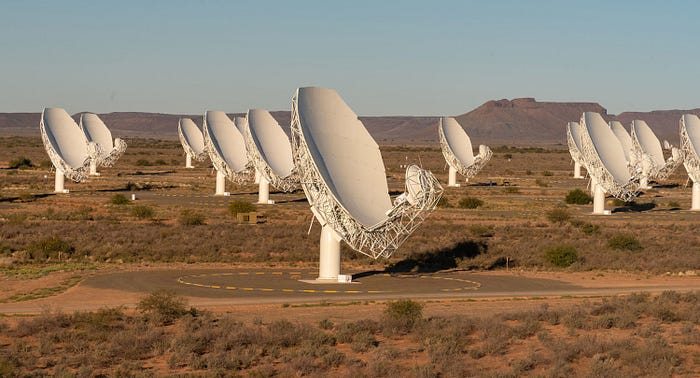
The MeerKAT radio telescope in South Africa. (Credit: NRF/SARAO)
The MeerKAT radio telescope in South Africa conducted on November 5, 2025 a search for narrowband radio transmission from the interstellar object 3I/ATLAS using the commensal backend BLUSE suitable for a real-time search for radio technological signatures. As reported here, a total of 23,689 signals were detected; however, all were determined to not be spatially consistent with the position of 3I/ATLAS and thus were likely caused by human-made radio frequency interference. From these observations, the observers established a detection limit of 0.17 Watts over the frequency range of 900 to 1670 megahertz, approximately equivalent to the power output of a mobile phone handset at the distance to 3I/ATLAS, which was 334 million kilometers at the time.
Today at 3PM ET, NASA will broadcast a press conference here in which new data from ground-based and space-based observations will be publicly released for the first time after the government shutdown. The data will include images of 3I/ATLAS when the object came within 29 million kilometers from Mars on October 3, 2025. At that time, the HiRISE camera onboard the Mars Reconnaissance Orbiter could have imaged 3I/ATLAS with a pixel resolution of 30 kilometers.
The brightest pixel in the HiRISE image would constrain the nucleus size and reveal the geometry of the glow around it. It is also interesting to check if there is any evidence for new objects that either accompanied 3I/ATLAS or left it towards Mars. They could imply fragments from an iceberg that broke up or mini-probes released by a technological mothership.
The fundamental question looming in the background remains: “Is 3I/ATLAS a rare comet of a type never seen before or a technological object?” So far, 3I/ATLAS did not display any unambiguous technological signatures, such as a major maneuver, artificial light or transmission of a radio signal.
Below is a recap of the anomalies of 3I/ATLAS that could flag a technological signature:
1. Its trajectory opposite to the direction of motion of the planets is aligned to within five degrees with the ecliptic plane of the planets around the Sun, with a likelihood of 0.2 per cent (see here). This suggests that the trajectory may have been designed for a reconnaissance purpose.
2. During July and August as well as in early November of 2025, it displayed a sunward jet (anti-tail) that is not an optical illusion from geometric perspective, unlike familiar comets (see here). This might be a technological signature.
3. Its nucleus is about a million times more massive than 1I/`Oumuamua, an interstellar object discovered in 2017, and a thousand times more massive than 2I/Borisov, discovered in 2019, while moving faster than both, altogether with a likelihood of less than 0.1 per cent (see here and here). This suggests that it may have targeted the inner solar system rather than being drawn from the reservoir of icy rocks.
4. Its arrival time was fine-tuned to bring it within tens of millions of kilometers from Mars, Venus and Jupiter and be unobservable from Earth at perihelion, with a likelihood of 0.005 per cent (see here).
5. Its gas plume contains much more nickel than iron (as found in industrially-produced nickel alloys) and a nickel to cyanide ratio that is orders of magnitude larger than that of all known comets, including 2I/Borisov, with a likelihood below 1 per cent (see here). This may be a signature of industrial production of its surface.
6. Its gas plume contains only 4 per cent water by mass, a primary constituent of familiar comets (see here).
7. It shows extreme negative polarization of light, unprecedented for all known comets, including 2I/Borisov, with a likelihood below 1 per cent (see here). This might be a technological signature.
8. It arrived from a direction coincident with the radio ‘Wow! Signal’ to within 9 degrees, with a likelihood of 0.6 per cent (see here). This might imply that the `Wow! Signal’ may have originated from it or its senders.
9. Near perihelion, it brightened faster than any known comet and was bluer than the Sun (see here). Perhaps this is a signature that its engine turned on.
10. It exhibits jets in the direction of the Sun and opposite to it, which require an unreasonably large surface area in order to absorb enough sunlight needed to sublimate enough ice to feed the mass flux of these jets (as calculated here). Perhaps the jets originate from technological thrusters.
11. Near perihelion it exhibits non-gravitational acceleration which requires massive evaporation, whereas preliminary images indicate that the object maintained its integrity and did not break up (as discussed here). Perhaps the acceleration was produced by an engine.
12. Its tightly-collimated jets maintain orientation across a million kilometers in multiple directions relative to the Sun despite its measured rotation (as discussed here). This might imply that they are used for navigation or associated with the release of mini-probes from a mothership.
If an interstellar object happens to be technological, it could pose a threat to humanity. A few months ago, I described the `Loeb Scale’ (as quantified here and here) — where a rank of `0' implies a natural comet and a rank of `10' corresponds to alien technology that threatens humanity. We do not have a response protocol for alien technology, but after the first encounter — as long as we survive it — there will be political will to invest trillions of dollars in a warning system of interceptors that take close-up photos of anomalous interstellar objects. 3I/ATLAS is expected to arrive closest to Earth at a distance of 269 million kilometers on December 19, 2025. Let us hope that it will not deliver us any unwanted gifts for the holidays.


No comments:
Post a Comment