Interesting. this is important because it may launch the industriall production of biochar. The cement industry has the kilns necessary to produce high volumes of biochar. The wood industry needs to be grooming woodlands to produce wood chips. These woodchip need to be air dried and then rechipped while stiill raw to bring to a useful size. these can be then put through a kiln to produce biochar.
all this can be integrated around even a cement kiln as a method to dump a lot of the heat..
All this produces right sized biochar particles. You do not want to be grinding biochar if you can.
obviously we can absorb unlimited biochar into the agricultural industry and should.
3D-printable concrete alternative hardens in three days, not four weeks
By Ben Coxworth
November 25, 2025
According to the scientists, the new material "surpasses 17 megapascals, the strength required of residential structural concrete, in just three days, compared to as long as 28 days for traditional cement-based concrete"
Although we've heard a lot about how 3D-printing concrete homes speeds up the construction process, you still have to wait up to 28 days for the concrete to sufficiently cure. A new printable substitute, however, is ready to go in just three days.
Concrete consists of three parts: water, an aggregate such as sand or gravel, and a cement which binds everything together. The cement is the part that typically takes about a month to cure after being poured. And a slow curing time isn't cement's only problem.
Traditional Portland-style cement is made by grinding up limestone and other raw materials, then heating the resulting powder to temperatures of up to 1,450 ºC (2,642 ºF). Unfortunately, the processes by which that heat is generated produce a lot of carbon dioxide.
What's more, as the heated limestone forms into cement via a process known as calcination, it releases trapped carbon dioxide as a byproduct. The combination of that CO2 and the CO2 produced in the heat-generating process is estimated to be responsible for 5% to 8% of all human-caused greenhouse gas emissions.
That's where the new 3D-printable material comes in.
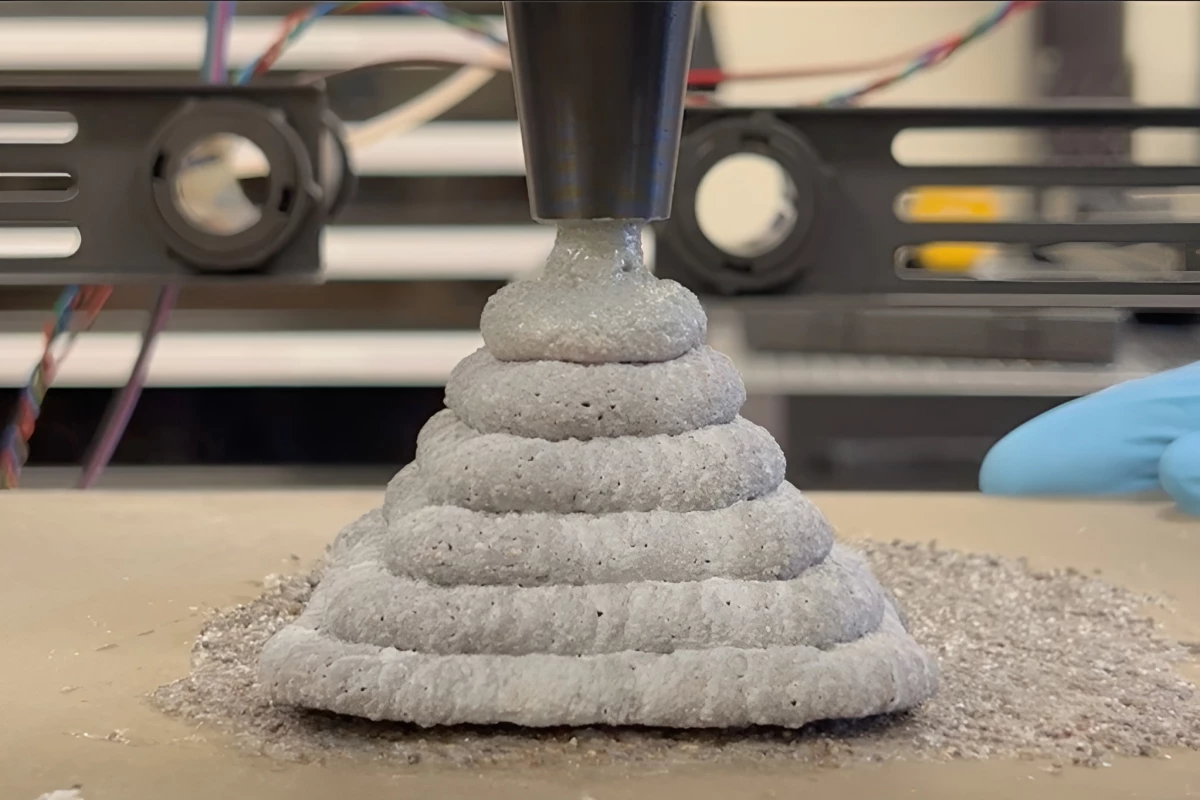
Created by Asst. Prof. Devin Roach, doctoral student Nicolas Gonsalves and colleagues at Oregon State University, it's composed mainly of clay soil infused with hemp fibers, sand and biochar. The latter is a charcoal-like material produced via a process called pyrolysis, in which heat is used to decompose wood chips and other organic material in the absence of oxygen.
Importantly, instead of Portland cement, the new material utilizes a thermally-triggered acrylamide-based binding agent. In a chemical reaction known as frontal polymerization, that agent initiates the curing process as soon as the mixture is extruded from the printing nozzle. This makes it strong enough to be printed over unsupported gaps, such as the tops of window openings.
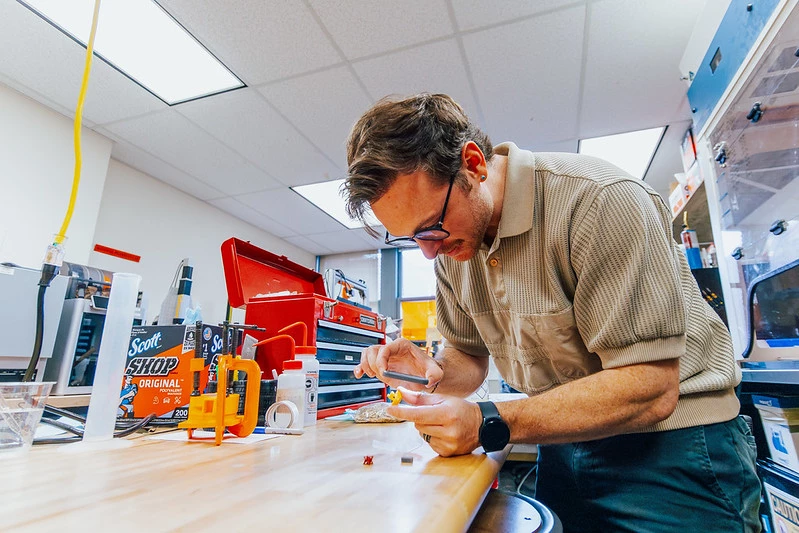
Asst. Prof. Devin Roach at work in his lab
"The printed material has a buildable strength of 3 megapascals immediately after printing, enabling the construction of multilayer walls and freestanding overhangs like roofs," says Roach. "It surpasses 17 megapascals, the strength required of residential structural concrete, in just three days, compared to as long as 28 days for traditional cement-based concrete."
And although it can be built upon in three days, it fully cures in eight to 10 days, reaching a strength of over 40 megapascals.
The scientists are now working on bringing the cost of the material down, as it's currently pricier than its conventional counterpart. A paper on the research was recently published in the journal Advanced Composites and Hybrid Materials.


No comments:
Post a Comment