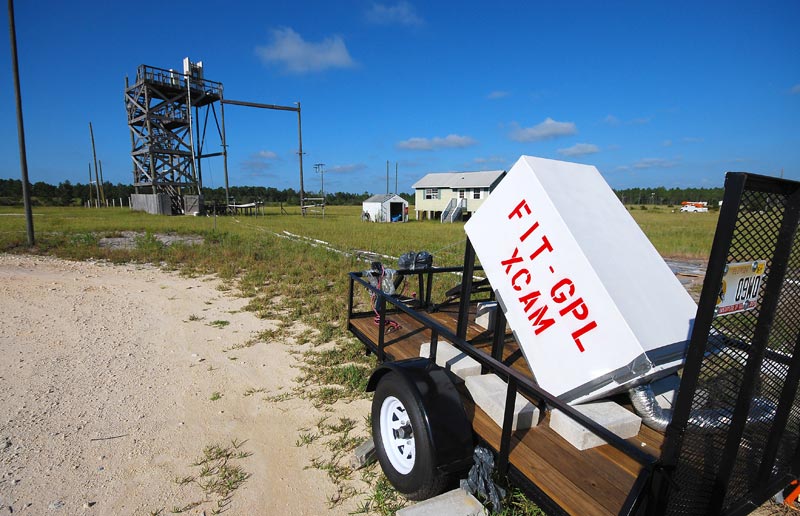
X-rays filmed at an amazing 10,000 frames per second. I think we want to use this at Focus Fusion
to capture the plasmoid forming up if it can be done. I suspect X-rays are blasted loose there.
The methodology will at least teach us something about the
fine structure of a lightning bolt.
Here we already discover that lightning is emitted at or
about the tip of a bolt and not from the trailing plasma path. This is not too surprising when one considers
how we produce them in a tube by blasting electrons into a plate.
X-ray vision tracks lighting bursts
Dec 16, 2010
Blink and you've missed it. Researchers in the US have
captured the world's first X-ray images of lightning, by creating a special
camera that can capture radiation at 10 million frames per second. They
presented their new findings at the American Geophysical Union (AGU) Fall
Meeting in San Francisco
and they say that this new view of lightning could help to solve some of the
mysteries of this spectacular natural phenomenon.
The research was carried out at the International Center
for Lightning Research and Testing, located in Florida . It is one of the few sites in world
where lightning is initiated and studied under controlled conditions. By firing
rockets with trailing wires into thunder clouds, scientists are able to
generate electric fields that are large enough to trigger bolts of lightning,
which then propagate back down towards the rocket launch tower.
Joseph Dwyer and colleagues at the Florida
Institute of Technology became interested in the fact that lightning emits
X-rays as it propagates through the air, a phenomenon that was only noted in
the past decade. But given that X-ray sources in lightning travel through the
Earth's atmosphere at velocities approaching the speed of light, it is
difficult to catch them on camera before they disappear. In addition, they
cannot be imaged with standard mirrors and lenses because huge amounts of
material are required to prevent X-rays and gamma rays from entering through
the sides of a camera.
Tried and true method
Dwyer's team has created a customized camera that
has 30 detectors made from a combination of sodium iodide and photomultiplier
tubes, each measuring 3 × 3 inch. The device, which is
approximately the size of a standard refrigerator, is also equipped with a
3 inch pinhole aperture, and can record X-rays at 10 million frames per second.
"This is actually a very old technique for making images, like that seen
in a camera obscura," Dwyer says.
We're seeing lightning as Superman would see
it with his X-ray vision Joseph Dwyer, Florida Institute of Technology
During July and August this year, Dwyer's team
studied four rocket-triggered lightning flashes at the Florida test site. Each flash lasted for
approximately two seconds and the resulting sequences of images revealed that
X-rays emerged primarily from the vicinity of the lightning tip as it
propagated towards the Earth. As the lightning crashed into the control tower
it also triggered large bursts of gamma radiation, which were also captured by
the camera.
"For the first time we're catching a glimpse
of lightning in the X-ray emission," says Dwyer. "We're seeing
lightning as Superman would see it with his X-ray vision".
Dwyer hopes that the images can help to explain
how bolts of lightning propagate through the air – a process that is still
poorly understood. "When lightning propagates it moves in a halting manner
called stepping. It will pause, then leap forward, pause, leap forward... We
don't know how or why it chooses to do this," he says. "It is
difficult to come up with models to explain this motion, since we don't know
what the basic picture is, but the images really help. They tell us where the
charges are, where the high fields are and where the air is breaking
down."
About
the author
James Dacey is
a reporter for physicsworld.com.
He reports from the American Geophysical Union Fall Meeting in San Francisco


0 comments:
Post a Comment