
The first sexual revolution was an unplanned consequence of the advent of the pill. We now know we need to do way better.. throw in cthe real existencial threat of global deplopulation and doing better is no longer opyional
that realy means dealing with not just the problem of babies and their proper support, but also the problem of sex itself.
Both can be solved if we decide to.
A second sexual revolution
Until Shere Hite’s Report, even the most daring sexologists refused to listen to what women desired and hated in sex
is a historian of global feminism. She holds a Leverhulme postdoctoral fellowship at King’s College London, UK. She is the author of The Book That Taught the World to Orgasm and then Disappeared (2026).
In 1972, Shere Hite, a Playboy model turned feminist sex researcher, jumped on a motorbike and drove around Manhattan. With a cascade of strawberry blonde curls peeping out under the helmet, rosebud lips visible under the visor, and a vintage lace gown streaming behind her, she handed out surveys to any woman who would take one. It was all about sex. Across 58 questions, Hite asked: ‘Could you describe what an orgasm feels like to you?’; ‘Do you feel free to do all the things you would like [in sex], or do you think the other person(s) would be shocked?’; ‘Do you think sex is in any way political?’ The responses formed the basis of the feminist sexology bestseller The Hite Report: A Nationwide Study of Female Sexuality (1976). It sold 50 million copies.
This was among the first books that asked women how they felt about sex, rather than telling them what to feel. Its great provocation was that most American women were sexually dissatisfied: 70 per cent of them could not orgasm from penetrative sex but required clitoral stimulation; a significant proportion of women faked orgasms. The Hite Report remains the 30th bestselling book of all time, and one of the most-read books of the 20th century. Yet today it and its author have largely vanished.
By the early 1970s, the number of young women in the US who reported having had premarital sex was around 62 per cent – up from 7.6 per cent of those born before 1900. The Pill was widely available – 10 million women were using it – decoupling sex from reproduction for the first time in history. And the introduction of no-fault divorce in California in 1969 (soon followed by other states) meant that women could more easily free themselves from loveless marriages. Into this confounding sexual revolution Shere published her Hite Report.
Hite found that the sexual revolution meant more sex for women, but not better sex. For many of the women she surveyed, sex still followed a similar and unsatisfactory pattern that one woman described as ‘a little kiss, a little feel, a finger for arousal, a touch of breast and he’s on top, wham it’s over.’ Invariably, male orgasm determined the end of sex. One woman, freed up by the sexual revolution to have many lovers, noted that ‘I’m beginning to think there must be something like a sexual “Robert’s Rules of Order” which every guy follows.’ Even Alex Comfort’s widely read book The Joy of Sex (1972) couldn’t get away from the sexual script that saw penis-in-vagina sex as the pièce de résistance. (A Black lesbian who filled out the Original Survey, on which The Hite Report was based, remarked that she ‘didn’t think much’ of Comfort’s contribution.) Women also felt that during the sexual revolution they had ‘lost their right to say “no”’. One woman told Hite: ‘Most men didn’t give a damn about whether I wanted to have sex with them or not; if I didn’t want to screw them, they would … try to lecture me into being “free”.’ Sexual inequality percolated through the revolution.
Hite’s path to feminism was unusual. While enrolled on a PhD at Columbia University in New York, she worked as a model, sometimes doing fashion jobs, sometimes porn (which paid better), and was hired by Olivetti typewriters to appear in an advertisement. But, as Hite later recalled, when the advertisement was published, she found her image appeared beneath a sexist caption: ‘The typewriter is so smart that she doesn’t have to be.’ That prompted the New York chapter of the National Organization for Women (NOW) to launch a protest. They marched through Manhattan with placards that proclaimed ‘Don’t Drown In The Olivetti Typing Pool’. Hite was overjoyed by the support. She contacted NOW and soon became involved in political campaigns and consciousness-raising groups (CR), the key tactic of women’s liberation.
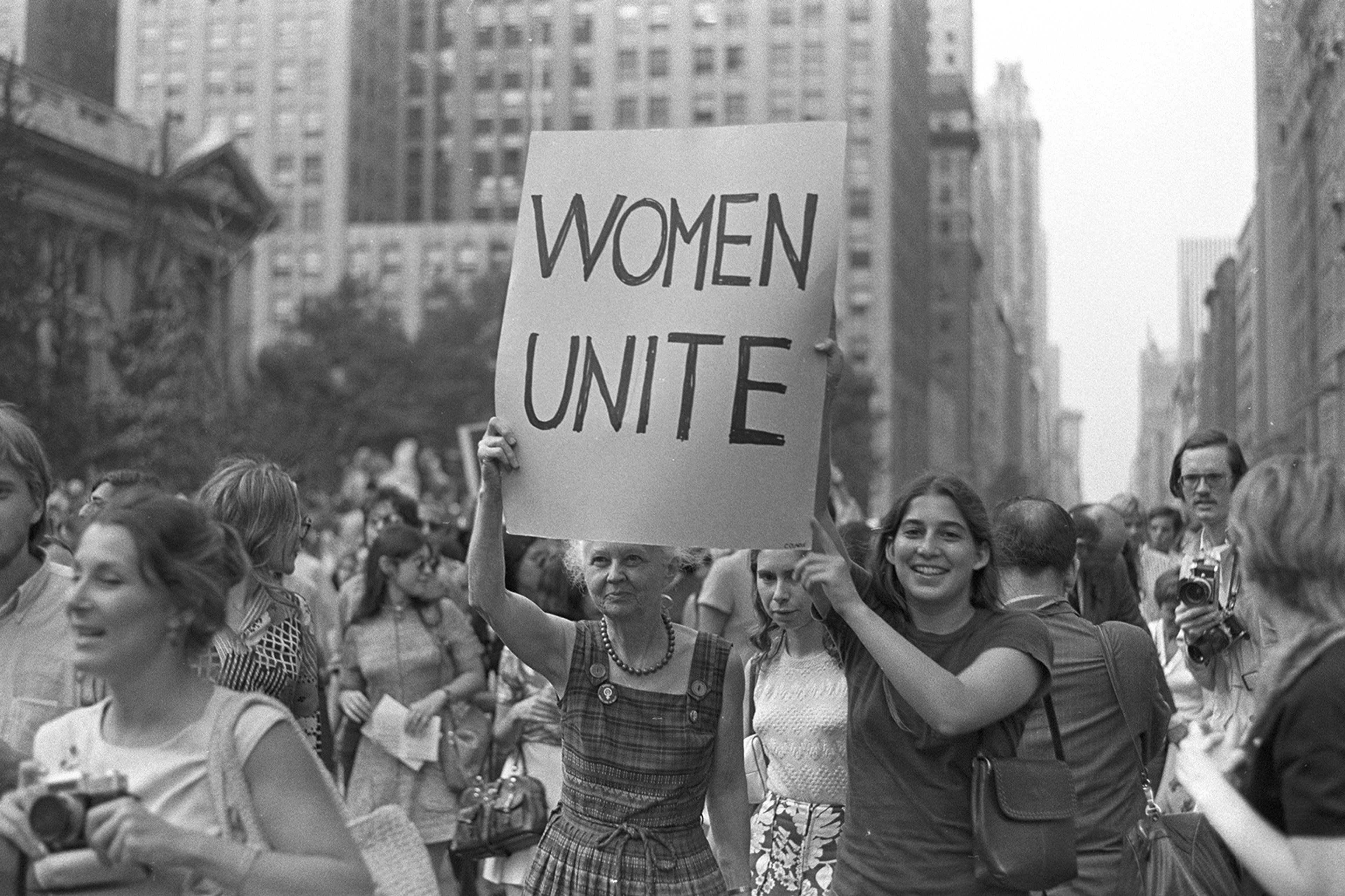
The Women’s Strike for Equality organised by the National Organization for Women in celebration of the 50th anniversary of the 19th amendment, New York City, 26 August 1970. Photo by Bob Parent/Getty Images
At CR, women met in small groups to talk about how a sexist society shaped them, often against their own interests. They would take turns answering questions like ‘How do you feel about housework?’ and ‘How do you feel about ageing?’ Women came to understand that their feelings – often bad – were political, the result of a deeply unequal world, not their individual failings. They often described this moment of consciousness raising as a ‘click’: there was a political cause to their personal misery. Feelings were a form of expertise. Women could follow them to paint a collective picture of what life was like as women, what needed to change, and how they might go about it. But Hite noticed something else at CR. Women talked of their feelings about every aspect of culture and society – except for sex. Even in these groups, sex was still considered a private matter – personal, even shameful.
A porn mag ran Hite’s questionnaire ‘in the interest of better communication [with] women’
There had been some feminist writing about sex. In The Myth of the Vaginal Orgasm (1970), Anne Koedt argued forcefully that all orgasms were clitoral. Erica Jong, in her novel Fear of Flying (1973), celebrated the pleasures of the ‘zipless fuck’ (a sexual encounter without commitment or emotion). Nancy Friday’s My Secret Garden (1973) detailed women’s most explicit fantasies. Both Friday’s and Jong’s works were blockbusters, and many women who filled out Hite’s Original Survey reported reading them. But how did these declarations, fictitious accounts and wild wishes match up to the truth of women’s sex lives? To find out, Hite proposed a weekend-long CR conference to discuss sex, frankly. Her comrades, however, were flabbergasted, even horrified; one woman protested: ‘You think I’m going to stand up and tell everyone about how I have orgasms!’ To overcome women’s shyness and shame about sex, Hite developed her anonymous questionnaire.
Hite’s questionnaire travelled well beyond the women’s movement. First, she handed it out in New York, and soon she was sending 100,000 copies through abortion rights groups and church newsletters. Brides and Mademoiselle magazines reproduced the questionnaire, and Oui, a porn mag, ran it ‘in the interest of better communication [with] women’, alongside a centrefold of ‘better girls than last month’. Men passed it to their wives and girlfriends, and women who came across the questionnaire showed it wide-eyed to their female friends, mothers passed it to sisters, and teachers to students.
Responses to the questionnaire uncovered something surprising. The major influence on many women’s sex lives was not feminism or the sexual revolution, but psychoanalysis. In Sigmund Freud’s Three Essays on the Theory of Sexuality (1905), he grafted ideas of mature/immature and healthy/dysfunctional forms of female sexuality onto the vagina and clitoris, respectively. According to Freud, girls find pleasure in their clitoris, just as young boys do in their penis, but as girls mature into women, the pleasure centre moves from the clitoris to the vagina as women ‘put aside their childish masculinity’. In the mature, heterosexual woman, Freud located the erotic and the reproductive in the same place: the vagina.
As Freud saw it, the clitoris would naturally ‘transmit excitation to the adjacent sexual parts’ the way a ‘pine shaving’ would help ‘set a log of harder wood on fire’. The ‘log’ he was referring to was the vagina – but this simile choice was a monstrous Freudian slip, exposing who the vaginal orgasm was for, whose pleasure it would increase, and the limits of Freud’s own gender politics. If grown women could not orgasm vaginally because the ‘vaginal orifice’ remained ‘anaesthet[ised]’, this was because of their sexual immaturity. Freud recommended this should be treated with psychoanalysis. In other words, not being able to orgasm vaginally was seen as a mental illness.
By the 1970s, the problem was with conservative neo-Freudians. Many women who could not orgasm vaginally had been sent to Freudian psychotherapy, which wholly embraced anti-feminism from the 1940s on. As the historian Jane Gerhard has shown in Desiring Revolution (2001), psychoanalysts held that heterosexual, reproductive sex was the only model of ‘mature’ femininity. In therapy, women were told that their lack of vaginal orgasm was a result of neurotic blocks and deficiencies in the psyche, and they believed it. One woman told Hite: ‘I can have an orgasm with clitoral stimulation but I have never had one with intercourse. This is purely a fear thing … My therapist helped me see it.’ Another spoke of how she came to see clitoral orgasm as ‘selfish or infantile (thanks to Freud, I guess).’
Conservative neo-Freudians insisted to women that their inability to orgasm vaginally was a physical symptom of their psychic refusal to adjust to their role as women. This was the price they paid for rejecting their passive, maternal place in the bedroom and the family. The idea extended far beyond the therapist’s office. Even if women were not in therapy, Hite, like Betty Friedan before her, suggested that the ‘influence of these psychiatric theories on women has been strong and pervasive … these unfounded and anti-women theories [are] endlessly repeated’ in women’s magazines, in movies, in marriage manuals. In the survey, women used therapeutic language again and again to scold themselves: ‘I must let go, relax and trust, unlearn my taboos and defences.’
This is why major feminist thinkers like Hite, Friedan, Shulamith Firestone and Kate Millett wrote against psychoanalysis. As they saw it, therapy helped women to accept the unacceptable and adjust to the conditions around them, rather than changing those conditions. ‘I wish we could have back all the time and energy we have spent blaming ourselves,’ Hite wrote. ‘And all the money we have spent “flocking to the psychiatrists” … I would like to have what we would have built with that energy.’
By looking at sex through the lens of feminism, Hite found that it was shot through with power and inequality
In her questionnaire, she also asked about recent sexology: ‘Have you read Masters and Johnson’s recent scientific studies on human sexual response …? What did you think of them? Of Kinsey? Any other writers?’ She wondered if this newer work would help women flip the sexual script. Working across the 1940s and ’50s, the biologist Alfred Kinsey was interested in how people really did it, beyond what social norms prescribed. Through in-depth interviews with 18,000 people, he sought to learn how people had sex, with whom, and how often. He fearlessly asked: did people have sex outside marriage? With people of the same sex? In public? With animals? He published his Kinsey Reports in 1948 (on men) and 1953 (on women), after which The Hite Report was named. As Hite explained on The Mike Douglas Show in 1982: ‘Kinsey did a service in putting on the map how often people did what with whom. But my area was a little different, I asked people Why do you do it?, How do you feel about it? And Would you like to be different? Would you like things to be different? So I’m really trying to draw a larger picture of the society and how people are feeling within that society.’
The gynaecologist William Masters and the sexologist Virginia Johnson were interested in people’s physical responses to sex. They conducted direct laboratory observation of nearly 10,000 sex acts from the late 1950s to 1965. They invited volunteers – initially sex workers – and hooked them up to wires, which enabled them to measure heart rate during sex and contractions during orgasm. They observed women having sex with a glass dildo improbably called Ulysses. A light and camera within Ulysses allowed them to see inside the vagina during sex, and observe the moment of orgasm. This led to the conclusion, important for The Hite Report, that all women’s orgasms were clitoral orgasms, and that women who were orgasming from intercourse were doing so because the clitoris was indirectly stimulated by the penis. Masters and Johnson’s findings gave them the opportunity to depose penetration as the highest form of sex – and elevate masturbation, clitoral stimulation and lesbian sex as possibilities. Alas, they did not. Instead, they merely suggested that most women could orgasm from the indirect stimulation of the clitoris during penetration, that this was automatic, part of the ‘normal’ course of sex.
Hite concluded that Masters and Johnson never suggested direct clitoral stimulation for women because ‘they continued to view sex through certain cultural blinders’. She was being diplomatic here; these two researchers were deeply committed to monogamous, heterosexual marriage as the highest form of relationship. From 1968, they ran a treatment programme for ‘dissatisfied homosexual men’, helping them to ‘convert’ to heterosexuality, which continued long after homosexuality was removed from the Diagnostic and Statistical Manual of Mental Disorders as a psychological disorder in 1973. Masters and Johnson’s ideas about women also reflected the pair’s sexual values. If orgasm for women was par for the course, this meant that there was no need for men to have sex differently; they could maintain the predictable sex that served them so well and many women not at all.
For Hite, it wasn’t because of lack of knowledge that women didn’t speak up about what they wanted in sex – it was lack of power. Her great innovation lay in bringing feminism to sex. By looking at sex through the lens of feminism, Hite found that it was shot through with power and inequality. Society insisted that women, like men, should find their greatest pleasure in penetrative sex: the woman penetrated, the man penetrating. In an interview in 1977, Hite declared that ‘sex is sexist … women’s sex lives clearly reflect their second-class position in the society. Women, still, in 1976, make only 60 per cent of the amount of money men make for the same work: men have the right to more rewards (money, services, respect) than women. Just so in sex.’
Like many white women involved in the women’s liberation movement, Hite understood gender as the primary oppression in women’s lives, from which all other oppression, such as class and race, flowed. Black feminists argued that when the women’s movement referred to women it meant white women, but this whiteness was almost never mentioned – it was made invisible in the universal idea of ‘woman’.
Race went unanalysed in Hite’s study. But Black women did read and respond. They filled out her questionnaire and wrote letters after they read the book, and often they pushed her project further. One Black woman, who recorded her responses on tape, remarked: ‘When I was growing up, Black women had no beauty.’ A young Black law student wrote that she couldn’t ‘screw across barriers’, that white men didn’t desire her. A Chinese American woman noted that her racial identity made a difference to her sex life. She noted sardonically that ‘Chinese is “in” this year.’ These responses demonstrated how race and racism are, like gender injustice, woven into sexual encounters, and offer insight into how women of colour negotiated this discrimination.
What has become of the sexual revolution – and what does Hite’s work still have to offer? Today, women’s pleasure is taken more seriously – thanks, in part, to feminists like Hite. The majority of women whom Hite surveyed regularly masturbated to orgasm, but felt ‘lonely, guilty, unwanted, selfish, silly and generally bad’ as a result. That shame is not nearly as widespread as it used to be: one study of American women in 2014 found that a majority felt ‘sexually empowered’ after masturbating. In the UK, the Labour MP Samantha Niblett launched ‘Yes Sex Please, We’re British!’, a play on the title of a comedy film from 1973; she plans to host a sex-toy exhibition in the Palace of Westminster as part of her campaign to promote sex education and destigmatise women’s pleasure.
Laws around rape and consent have changed too, owing to feminist pressure. As legal scholars and historians such as Alecia Simmonds, Izabella Scott and Joanna Bourke write, rape is no longer a crime of force as it was in previous centuries – defined as damage to a man’s property, that is, his wife or virgin daughter. Rape has been redefined in terms of sexual consent. Courts in rape trials now ascertain how consent was given or not: what did the victim say, what did the perpetrator ask? And consent has permeated sexual politics far beyond the courts. It’s not just the litmus test for whether sex was rape, but the mode by which pleasurable sex can be achieved. We are, as the scholar Katherine Angel writes in Tomorrow Sex Will Be Good Again (2021), living in an age where ‘the ideal … of consent reigns supreme.’
Since the 2000s, women have been urged to find out what they want and go for it assertively. The rise of consent politics dovetailed with the age of ‘girl boss’ feminism, which urged women to ‘lean in’ in both their personal and professional lives. Hite helped usher in this change. In her book she urged women: ‘You have to care about yourself and want to please yourself, and you have to feel it is your right. You have to do it, whatever it is – or ask for it, very clearly and very specifically.’
Hite was highly combative, quick to quit interviews if she sensed misogyny (which was often)
And yet, for Hite, knowing yourself and speaking up was only the beginning. It was not a bad start, but she knew that structural inequality couldn’t really be solved by a straight couple in bed, no matter how honest their communication. She knew that inequality pervades our choices and feelings long before we’ve set foot in the bedroom, before we’ve uttered a yes or a no.
The focus today on consent has not challenged gender inequality beyond the bedroom. The gender pay gap, attacks on abortion rights, endemic sexual violence, and the orgasm gap – which names the disparity between men and women’s orgasms in straight sex – roll on relentlessly, shaping our desires long before the sexual encounter. Nor has our age of consent held back the tide of the alt-Right. Manosphere influencers preach that women’s sexual assertiveness is evidence that feminism has gone too far and that the world is now stacked against men. Tradwives, too, argue that women having multiple sexual partners (which they refer to as a ‘body count’) before marriage makes them unhappy, resorting to tired old claims that women are not ‘built’ for casual sex – only monogamy, childbearing and wifely submission.
Hite published two more books: The Hite Report on Male Sexuality (1981) and Women and Love (1987). The responses to these were very different from her first. The later books were methodologically flawed, and the statistics she uncovered were startling to the point of being unconvincing: ‘84 per cent of women are not satisfied emotionally with their relationships,’ she claimed, and 70 per cent of women and men in long-term marriages had affairs. These statistics were not corroborated; other research reported an infidelity rate of 15-20 per cent for women. Furthermore, Hite was highly combative, quick to quit interviews if she sensed misogyny (which was often). She herself became the story – not the inarguable data of a robust survey. When in 1987 an interviewer for the TV show 60 Minutes Australia opened with: ‘You’ve been accused of man bashing –’ Hite interrupted him to say: ‘Yeah, and it’s gonna happen right here!’ before storming out. The media had their narrative, and it wasn’t her serious work.
During the anti-feminist backlash of the late-1980s and ’90s, Hite disappeared in a storm of media attacks, wrought by a rising New Right. Many conservatives felt that the upheavals of the 1960s – feminism and civil rights – had shattered their worlds. The New Right, which included Evangelical leaders such as Tim LaHaye and Jerry Falwell, and Right-wing women such as Phyllis Schlafly, Anita Bryant and Beverly LaHaye, gave vent to this gathering discontent. They argued that feminism was ‘unnatural’ and that biological differences between men and women excused inequality. They braided this with a politics of grievance, suggesting that the progressive politics of the 1960s and ’70s had captured the interests of government and left ‘ordinary’ Americans behind.
Soon, the media closed ranks. From the London Review of Books and The Washington Post to the New York Post and Penthouse, all went after her. Time magazine wrote that Women and Love was ‘the author’s own male-bashing diatribe’, and that the entire book was ‘full of extreme views’ of malcontented women. New York magazine claimed that she ‘totally neglects biology’, and that men were naturally promiscuous. If the success of the first Hite Report narrates the rise of feminism, then the later trashing of Hite tells the story of its conservative backlash. Hite fled the US in the mid-1990s, and spent her last years living peripatetically across Europe. She died in Tottenham, north London, in 2020.
In the first Hite Report she quoted several women on how the women’s movement changed their sex lives. One wrote: ‘With the onset of the women’s movement, and its personal effect on me, I’ve stopped faking them.’ Another: ‘I don’t think I ever asked for what I wanted … Now the women’s movement has helped me to be outspoken. I ask for what I want in all sorts of situations – church, work, the supermarket, local government – and in bed.’ It was women’s liberation that would make ‘a new kind of physical relations to go with a new, more humane and pro-women society’. In the long term, a gender-just world would remake the conditions that shaped desires and change the way that sexual choices are moulded. But Hite believed that feminist struggle would change women in the present, too. As women came to see themselves and others not as objects but as subjects, they would begin, at last, to be free. Throughout her life, Hite was uncompromising: to change sex for the better, women must be feminists.


No comments:
Post a Comment