understand that India is geographically the size of Western Europe. Its population is 1.4 billion which is likely twice the true size of China. and ten times anyone else locally. It has every reason to engage with everyone and make that foreign policy.
It is also wonderfully defended by geography against all forms of military adventurism as recent Chinese nonsense proved.
So this is a pragmatic approach.
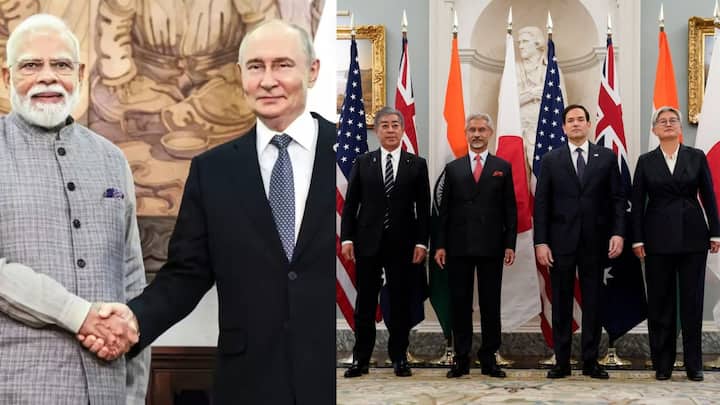
Brics to Quad: How India keeps both sides of the world open
India is deepening ties with Brics for energy, trade and Global South cooperation while relying on the US and its Indo-Pacific partners for technology, defence and maritime security. The strategy allows New Delhi to pursue its interests without becoming dependent on any one bloc
A member of both Brics and the Quad, New Delhi balances ties with major powers while pursuing its strategic interests across economic, security and diplomatic fronts. (Reuters)
Sneha Swaminathan|Sep 11, 2026, 11:55:49 IST
https://www.firstpost.com/india/brics-to-quad-how-india-keeps-both-sides-of-the-world-open-14044901.html#goog_rewarded
India's foreign policy is built around a simple idea. It does not have to choose one side of the global divide.
Instead of treating the Western alliance and non-Western groupings as opposing camps, India uses different international platforms for different strategic goals. Brics and the Shanghai Cooperation Organisation (SCO), for instance, provide avenues for India to strengthen energy ties, expand trade, push for changes to the global financial system and deepen its engagement with the Global South.
At the same time, India's partnerships with the US and other Western countries are important for advanced technology, defence cooperation, semiconductor supply chains and security in the Indo-Pacific.
This approach is often described as multi-alignment. The objective is to keep India's strategic options open while ensuring that no single power becomes indispensable to its economic or security interests.
Russia, energy and India's balancing act
The clearest example of this approach is India's relationship with Russia.
After Russia invaded Ukraine, India sharply increased its purchases of Russian crude. Russian oil, which accounted for less than 1 per cent of India's oil imports before the war, rose to more than 40 per cent of the country's oil basket.
New Delhi faced criticism and pressure from Washington over its continued purchases of Russian energy, particularly as the US and its allies imposed sanctions on Moscow. India, however, defended its position by arguing that buying Russian crude was necessary for its domestic economy and helped prevent a sharper rise in global oil prices.
At the same time, India did not allow its relationship with Russia to stop it from deepening ties with the US. It expanded defence and technology cooperation under the Initiative on Critical and Emerging Technology, or iCET, and continued maritime exercises with the US, Japan and Australia through the Quad.
In other words, India maintained its energy relationship with Moscow while building stronger security and technology partnerships with Washington and its allies.
Brics, the dollar and local currencies
Finance is another area where India's multi-alignment is visible.
Countries such as Russia, China and Iran have pushed within Brics for reducing dependence on the US dollar. There have also been proposals for a common Brics currency.
India, however, has been more cautious.
Rather than backing an explicitly anti-dollar currency bloc, New Delhi has promoted trade settlements in local currencies. This could include arrangements such as rupee-dirham or rupee-rouble trade, allowing businesses to reduce transaction costs and their exposure to currency fluctuations.
At the same time, India has not sought to cut itself off from the existing global financial system. Its financial institutions remain connected to Western capital markets and international payment networks such as SWIFT.
India has also sought to expand the international use of its own digital infrastructure, including the Unified Payments Interface, or UPI.
The approach therefore is not about replacing one financial system with another overnight. It is about creating more options while remaining connected to the dollar-based global economy.
Managing China while working with Beijing
China presents an even more complicated challenge.
Beijing remains India's biggest strategic competitor along its northern border, particularly after the 2020 Galwan clash. At the same time, China is a major trading partner and dominates India's trade with Brics countries.
India imported commodities worth $321.8 billion from Brics countries, with China accounting for the largest share.
Despite their differences, India continues to participate actively in Brics alongside China. New Delhi's presence allows it to shape the group's agenda and prevent Brics from becoming entirely centred on an anti-Western narrative.
But India is also building partnerships that can help counter China's growing influence, particularly in the Indian Ocean.
Through the Quad, India works with the US, Japan and Australia on maritime security, information sharing, supply chain resilience and other areas aimed at maintaining a free and open Indo-Pacific.
This creates a careful balance: India can cooperate with China within Brics while simultaneously working with countries such as the US, Japan and Australia to protect its own strategic interests.
Two tracks, one foreign policy
India's economic and strategic relationships operate on two broad tracks, with each set of partnerships serving a different purpose. Through Brics and other non-Western groupings, India focuses on energy security, access to raw materials, trade with emerging economies and a greater role for the Global South in global institutions. Intra-Brics trade stood at $417.5 billion in FY26, driven in part by energy imports and trade with the UAE.
Advertisement
Energy remains a major priority. India's ties with Russia provide access to discounted crude, while Brics also offers opportunities to strengthen trade in fertilisers and other raw materials. At the institutional level, India uses the grouping to push for reforms in organisations such as the UN, IMF and World Bank and to seek a greater voice for developing economies.
India's partnerships with the US, Europe and Indo-Pacific countries serve a different set of interests. Trade with the US and EU is worth more than $200 billion, with IT, technology and services forming an important part of these economic ties. India is also seeking greater cooperation in advanced manufacturing, semiconductor investments and emerging technologies.
On the security front, Western and Indo-Pacific partnerships give India access to defence technology and closer cooperation on maritime security. Through the Quad, India works with the US, Japan and Australia on areas such as maritime awareness, supply chain resilience and joint exercises.
The financial strategy follows the same pattern. Within Brics, India supports greater use of local currencies for trade and efforts to reform global financial institutions. At the same time, it remains connected to Western capital markets and the existing international financial system.
Why multi-alignment matters
For India, the strategy is ultimately about retaining room to manoeuvre.
The country needs Russian energy and defence relationships, access to Western technology and capital, stable trade with China, and stronger partnerships across the Global South. Choosing one camp at the expense of the others could limit India's economic and strategic options.
That is why New Delhi has resisted the idea that Brics must become an anti-Western grouping. At the same time, it has avoided becoming fully dependent on Western alliances.
External Affairs Minister S Jaishankar has summed up the approach with the phrase 'non-West, but not anti-West'.
India's multi-alignment is therefore less about balancing two fixed camps and more about using each partnership where it serves the country's interests. The aim is to secure energy, technology, trade and national security while preserving strategic autonomy.
No comments:
Post a Comment