Rcall that our entire knowldege regarding comets is a body of conjecture. We at least do see meteorites and the like hitting the ground. Otherwise for comets we had one break up and slam into jupiter. We also suspect one impacted the Ice Cap in 12900 BP. otherwise we have observed a wide range of halos.
they all seem to have the material integrity of a large snowball.
my recent post suggested that they may be real objects transiting between stars. Iit is obvious that while transit speed can be a real fraction of light speed ,actual passage through the solar envelope needs to operate at a far lower speed. Is it possible that nothing actually originates from the Kuiper belt/ A near passage by the solar system would need a huge orbital chasnge from the belt and we have little evidence of that and these are not rare occurences on the scale suggested.
does an object transiting inter stellar space at say .4c pick up a powerful charge able to attract free materai enroute? Can changing velocity down draw in local material as it passes by. neither can be discounted and both explains the observed behavior.
Is the Recent Surge in Meteor Fireballs on Earth Related to 3I/ATLAS?
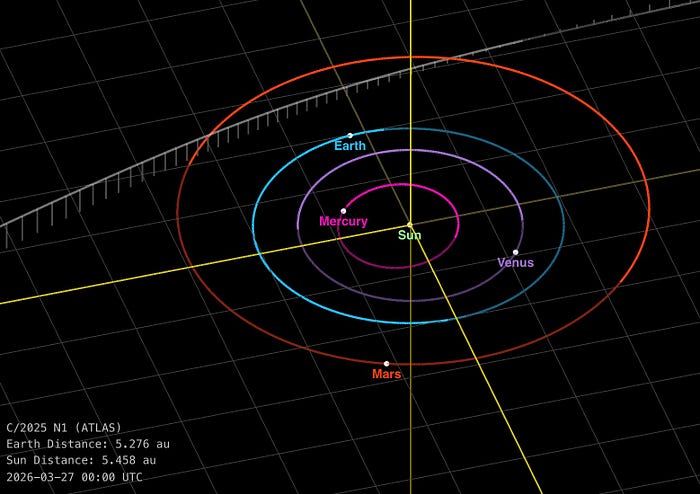
Recently, Earth arrived closest to the path of 3I/ATLAS through the Solar System. This 3D visualization shows the anti-clockwise orbit of Earth (and other planets) around the Sun, with positions marked for March 27, 2026. The past trajectory of 3I/ATLAS is shown in gray, including its elevation from the Earth’s ecliptic plane. (image credit: NASA/JPL)
In the second half of March 2026, Earth arrived within its closest distance of 54.6 million kilometers from the path of the interstellar object 3I/ATLAS through the Solar System. By now, 3I/ATLAS is heading out of the Solar System at a distance of 5.3 times the Sun’s distance from Earth.
Back on August 8–12, 2025, data the SPHEREx space observatory revealed a carbon-dioxide gas plume extending out to a distance of at least 348,000 kilometers from the nucleus of 3I/ATLAS (as reported in the caption of Figure 2 here).
In case this gas cloud around 3I/ATLAS was accompanied by solid fragments of debris from 3I/ATLAS, some of these fragments could have collided in recent months with Earth. Let us work some numbers that could educate us whether such collisions are possible.
The ejection speed required for a fragment to cross a distance of 54.6 million kilometers in the seven months that elapsed since August 2025 is 3 kilometers per second. This is just 5% of the speed of 3I/ATLAS through the Solar System, which is about 60 kilometers per second. But if these fragments departed from 3I/ATLAS ten years ago, when the interstellar object was located at a distance of 126 times the Earth-Sun separation, the required ejection speed would have been only 170 meters per second, comparable to the thermal speed of the gas molecules surrounding it. This implies that if 3I/ATLAS shed solid fragments from its surface a long time ago, some of these fragments could have potentially impacted Earth in recent months.
In a recent paper that I co-authored with Valentin Thos and Andi Burkert (accessible here), the mass of 3I/ATLAS was estimated, based on its non-gravitational acceleration, to be of order a billion metric tons. Assuming that a tenth of this mass was broken into fragment of centimeter-radius, a total of ten trillion fragments — each carrying a mass of 10 grams, were shed by 3I/ATLAS. The maximum fraction of these fragments that could intercept the Earth equals to the ratio of the cross-sectional area of the Earth divided by the surface area of a sphere with a radius of 54.6 million kilometers. This gives a total maximum of 34,000 fragments that would burn up as a result of their passage through the Earth’s atmosphere and appear as meteor fireballs in the sky.
The expected surge in the number of meteor fireballs scales in proportion to the fraction of the mass of 3I/ATLAS carried by the fragments (assumed to be 10% in the above estimate) and inversely with the fragment mass (assumed to be 10 grams above) or the square of the distance that the fragments traveled before hitting Earth (assumed to be 54.6 million kilometers above). Adopting more pessimistic values of a mass fraction of 1% and a distance similar to the Earth-Sun separation (150 million kilometers) still yields 30 extra fireballs triggered by meteoroids, each measuring 5 centimeter (2-inches) in diameter.
But even in the most optimistic scenario, where half the mass of 3I/ATLAS was lost to fragments, no excess meteoroids larger than a meter in diameter or a ton in mass, are expected. There is not enough mass available in 3I/ATLAS to create a sufficient number fragments so massive that one of them will intercept the Earth.
On March 21, 2026 at 4:40PM CT, a 1-ton meteoroid broke apart above the Houston metro area, producing loud boom and a 26-ton TNT equivalent airburst (as reported here). On March 17, 2026 at 8:57 AM ET, a 7-ton meteoroid exploded over Lake Erie, producing a boom and a 250-tons TNT equivalent airburst across Ohio and into Pennsylvania (as reported here). These recent fireballs are too energetic to be associated with 3I/ATLAS.
Press enter or click to view image in full size
 (Image credit: Mike Hankey/Claude)
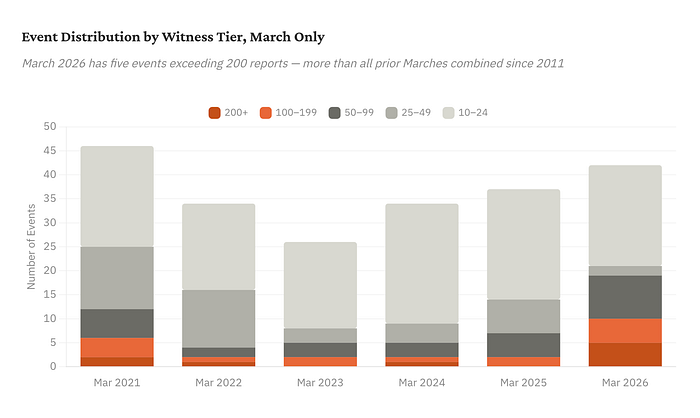
Nevertheless, there appears to be a surge in the number of smaller meteor fireballs during the first quarter of 2026. A report this week by the American Meteor Society (posted here) documented an increase by a factor of a few in the number of bright events witnessed by more than 200 people. Almost half of all March 2026 events were each seen by more than 50 people. The March 2026 average witness count per event was 142.7 — nearly three times the next-highest March on record (49.4 in 2021).
A systematic study of the directional and velocity information for the 2026 meteoroids of different sizes could assess which any subset of them might have properties consistent with past ejections of fragments by 3I/ATLAS towards Earth. If the timing, arrival direction and speed of any them are consistent with an ejection from 3I/ATLAS, then finding related meteorites on the ground would be revealing about the nature and origin of 3I/ATLAS.
***
Yesterday, NASA announced here that there is no reason to get excited because the recent surge in meteor fireballs is simply associated with the fireball season.
On a separate note, a NASA representative argued that a cone-shaped object on Mars is a rock that was naturally formed from Martian winds. When asked by a New York Post reporter about this assessment, I replied: “The conical object was observed by different cameras on the Curiosity rover and viewed from different angles, as discussed in my essay, posted at:
The Curiosity image clearly shows that no rock resembles this object within its natural environment. In addition, a rock is not expected to have a smooth cylindrical surface with a flat end. If this object is a rock, we should see other examples of it. I challenge the NASA representative to show us another example of a rock that resembles this object in any of the Curiosity rover images.
It is ironic that NASA named its rover Curiosity whereas NASA representatives lack any sense of curiosity about this anomalous object. By sweeping anomalies under the carpet of traditional thinking, we miss opportunities for discovering something new.”
No comments:
Post a Comment