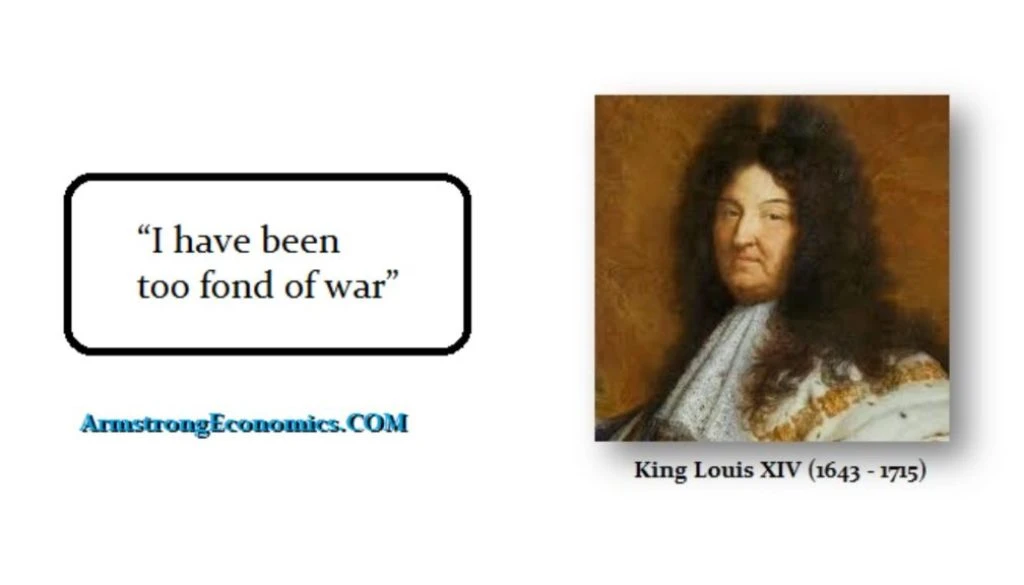
All thinking on war ignores its fundamental economic reality of its central function.. It destroys all forms of wealth not least the future earning power of the dead. Its execution however forces targeted fiat money creation which inflates demand for war making tools.
Yet good policy can generate post war application of coin and talent. This can be done without a war.
The primary failure of policy has been a failure to identify where money needs to flow. most folks are simly not smart enough. The USA spends 80 percent of its fiat money on sustaining mlitary investment and this is against better investments like roads et al even At least the romans had the good sense to use their soldiers to build roads.
Today we are learning that a real trade war destroys wealth. Thus Canada is shifting critical commodities offshore including energy and far worse Aluminium to preserve cash flow. this will force massive industrial shutdowns in the USA and if potash is withheld , a major agriculture slowdown. .
War Bankrupts Empires, Nations & City-States – Here We Go Again
July 31, 2025
https://www.activistpost.com/war-bankrupts-empires-nations-city-states-here-we-go-again/
France was on the brink of its Fifth bankruptcy in 1720. France defaulted in 1558 under Henry II, following the costly Habsburg-Valois Wars (also known as the Italian Wars), the outright repudiation of debt, and currency devaluation. Then in 1648, a Debt Crisis occurred under Louis XIV (Early Reign) with the Thirty Years’ War (1618–1648) and the Franco-Spanish War (1635–1659). Louis XIV suspended payments and manipulated currency. Then, in 1661, there was another financial collapse under Louis XIV, when Finance Minister Nicolas Fouquet was arrested for corruption. Jean-Baptiste Colbert later reformed finances, but debt remained high.
Then, in 1715, France fell into bankruptcy following the death of Louis XIV. The War of the Spanish Succession (1701–1714) left France deeply indebted. The regency of Philippe d’Orléans implemented the Visa of 1715, a partial debt repudiation. This brings us to 1720 and the collapse of the Mississippi Bubble (John Law’s system), for which history blamed him without examining France’s chronic debt problems. John Law’s speculative financial scheme collapsed, resulting in hyperinflation of paper money and a banking crisis. The French government defaulted on its obligations.
This was followed by the 1770 Bankruptcy under Louis XV. The Seven Years’ War (1756–1763) and financial mismanagement led to another debt crisis. The Finance Minister Étienne de Silhouette and later René de Maupeou imposed austerity and partial defaults.
Then, just 19 years later, this brings us to the debt crisis that sparked the 1789 French Revolution. The Pre-Revolution Financial Crisis was when France was effectively bankrupt under Louis XVI, leading to the Estates-General and the French Revolution (1789). The revolutionary government later repudiated royal debt.
Then, 23 years later, we come to the 1812–1813 Financial Crisis under Napoleon. The Napoleonic Wars drained French finances. The government resorted to forced loans and currency debasement. Just 5 years later, we come to the 1818 Post-Napoleonic Debt Restructuring. After Waterloo (1815), France struggled with reparations and debt. The Duc de Richelieu negotiated loans to stabilize finances. It is a wonder why anyone lends to governments that always want war.
We arrive at the next Revolution in 1848 and the 1848 Financial Crisis during the Second Republic. The February Revolution led to a credit crunch. The government imposed emergency financial measures, as it was unable to meet its debts, given that this was a socialist revolution against the wealthy.
Never learning from the past, which they always seem to assume is gone, we again arrive at the 1871 Post-Franco-Prussian War Bankruptcy Threat. Here, France had to pay 5 billion francs in reparations to Germany after losing the war. The government took massive loans (e.g., Morgan Loans) to avoid default. This was also why France demanded reparations from Germany after World War I, which resulted in bringing Hitler to power in 1933.
Then there was the Great Depression. Here, France was forced to restructure again in 1936, with the Franc Devaluation and Debt Restructuring. The Great Depression weakened France’s economy. The Popular Front government devalued the franc and restructured debt.
Then there was the 2010 EU Debt Crisis, which most people look at in relation to Greece and stop there. The 2010s European Debt Crisis (Near-Default Risk) contagion affected France, which faced high deficits but avoided sovereign default. Debt-to-GDP rose sharply, but the country barely maintained its creditworthiness and is once again incurring deficits, all to wage war on Russia.
Here we go again. We will see massive sovereign defaults in Europe as they wage war on Russia at the behest of NATO and the Neocons.
No comments:
Post a Comment