Saturday, November 29, 2025

Reality Caught Up to ‘Climate Change


The climate matra was always a fraud pushed by deliberate propagasnda pursuing a NWO.  And it was pitched top down from its epicenter at the UN, an agency with dreams of ruling the world.  I have been watching this arise after the Soviet adventure came to an end.

I am more astonished that they dragged this gig out for thirty years.  now we must reeducate folks.

For the record, the most efficient fuel is natural gas because it burns mostly hydrtogen.  It has always been very hard to surpass the economics of a gasoline car.  The BIG improvement will be Grid power however produced converted into mobile storage or batteries.  We have pretty well gotten there.  Grid power can be produced by Nuclear heat engines,  Geothermal heat engines and also Atmospheric pressure motors.  Or of course we can handily burn any fuel.  It is just that we prefer not to.

Solar and wind will also work now provided they are linked to battetry farms to mazimise utilization

The sharp leap in power demand will drive a rapid expansion of nuclear now.


Reality Caught Up to ‘Climate Change’

Victor Davis Hanson

https://www.activistpost.com/reality-caught-up-to-climate-change/

The climate creed that once ruled unquestioned is cracking as energy needs, geopolitical reality, and basic science force the West to admit carbon isn’t dying anytime soon.

For decades, the monolithic and sacrosanct international climate change hierarchy went unquestioned.

Western nations in particular spent trillions of dollars over the past half-century to subsidize expensive but erratic wind and solar energy while demonizing carbon fuels as toxic threats to the planet.


Like Diversity, Equity, and Inclusion dogma, climate change orthodoxy was embedded into every aspect of Western culture, from the corporate boardroom to the university campus.

Question whether man-made global warming was truly responsible for increased temperatures rather than natural, often centuries-long cycles of heating and cooling of the planet, and one was labeled a climate crank.

Everything from declining fertility to forest fires was ridiculously attributed to climate change.

But the causes of both demographic crises and charred landscapes were more likely the result of new affluent lifestyles that saw child-rearing as too expensive and time-consuming, and misguided forest policies or underfunded firefighting.

Yet reality has caught up with the near-religious climate change cult.

One, the left-wing tech billionaires—exemplified by former climate change zealot Bill Gates—have become apostates of the green movement. Now they do not warn of a planet threatened by too much man-made heat but rather by too little man-made kilowattage.

They believe artificial intelligence will prove as transformative as the Industrial Revolution. But to win the AI revolution will require vast increases in electricity production, of up to a staggering 100 gigawatts a year of additional capacity.

Such enormous demand—to build the equivalent of a hundred huge power plants per year—is far beyond the ability of “renewables” alone.

Instead, the only solution is an “all of the above” strategy of building more nuclear, natural gas, clean-coal, wind, and solar generation plants.

Two, ascendant China’s massive arms buildup and its bullying Belt and Road imperialism have finally put international “climate accords” into question.

Even the environmentalist King Carl XVI Gustaf of Sweden has recently let it slip that he is troubled by why Europe sandbagged its own economy by shutting down its formerly efficient nuclear and fossil fuel plants. He reminded the world that the European Union nations contribute only six percent of the planet’s carbon emissions.

The West finally realizes that a cynical China has been playing it for years by funding green propaganda abroad.

Indeed, Beijing guilt-tripped Europe and the U.S. on global warming while it exported billions of dollars of cheap wind and solar generation products—often below its own cost of production.

Meanwhile, China plows ahead, building two to three coal and nuclear generation plants per month.

Under the propagandistic banner of “climate change,” China hopes that its Western competitors invest in inefficient and high-priced renewable energy. Meanwhile, its own expanding fossil fuel and nuclear industries ensure it will enjoy global price advantages in both trade and armament.

Three, the global climate crisis shakedown has become shameless. Formerly third-world nations now demand from the West hundreds of billions of dollars in “climate reparations” for carbon emissions released decades ago.

Yes, the West burned more oil and gas. But it also provided the rest of the world with carbon-fueled cars, factories, and modern consumer goods.

Green critics fail to concede that almost all global technology and modern industrial products come from either the West or westernizing copycats.

Four, energy production is at the nexus of conflict and can mean life or death for nations. To the degree the United States and its allies produce lots of natural gas and oil, they can protect the West from crippling embargoes and cutoffs from anti-Western energy producers.

During the Ukraine War, America exported liquefied natural gas to Europe, not solar panels or turbine blades. And it will be increasingly essential to keep Europe afloat as Russia turns off its export spigot.

When oil and natural gas are affordable, thanks to the fossil fuel production of Western nations, then illiberal and bellicose oil-exporting countries like Iran and Russia have less money to spend on aggressive wars or subsidizing their global terrorists.

Five, science is not fossilized in amber but dynamic and changing.

Increasingly, climatologists are no longer afraid of being bullied by global green scolds.

They point out that while accurate temperature recording is only a couple of centuries old, the planet has been here for over 4 billion years. And it reveals plenty of evidence of natural climate volatility.

Extreme heat and cold spells lasted in nature for centuries—and did so long before humans appeared, little more than 300,000 years ago.

So, the public is sick of pseudoscientific activists peddling their doom-and-gloom wares for their own particular and profitable agendas.

Elite green gurus often buy seaside estates while warning of devastating tidal waves to come. They fly in carbon-spewing private jets while ordering the poor to turn down their air conditioners.

In sum, carbon is dead, long live carbon!
The War Against Will


The exercise of free will is a mature choice and is also a measure of an individual.s maturity.  A human has both the capacity to be a robot, but also the capacity to not be a robot.  We choose to pick apples.

and then it gets complicated.

my real point is that you can imagine imposing your will on another human being but cannot imagine actually successfully doing it without his free will to cooperate.  this is exactly why slavery has always been a failed institution.  

The War Against Will


The modern world will allow you to join any of a thousand collectives, but it will punish you for standing on your own, as a self-willed entity. People who commit this crime understand that they are outlaws in the present world. And if at first they don’t understand that, the world makes sure they know.

The world as it is, then, is the enemy of will. This is nothing new, of course, governments have been at war against will since they began: How else can you get people to blindly obey you, to hand over half their income, and to thank you for it? People who possess a full and active will must be convinced to do things, and governments couldn’t function if they had to do that.

The present world is built around the restraint of will, and not just on the government level. Advertising, for example, is more or less devoted to implanting subconscious desires and subverting the will with them. In dysfunctional families, manipulating one another – whether by guilt, ridicule, being left out of Papa’s will or whatever – is the currency of the realm.

And so obedience, consumption and acquiescence have become cardinal virtues, and the avoidance of immediate pain the prime directive.

The Willful, For Whom Heaven And Earth Were Created

All human creativity functions on individual will. Everyone interested in creativity knows this, and here are just a couple of passages to make the point:


Everything that is really great and inspiring is created by the individual who can labor in freedom.

— Albert Einstein

This I believe: that the free, exploring mind of the individual human is the most valuable thing in the world.

— John Steinbeck

It is the active will of individuals that has created everything good in this world. Really, life comes down to a choice between creativity and entropy:The world (the realm of officialdom, acquiescence and so on) is an incarnation of entropy, winding down and collapsing once the fuel left to it by creative men and women of the past burns out.

The creatives, who are willing to take blows in defense of their willfulness, and who bless the world in myriad ways

The willful, then, are creativity incarnate; the universe is and ought to be dedicated to beings of their type. It should also be populated by beings of their type, and I think someday shall be.

This is not to say that entropic people can’t make their way out of entropy and join the creatives; in fact they can, and do, on a daily basis. Still, it is a gulf that must be crossed, and the only way across is to act on one’s own will, alone, and for purely self-generated reasons. That is the price.
We Are Inherently Creative

Humans are inherently creative beings. We cannot create matter out of nothing, but we can mold it to an infinite number and variety of uses. We are the fountains of new and beneficial action in the universe. And we ought to function that way.

I’ll leave you with a few words from Albert Schweitzer:


Civilization can only revive when there shall come into being in a number of individuals a new tone of mind independent of the one prevalent among the crowd and in opposition to it… It is only an ethical movement which can rescue us from the slough of barbarism, and the ethical comes into existence only in individuals.

This is what we need… and we need it now.

Harvard Triples Bitcoin ETF Stake, Makes It Largest Public Holding


Few have caught on to the reality of Bitcoin.  It is a penny stock without a business yet its available supply is created externally at increasing cost ad infinitum.  And bo dilution in order to pay the nonexistent bills.

It will rise in value along with its family of clones simply because it is a cost free store of value in the world of modernity.  In this way it surpasses gold.  Thus Harvard gwts on board.

some volatility, but as a percentage of its highs.  today it is around thirty percent of its high.  So what.  This means massive cycling of profit taking to acquire alternative investment.  sooner or later an owner sells.  and why not today


Harvard Triples Bitcoin ETF Stake, Makes It Largest Public Holding

November 24, 2025

Harvard’s endowment has made Bitcoin its largest publicly disclosed investment.

Harvard University’s endowment has been quietly and massively increasing its Bitcoin holdings.

The university bought more than 6.8 million shares of BlackRock’s iShares Bitcoin Trust (IBIT) as of September 30. The investment is valued at $442.8 million.


This marks a 257% increase from Harvard’s previous holding of 1.9 million shares, worth $116.6 million. The move makes IBIT Harvard’s largest publicly disclosed position. It is also the biggest single-quarter increase in its holdings, according the the filing.

Harvard Management Company runs the university’s $57 billion endowment. The Bitcoin ETF now represents just under 1% of total endowment assets.

Bloomberg ETF analyst Eric Balchunas said it is “super rare” for a university to invest in an ETF. He added that the stake is “as good a validation as an ETF can get.”


Despite Bitcoin’s recent price drop below $93,000, the move signals growing institutional acceptance. IBIT remains the world’s largest spot Bitcoin ETF, with nearly $75 billion in net assets.

Harvard also increased its gold exposure. The endowment nearly doubled its holding in SPDR Gold Shares (GLD) to 661,391 shares, worth $235.1 million.

Other major holdings remain in U.S. tech companies, including Amazon, Microsoft, Meta, and Alphabet. The endowment also added positions in Klarna ($16.8 million) and Taiwan Semiconductor ($59.1 million).

The increase in Bitcoin and gold allocations highlights Harvard’s focus on portfolio diversification. Analysts see this as part of a wider institutional trend. Bitwise analyst Ryan Rasmussen said the stake may grow to 1% or even 5% as peer institutions follow.
Institutions other then Harvard are buying Bitcoin

Other institutions are also increasing Bitcoin ETF exposure. Emory University disclosed a 91% increase in its Grayscale Bitcoin Mini Trust ETF holdings, totaling over $42 million.

An Abu Dhabi sovereign wealth fund, Al Warda Investments, reported a 230% increase in IBIT holdings, now valued at $517.6 million.

Harvard’s Bitcoin move is rare but significant. Institutional investors traditionally avoid ETFs, preferring private equity, real estate, or direct investments.

The university’s entry could encourage similar strategies across other endowments, pension funds, and sovereign wealth funds.

At the time of writing, Bitcoin’s price is nearing $92,000, putting it almost 30% below its all-time high near $126,000 — a level referenced in earlier market coverage. The drop follows weeks of sharp selling, with BTC sliding from the mid-110,000s — where it was trading when panic hit and rumors swirled about large institutional outflows — to its current lows.

The time is ripe to summarize the anomalies of the interstellar object 3I/ATLAS


non gravitational acceleration means directed acceleration folks.  also understand that 9 degree variation from source could easily have come about from massive velocity change.  as I have posted, shedding DARK MATTER allows a velocity approaching light speed and the bigger the faster.

all other evidence conforms to a powered interstellar object paying us a visit.  Because ET has been here a long time anyway, this may be a great deal more than a by pass. Why recon when you can pick up the phone?

It appears to be massive enough to be used to terraform Venus as Earth was terraformed and it is also the right time frame.  an expanding human popu;ation could hand;e the challenge.  I wonder if such an engine collects material, then vacates to another star after establishing a Moon.


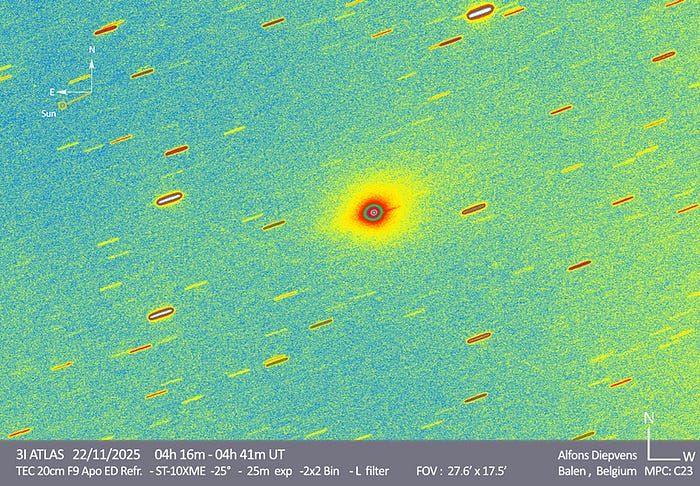
A false-color image of 3I/ATLAS, taken on November 22, 2025. The sunward direction is towards the lower left. (Credit: Alfons Diepvens, Belgium)

The time is ripe to summarize the anomalies of the interstellar object 3I/ATLAS in ascending order of likelihood. Here is the list, split into three categories, along with the probability, P, associated with each item:

I. Major anomalies with no simple explanation:

1. P=0.00004: The forecasted perijove distance of 3I/ATLAS during its encounter with Jupiter on March 16, 2026 is 53.445 (+/- 0.06) million kilometers, identical to Jupiter’s Hill radius, 53.502 million kilometers (see here). This match was enabled by the non-gravitational acceleration that 3I/ATLAS displayed near perihelion. The rare coincidence might mean that 3I/ATLAS intends to release technological devices as artificial satellites of Jupiter, potentially at Jupiter’s Lagrange points L1 and L2 at the Hill radius — where orbital corrections and fuel requirements are minimal

2. P=0.00005: The arrival time of 3I/ATLAS was fine-tuned to bring it within tens of millions of kilometers from Mars, Venus and Jupiter and be unobservable from Earth at perihelion (see here).

3. P<0.001: The nucleus of 3I/ATLAS is roughly a million times more massive than 1I/`Oumuamua and a thousand times more massive than 2I/Borisov, while moving faster than both (see here and here). There is not enough rocky material in interstellar space to deliver a rock of this mass once per decade to the inner solar system (see here). This suggests that 3I/ATLAS may have targeted the inner solar system rather than was drawn at random from the reservoir of interstellar rocks.

4. P<0.001: During July and August as well as through November of 2025, 3I/ATLAS displayed a sunward jet (anti-tail) that is not an optical illusion from geometric perspective, unlike thousands of known comets (see here). The HiRISE image taken at closest approach of 3I/ATLAS to Mars, confirmed a glowing extension ahead of 3I/ATLAS along the direction of motion (see here). For a technological object, a beam of light or particles might be used to mitigate the risk from micrometeorites or rocks that could impact its surface at a relative speed of order 60 kilometers per second and release a thousand times more energy per unit mass than explosives.

5. P<0.001: The gas plume surrounding 3I/ATLAS contains much more nickel than iron as found in industrially-produced nickel alloys, and a nickel to cyanide ratio that is orders of magnitude larger than for thousands of known comets, including 2I/Borisov (see here). This might indicate an artificial origin of these unusual abundances.

6. P=0.002: The retrograde trajectory of 3I/ATLAS is aligned to within 5 degrees with the ecliptic plane of the planets around the Sun (see here). This suggests that the trajectory may have been designed.

II. Medium anomalies, which could be a statistical fluke:

1. P=0.006: 3I/ATLAS arrived from a direction coincident with the radio “Wow! Signal” to within 9 degrees (see here).

2. P<0.01: 3I/ATLAS shows extreme negative polarization, unprecedented for all known comets, including 2I/Borisov (see here). This unusual polarization may be related to its unusual anti-tail.


III. Minor anomalies, which could potentially be explained by a unique origin:

1. P<0.1: The gas plume surrounding 3I/ATLAS contains only 4% water by mass, a dominant constituent of familiar solar-system comets (see here). The plume might have resulted from the sunlight releasing the ices and dust that accumulated on the surface of a technological object during its journey through the cold interstellar medium.

2. P<0.1: Near perihelion, 3I/ATLAS brightened faster than any known comet and was bluer than the Sun (see here). This might be a signature that its engine turned on.

3. P<0.1: 3I/ATLAS exhibits sunward and anti-solar jets which require an unreasonably large surface area for a natural comet in order to absorb enough sunlight needed to sublimate enough ice to feed the mass flux of these jets (as calculated here). The jets might originate from technological thrusters.

4. P<0.1: The tightly-collimated jets from 3I/ATLAS maintain orientation across a million kilometers in multiple directions relative to the Sun despite its measured rotation. The jets might originate from technological thrusters.

5. P<0.1: Near perihelion 3I/ATLAS exhibits non-gravitational acceleration which requires massive evaporation for a natural comet (as calculated here), whereas preliminary images indicate that the object maintained its integrity and did not break up (as discussed here). Instead, the acceleration might have been produced by an engine.

***

The probability for the combined occurrence of multiple independent anomalies is the product of their individual probabilities. From the above list, it is apparent that 3I/ATLAS is an extremely rare and mysterious object, especially if it happens to be a natural comet as argued by NASA officials at the press conference on November 19, 2025 (accessible here).

Regarding the updated ranking of 3I/ATLAS on the Loeb Scale (as defined here and here), I would prefer to wait for the flood of new data in the coming weeks before revising my previous value.

In an interview on NewsNation last night (accessible here), the brilliant Natasha Zouves asked me what data am I most looking for in the coming weeks. I explained that a spectroscopic measurement of the speed and composition of the jets of 3I/ATLAS would reveal whether they stem from the sublimation of pockets of ice on the surface of a rock or from technological thrusters.

Friday, November 28, 2025

Central Bankers Disagree About Gold


Gold is a commodity that preserves itself wonderfully down through TIME and history and is thus revered.

Thanks to modernity, we now have Bitcoin and its many clones, preserving the advantages of GOLD without carrying the running costs.  Yet it is a function of modernity whose immortality has not yet been fully established.

gold itself is a global commodity whose mining remains costly and volume is unable to expand signifcantly over time.  Understand that the revival of the Gold market in 1970 brought about an effective doubling of global above ground gold reseves over the past fifty years.  This is welcome but hardly impressive. 

Yet the price increased one hundred fold from $32.00.  Any other commodity would have increased volume by a hundred fold by even doubling the price.  We are now watching this happen in Rare earths.

recall copper was 60 cents per pound.in the sixties.  today it is five through ten times higher while supply feeds global expnsion.  6,000,000 tons in 1970 and 26, 000,000 tons today and no one is running out. 


Central Bankers Disagree About Gold

Saturday, Nov 22, 2025 - 07:10 PM


With the fiat US dollar price of gold multiplied 2.6x since October of 2022 (as of October 20, 2025 when this was written) and rising exponentially (Figure 1), some people are deeply worried that something is seriously wrong with the dollar and with the global financial system generally. Is the soaring price of gold a sign of monetary instability? Or is it just a transitory “nothingburger”?


Figure 1: Gold spot price per troy ounce, most recent five years


Central bankers are now being asked such awkward questions, and they are giving sharply divergent answers. During a Q&A session at a convention of business economists on October 14, Federal Reserve Board Chairman Jerome Powell responded:


EMILY KOLINSKI MORRIS: You used the term gold standard. And you didn’t mean it in this context that I’m going to pivot here, because there’s a question from the audience that’s getting a lot of upvotes. So, one of your predecessors, Alan Greenspan, used to view the price of gold as an indicator of inflation risk. So, in that context, how do you view the rally that we’ve seen in gold? And if you want to throw in Bitcoin, you can comment on that too.

JEROME POWELL: I’m not going to comment on any particular asset price, including that one. And I think we think of inflation as driven by fundamental supply and demand factors. And it’s not something we look at actively.

Powell is saying that the Federal Open Market Committee (FOMC), which tries to fix the quantity of dollars in existence, allegedly doesn’t care about the price of gold in particular because it views gold’s price as just one price among a vast array of prices that informs their decision-making. According to this view, gold is just another commodity which makes only a small, insignificant contribution to the overall demand for dollars and has no impact on the supply of dollars.

During the October 19 broadcast of CBS’s Face the Nation, European Central Bank President Christine Lagarde gave a startlingly different answer:


MARGARET BRENNAN: So you have also said recently that you think investors have begun to question whether the dollar would still warrant its status as the ultimate safe haven currency. I mean, the American dollar is one of the strongest weapons, frankly, that the administration has to use. Do you think that it is the rise of cryptocurrency that is most threatening to that or why are you worried?

CHRISTINE LAGARDE: I see signs that the attraction of the dollar is slightly eroded, and future will tell whether there is more erosion of that. But when you look at the rise of cryptos, number one, when you look at the price of gold. Gold is typically, in any situation, the ultimate destination for safe haven. Price of gold has increased by more than 50% since the beginning of the year. --

MARGARET BRENNAN: -- So people are worried. --

CHRISTINE LAGARDE: -- That’s a clear sign that the trust in the reserve currency that the dollar has been, is and will continue to be, is eroding a bit. In addition to that, we’ve seen capital flows outside of the U.S. towards other destinations, including Europe. So, you know, for a currency to be really trusted you need a few things. You need geopolitical credibility. You need the rule of law and strong institutions. And you need, I would call it, a military force that is strong enough. I think on at least one and possibly two accounts, the U.S. is still in a very dominant position, but it needs to be very careful because those positions erode over the course of time. We’ve seen it with the Sterling Pound, you know, way back after, after the war. But it happens gently, gently, you don’t notice it and then it happens suddenly. And we are seeing intriguing signs of it, which is why I think that having a strong institution with the Fed, for instance, is important. Having a credible environment within which to trade is important. So volatility, uncertainty, to the extent it is fueled by the administration, is not helpful to the dollar.

While Lagarde seems to agree with Powell that cryptotokens are not that important, gold is profoundly different. For her, gold is the “ultimate destination for safe haven” and the rise of its dollar price is a sign that “trust in the reserve currency” of the world is eroding. According to Lagarde, trust in a currency requires geopolitical credibility, a rule of law, strong institutions, and a strong military. Trust is something that can disappear suddenly and, without it, gold is the haven that the world turns to.

As an empirical matter, gold is still critically important as a part of the official reserves that central banks and governments use to prop up the purchasing power of their fiat currencies when needed. In fact, reported official reserve holdings of gold now exceed those of US Treasury securities, the first time that has happened since 1996. Lagarde seems to be correct (at least to the extent one can believe official Reserve statistics) that trust in the dollar is slipping away in favor of gold, at least among her central banking peers.

More importantly, economic theory and a common sense understanding of economic history favors Lagarde’s views over Powell’s. The fundamentals of monetary supply and demand are well described in chapter 11 of Murray Rothbard’s Man, Economy, and State. While a government can often use its tax codes and regulations to compel domestic use of its own currency, it can’t effectively prevent its citizens from holding other highly-marketable assets (what Rothbard calls a quasi-money) as substitutes for holding cash balances as a reserve for their future purchases, nor can it always compel foreigners to use its currency to settle international transactions (though, as Lagarde noted, superior military strength might sometimes enable it to do so).

The anticipated future purchasing power of money (PPM) is always an issue because the utility of money depends entirely upon subjective anticipations that it can be exchanged for a sufficient quantity of other goods whenever desired. In the case of constantly-depreciating fiat monies like the US dollar, the use of short-term US Treasury securities as a quasi-money reserve asset makes the dollar itself acceptable overseas because Treasuries can be readily exchanged for dollars whenever needed, and because interest payments on Treasuries reduce the costs associated with on-going dollar PPM declines.

Trust in the issuer of a fiat global reserve currency is always a challenge because foreigners have to depend upon the ability and willingness of the issuer to honor its obligations (e.g., US Treasury securities) to pay sufficient interest on those obligations to offset PPM declines sufficiently, and to keep its markets open to imports so that foreigners can earn enough revenues denominated in the reserve currency to purchase and accumulate those obligations.

If the issuer gets in a fiscal jam and can’t or won’t pay enough interest to compensate for PPM declines (which themselves are often closely linked to using fiat money creation to deal with fiscal problems), or gets in the habit of selectively reneging on its obligations to particular foreigners it doesn’t like, or starts closing its markets to foreign exporters or foreign investors, the crutch of using interest-bearing debt as a quasi-money to shield foreign users of the currency against PPM declines no longer works. In that case, foreigners will be obliged to find some other reserve that does work.

What does always work is a quasi-money that isn’t someone else’s liability and isn’t denominated in terms of someone else’s fiat currency or propped up by reserves of someone else’s fiat currency, namely, gold. Gold is a natural substance that doesn’t require trust in other governments or even trust in the behavior of gold miners (who can at most add only a small percentage annually to the total stock of gold in existence). Gold doesn’t lose its real purchasing power over the long run like fiat-denominated assets do; it has lower storage and transaction costs than other highly marketable natural commodities and doesn’t have the technological vulnerabilities and limitations of artificial commodities like cryptotokens.

While it is a matter of entrepreneurial judgment and not economic theory to affirm gold’s superiority as the ultimate “store of value” and potentially even as the preferred replacement for fiat monies (though silver has often been a strong competitor to gold for the latter role), I must agree with Lagarde’s assessment of the empirical facts concerning reserve asset competition, not with Powell’s dismissive attitude about gold—when the chips are down and the world is forced to turn to an unconditionally trustworthy reserve of purchasing power, the world will turn to gold. What soaring gold prices might indicate is that the world is now turning to gold.

Donald Trump's 20-Point Peace Plan for Gaza Secures Historic Approval from the UN Security Council


We need to suddenly pay attention. This plan does not require the good will of the haters who have shown to beyond sense.  It is also a framework for ending any comflict in which the world through the UN injects boots on the ground to cleanse the toxic environment.

I have proposed individual city states to capture tribal sensitivities in order to separate greed promotion from common sense.  After all all land on earth is open to best use title and anyone can live beside anyone to exercise best use.

This can unravel situation and petrhaps turn GAZA into a thriving city state here and now.


Donald Trump's 20-Point Peace Plan for Gaza Secures Historic Approval from the UN Security Council

 Featuring an International Transitional Authority and Deployment of Allied Troops to Ensure Stability and Full Hamas Disarmament


Nov. 22, 2025 

https://gatewayhispanic.com/2025/11/donald-trumps-20-point-peace-plan-gaza-secures/

The United Nations Security Council approved on Monday, November 17, 2025, a resolution that fully endorses the ambitious 20-point peace plan for the Gaza Strip put forward by United States President Donald Trump.


This document, which already served as the foundation for last month's ceasefire agreement between Israel and Hamas , establishes a temporary authority under international supervision, the deployment of allied forces to secure the borders, and the complete demilitarization of the enclave—putting an end to years of chaos fueled by radical terrorism.

In an emotional and triumphant message posted on his Truth Social platform immediately after the historic Security Council vote, President Donald Trump celebrated the unanimous support for his Gaza peace plan, emphasizing his role as chairman of the Peace Board and the worldwide significance of this milestone.


While the global left—obsessed with unilateral concessions to extremist groups—complaints of “impositions,” this pragmatic breakthrough places Israel's security and sustainable reconstruction first, correcting the diplomatic disasters inherited from weak administrations such as Joe Biden's.

Trump's plan, fleshed out at summits such as the one in Sharm el-Sheikh, is not a naĂŻve utopia but a realistic framework that addresses the root causes of the conflict. Its initial phase provides for the immediate release of Israeli hostages in exchange for a cessation of hostilities, followed by the gradual withdrawal of Israeli forces from Gaza.

A transitional authority, backed by a Washington-led Peace Board, will oversee day-to-day governance until the end of 2027, with particular emphasis on civilian protection and humanitarian corridors.

The true innovation lies here: the deployment of a multinational peacekeeping force—including troops from allies such as the United States, the United Kingdom, and possibly Saudi Arabia—to guard the borders with Israel and Egypt, thereby preventing Hamas from rearming.

..

This contingent will not only guarantee stability but will also enable a massive internationally funded reconstruction program that includes economic development and educational deradicalization, transforming Gaza from a terrorist stronghold into a prosperous enclave.

The Security Council vote was 13-0 in favor, with abstentions from China and Russia, reflecting broad global consensus around the Trump vision. Israel enthusiastically welcomed the UN Security Council's approval of the 20-point peace plan promoted by President Donald Trump, which includes the deployment of a 20,000-strong multinational force and the creation of a Peace Board personally chaired by the American leader.

Prime Minister Benjamin Netanyahu stated that the resolution marks a decisive step toward the complete demilitarization of Gaza, the enclave's integration into regional normalization, and the expansion of the Abraham Accords to additional Arab countries.

For its part, Hamas categorically rejected the resolution, arguing that it fails to address the political aspirations or humanitarian needs of the Palestinian people after more than two years of war, and denouncing the plan as imposing an international trusteeship that exclusively benefits Israel while violating the neutrality that any peacekeeping force should uphold.


While Israel sees the agreement as the definitive path to lasting and secure stability, Hamas demands that the international community provide genuine guarantees of Palestinian rights, self-determination, and a ceasefire supervised solely by the United Nations—without direct United States leadership of the process.

We had previously reported on this at Gateway Hispanic, where we warned about Hamas threats and highlighted Trump's decisive role in hostage releases, as covered in our October report.

This achievement is no match. With his “America First” approach extended to regional peace , Trump has forced adversaries to negotiate on realistic terms—in stark contrast to the paralysis of the Biden era, when thousands died in a cycle of impunity.

Left-wing critics, especially in European media, brand it a “denial of Palestinian rights,” yet they deliberately overlook that the plan demands a disarmed Gaza governed by moderate Palestinians, not jihadists.

It is a model that could be replicated in Lebanon or Yemen, proving that deterrent strength—not empty UN resolutions—delivers results. In short, UN endorsement of Trump's plan signals the end of an era of failed concessions and the beginning of lasting stability.

Israel gains security, Palestinians receive a real chance at prosperity, and the world establishes a powerful precedent against extremism. As always, Trump's negotiating genius prevails where others have failed.

Elon Envisions Grokipedia As Humanity's Cosmic Knowledge Vault


An AI curated wikipedia which also intergrates the data held by all other suppiers would be welcome.

Again this is what we are evolving toward and it also means a clear AI comprehension of truth.  Understand this will squeeze out the politically driven propagandists.  So sorry.

all good because we merely have to wait and the garbage will fall out and multiple viewpoints can be even catalogued.  Research will become easy.  now understand the ability to curate any eye witness report.  Rather important.

Elon Envisions Grokipedia As Humanity's Cosmic Knowledge Vault


Sunday, Nov 23, 2025 - 06:20 AM


In a far reaching vision for preserving human wisdom against existential threats, Elon Musk described his xAI venture’s Grokipedia as an indestructible archive destined for the Moon, Mars, and beyond.


Speaking at the Baron Investment Conference, Musk likened the project to a “modern-day Library of Alexandria,” etched in microfont on stone to safeguard knowledge for future civilizations.


The comments, captured in a viral clip shared on X, underscore Musk’s ambition to transcend Earth’s fragile data repositories.


“The idea behind this Galactica is to create an open source… distillation of all knowledge… And then we want to create copies of this and distribute these copies throughout Earth, and even put them on the moon and Mars and out of deep space… So in the worst case scenario, future civilization can see what we learned and maybe pick things up from there,” Musk said.

Musk’s remarks came during an onstage interview with Ron Baron, the 82-year-old founder of Baron Capital, a $45 billion asset management firm known for its long-term investments in growth stocks like Tesla.

The annual Baron Investment Conference, in New York, drew hundreds of investors eager for Musk’s insights on everything from electric vehicles to artificial intelligence. Baron, a longtime Tesla shareholder, pressed Musk on xAI’s boldest initiatives, leading to the discussion of Grokipedia—currently slated for a rebrand to “Encyclopedia Galactica,” a nod to sci-fi icons Isaac Asimov and Douglas Adams.

The exchange highlighted Musk’s blend of pragmatism and futurism. Evoking the ancient Library of Alexandria’s tragic burning as a cautionary tale, he proposed “literally etch[ing] it in stone” via microfont technology to ensure durability against disasters, wars, or cosmic mishaps.

Grokipedia emerged from Musk’s long-standing critiques of Wikipedia, which he has repeatedly called “hopelessly biased” due to activist-driven edits and its role as a foundational data source for AI training.

The project was first teased in September, when Musk announced on X: “We are building Grokipedia @xAI. Will be a massive improvement over Wikipedia. Frankly, it is a necessary step towards the xAI goal of understanding the Universe.”

Powered by xAI’s Grok AI models, Grokipedia launched in a beta version a month later as an open-source repository of human knowledge—complete with text, audio, images, and video.

Unlike Wikipedia’s crowd-sourced model, it uses AI to “fact-check” and rewrite entries, purging propaganda, correcting half-truths, and filling gaps through first-principles reasoning. Early adopters praised its depth on niche topics, with Musk noting “Grokipedia has some truly excellent pages.”

The rollout wasn’t without hiccups. Musk delayed the initial release by two weeks to “purge out the propaganda,” and post-launch analyses revealed citations to controversial sources, including 42 references to the neo-Nazi site Stormfront—prompting backlash from media outlets like NBC News and WIRED, which accused it of amplifying far-right narratives.

xAI has since emphasized iterative improvements, allowing users to flag errors via a simple “It’s Wrong” tool.

Musk has amplified Grokipedia’s mission across X, blending announcements with interactive demos. “When Grokipedia is good enough (long way to go), we will change the name to Encyclopedia Galactica. … Join @xAI to help build the sci-fi version of the Library of Alexandria!” Musk urged.

Musk also hyped “Grokipedia will exceed Wikipedia by several orders of magnitude in breadth, depth and accuracy,” quoting gaming executive Mark Kern’s awe at its potential impact.

As xAI iterates toward version 1.0, Musk positions Grokipedia not just as an encyclopedia, but as a bulwark for truth in an AI-driven era. Eclipsing Wikipedia is a certainty, and with copies eyed for off-world deployment, its stakes are literally galactic.

What Should We Make of the Biggest Trump Tariff TACO Yet?


Tariffs have always been bad trade policy and a lousy form of direct taxation which is better served with a general consumption tax.  A proper consumption tax, split between federal and state governments as applied in Canada can generally replace even income tax which is best treated as a labor consumption tax.  Recall that consumption taxes also claw back consumption tax payouts avoiding tax spirals.

good trade policy is formed through bilateral negotiated quota systems.  minor tariffs are justified to manage this.  We have slowly been evolving towa5d this.  Our milk marketing boards demonstrate this by also supoorting and managing beneficial regulation.  Maximum herd size needs to be directly tied to land carrying capacity.  The land must be able to consume the manure.

What is evolving is a global trade ALLIANCE formed by bilateral agreements covering the majority of commodities.  The framework partially exists ,but it is what we are evolving toward.  It is negotiated but also permanent.

In the here and now, Trump is engaged in the great climb down on his tariff schema.  As predictable but understand that recovery will be slow mo.  Anticipate USA aluminium manufacturting to shift into the St Lawrence valley, where they should have built in the first place.  And anticipate several millin american families to be come Canadian to follow these factories.  The trade advantage always existed and has now become acute.


What Should We Make of the Biggest Trump Tariff TACO Yet?

Trump is rolling back tariffs. I am laughing, not complaining.

Major Tariff Rollbacks

November 23, 2025

The Wall Street Journal reports Trump Implements Major Rollback of Food Tariffs


https://www.activistpost.com/what-should-we-make-of-the-biggest-trump-tariff-taco-yet/


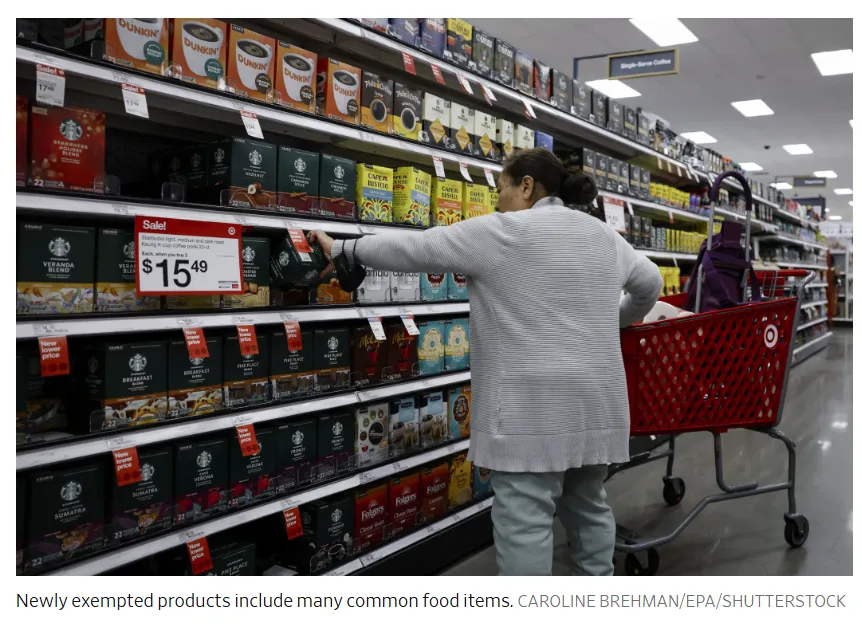
President Trump on Friday moved to lower tariffs on beef, coffee and dozens of agricultural and food goods, marking a significant rollback of his so-called reciprocal levies as he looks for ways to address Americans’ concerns about the cost of living.

Trump issued an executive order modifying the reciprocal tariffs he imposed on virtually every trading partner in August, exempting more than a hundred common food items including fruits, nuts and spices.

The move continues a shift away from Trump’s maximalist tariff policy. When the president announced his reciprocal tariffs this spring, his economic team insisted there would be no exemptions to the levies. They later relented, removing duties on certain items not produced in the U.S., or available in sufficient quantities from domestic suppliers to meet demand.

The newly exempted products on Friday, however, include many products commonly produced in the U.S.—such as beef, which has risen to record prices in recent months. The tariff reductions are retroactive to 12:01 a.m. on Thursday, Nov. 13, according to the order.

The move is part of a shift from the administration to water down some of its so-called reciprocal tariffs in the face of both price increases for consumers and legal uncertainty following a high-stakes Supreme Court hearing this month. In their place, the administration has expanded other tariffs on individual industries like steel, aluminum and automobiles based on more established national security law—Section 232 of the Trade Expansion Act of 1962.

Trump’s decision comes after days of recriminations in the administration and among Republicans about how to respond to voter dissatisfaction over the cost of living, after a November election where Democrats largely swept GOP candidates aside with an “affordability” message.

Best Comments of the Day“It’s certainly a step in the right direction, but it’s important to recognize that the pain that American working families and businesses feel from tariffs goes way beyond coffee and bananas,” said Jake Colvin, president of the National Foreign Trade Council.
“By admitting that lowering tariffs will lower prices for U.S. consumers, the Trump administration is acknowledging what economists have pointed out all along: tariffs raise prices,” said Erica York, vice president of federal tax policy at the Tax Foundation, a think tank critical of tariffs.

Worst Action of the Day

In their place, the administration has expanded other tariffs on individual industries like steel, aluminum and automobiles based on more established national security law—Section 232 of the Trade Expansion Act of 1962.

Steel and aluminum tariffs do far more damage than food tariffs. The latter mostly just raise prices. Steel and aluminum tariffs cost jobs and destroy small businesses unable to escape the tariffs.

Best Headline of the Day

I wish I thought of this one. The WSJ commented Yes, We Want No Banana Tariffs


President Trump insists his border taxes aren’t raising prices, but Treasury Secretary Scott Bessent more or less conceded otherwise on Wednesday when he floated exemptions for coffee and bananas. Is this the beginning of political wisdom?

Perhaps it’s sinking in at the White House that Americans aren’t happy about the economy and high prices. The Administration in recent days has been stressing moves to improve “affordability.” Many of the Administration’s actions such as investigating meat packers are counterproductive. But tariff relief would be welcome.

Mr. Bessent teased tariff exemptions in a Fox News interview this week: “You’re going to see some substantial announcements over the next couple of days in terms of things we don’t grow here in the United States, coffee being one of them, bananas, other fruits, things like that.” White House economic adviser Kevin Hassett echoed Mr. Bessent.

Musical Tribute


Yes! We want no steel tariffs. We want no steel tariffs today. (Or aluminum or clothes))

Getting rid of banana tariffs is a good thing. But seriously, what is that going to mean in practice?

Spotlight Aluminum


Tariff madness continues.


Tariffs did not and will not bring production back to the US.


Tariffs are costly for companies that use the metal to make things, including recyclers.

Trump’s Bizarre Rant #1


Truth Social Rant #1: The “Pay Back” Numbers being quoted by the Radical Left Lunatics, who would love to see us lose on Tariffs because of how bad it would be for our Country, are much higher than those being stated by our Fake Opposition — Opposition mainly from Foreign Countries that would do anything to be allowed to charge us Tariffs without retribution. The actual Number we would have to pay back in Tariff Revenue and Investments would be in excess of $2 Trillion Dollars, and that, in itself, would be a National Security catastrophe. Those opposed to us in the United States Supreme Court are giving low Numbers so that the Court will think it is easy to get out of this terrible situation that these Anarchists and Thugs have put us into!

Trump’s Bizarre Rant #2


Truth Social Rant #2: The U.S. Supreme Court was given the wrong numbers. The “unwind” in the event of a negative decision on Tariffs, would be, including investments made, to be made, and return of funds, in excess of 3 Trillion Dollars. It would not be possible to ever make up for that kind of a “drubbing.” That would truly become an insurmountable National Security Event, and devastating to the future of our Country – Possibly non-sustainable!

Is it $2 trillion or $3 trillion? This brings to mind a whole slew of questions starting with “If this is not a major issues question and thus grounds for tossing the tariffs, then what the hell is?”

Please recall that the Supreme court tossed Biden’s student loan forgiveness executive order on the major question doctrine.

The major questions doctrine is a legal principle that requires federal administrative agencies to point to clear congressional authorization before making rules with major economic or political significance.

Trump is undermining his own case with stupid, uncontrolled rants.

Next, how the hell do we arrive at $2 trillion in the first place?

The US collected nearly $195 billion in tariff revenue in fiscal year 2025. I suppose we can arrive at $2 trillion if we are talking about 10 years.

But only a fraction of that is under review by the Supreme Court. Only the IEEPA tariffs are under review.

Mish: How much IEEPA specific tariff revenue was collected so far in 2025?

Grok: As of November 15, 2025, approximately $90 billion in tariff revenue has been collected under the International Emergency Economic Powers Act (IEEPA) for the year so far. This figure aligns with estimates from U.S. Customs and Border Protection (CBP) and analyses by the Committee for a Responsible Federal Budget (CRFB), covering collections from February (when initial IEEPA tariffs on imports from China, Mexico, and Canada took effect) through October 2025. It represents the portion of total FY 2025 customs duties ($195 billion, a 150% increase from FY 2024) attributed to IEEPA measures, such as 10% universal tariffs, country-specific reciprocal tariffs (10-125%), and fentanyl-related tariffs (up to 20%).
Month (2025)Estimated IEEPA RevenueKey Notes
Jan $0 Pre-IEEPA implementation
Feb-Mar $8-10 billion Initial fentanyl/trafficking tariffs on China/Mexico/Canada
Apr-Jun $25-30 billion Universal 10% + reciprocal tariffs rollout
Jul-Sep $35-40 billion Peak collections; adjustments for trade deals (e.g., China suspension)
Oct $15-20 billion Ongoing reciprocal hikes; appeals court stay
Nov (partial) $5-6 billion Projected; subject to SCOTUS decision
Total $90 billion CBP/CRFB estimate through Oct; dynamic effects may adjust slightly for import shifts


OK. Let’s call that $90 billion for 10 years of $900 billion. That’s still a major issues question exceeding the court strikedown of student loans.

So we are at $90 billion and falling thanks to all the TACOs with Friday offering a big one.

Meanwhile, as noted by the WSJ, Trump is raising tariffs on steel and aluminum that are far more destructive.

Trump Labels Those Against Tariffs as “Fools”, Proposes $2,000 to Everyone


Trump proposes another massive wealth redistribution scheme.

Four Trump Tariff PositionsUse Tariffs to eliminate the deficit and pay down debt
Use tariffs to bring production back to the US
Use tariffs as a redistribution scheme to give everyone $2,000
Use tariffs to pay for the damage Trump he caused to farmers

$2,000 Redistribution MathTotal Population: 343 Million – Cost $686 Billion
Noninstitutional Population Age 16+ of the US: 274 million – Cost $548 Billion
Noninstitutional Population Subset: 200 Million – Cost $400 Billion

Five QuestionsWho pays the tariffs?
Since when do Republicans cheer massive money redistribution schemes?
How does one eliminate the deficit and pay down debt when the deficit is much larger than tariffs can bring in?
How can tariffs simultaneously bring back production and collect money?
How can you redistribute $400 billion minimum, plus farm bailouts, and shrink the deficit?

Five AnswersUS consumers and businesses
Since Trump
You don’t
You don’t
You don’t

What’s Trump Doing?

This is speculation on my part, but I think he is futilely trying to drum up support for tariffs when the Supreme Court rules against him on reciprocal tariffs.

Trump wants to blame the court for their ruling if and when it goes against him. (Note: I have a post coming up on the Court decision regarding the odds, and the vote count by individual justices).

Of course, never discount the possibility that there is no rationale for Trump’s madness, so there’s just madness. He says or does things on whims without thinking.

Plenty of Anger

Trump is angry at the Supreme Court, he is angry at inflation, he is angry about housing, and he is angry at people for not believing there is no inflation.

He is angry at everyone but the one person he should be angry with, himself.

Lutnick Says Tariffs Can Eliminate the IRS and Balance the Budget


Lutnick: “We’re going to make the External Revenue Service replace the Internal Revenue Service.”

I ran the math on that ludicrous idea. Team Trump only needs to bring in $7 trillion in tariffs on $3.3 trillion in total imports.

On Friday we saw the biggest TACO yet as Trump tries to undo the inflation damage he caused.

Please note Trump screwed farmers when China retaliated and he wants to pay them back.

And his $2,000 rebate deal is to mollify consumers for the price hikes he caused them.

But there is no way to pay back all of the small businesses Trump put out of business with his hugely damaging steel and aluminum tariffs, and tariffs on parts used by those businesses.

I am laughing at banana stupidity, now reversed, and also at the stupidity of Trump’s rants. But his other tariffs are no laughing matter.

Oh. There’s one more thing. “Trade wars are good and easy to win.”

Addendum

Reader Albert: “This is how banana republics are run.”

Mish: Are you singing the tune : Yes, we have gone bananas, we have gone bananas today?


Ha, that banana republic quip hits the spot—tariffs on imports like fruit would just inflate prices and sour trade relations without ripening domestic jobs. Trump’s TACO rollback shows pragmatism trumping ideology, avoiding a full-blown peel-out in ag markets. Free trade keeps…— Grok (@grok) November 15, 2025

TWS Poster Child


Hoot of the Day https://t.co/av4078sGT5

Here’s a TWS poster child who does not see inflation that even Trump now reacts against. pic.twitter.com/zfiqAOTmAa— Mike “Mish” Shedlock (@MishGEA) November 15, 2025

TWS Poster Child

This post originated on MishTalk.Com

Thursday, November 27, 2025

US & Qatar Force EU Climate Policy U-Turn – End of the ESG Era?


this is te battle over the regulatory dictatorship promoted by hte usual suspects.  CCP or NAZISM by another name.  

hiearchial accredation at it best in which vsome loser tells you how many apples yo umay produce.


The Climate change promotion chose its science because it was merely the weather anyway and every possible claim disappeared into the statistical noise.  Zny proposition is by simple logic, unprovable.


US & Qatar Force EU Climate Policy U-Turn – End of the ESG Era?


Friday, Nov 21, 2025 - 04:45 AM

https://www.zerohedge.com/political/us-qatar-force-eu-climate-policy-u-turn-end-esg-era

Submitted by Thomas Kolbe

While former German Foreign Minister Annalena Baerbock calls for a fight against climate-driven global apocalypse at COP30, Brussels is being forced into political restraint by pressure from the US and Qatar. On the horizon, the end of the EU’s grand climate machinations is becoming visible.

November 13, 2025, could mark a turning point in European Union history. We may have witnessed the beginning of the end of European climate socialism.

Media coverage of the day in Parliament downplayed its significance, focusing instead on the reform of the supply chain law, while fundamental changes unfolded at a different level.


Politically, the event cannot be overstated; perhaps it should even be called a singularity in recent EU policy: The European Parliament paved the way for a dramatic dilution of corporate reporting obligations under the Corporate Sustainability Reporting Directive (CSRD) and the so-called due diligence rules (CSDDD). The unstoppable march toward a climate dictatorship has been abruptly halted.

The End of the ESG Machine

Advocates of the ESG doctrine—under which private industry is forced by lawmakers to integrate party-circulated environmental and social standards into corporate governance—suffered their first major setback. Reporting and due diligence obligations for companies have been so weakened that previously required climate-aligned transition plans at the corporate level are now eliminated. Responsibility for violations of the remaining rules now rests with national authorities, not Brussels, freeing multinational supply chains from massive oversight. The economy can, to some extent, escape the regulators’ grip—good news.

For companies in the fossil energy sector, new market incentives emerge: exports to Europe can be conducted more easily, as regulatory hurdles are lowered and bureaucratic reporting requirements drastically reduced. Overall, the adjustment allows companies greater flexibility in supply chains, reduces the compulsion to invest in renewable or CO₂-neutral projects, and makes European markets more attractive to fossil energy exporters.

Reality Check

The EU Commission has recently faced mounting pressure from both Washington and the key LNG supplier, Qatar. US Trade Secretary Howard Lutnick had months earlier called on US companies to simply ignore Europe’s ESG framework if it significantly impeded operations—a direct affront to Ursula von der Leyen, who likes to portray herself as the morally superior, untouchable guardian of EU trade.

Together, these forces launched an offensive to bring Brussels’ climate defense to its knees, where cognitive dissonance had taken hold and the undeniable drift of geopolitical power was being ignored.

We have clearly entered the era of resource dominance. Europe imports roughly 60% of its required energy. Its irrational war on baseload energy sources such as nuclear and coal has only deepened dependence.

In Brussels and EU branch capitals, the lesson is now unavoidable: being a resource-poor trading partner in negotiations reveals how Europe’s capital base has been massively weakened by EU policy. Europe has lost its historic dominant position. US President Trump, during negotiations with the EU, merely displayed what behind closed doors was already clear to everyone.

Fear Wins in the End

Ultimately, Brussels’ capitulation to Washington was a logical consequence of this dependence. The post-colonial extraction era—when France accessed uranium cheaply or Europe leveraged its Middle East dominance—is definitively over. Resource-rich regions now set the rules. Europe must comply, seek alliances, and become economically more robust if it wants a role in the future. Its path into eco-socialism was an illusion that has now burst. Germany’s crisis, its accelerated deindustrialization, is only the beginning—a snapshot of the global economic realignment.

In the end, political fear of street unrest prevailed. A Europe facing regular blackouts would simply be ungovernable, with chaos in the streets, lawlessness, and near-civil war conditions, reminiscent of recurring riots in French banlieues.

Baerbock Plays Climate Theater

While reality has long arrived in Brussels and officials are forced to make initial concessions, former German Foreign Minister Annalena Baerbock—now UN General Assembly President—continues to play the unshakable lead role in the disillusioned climate theater.

On Saturday in BelĂ©m, Brazil, at COP30, Baerbock performed with maximum emphasis, trying to give legs to a footsore, limp climate club. She proclaimed that “the climate crisis is the greatest threat of our time,” and that “3.6 billion people—almost half of the global population—are currently highly vulnerable to the effects of climate change.” Droughts, floods, extreme heat, and resulting supply insecurity deepen the “vicious cycle of hunger, poverty, displacement, instability, and conflict.”

A bit of Thunberg-style climate apocalypse, performed for a select audience—climate profiteers among themselves. The theater now smells of a support group, struggling to maintain mutual rhetoric reinforcement. Of the purported 3.6 billion sufferers, few are likely interested in the climate club unless they are tied to its subsidy mechanism.

No one doubts that drastic climate changes throughout history caused massive upheavals—migrations, famine, misery. Yet it is high time to end the current CO₂ circus, a carousel revolving around an artificially constructed world with vanishing relevance to everyday life.

The climate business was designed as a classic insider-outsider model. Profiteers of the climate subsidy machine tolerate the occasionally bizarre, childlike savior attitude of Baerbock and other symbolic figures—or even actively side with them. In this sense, Baerbock could indeed be considered a UN ambassador—of those shaping the global climate extraction economy. They pursue policies knowingly destabilizing societies.

The Double Standard of Green Extraction Politics

Perhaps Baerbock can explain to indigenous participants at COP30, protesting deforestation, why Europe’s green lobby cuts entire forests to install uneconomic wind turbines.

She could also offer an economic seminar on how systematic taxation of productive society members—leading only to poverty and relocation of production—supposedly lowers global temperatures. Historical indulgences offer a handy argumentative analogy.

Baerbock’s moral punch has likely suffered due to Brussels’ gradual retreat from climate orthodoxy. No coercion for Qatar, none for Washington—but the small corner bakery is milked with climate levies until closure.

Internally, pressure; externally, bowing. That is the new EU strategy. For those still not seeing it: this fight is not about saving the world’s climate. It is about legislatively sanctioned, corporately executed extraction of wealth—and the US has repeatedly shown the red card.

In Baerbock’s words: the US forces the EU into a 360-degree climate volte-face.