
The idea is that the source of the zodiacal glow is comet dust. That the principal source of accumulated dust on the ice caps is remnant comet dust. That appears quite reasonable.
A quick check on samples of such dust from Antarctica reveals that all such material was strongly heated. This quickly explains the lack of elemental carbon. As discussed in previous postings, the principle component of comet dust will likely be elemental carbon.
When we have meteorites come in with a bright tail, the assumption has been that this is caused by superheated material reemitting light. This is true to some degree or the other. However, a strong carbon content oxidizing would account for the exceptionally bright glow such as just took place over the Great Plains the other night.
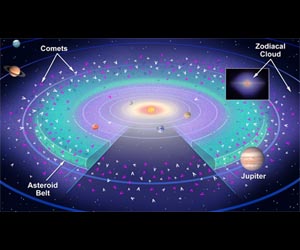
Anyway, this is a neat image.
Source Of Zodiac Glow Identified
by Staff Writers
Nesvorny and Jenniskens, with the help of Harold Levison and William Bottke of the Southwest Research Institute, David Vokrouhlicky of the Institute of Astronomy at Charles University in Prague , and Matthieu Gounelle of the Natural History Museum in Paris
The eerie glow that straddles the night time zodiac in the eastern sky is no longer a mystery. First explained by Joshua Childrey in 1661 as sunlight scattered in our direction by dust particles in the solar system, the source of that dust was long debated.
In a paper to appear in the April 20 issue of The Astrophysical Journal, David Nesvorny and Peter Jenniskens put the stake in asteroids. More than 85 percent of the dust, they conclude, originated from Jupiter Family comets, not asteroids.
"This is the first fully dynamical model of the zodiacal cloud," says planetary scientist Nesvorny of the Southwest Research Institute in Boulder , Colo.
This result confirms what meteor astronomer Jenniskens of the SETI Institute in Mountain View , Calif.
Instead, Jenniskens discovered a dormant comet in the Quadrantid meteor shower in 2003 and has since identified a number of other such parent bodies. While most are inactive in their present orbit around the Sun, all have in common that they broke apart violently at some point in time in the past few thousand years, creating dust streams that now have migrated into Earth's path.
Nesvorny and Jenniskens, with the help of Harold Levison and William Bottke of the Southwest Research Institute, David Vokrouhlicky of the Institute of Astronomyat Charles University in Prague , and Matthieu Gounelle of the Natural History Museum in Paris
In doing so, they solved another mystery. It was long known that snow in Antarctica is laced with micro-meteorites, some 80 to 90 percent of which have a peculiar primitive composition, rare among the larger meteorites that we know originated from asteroids.
Instead, Nesvorny and Jenniskens suggest that most antarctic micro-meteorites are pieces of comets. According to their calculations, cometary grains dive into Earth's atmosphere at entry speeds low enough for them to survive, reach the ground, and be picked up later by a curious micro-meteorite hunter.


No comments:
Post a Comment